Latest Comments

Guest - Aislinn Dyestuff Citizen Science.
09. Oktober 2026
This is a great project. I look forward to the results. Thanks for letting us know.
Guest - Aislinn Time for...
09. Oktober 2026
Looks delicious!
Guest - Katrin Sprang Discussion
18. September 2026
Hi Rachel, I have looked for more photos of you, but that was not very successful. I found a link on...
Guest - Beatrix Sprang Discussion
15. September 2026
That lozenge pattern element is not a photograph, but a scan. So it should be to scale. But I pinned...
Guest - Katrin Sprang Discussion
15. September 2026
I was not referring to Rachel's reconstruction (is the reconstruction you refer to the one photograp...
SEP.
13
0

Random Linkage.

Here are some random links for you:

German article about dye analysis in textiles. And a second one about the same team and topic.

At the Unperfekthaus in Essen, there's a tablet weaver meeting on November 16 - read more about it here if that sounds like you want to join in.

An early medieval whorl with inscription has been found in Poland.

The Textile Research Centre Leiden has an exhibition about socks and stockings that will run until December 19.

 
0
SEP.
02
0

Weekend Weaving Workshop: Done.

I've spent this weekend teaching weaving to six wonderfully enthusiastic people - and I can tell you that while everyone enjoyed it (as I was told so) - I think nobody had more fun that I did.

Tablet weaving is one of my favourite teaching topics. It's simultaneously easy and brain-bending. There's simple rules to follow, and within those rules, you are completely free to do as you wish. Mistakes are easy to make, but they are also easy to spot, and after a while you make less and less of them. And for teaching purposes, with the system that I have developed for weaving both "normal" patterns and twill patterns, it's even not relevant whether someone has been doing tablet weaving before or not.

So everyone gets the basic explanations, then we get to work making a warp, and then weaving starts. Which, about inevitably, results in a room full of very quiet, very concentrated people, exploring the structures and possibilities of tablet-woven bands, conjuring up patterns. It actually was so quiet that I could hear a pin drop. (Yes, I actually tried. It was only just audible, but that was because the floor in the room was relatively soft, so the pin made very, very little noise.)

In my course description, I purposely did not promise that we'd get into twill, as this can be hard to gauge. While a weekend course is usually enough to at least touch the basics (the plain background, and the principle of how to weave a motif in that), I can't guarantee that more will be covered, as this very much depends on the individual group. In some groups, the weavers want more time to explore diagonals patterns, for instance, and that, of course, is a wonderful thing as well.

This weekend, however, everybody was keen on getting some twill shenanigans done, and so we did. I can tell you that for me as the teacher, seeing that first line in everyone's band move first there, then here - that is the most exciting simple line that I know. Also, it means that I get to tell one of my favourite teaching stories: The one about the little renegade tablet that wants to start a revolution.

That is another thing teaching in this style has taught me - if you work paperless, without drafts, stories and mnemonic aids are wonderful tools to help explain things, and to help remember them. I don't know how pattern instructions were passed on in medieval societies, but I could well imagine a teacher tell a story to the pupils to help them remember what needs to be done at a given place in a pattern. It would probably not have been the story about a little tablet being a revolutionary and turning everything around (which is something that would not have latched onto basic cultural knowledge and background as it does with today's people), but it might have been something else fulfilling the same purpose. Songs and stories make wonderful tools for keeping things in minds, and I thoroughly enjoy teaching with stories. And daring little revolutionary tablets that prepare their revolution in the underground, quietly, looking like every other tablet for a while... until, suddenly...
0
JULI
11
0

Design Fiddling.

After figuring out the letters, and how much space to leave between words, and how far the lines should be apart, one more thing remained to do: the layout.

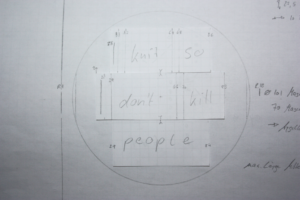
Measuring the ratio between height and width of the knitting, and counting the individual letter width, and cutting strips of paper with the appropriate measurements, and some more fiddling later, I finally had this:


which was my super-sophisticated knitting plan for actually making this. Including a plan on how much to cast on.

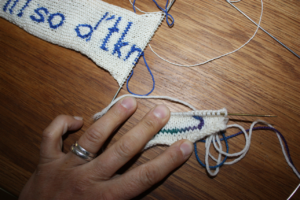
And then came some swatching:


Which only left one thing to do - the actual um knitting. That took some time, especially as I managed to botch in a few instances. That's proof that one should not knit things that require brains while tired!

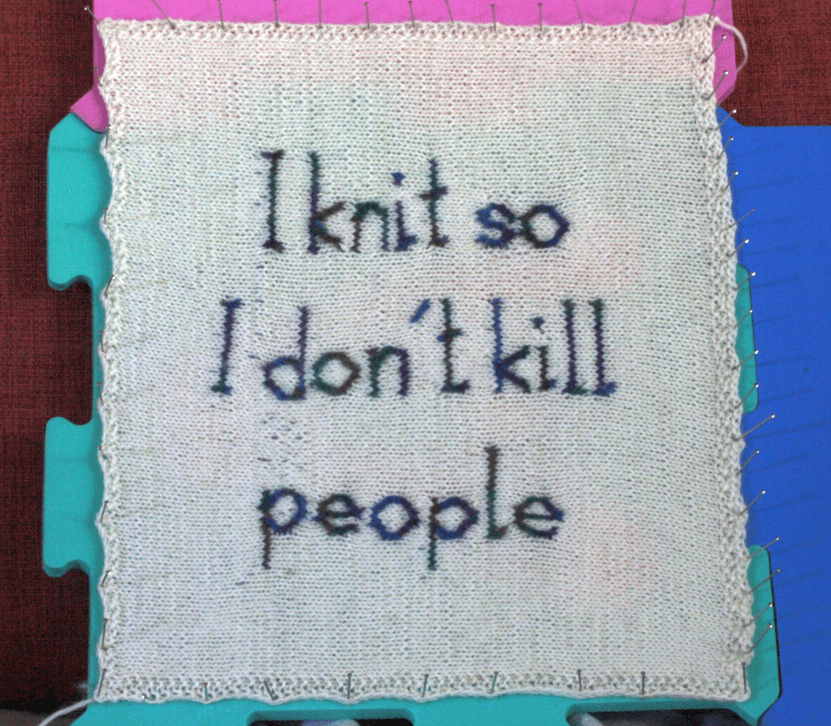
I finally finished this knit, though. There was a stint of late-night-blocking, and it came out like this:


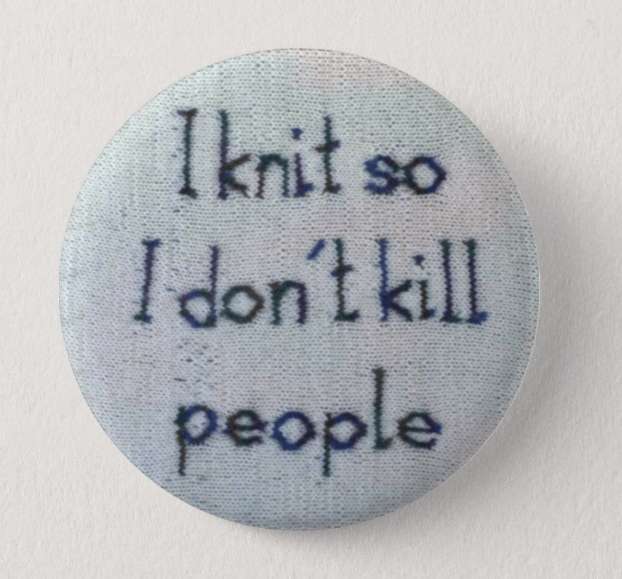
Now I only need to turn it into a button - and hope it will amuse other people just as much as me. That's how it will look, approximately:


The buttons have a diameter of 55 mm, which means that it will be possible to see a bit of the knit texture in the background, or so I hope. It's not blatantly clear that this is knitted text, I think - but it wil have to be good enough, as there's no way to knit letters across fewer stitches.

So. What do you think? Should I go for it?
0
JULI
10
0

Even More Button Shenanigans.

While at the topic of buttons related to knitting, well, there's one utterly classical phrase that lots of people find funny, or appreciate, or want to use as a heads-up for their environment.

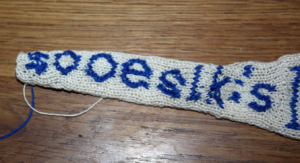
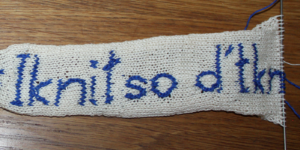
Which, of course, needs more letters than k, n, i, and t. So I sat down and started to figure out the tricky complex letters - s, e, o. And then other stuff. The first tries were, um, rather wonky:


But eventually, there was progress. And something more like actual text:


Have you guessed the text of the classical slogan yet?
0
JULI
09
2

Buttons Under Construction!

Let me tell you about buttons. Not the kind to close your garments, but the kind with a pin on the back that you pin to your clothing, or backpack, or whatever, to make a statement.

Though I rarely wear these, I very much like them. I like the way you can easily add them to whatever fabric you want to, telling people something about you, or your mood, or to amuse them with a funny quip or picture.

As with so many things that I like, and where I think the world needs more of, after a while, I'm getting an itch to have it made, and offer it in the shop. (Yes, I know, it's not medieval at all. That's why I have the "miscellaneous" section, and I'm actually pondering making a "This Is Not Medieval but Fun" section in the shop. Though I might call it "Modern Shenanigans" instead - much shorter.)

There was one teeny tiny problem, though. To have a nice button, you need a nice design - and I wanted something more than just a random selected font centred on a round button to write stuff. That's just... hm. Well.

It is, of course, technically possible to make a button design like this with hand-lettering. This could even be enhanced with a bit of a drawing, where it suits, here and there. Which would be a spectacularly wonderful thing, but unfortunately, both my drawing skills and my hand-lettering skills are, at best, mediocre.

And then it somehow struck me. I could knit the button design. Because... well... that's how my brain works, sometimes, when I wake up early on a Saturday morning.

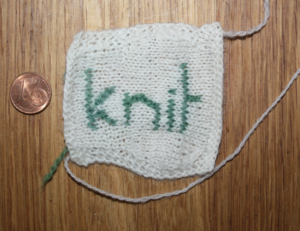
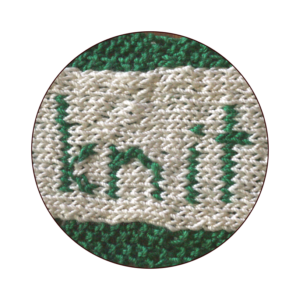
So I sat down, and I cast on some stitches, and I made this:


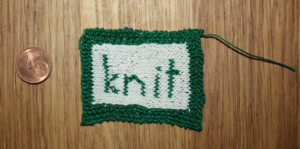
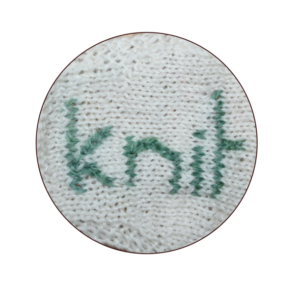
and showed it to the Most Patient Husband, and he said "maybe do it with smoother yarn", and he suggested some cotton yarn that I had lying around, so I finally got to use my very small needles as well, and I made this:


and this could actually already be turned into a button design, and it would look like this:


or, with the first version, like this:


and I must admit it amuses me no end. It's knit and says knit. Knit knit. Ah. (Yes, I'm easy to amuse.)

So. Should I do this? Get these printed as buttons? And if so, which version?
0
JUNI
27
0

Tablet weaving Shenanigans, Part 2 - or: Don't forget the weft.

When I started out trying to reconstruct how twill may have been tablet woven back in the Middle Ages, I had a list of things that the method would need to deliver - if you like being fancy, you could say I had a Requirement Specification. Apart from the obvious (has to work without written patterns, has to work with an indefinite number of tablets), one of my list items was "has to be robust" as in the system should be so workable that it is possible to stop at any time and take up the work again without a problem, and that it should be possible to weave while other stuff is going on in the vicinity, or while you're not one hundred percent fit. Also obviously, weaving really complex patterns in fine silk on a wide band won't work if you are bone tired and there is a bunch of people nattering at you - but to do simpler twill motifs, it should not matter if there is a group of others chatting in the same room, and you are keeping half an ear on it, occasionally joining into the chat.

Both the coffee cup weaving and the UFO weaving took place while there was a pen-and-paper roleplaying session going on in the same room, which for me sort of qualifies as "mildly distractive environment". So for my expectations, the system is robust enough; it does happen occasionally that I forget to re-order a few tablets, but I usually catch this even before turning them, and if I don't, it becomes really obvious right afterwards, and is easy to fix. (Turn the offenders back, sort, re-turn them.)

Something that happens even more occasionally, but that is much, much more of a nuisance: Forgetting a weft thread. This has really obnoxious results. First of all, it only becomes rather obvious a good while after the vile deed has happened, and I'm usually not willing to unweave two picks to fix the issue. Unfixed, the forgetting of a weft results in long floats across the width of the band, which can be very obvious if you are looking at the structure (or are a nitpicky person and are looking for mistakes). It actually happened twice when I was doing the UFO, see if you can find the spots:
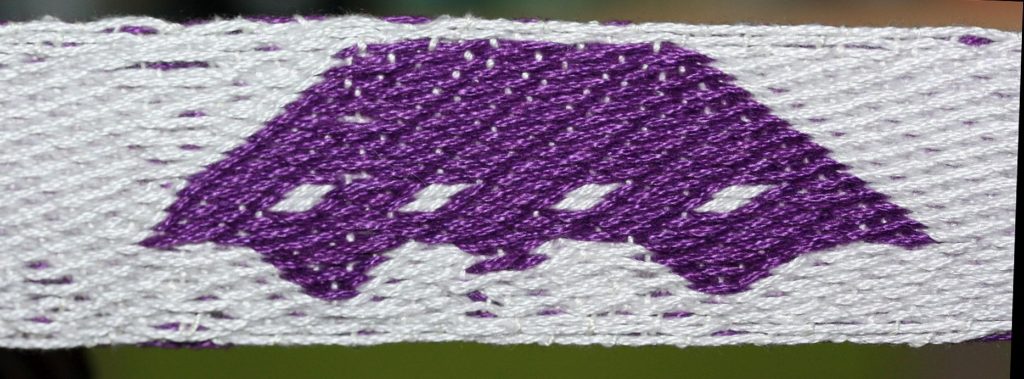


Have you found them?

The second effect of forgetting a weft, which is at least as annoying, is that I use the side the shuttle hangs on as an indicator of what may or may not be done at that stage, pattern-wise. So having forgotten a weft, this changes, which can be confusing, even when using a marker on one side of the band to keep track of the "do-things-side" as opposed to the "maintenance-mode-side".

I complained about this to the Most Patient Husband Of Them All, and he quite correctly said that there must be a way to see that the weft thread is missing... so we spent a while discussing all the possible ways we could, collectively, think of.

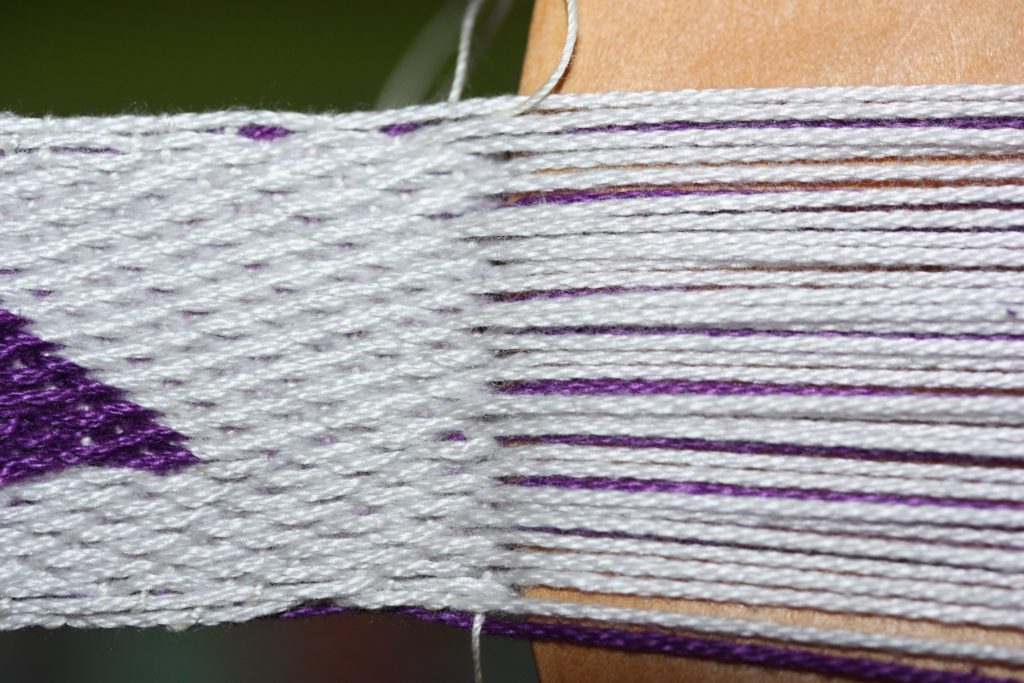
The end result was that since the missing weft causes a change in the band structure, it is possible to see it right after you turn the tablets and press in the shed. However, since every thread is only tied down by the weft every fourth pass, this means only every fourth tablet shows this structural difference - so it is visible, but it is very subtle.

Here is how it looks with the weft thread in:


And this is the same pick without the weft thread:
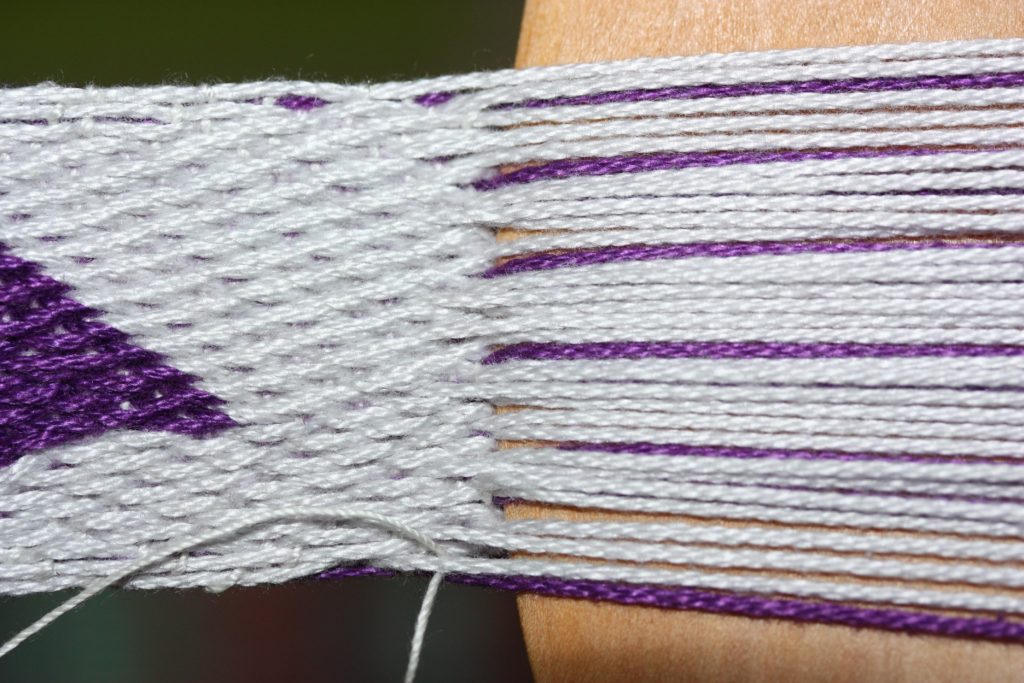


It's no wonder I never noticed before when I had missed putting in a weft (and none of my students did when this happened in a workshop). Now that I know what to look for, though, I'll keep an eye open for the telltale tiny gaps on the edge of the weaving knife when pressing in.

Are you occasionally forgetting the weft? Do you go back when that happens to you?
0
JUNI
26
7

Tablet weaving Shenanigans, Part 1

I've done a bit more tablet weaving again recently, in preparation for the two courses that I'll be giving (August 31/September 1, and September 14)... and, of course, things happened.

When at the last Textile Forum, one of the lovely people there gifted me with a bit of yarn in colours that I loved, and that was enough for a nice warp for a playband with 20 tablets. I've been wanting to do a simple playband anyways, with 20 tablets, as a demo band for my weaving lessons, or for explanations, so I happily did the warping, and my cunning plan for the weaving was to do variations on diagonals, as inspiration for course participants looking for pattern possibilities.

I started out doing this, and it went well for a while, resulting in things like this:


which was fine, and exactly what I wanted.

And then... then I got bored. Diagonals all the time... sigh. So I sort of by accident transitioned into twill, and then suddenly, well, this happened:


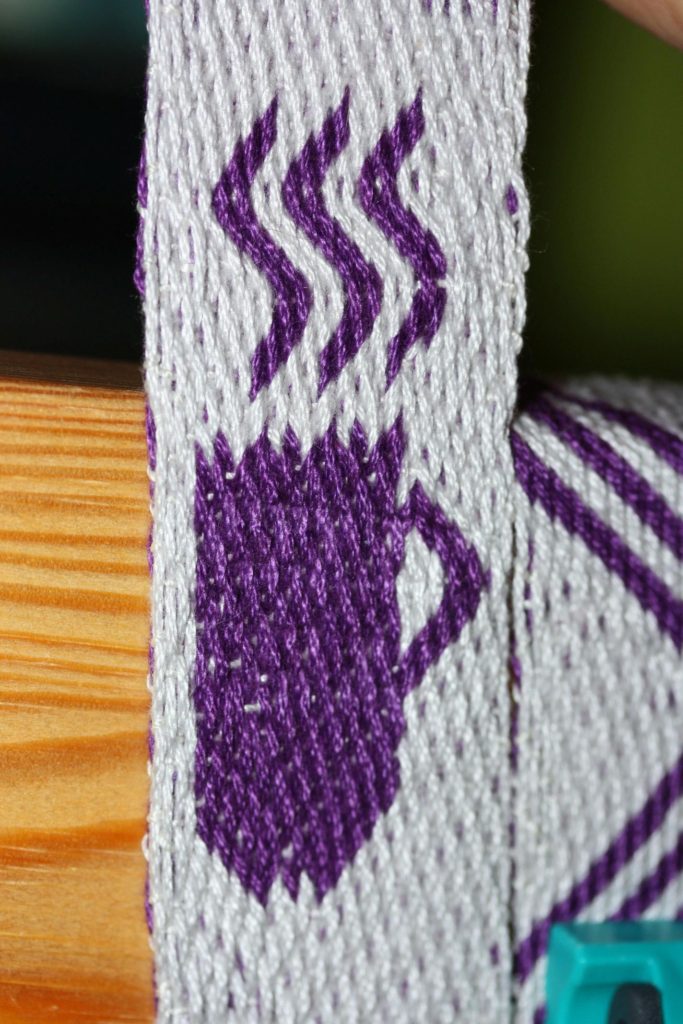
followed by this:


because obviously, what you really need to weave as motifs when working with a reconstructed historical weaving technique, are steaming cups of coffee and the UFO from Space Invaders.

Right?
0

By accepting you will be accessing a service provided by a third-party external to https://pallia.net/

Kontakt