Latest Comments

Guest - Aislinn Dyestuff Citizen Science.
09. Oktober 2026
This is a great project. I look forward to the results. Thanks for letting us know.
Guest - Aislinn Time for...
09. Oktober 2026
Looks delicious!
Guest - Katrin Sprang Discussion
18. September 2026
Hi Rachel, I have looked for more photos of you, but that was not very successful. I found a link on...
Guest - Beatrix Sprang Discussion
15. September 2026
That lozenge pattern element is not a photograph, but a scan. So it should be to scale. But I pinned...
Guest - Katrin Sprang Discussion
15. September 2026
I was not referring to Rachel's reconstruction (is the reconstruction you refer to the one photograp...
MäRZ
10
0

Winding a Shuttle.

Shuttles are a handy thing... I've found, however, that a lot of people only use about a third of a shuttle's capacity. (And now I feel like one of those Scientology guys telling people they only use about 10 percent of their brain capacity...)

Anyways, I made a short and not-very-beautiful, but hopefully clear-and-helpful-enough video on how you can get more yarn onto your shuttle:


Basically you wind the yarn around the middle of the shuttle until there is a good bit on there; the yarn shouldn't be completely filling the incut bits, but usually there's a point where the yarn is piling up a lot in the middle, but there's still space in the openings. That is when you switch to winding your yarn figure-eight-wise around the side edges of the shuttle, first one, then the other. Stop when the shuttle openings are all full, or when you feel that you have enough yarn on there now.

I can't remember who showed this trick to me, and when, but I've done it ever since, and it is so useful! It's also the main reason why I strongly prefer shuttles in the simple,  symmetrical form like the one in the video; some shuttles these days have the opening at the side corners instead of in the middle of their short sides, and I always feel that winding them is a real chore, plus the figure-of-eight winding around the sides will not work.

What will also not work (or work very well) if you do this is pressing your weft in with the shuttle. I know that quite a few people use their shuttle (usually a wooden one, in that case, and sometimes with an edge especially made for this) to beat in; I've never done that, as it has always felt weird to me somehow. Also I beat in at a stage where I don't insert the weft right away afterwards in most cases, so using the shuttle or using some other implement makes no difference to me - and since I discovered how well the Dublin weaving knife works, I'm not using anything else anymore anyways. (The shuttle in the video, by the way, is one of my parchment shuttles - now with a larger opening so it can hold more yarn.)
 
0
MäRZ
09
0

Albecunde!

To my great delight, I have the permission to share some of my pictures from the Albecunde tablet weave with you... so here you go:


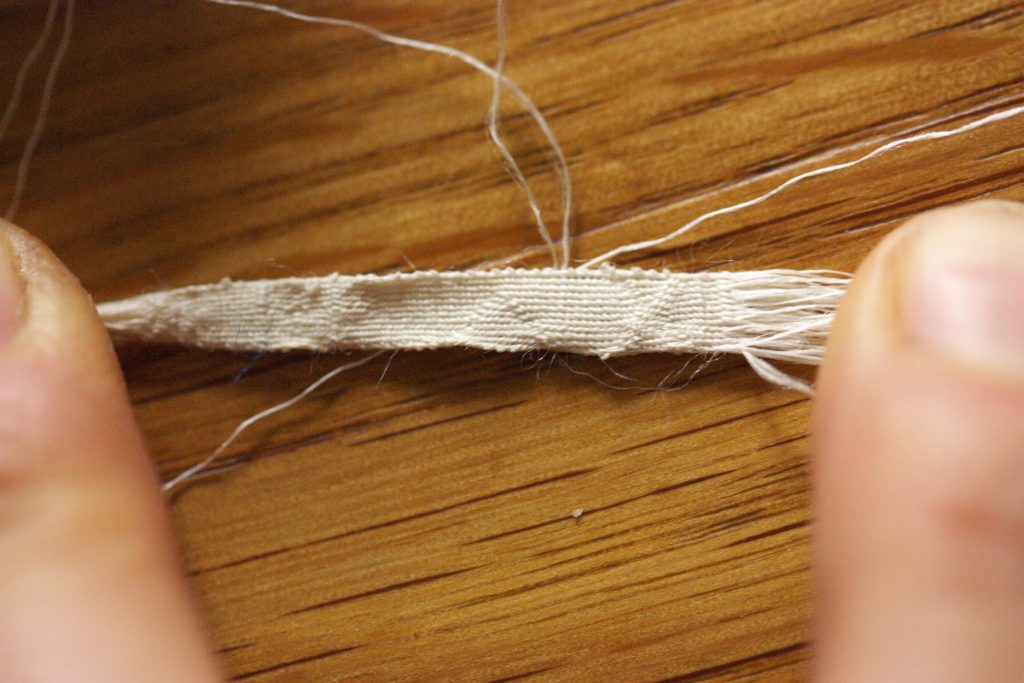
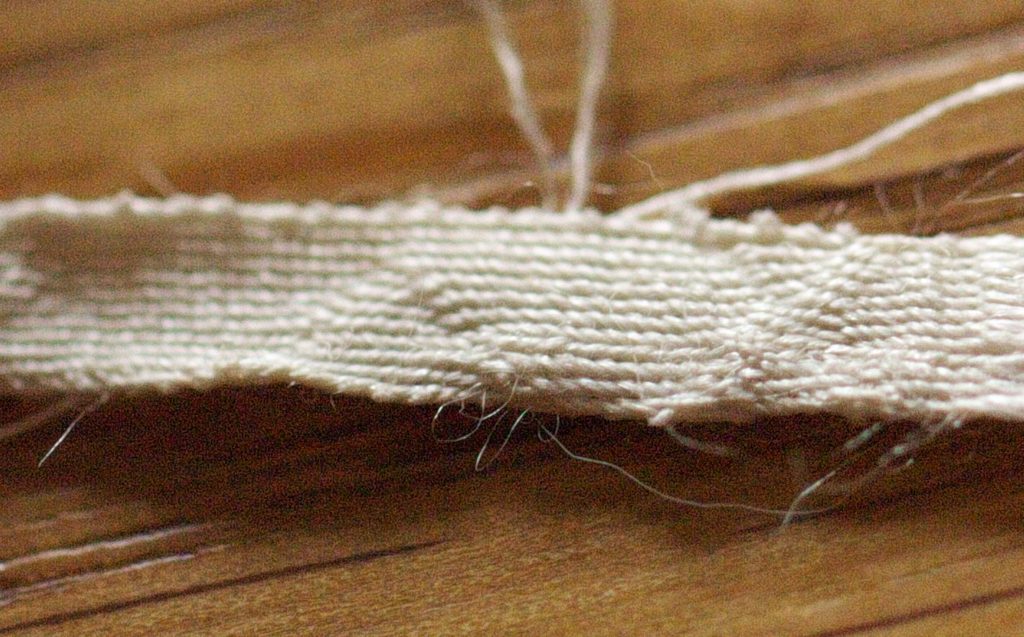
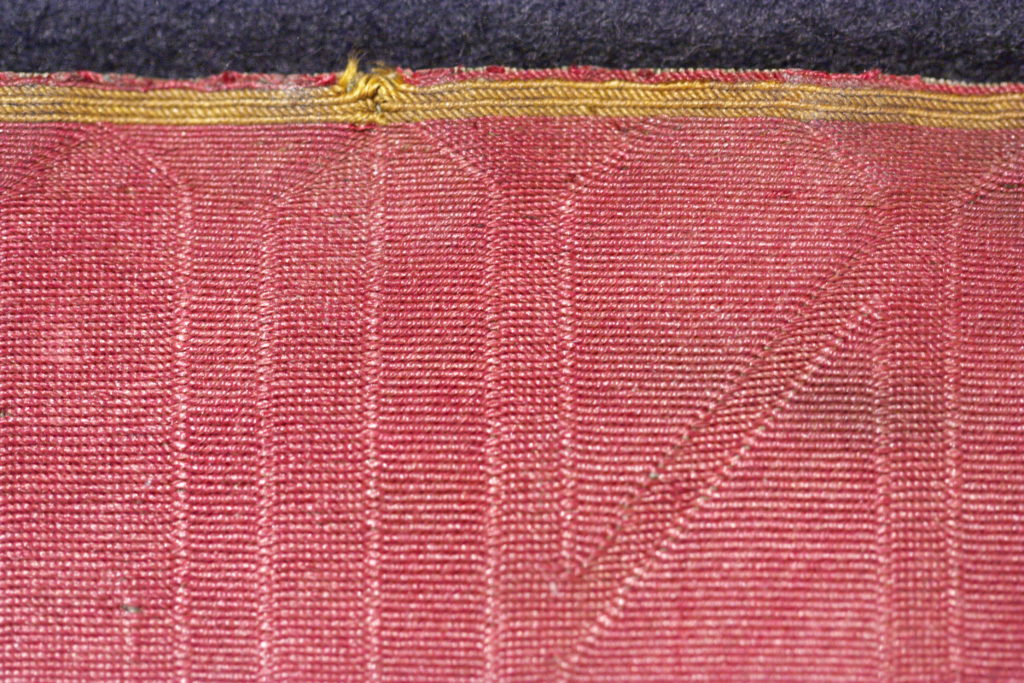
This is a close-up of a detail from the Albecunde weave. You can see that the weft threads are pressed in very, very closely. You can also admire the beautiful colour (after so many hundreds of years!)

At about the middle of the image, there's a general reversal of turn direction of all the tablets, including the 6 selvedge tablets (there's some damage at the selvedge in that spot as well).

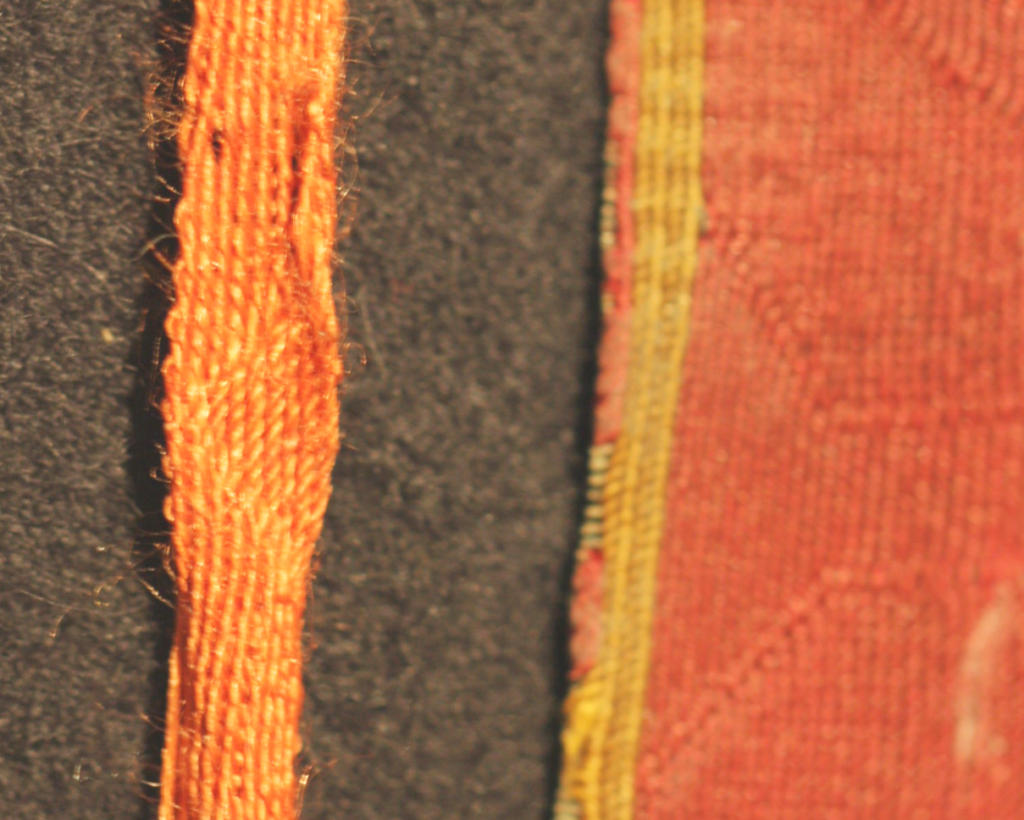
And here it is in blurry comparison to one of my bands, woven from the embroidery silk:


The individual tablet cords really are tiny... my band is about 4 mm wide with 9 tablets, and the original about 38 mm with 92 tablets.

You can visit the original in the Museum St. Afra in Augsburg, it is well worth a visit!
0
MäRZ
06
1

Teeny-tiny, and Shiny.

I've reported about the museum trip to see the Albecunde band... and of course, I had to do a little bit of testing. I used the Texel Stocking silk, which is 4-ply and only partly de-gummed; the individual strands are about 110 den in thickness, so I split up the yarn and pulled one of the strands through each of the tablet holes of one tablet.

That was fiddly, but not too bad; for my sanity, I only did 12 tablets anyways.

So... the result: The partly de-gummed silk is very, very pleasant to weave with. I'm getting a nice and tight structure as well; the silk is also still quite shiny even though there's some of the sericin still in. I also have the impression that the manipulation sort of splits the individual filaments apart, adding to the shine.

It's fine. It's tiny. It's relatively shiny. I probably don't need to mention that it is slow work, because it is so fine and the individual picks add very little to the length of the band. And of course there's not the bang effect the original gives, with its large width, but even white on white, the pattern is visible in a very subtle way:


I'm not sure yet why some of the patterning seems clearer than some other bits...


but as you can see, hopefully, there's a threading direction mistake (as, by the way, there was in the original for a bit) in one of the tablets. I'll probably play some more with this, and take some more macro pictures, and will hopefully figure out where the issues are. Might also be that the pattern will be easier to read on a coloured band. (I think I have some silk paint somewhere in a box in the basement...)

 
Also - this silk is too thin. If I calculate from the 4 mm the dozen tablets give me, I'd end up at 30 mm instead of  38 with 92 tablets (which is what the original has). So... about 150 den should do the trick, if mathematics don't mislead me here.

 
0
MäRZ
05
2

NESAT!

It's 2020... which means it is three years since the last NESAT conference. Which means that it's time for the next one. I already wrote about trying to get things done early this time around, and testing my demo. The conference is in May, so there's still a good bit of time until things get seriously deadline-y, but nevertheless I'm quite relieved that I have figured it out now.

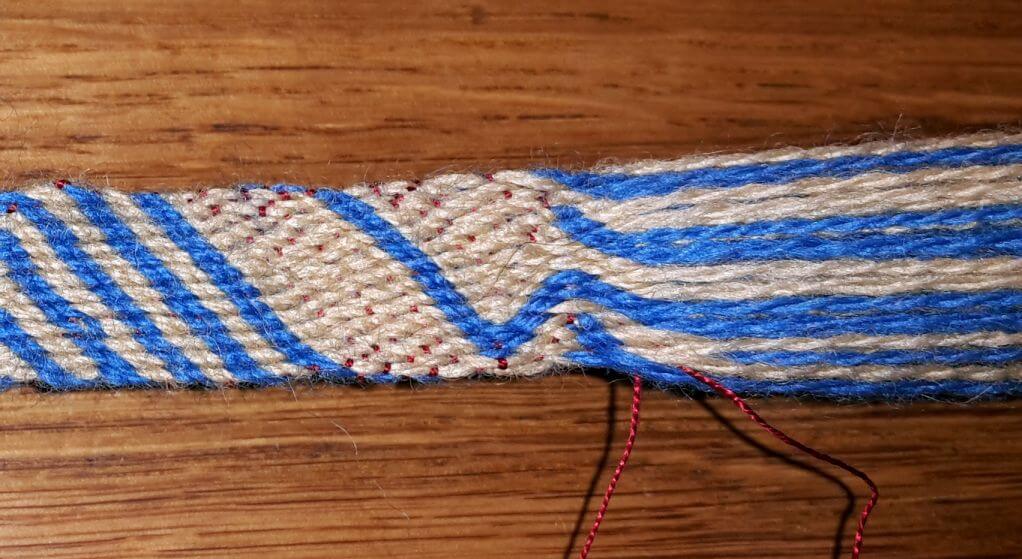
I played around with the demo setup a bit more, cutting the number of tablets down from 12 to ten (which is just, juuuust enough to show the twill pattern rhythm, and the block that forms when a diagonal is cruising its way across the stack of tablets). I've also changed the sequence a bit, including a tiny strip of double face now, then diagonals, then diagonal patterning, and finally a little bit of patterning on 3/1 broken twill (which includes the crux of the thing, the direction change in twill background).

Cutting down to only ten tablets did make a difference. The larger difference was probably made by me abandoning my lovely, trusty weaving knife in favour of just the finger, and not bothering about the fact that my band width is not so even, and the wefts are sloppily tightened.

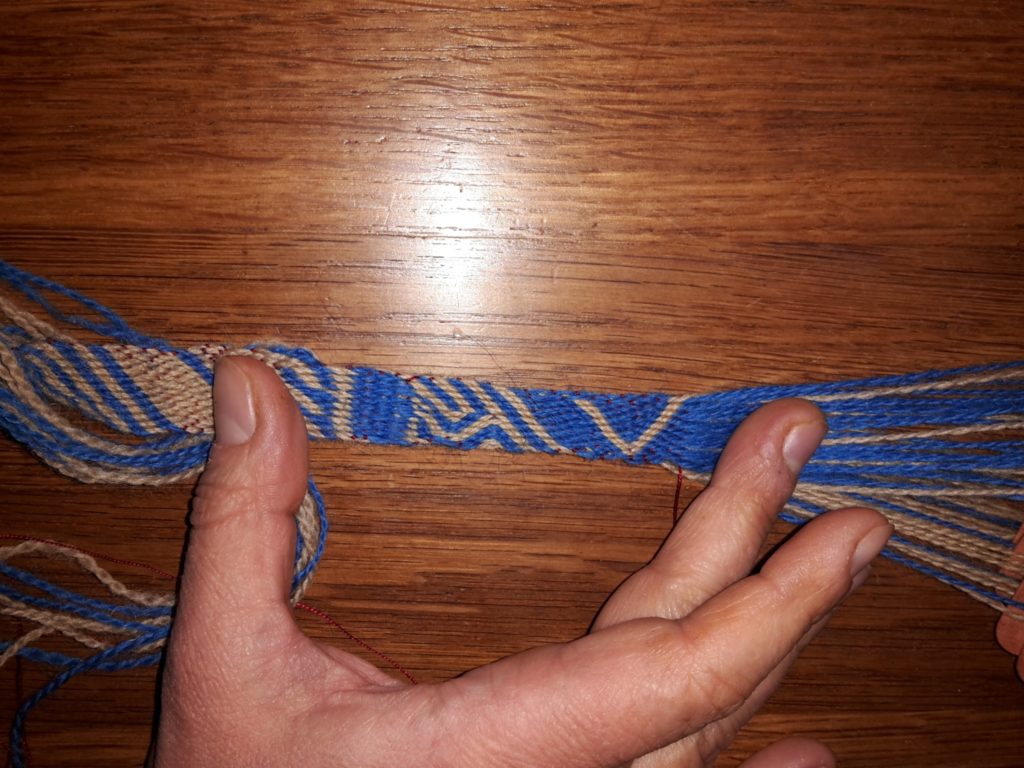
30 minutes is still a very, very short amount of time. It also still results in a very short bit of weaving:


However, the new sequence means I can explain things better as I go along, and that I can, miraculously, squeeze all the important bits into my time slot. Hooray!

Now I only have to make a suitable warp for the conference demo (as I've used up the one on the picture), make sufficient notes of what to do and what to explain at which stage, and then do another practice run or three shortly before the conference.

Which means that I'm now free to work on the other NESAT presentation - also about tablet weaving, but entirely different bands in an entirely different structure. Fun things!

 
0
FEB.
26
0

What I did on Monday.

As you know from yesterday's post, I spent Monday on a museum visit. Monday.

In case you're not familiar with German museums: They usually are all closed on Mondays, and there are very, very few exceptions to that rule. That means when you're in there on that day, it is either a special occasion (such as a public holiday, or a special event in the museum) or you have an appointment for something that happens best when there is no public around.

In my case, I had the wonderful opportunity to meet with two fellow textile people and see a few early medieval tablet weaves that are in the exhibition of the Diözesanmuseum St. Afra: The Witgarius-Belt and the Albecunde-Belt. The latter also has a piece of the so-called Mary's Belt attached to it. (Unfortunately, there are almost no pictures of these belts on the internet - you can see a tiny one of Witgarius here, and a tiny one of Albecunde's belt (usually called Ailbecunde's belt) here.

All three are tablet-woven, and all of them are done in different variations of the technique: The Albecunde-Belt is woven all in one colour, with letters made by turn direction changes to form a subtle pattern that will be visible in certain angles and almost invisible in others. The threads are very, very fine, and the weave is incredibly dense. The start of the inscription, which also gives the belt its name, is "N NOMINE DOMINI ALBECUND" ... and while the first missing letter clearly has to be an I, I'm not quite sure about how it all goes on - it looks like a letter Q to me after the D, followed by an E, which is sort of weird. Anyways, the sure weirdness is that there is definitely no I in the name Albecund... - but there is a swap of the tablet turn direction between the A and the L, which might have led to the interpretation of a letter I. That was a first very interesting thing; the other, for me, was the density of the weave, which results in very pleasant angles of the letter serifs. You might know the syndrome of stretched-out, elongated patterns in tablet weaving? Well, this has clearly not happened here. It has not happened in a way that has deeply, thoroughly impressed me, and I now am convinced that I have to work on my weft-pressing technique, as there's obviously room for improvement.

The Witgarius-Belt has a similar ground weave - wine-red silk, with edge tablets in yellowish silk and red silk - and a similar density, but is brocaded. The gold thread brocading does, again, form letters; they show up in red on gold background on one side and in gold on red background on the other side.

The third of the pieces is only preserved as two small fragments, and one of them is on the back of the Albecunde-Belt, and thus not really visible. The larger fragment, though, can be seen on the belt front; it shows animals woven in 3/1 broken twill technique, alternatingly white on a background of coloured stripes and coloured on a white background. That was, of course, very interesting for me as well, and I hope to weave one or two of the animals in the near-ish future. My count comes to 41 tablets for the pattern zone, which fits in nicely for my play-band with the 42 tablets... and one of the motifs is a rather nice-looking duck-like animal. I haven't done a duck yet, so...

It was amazing to see these things close up (the case was opened for us, so we could take a closer look). Especially the Albecunde-Belt was a delight to look at. The technique itself, in which this is woven, is really simple - but the fineness of the threads, the evenness of the weave, and especially how densely the wefts are packed in reveals the true mastery of the weaver. It seems like the ultimate impressive understatement status symbol, something simple brought to utter perfection.

As you can see, my brain is still rather full of the impressions. Also, I have a good number of photographs, and quite a few things to try out once I get to string up my tablet weaves again, and altogether I'm very, very happy.

Museum Mondays? They are wonderful. Won.der.ful.
0
FEB.
25
0

Yes, I'm still here!

Sorry for the unannounced blog silence yesterday - I was off on a research trip, and I had planned to blog on the train when going back, but then things happened. Good things, mind you, but they were solidly in the way of my plan.

Research trips usually take longer than one expects, and there's lots of photos and thinking, but there's also always something that gets forgotten. (I'm at the count of two things for the trip yesterday, currently. More might pop up.) I also usually get into a sort of "oh that is so cool" rush, and my brain goes on overdrive, and then, at some point, I crash. Completely. As in "brain to mush".

So yesterday's trip did go wonderfully well as these things go - I met with lovely colleagues, got to talk about different textile techniques, and had the wonderful opportunity to see three medieval tablet weaves up close. I then went to see a fourth one - the Ulrichsmanipel - together with my two colleagues, and so it got a bit later than I'd originally estimated. Which meant that the train home was no ICE, and thus had no wifi, and so my plan to blog something while on the train back did not work out.

By the time I was back home, my brain had reached the final state of complete mushiness, and there you go - instant blog silence due to too much textile overload. The best kind of instant blog silence, if you ask me!

Now there's the post-research-trip stuff to do: Sort through the impressions, sort through the pictures, delete all the very blurry ones, and get everything in a semblance of order. Bonus when going through the pictures: repeats of "oh, that is so amazing" might happen...
0
FEB.
20
0

Info Squashing.

NESAT is coming up - well, not utterly urgently and soon yet, but it is looming enough for me to think about it. Especially since I've registered to give an explanatory demo about my method on tablet weaving twill patterns without a pattern draft... and that, in turn, means I will have to aim for an explanation plus demo in about 20-30 minutes. Probably 30 minutes - since my two test runs that I made, quietly mumbling things to myself, took about half an hour.

So here I am, once again with the usual question of "how do I squash as much information as possible into X minutes while still keeping things understandable?" Which is the challenge I'm more or less facing every single time when I give a presentation, or a demo. (Or a workshop. I tend to fill workshops up with lots of info as well.)

For this specific problem, it starts with finding the perfect number of tablets. I have tried things out with a  dozen - which is enough to show the patterns when doing twill background, and how a pattern block moves across the band. For speed purposes, a few less would be even better, so I might cut the number down to ten.

I've also found that the best I can do in the demo is to explain what twill is based on (the diagonals) and show how to do a twill direction reversal. All the rest of how this makes it possible to weave basically anything on the fly will have to be explanatory only - probably with some additional demo bands and printed out pictures. Because this entirely unspectacular looking bit of diagonals and twill weaving, measuring a puny 5 cm, takes me half an hour to weave:

With talking about what I'm doing, and explaining, and showing some things to the empty air. (The cat refused to stand in as audience... she much preferred to nap somewhere else. Ah well.)

So... I'll fine-tune some more, and do it again, and make notes on what to print out in addition, and notes on what I want to say in what sequence. And then, I hope, it will eventually result in a nice little demo that will make my colleagues happy!
0

By accepting you will be accessing a service provided by a third-party external to https://pallia.net/

Kontakt