Latest Comments

Guest - Aislinn Dyestuff Citizen Science.
09. Oktober 2026
This is a great project. I look forward to the results. Thanks for letting us know.
Guest - Aislinn Time for...
09. Oktober 2026
Looks delicious!
Guest - Katrin Sprang Discussion
18. September 2026
Hi Rachel, I have looked for more photos of you, but that was not very successful. I found a link on...
Guest - Beatrix Sprang Discussion
15. September 2026
That lozenge pattern element is not a photograph, but a scan. So it should be to scale. But I pinned...
Guest - Katrin Sprang Discussion
15. September 2026
I was not referring to Rachel's reconstruction (is the reconstruction you refer to the one photograp...
JAN.
20
0

That Was A Busy Day!

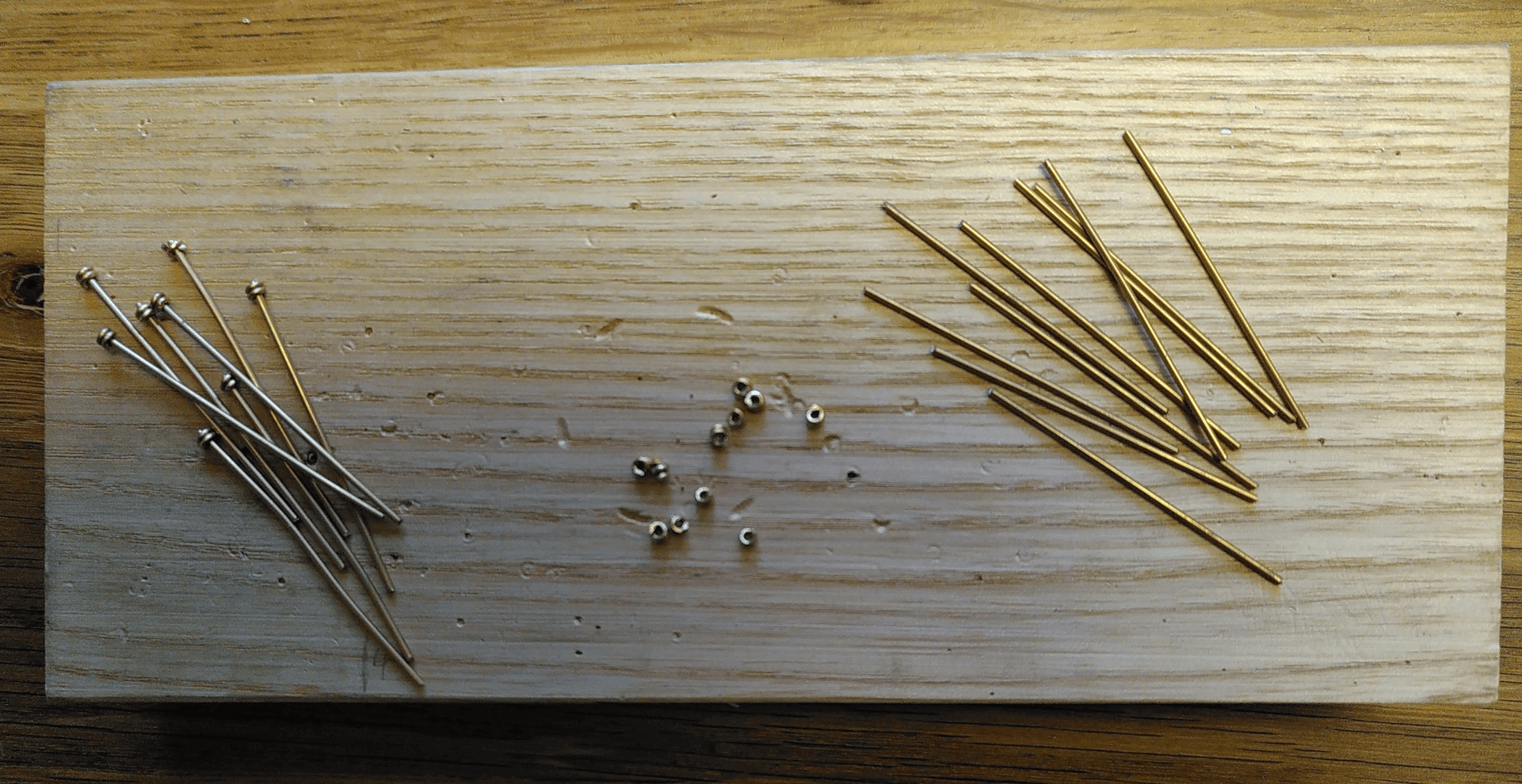
Today was gobbled up by all kinds of preparation tasks for the two upcoming online workshops - especially making a few more distaffs, and some more pins for said distaffs.


It's been a while since my last pin-making session, so I was really looking forward to this. It's a fun task, if a little fiddly at times, and winding the coil for the pinheads takes a bit of a toll on the fingers... but I still like it a lot. (And I only lost one pinhead somewhere on the floor...)

I really like the simple look of these. Mind you, I also enjoy pins with fancy heads, and pins with pressed heads, but these are charming in their own way somehow.

So - pin-making, distaff-making, distaff-dressing, cutting the fabric for the sewing workshop, and packing things in boxes to be sent off. More boxes tomorrow - plus hopefully some time for the overdue book-keeping, and a few other desk and writing tasks.
0
JAN.
18
0

ATR 63 is out!

Archaeological Textiles Review Issue 63 has come out a bit ago, and - as usual - you can download the pdf version for free from the ATR website.

The issue has articles about Nubian textile fragments, Greek clothing terminology, Viking Age textiles and tapestries, and tablet weaving from Hallstatt, among other things. If you're interested in archaeological textiles, it's definitely worth checking out!
0
JAN.
17
0

I'm back!

I'm back from the winter break - so: Happy New Year to all of you!

There's a bit of catching up to do, obviously, and one of the most important tasks of today was finish packing all the orders that came in during the break. I've been working on that, and a bunch of other things, the past few days already. There were hopes that I'd actually get a bit more of the things on the list done, but website relaunches are a notoriously obstinate thing. (There's progress, though.)

Packing has been successfully done, though, and the things are going to the post now.

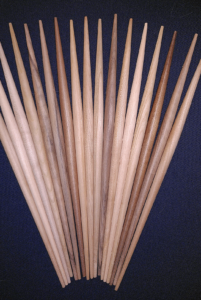
There's also some other shop stuff on the line, including a few new things to be sorted into stock - I have a new shape of spindle sticks. Those need to be described, and photographed, and put into the shop. I also have to take new photos of the pearwood spindle sticks, as the current batch is much, much more varied in colour and texture than the previous one:

[caption id="attachment_6666" align="alignnone" width="201"] New pearwood spindle sticks for the shop - now in a larger range of natural wood variation than before...


Already in there are the new online courses, both in German: One for Medieval Spinning on February 6, and one for sewing techniques on March 6.
0
NOV.
25
0

Spinning Speed Ponderings.

Sometimes I have days (or is it still nights?) when I wake up way too early and cannot get back to sleep... so I usually get up and try to do something useful. Such as... work.

Today was one of those days - which means that it's now mid-afternoon and I'm feeling a bit more tired than I'd like to be, but there's still a stack of office work to be handled. (If you're wondering what I did the rest of the day, the answer is simple: For most of the time, I turned fluffy stuff into yarn.) It's no huge help that the cat is curled up on the sofa, napping and looking very cute and cuddle-able. There's visible progress, though. Yarn is happening! Not quite as quickly as I'd like it to, but hey, that's life.

Spinning speeds are something weird anyways. When I'm spinning for a project, I record all the time I spend on it, and I try to split time-keeping and -recording into the individual tasks to have a better overview in the end. So I will make notes for the time spent spinning, skeining, and wet-finishing the yarns. I did this for past projects as well, and I found that spinning speeds are not completely consistent. That is partly due to current form, partly depends on the kind of yarn to be spun and the fibre (and fibre prep), but there's also another factor: It's quite easy to fall into a slow, relaxed, dreamy pace even though I can draft faster. That will lead to slower spinning speed, of course, thank you Captain Obvious.

I'm not quite sure where that comes from - when I still only had my little wheel, the limiting factor was not the drafting speed, but the treadling speed. (There's only so fast that you can pedal.) With the hand-spindle, flicking speed and spindle turning speed is one limiting factor, the other is winding up speed. Winding up takes a lot of time, even if it's done quickly and efficiently. With the e-spinner, neither of these is there - so I can spin just as fast as I can draft.

In theory, that is quite, quite fast. I've done short test runs to find out how fast I can go, and it was significantly faster than with the spindle or treadle wheel - I think it was in the 140 m per hour range, or even a little higher. There are, however, limits to a sustainable drafting speed. I've learned that while I am able to go as fast for a short time, I'll fall into a slower rhythm when I am working for longer stretches of time. Which is okay - no sprinter is going to hold their speed for a marathon distance. The really evil trap, though, is when things start to feel so meditative and calming that spinning speed goes down some more, and more.

So when I'm production spinning now, I'm not only checking regularly for thickness, twist angle, overall okay-looking-ness of the yarn, progress on the bobbin and whether I have to move to the next bit of bobbin, and status of my tea cup (which includes heat and fill levels of tea), but also remind myself to keep up the good speed, and not start dawdling. I'm also wondering if people back in history had the same issues when spinning, and how they handled things. Did the medieval housewife care about whether she could be faster, or not? Was there more of a "it takes time, and will be done when it's done" mindset than we have today? I could well imagine that - but, of course, that is wild conjecture.

What do you think about the need for speed in medieval crafts, and medieval production? Is that a modern thing only? Did it depend? If so, on what? And if you're a spinner, are you leisure spinning, or production spinning? Do you have different spinning speeds? Have you ever tried to spin as fast as possible for a longer time? I'd love to hear about your experiences...
0
NOV.
09
4

Modern Tools For Reconstruction Work?

Following up on the cording and cording tool use discussion - here's a few thoughts about modern tool use for reproducing ancient or old things.

In an ideal world, if you're doing a reconstruction, everything would be as it was in the original - same materials, same processes, same tools. However, that is usually not possible - due to a number of reasons.

Sometimes, getting materials that correspond to the original material is not possible. That is especially the case when working with plant or animal materials that have been undergoing selective breeding for a few hundreds, or thousands, of years since the original item was made. You don't get the medieval varieties of food crops these days anymore (maybe with a few very rare exceptions), and if we're looking at animal materials, whether bone from cattle or wool from sheep, there's been a huge lot of change as well. So compromises may be necessary starting with the material, which will, of course, have an influence on the finished piece.

Using the original tools and processes is the next part that can turn out to be more difficult than one thinks at first. First obstacle is that we often don't know how, exactly, something was made. With a lot of textile work it's possible to use different processes and different tools to arrive at the exact same outcome. You will not be able to tell whether a yarn was spun on a spindle or on a more modern spinning wheel if the spinner takes care to match the properties of the original thread, for example. Same thing applies for a woven fabric - if there's no tell-tale things like a starting border, how could a bit of fabric let you know what loom type it was woven on?

For purposes of research and experiential archaeology (and in some cases, if there's a question to answer and the setup is done accordingly, even experimental archaeology), it would of course be preferable to use tools and processes that are known for the period the original item comes from. However... when a reproduction is commissioned, there is often a limit to the amount of time available before the thing has to be finished, and - even more important - there is also a limit to the amount of money that can be spent on a single item. Both these constraints will make speeding the whole thing up a very attractive, or very necessary, thing.

So while I enjoy working with old methods and reconstructed tools, personally, I have no problem whatsoever with using modern gadgets for my reproduction work if there will be no perceivable difference in the end product. Using an e-spinner for making yarns, or a modern cording tool for making cords, or a treadle loom instead of a warp-weighted one for weaving plain fabrics, these are all things that can still result in a reproduction that is as close as possible to the original while cutting down on costs a lot. And I personally do prefer to make these compromises in the process to make repros more affordable, thus getting more of them out into the world, for people to see and touch and experience, than having a "perfect" replica made once in a blue moon.

Though if you should know of someone wanting to have something made using all old reconstructed methods only - do send them my way, I'd be happy to be part of such a project, too!

 
0
OKT.
27
2

More Photo Thoughts.

Since writing about the photo-taking spree, I thought that maybe it would be a thing to share some of my tips with you, regarding taking photographs of objects... just in case. Right?

First of all - if you are planning to take photos in a museum (which for most of us will be the most common thing), make sure that you are allowed to do so. Museums normally do not allow the use of flash, and often the use of a tripod is also forbidden. You might get allowed that if you ask nicely, and explain what you want to have the photos for. Make sure you know the museum's wishes on whether the pictures may be shared, or published, and under what conditions.

When taking photos, using the flash is out because of the potential of light damage to objects, especially textiles. It's also not much use anyways, as the glass cases will reflect the light, rendering your picture unhelpful.

So. Ideally, you want to have a camera that can do raw photos (digital negatives), and have a "fast lens". I've had good results with tuning exposure down in the general settings, going for slightly to considerably underexposed pictures, then upping exposure in the post-production. A dark picture can be lightened, but a blurry picture stays blurry. Some modern lenses and cameras offer a stabilising mode - that can definitely help.

Sometimes you can get away with actually touching the lens to the glass of the case (not all museums will suffer you to do this, and I've been told off for it more than once); that helps to stabilise these always-shaking hands that humans have. If you may use a tripod, do. In that case, a remote control for taking the photos is a good thing, otherwise your tripod might still vibrate from your pressing the button.

Try to keep your lens parallel to the object, so you can have a good depth of field; that is especially important if you are using a zoom lens or macro lens.

Using a white balance gadget can save you a good bit of time in processing your images afterwards.

Take a lot of pictures. And then some more. Thanks to digital photography, that is not costing an arm and a leg anymore as it used to in the times of analog film, so maybe invest in one or two good, fast storage cards extra and then click away.

Finally, and possibly the most important bit of advice: Make sure you'll know afterwards what you did take pictures of! When I'm doing museum photography, I always, always make sure to take a picture of the explanatory plaque as well; that holds the description of the piece and its inventory number. When I sort my images, I add that number to the description text in my photo database together with, duh, the name of the museum (which is usually not on the plaque...) - and if there are copyright or publishing restrictions on the photo, I make a remark of that as well.

Any thing that you have found especially helpful (or not helpful) when taking photos in museums, or in research situations? Let me know!
0
OKT.
26
0

Research Trip...

I had the huge pleasure of doing a research trip yesterday - connected to my colleague Andrea's project of researching the so-called Albecunde belt. (I've posted about that here, with an image of the band.) So I packed my photo equipment and my digital microscope and some tablet weave samples to cross-check things if necessary, and met up with Andrea. Then we went to Speyer together, to see the band recovered from an unknown cleric's tomb, dated to the 9th or 10th century. Like the Albecund band, this was woven as a band with letters, in red silk.

It is, also like the Albecund band, a simple thing - monochrome threads, made of fine silk with no twist, and all tablets threaded the same way and turning in the same direction for the background, then switching turn direction for the pattern (which is letters). The Speyer band also has a strip at each side that was originally decorated with a bit of simple brocading in silk.

We took a look, and tried to figure out how the original colouring may have been (as there were differences in colour in the side strips depending on whether the brocade had covered a spot or not), and of course we took photos. So many photos! I learned a lot from the mostly blurry photos from the last trip, so this time, there was a proper tripod with an arm to position the camera properly over the object, and getting the lens in plane with the band. There was also a proper digital microscope instead of the cheap children's play version that I had available last time, and oh, what a difference that made.

Now I have a huge amount of photos to sort through. The most important bit, though: There really is no twist in the silk that was used for the warp, and there is the same very strong twist angle to the tablet-woven cords as in the Albecund belt. Both of these are key to making the visual impact of the pattern as strong as possible.

The only thing I need now is a few extra days (or maybe weeks) of time to play around with untwisted, un-degummed silk...
0

By accepting you will be accessing a service provided by a third-party external to https://pallia.net/

Kontakt