Latest Comments

Guest - Aislinn Dyestuff Citizen Science.
09. Oktober 2026
This is a great project. I look forward to the results. Thanks for letting us know.
Guest - Aislinn Time for...
09. Oktober 2026
Looks delicious!
Guest - Katrin Sprang Discussion
18. September 2026
Hi Rachel, I have looked for more photos of you, but that was not very successful. I found a link on...
Guest - Beatrix Sprang Discussion
15. September 2026
That lozenge pattern element is not a photograph, but a scan. So it should be to scale. But I pinned...
Guest - Katrin Sprang Discussion
15. September 2026
I was not referring to Rachel's reconstruction (is the reconstruction you refer to the one photograp...
APR.
25
0

Travel and Vienna and Fair Stuff.

Sorry for the blog silence on Friday - I had planned to do a quick blogpost in the morning, and then fair prep took over my brain, and that was that. 

Fair prep was, little surprising, taking longer than usual. Well, fair prep always takes longer than planned or intended, and there's usually something that does not get done because it gets forgotten, or there's just not enough time anymore - but not having done this for more than two years, everything was very rusty and everything took even longer than the normal longer than usual. 

No really important things got forgotten, though, everything fit into the car, and actually standing at a market stall again with real people stopping by to chat and look at things and buy whatever they needed was a wonderful change to everything online only. 

I also got to hang out again with Margit from Alte Künste, as we shared fair space as usual. 

On Sunday evening, it was the usual more-or-less chaotic packing, stuffing everything into the car, and now I'm sitting on the train on my way to Vienna for a bit of vocational training, an opportunity that I got thanks to EuroWeb. Which is absolutely wonderful and glorious, and I'm so looking forward to that, even if the timing is not perfect. (Prepping for the training workshop had to take place in parallel with the fair prep, and when I came home yesterday night, the bag for going to Vienna was already packed, so there was only the washbag to transfer over.)

The next few days, I'll get to discuss theoretical frameworks and terminology frameworks for visual identities with colleagues - that will certainly be a very interesting thing to do. It will also mean you're getting blog silence again - I'll be back here and writing on Monday, May 2.

Have a lovely week (I'm sure I will!)
0
APR.
21
0

Fair Food.

No, this time I'm not talking about food that is paid for fairly - but fair food as in the things I eat when on a fair. 

There is, obviously, a huge difference between going on a fair as a visitor and going on a fair as a vendor, though in both cases, I tend to bring my own food. Most of the time, the things offered at the food stalls are not, um, top-quality stuff in regards to ingredients and taste, and they are usually also quite high-priced. 

When I go to visit the Spiel game fair at Essen, the usual stuff we're taking along is sandwiches, some fruit, and a bit of chocolate or other sweet stuff. There's a nice breakfast in the morning and the group goes to have dinner at an Italian or other place in the evening. Packing and food prep for that is easy, as it's only the sweet stuff and maybe some extra fruit to pack and bring along, the sandwich ingredients are provided at breakfast time, as is more fruit. So nothing to think of or prep in the days before.

When I'm on a fair as a vendor, it's a wholly different picture. Sometimes breakfast is provided, but that's the exception; usually it's pack your own for all the event. Which means packing food that is ready to eat, does not need to be refrigerated, is more or less sensible, easy to eat a bit of and put away again (in case customers come along while you're munching), and preferably also tasty.

Bread and smoked sausages as well as boiled eggs are among the typical things that fit these requirements. Chocolate, of course - my rule is to take one bar of chocolate per day, just in case things happen and there's no time to eat properly. Carrots, radishes, and cucumbers are good choices for getting some fresh stuff that does not wilt when you look at it oddly. But something that is not bread is also very nice to have.

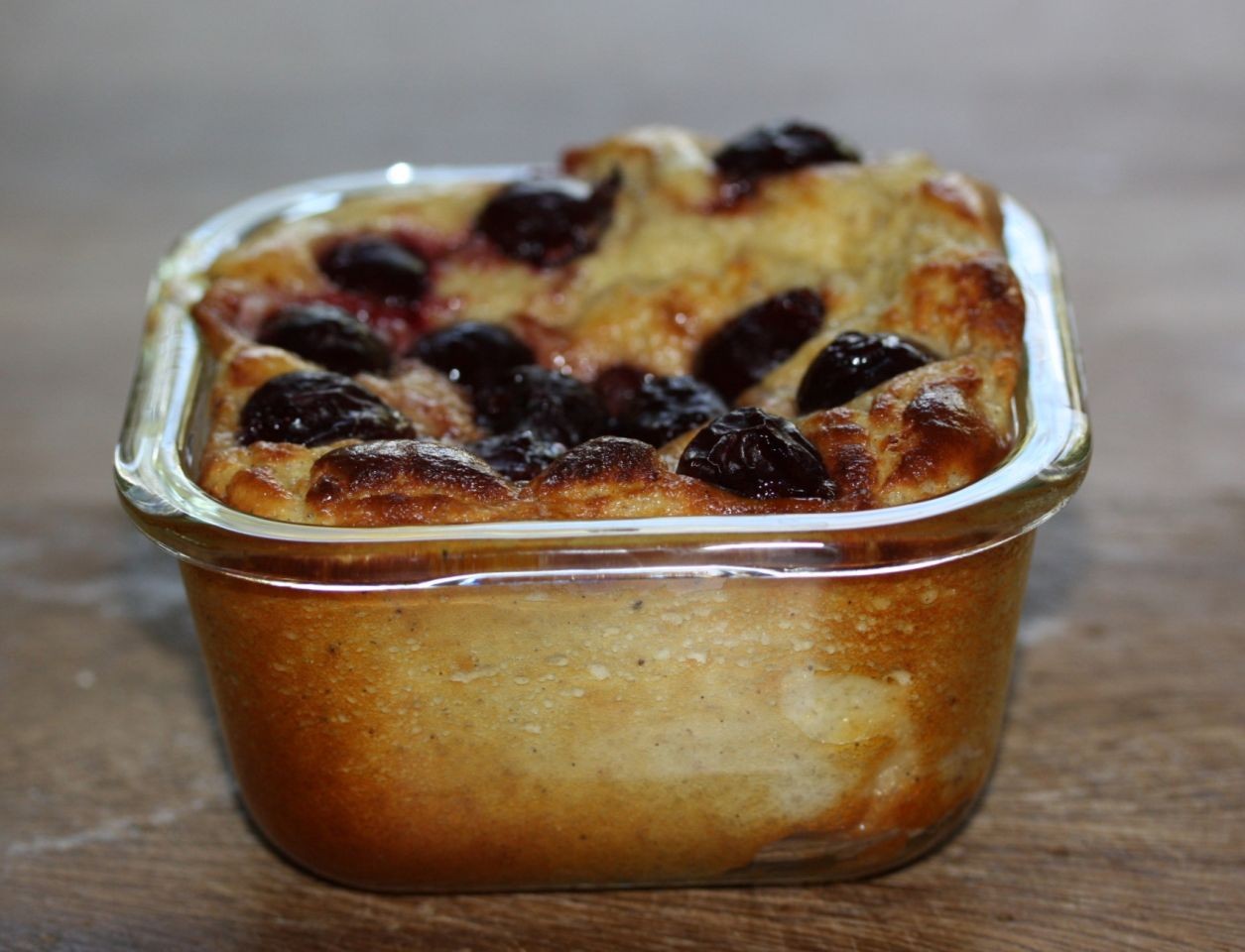
One of my not-bread-meal staples for these occasions is Quarkauflauf - which is, more or less, a crust-free cheesecake with fruit in it. And today's the first time since ages that I'm prepping this. With Zwetschgen as the fruit, that lovely variety of plums that I like so much, and that I find is unrivalled in Quarkauflauf. I don't really know why I haven't made this since the last fair, but I can tell you that I am very much looking forward to this fair food, to be consumed this weekend in Hohenlohe!

In case you're in the region, come see me at my stall, the fair runs Saturday and Sunday in Blaufelden. And if you have suggestions, or a favourite food to take along on travels or events, let me know in the comments - it's always interesting to hear what other people have to keep them going on events!

0
APR.
20
0

Articles!

While I was doing the website relaunch, I had to look at this and that. Which, obviously, included the site structure, and some of the texts. 

Among said texts were some in need of a bit of editing, or changing, or other tender loving care - and while I'm not finished with all the things I want to get up to date, or nicer to read, or both, I've at least finished one of them recently. That's a collection of online resources: Books and articles that are available for free in .pdf form. 

You can find the list under the main page category "Ressources and Helpful Things", and it's titled "Books and Articles" (much to everybody's surprise, I'm sure).

Because I try to keep my pages fully bilingual, with the same content, the page is also available in German. The contents are about the same, though the sorting is a bit different, and of course the explanatory text is in German. 

I hope you enjoy it, and find something useful in there!

0
APR.
07
0

The Time It Takes.

I've been doing textile maths again recently - regarding weaving processes, and how long things take. The question of "how long did it take" for medieval fabric production is one that comes up again and again.

Quite often, these calculations run for a single garment, or a small piece of cloth. I've had a sort-of revelation regarding spinning time when I did a rough estimate for a bolt of cloth about 20 m in length, medium quality - which would take me approximately half a year to spin the yarn for, working full-time.

Full time. Half a year.

The funny thing, though? If you're looking for yarn for fabric replicas, and you want to get a spinning mill to make your yarn for you, it won't take much shorter... because a lot of the small mills have waiting times of several months before they are able to process your order.

So, just in case you're a museum thinking about getting a textile replica? Be aware that it will take a lot of time even in the best case, unless it's only a very small item. I think most planners are not aware of how complex making a textile replica is. Of course there are several categories here as well, from "should look roughly like it from a distance of 2 metres in low light" to "our visitors are encouraged to touch and handle the piece". 

If it's the latter, things start with researching details of the original pieces such as type of fibre, fibre thickness, yarn diameter, the amount of twist and the look of the finished fabric. Then the hunt for the appropriate materials starts, followed by making the yarn, followed by weaving (or whatever other textile technique was used in the original). Not all modern weavers will work with historical style yarns, by the way. They are different than the yarns people are used to today... Dyeing, if required (which it often is) is another interesting beast to tame, and will also take some time.

With the masses of fabrics available these days in the shops, and the easy and quick buying of clothes, it's not on most people's radar anymore how time-consuming textile work is. Knitters will know about it, as will people who spin, or sew their own garments, but in most of those cases, the activities are hobby activities. Which means that there will be a general awareness of "it takes a long time", but the actual time is not measured objectively, and we all know perception can be misleading.

I have no good idea yet on how to propagate the knowledge to museums, though... 


0
APR.
05
2

Middle Gores and Riding Slits, Continued.

...but wait, there's more!

Florence commented on the post about Herjolfsnaes 42 (with some issues thanks to the blog software, it seems it is very non-mathematic-symbol-friendly):

I agree that if a person is buried wearing a garment does not prove that they also wore it in life - just that their family or community deemed it proper for them to be buried in them. And then, as you mentioned, there are the Greenland finds, where the corpses were wrapped in the garments and are not wearing them, so that's another thing altogether.


My point is: Proving a negative empirically can only be done on a large amount of data. Women never wearing short garments: Sure thing, loads of pictorial evidence for that. Women not wearing garments with a riding slit: Also loads of pictorial evidence, including the pictures of women riding astride. Now, women never wearing long gowns with a closed (as in sewn shut) middle gore: I cannot tell from a picture if there is a closed middle gore or not, could you give me a few examples?
In extant garments, we only have a few examples where we are quite sure those were worn by a woman. So, out of less than 5, none have a middle gore. But that's not a lot of data.


(Granted, I'm a physicist, a sample size of n=5 tells you nothing in my field)

I don't even know an extant long garment with a closed middle gore that is a associated with a person/corpse of any gender.


..

First of all - yes, that is not a lot of data I am working on. Unfortunately, we do not have a lot of data to work on, and I completely agree that a sample size of five or less is very, very scant. 

When I looked for garment evidence for my thesis, I got about 175 items altogether, from most of Europe (with limited things from Finland, and next to nothing from Eastern Europe) and for the timespan of 500 to 1500. I tried to include extant pieces that could give information on how something was tailored, so no pieces that have just a piece of seam or hem. There's probably some more that I missed, and in the years since, some more pieces have been found (Lengberg for instance), but I'd surmise that we haven't gotten up to significantly above 200 items.

Garment finds are really, really rare.

And now for the really juicy bit... is it possible to tell from the medieval images whether there's a middle gore sewn in, or not?

There is, to my eyes, a subtle difference between how folds in women's dresses and in men's tunics are shown. It's really subtle, though, and it took me a while to sort of put my finger on it. The difference gets less pronounced when the dress is wider, and it's not visible if the dress is tucked up into the belt as to fall in different folds.

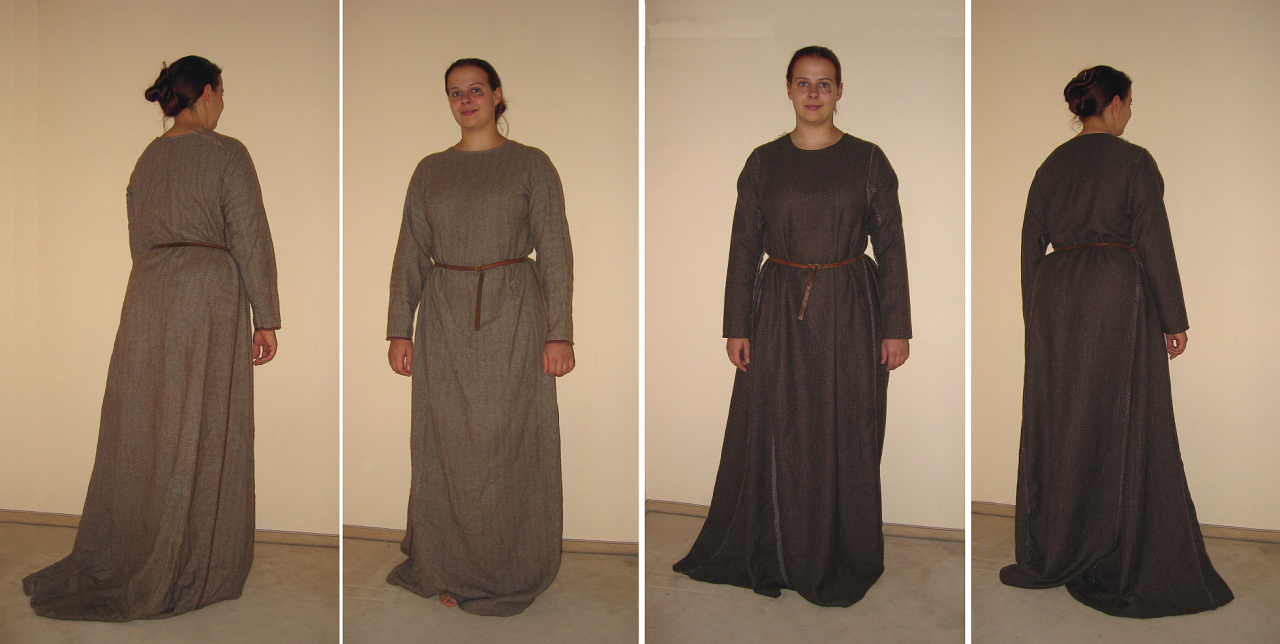
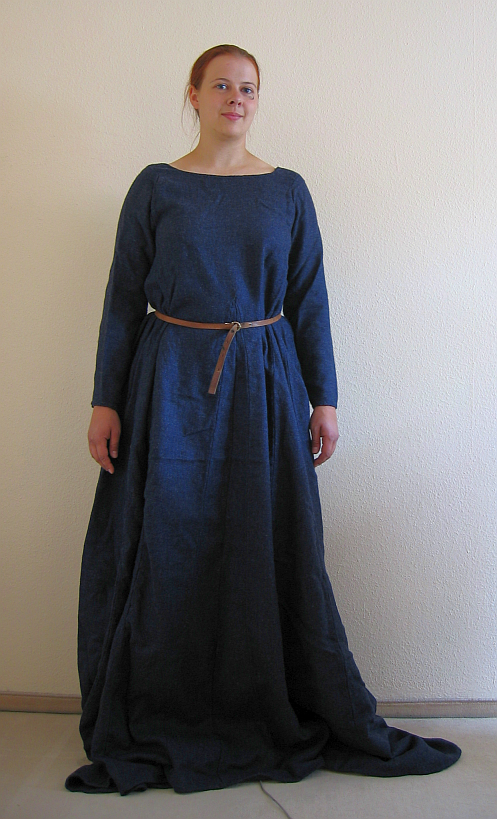
What I have only seen shown on women's dresses in artwork is the V- or U-shape of folds in the front part of the dress. These can both be seen on my dress reconstructions of St Elizabeth's and St Clare's dress, here:

You can see the U-form of the folds on the left dress, and a more subtle version of the folds running together in the front on the right. In comparison, the folds on the Herjolfsnes 42 look like this:

The folds are running straight downwards to outwards here. 

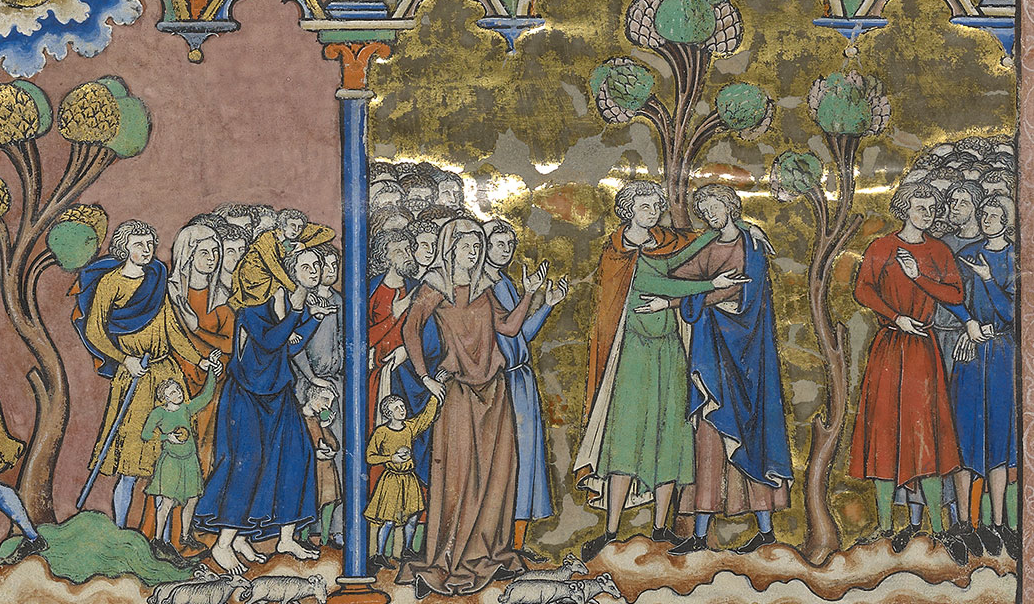
So how does this compare to medieval images? Here's one example:

Maciejowski Bible, The Morgan MS M.638, fol. 4v. See it in full size here: https://www.themorgan.org/collection/crusader-bible/8

On the men's tunics, the folds go straight down. On the women's dresses, the folds run towards the middle. At least that is how it looks to me - and yes, I will say again: the difference is subtle. Similar fall of folds can be seen on the other folios of the Maciejowski. (I'd like to go and hunt for more similar things in other manuscripts now, but unfortunately I'm running out of time for today.)

On many of the images that we have, it's not possible to tell how the folds run, or if there is a distinct difference between the male and female dress. Female dresses are often tucked up into the belt (not just drawn up, but a side fold of the dress taken up and stuffed in), and that will severely change how the fabric drapes and hide any "natural" front folds. Quite often, some mantle or cloak also hide what goes on in the front, for both men and women.

So in conclusion... I would not call what I see on the images as hard evidence, but to me, this impression of a subtle difference between how the women's dresses fall and drape, and how the men's tunics, especially those longer than knee-length fall and drape, is a very strong hint towards a different cut, and I would interpret that as the middle gore for the men's garments and no middle gore for the women.

What's your impression? Can you see a difference?

0
APR.
04
2

Ah, Vienna.

I'm back from the Vienna trip, and it was wonderful - giving a presentation in front of actual living, breathing human beings just is different from giving an online-only presentation. Though I am certainly delighted that the presentation was hybrid, that made it possible for a good number of other people to join in.

There were questions afterwards, and then there was the "Post-Kolloquium" which is the official moniker for "have a meal and some drinks together". It's been forever since I've been at a social like that and that, too, was wonderful.

On the next day, I got to meet up with some colleagues to have a look at a spectacular Bronze Age gold textile, or what's left of it, which is only the gold threads. Interesting debates were had about it, and I got to play a little with some of the testing textiles and give some input, and then there was time for a museum visit before we met up again for dinner.

Some more sightseeing was added in before we went home (the Most Patient Husband went along for the ride), there was bouldering at a Viennese gym (which sort of counts as sightseeing as well), way too much coffee, lots of delicious foods of all kinds, and a lot of rides on diverse public transport vehicles. I'm especially enamored with the Viennese Underground, as there are some sections where it goes overground, with very nice views, and even nicer stations designed by Otto Wagner, a famous architect. These stations are part of the cultural heritage and still in use, so you get to ride modern trains to historical buildings, built in a style that I like very much.

Using public transport this weekend had an added benefit: the vehicles are all heated. It got very cold in Vienna over the weekend, especially on Saturday and Sunday - there was even snow, and not just a few flakes, but enough for it to stay on rooftops and trees. Brrrr!

Now it's back to the desk for the more mundane everyday tasks... though there is the next presentation to prepare, for a workshop coming up towards the end of April. 

I'm still feeling a bit queasy about travelling, and meeting up with a lot of people within a short period of time; it's so different from the pandemically mostly secluded life that we have here, and that I've gotten so (maybe too) used to in the last two years. So I hope we haven't caught anything on our trip, and we plan to get a test today and in a few days again. 

As a side note regarding the pandemic: Rules in Austria are similar to those in Germany, which means that you will be allowed to take off your mask when in a restaurant and seated at the table. Which means that for the presentation, in the larger room with more air volume and lots of space for each person, everyone wore a mask... while those going to the post-colloqium were then seated at a small table, with little space between individuals, and in a much smaller room, not wearing a mask. I do get the rules, and I completely understand how these situations occur, but it's still sort of weird and makes the rules seem sort of haphazard...

0
MäRZ
24
0

Biased Much?

Sometimes, we fall into the trap of being human - there's certain things that we all just tend to do, and while they do make sense, usually, in an evolutionary context, it might lead to less than welcome outcomes in our modern world. Being human, and having these cognitive biases that we all have is, for instance, something that makes us vulnerable to con artists. Or to just acting stupidly all on our own.

One of the biases is the sunk cost fallacy - you've invested time, money, or both in something, and although reason tells you that it is a dead end and you should cut your losses, it is extremely hard to do so. I have definitely been a victim of that more than once! Confirmation bias is another very common one: favouring things that confirm what you already believe instead of staying objective and looking at your data in a more neutral way. Guilty, Your Honour.

Then there's also logical fallacies, such as using personal experience to dismiss statistics, or looking for patterns to fit a presumption (which sort of ties in with the confirmation bias). Recently, conversation between the Most Patient Husband of Them All and me has meandered to logical fallacies, and he has consequently presented me with a link to a very nice website, with lovely posters listing both biases and fallacies, which I now pass on to you for your delectation. You find them, and more, at www.yourfallacy.is and www.yourbias.is. Enjoy!

0

By accepting you will be accessing a service provided by a third-party external to https://pallia.net/

Kontakt