Latest Comments

Guest - Aislinn Dyestuff Citizen Science.
09. Oktober 2026
This is a great project. I look forward to the results. Thanks for letting us know.
Guest - Aislinn Time for...
09. Oktober 2026
Looks delicious!
Guest - Katrin Sprang Discussion
18. September 2026
Hi Rachel, I have looked for more photos of you, but that was not very successful. I found a link on...
Guest - Beatrix Sprang Discussion
15. September 2026
That lozenge pattern element is not a photograph, but a scan. So it should be to scale. But I pinned...
Guest - Katrin Sprang Discussion
15. September 2026
I was not referring to Rachel's reconstruction (is the reconstruction you refer to the one photograp...
SEP.
01
0

Stuff going on.

I feel like I'm a little (or a lot) behind today - which might be due to a moment of realising what all needs to be done, and the additional realisation that not all things can actually be done right now (even if they're small or smallish things), due to a number of different and diverse reasons.

It didn't help that I've been sidetracked by some necessary software updating, and trying to find what is cluttering my hard disc in the computer, and generally being somehow butterfly-minded today. (As in fluttering from one thought to another.)

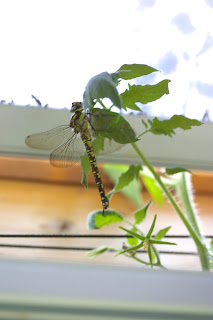
So... an appropriately non-related scatterbrainy picture for you.


This guy has hopefully found the way out of the conservatory by now. The flight patterns of this beautiful beast while trying to find a way out, though, reminded me too much of my brain pattern today...

(Oh, and just in case you want to know what was, or is, on the list of things to do today: Answer emails, take care of some PR stuff for the Beast, work on the Textileforum programme planning (which is almost finalised) and answer more emails...)
0
AUG.
28
1

Book things.

There's a slew of books out that you might want to know about... so here you go:

The last NESAT conference papers have been published recently, and are now available. Here's the book data:
K. Grömer and F. Pritchard (eds.) 2015: Aspects of the Design, Production and Use of Textiles and Clothing from the Bronze Age to the Early Modern Era. NESAT XII. The North European Symposium for Archaeological Textiles, 21st – 24th May 2014 in Hallstatt, Austria. Archaeolingua Main Series 33. Budapest 2015.
It costs 64 € plus s+h, and you can order it directly from the publisher, here.


Also out, and available: the kickstartered book "Drei Schnittbücher". It's taken a while for the wo ladies to get this all done, and I can absolutely understand - a book like that is a huge project, and it was totally worth the wait. If you've missed the Kickstarter and are wondering what I'm talking about, here's the link. (Also, you can buy the book directly from the printer, here. Or order it via the Big River Store, which I will not link to. Or, since it has an ISBN, probably also via your brick-and-mortar store of choice. Support (indie) booksellers!)

For those of you itching to read more about textiles from buildings, there's a slim volume out by
Beatrix Nutz, Irene Tomedi, Armin Torggler, Penelope W. Rogers: Gerüstlöcher als Tresore für archäologische Textilen. Fori pontai come casseforti di stoffe archeologiche.
Schriftenreihe Landesmuseum Schloss Tirol, Heft 6, 2015. 
It's in German and Italian and contains background information about the textiles found in Schloss Tirol, including lovely pictures of the surviving fragments, some of them still brightly coloured. You can see the table of contents here. You will need to email the institute in Innsbruck to order it: ur-fruehgeschichte[AT]uibk.ac.at. Price is 20 € plus s+h.

And in case your own life feels like a book - here's a list of things that might let you know your life is a novel by Chrétien de Troyes.
0
AUG.
27
0

Currently in the works...

I've been taking gazillions of photos recently, using my new softbox and lighting equipment. Most of the photos taken will be deleted again - what I'm trying to capture is not always cooperative, and thus I take five or ten pictures, and then five or ten from another angle, and then another five or ten for one that I will actually need.

Are you wondering what I'm shooting at?

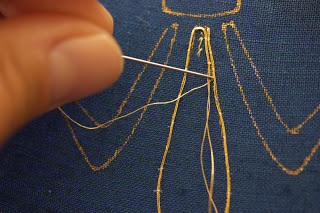
It's this:


Pictures for the instructions for the fleur-de-lis embroidery kit.
Goldwork is hard to photograph, because you need enough light, but not too much light so things are clear to see and yet the gold does not dazzle. Since the details I want to show are fairly small, that means a rather shallow depth of field even with good light - which explains the blurry fingers.

I'm confident that I should have all the photos needed to explain the ins and outs of the process now, though - I only need to sort through them, trim the pictures I will use, and finish writing the instructions in both German and English. And, of course, finish working this final prototype and put together the actual kits. They should be finished in time for the fair in Weikersheim!
0
AUG.
26
0

Spinning Instructions in English finally available!

Finally, the spinning instructions that I wrote a while ago have been proof-read and are available in English as well as in German. Putting them into the shop and blogging about it has been delayed a bit by the summer break, but now, finally, they are here.


They are either a part of the starter kit handspindle if you order it via the English version of the website (I then get all orders in English, too, so I know to put in the right printed version), or you can get them as a pdf file directly from my shop, for free! (You will need to register if you don't have an account yet.)

There should be a download link in the pdf "invoice" that is attached to your order email (the link is not directly in the email, so please make sure to open the pdf and look for the link there).


0
AUG.
25
0

New shipping fees.

Anyone who's ever been ordering things online, especially from across borders, knows the pain that shipping costs can be. They are often surprisingly high, and sometimes downright prohibitive.

I know that I have myself abandoned quite a few half-filled baskets for orders because the shipping costs were more than I was willing to pay. Sometimes I also wondered how on earth these people could arrive at shipping figures that high...

And then I started my own online shop.

Let me tell you this: Shipping costs are a pain for both sides. As a shop owner, you have to figure out how much to charge - which means costs for boxes, wrapping paper, labels, tape, stuffing material, the postage itself, and so on. (So on, in Germany, includes costs for licensing fees that cover the cost of recycling.) You also have to figure in that packing stuff and bringing it to the post office will take up time, in some cases considerable chunks of it. The more you send out, the more alike your wares are, the easier it is to calculate things, and packing will go faster, and you can get better rates on all the package-related stuff and even on postage.

I spent a lot of time and brain power on trying to figure out shipping prices that would be as fair as possible towards my customers, and still reliably cover the actual costs that I have. From time to time, there is some reason for me to check the shipping costs again, and sometimes I find that I can re-calculate them - because prices have changed, or because I send out more of thing A as opposed to thing B, and that means I can add another tier to the price ranges to make things better.

That happened recently - and now there's an additional shipping price for those of you who would like just the printed pattern of Dread Pirate Roberts' Winter Hat. I have added a special, as-low-as-possible price for shipping for the pattern, which is 2 € inside of Germany and 3.60 € for the rest of the world. Happy knitting!
0
AUG.
24
0

I am back!

My lovely summer break is over, and I am back home and back at work. It was a wonderful time off - I spent time with friends, enjoyed a canoe trip down beautiful Werra and Weser (two rivers in Germany), cuddled the cat, and generally relaxed. There was the yearly archaeologists' meet-up in Bamberg, too.


Not all of the last weeks was spent vacationing, though. I used a large chunk of the non-vacation time to get some research reading done and prepare a presentation I held day before yesterday for the people in the Museumsdorf Düppel in Berlin. It was very interesting, and with a very intense discussion afterwards.

I also spent some time on the further development of the fleur-de-lis embroidery set (the instructions with lots of pictures are in the works right now), washed some more wool, and I'm scheming to maybe offer some textile samples to demonstrate the difference between modern-style and medieval-style textiles in the future.

I also have a huge backlog of linky things to blog about, accumulated during the last weeks... let's start with the newest one:

It does not matter what archaeologists say - UFO lovers still insist this might be an alien.
0
JULI
15
0

Something new and wooly in the shop.

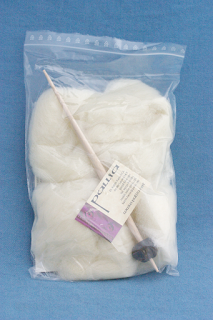
Just in time for some summer spinning, I have new wool in the shop - from a very rare sheep breed: Rouge du Roussillon.

Rouge du Roussillon, picture: Eponimm, CC BY-SA 3.0 (wikimedia)

These are red-legged, red-headed sheep originating in the French Pyrenees, with short-staple, fine wool. Just like many other heritage breeds, they have suffered with the changing times. These days, there are very, very few animals left - probably about two hundred.

Half of them are in Germany, and one herd for conservation breeding is living quite close to my place. You can see pictures of the herd in Nuremburg here.

A few weeks ago, I bought some of the freshly shorn wool from these sheep; now, finally (after a long wait for enough water for washing), the wool is ready to be sold.


It's almost white wool, fine and not very long staple, with a fine crimp. You can find out more about the wool here - and also get some of it, if you are so inclined!

I'm very happy to be able to offer this wool. Selling it supports the conservation breeding herd and, in addition, the conservation of the habitat that the sheep graze in, which is a very species-rich kind of grassland on poor, sandy soil (Sandmagerrasen in German). Plus it's a beautiful and rare fibre - what's not to like?
0

By accepting you will be accessing a service provided by a third-party external to https://pallia.net/

Kontakt