Latest Comments

Guest - Aislinn Dyestuff Citizen Science.
09. Oktober 2026
This is a great project. I look forward to the results. Thanks for letting us know.
Guest - Aislinn Time for...
09. Oktober 2026
Looks delicious!
Guest - Katrin Sprang Discussion
18. September 2026
Hi Rachel, I have looked for more photos of you, but that was not very successful. I found a link on...
Guest - Beatrix Sprang Discussion
15. September 2026
That lozenge pattern element is not a photograph, but a scan. So it should be to scale. But I pinned...
Guest - Katrin Sprang Discussion
15. September 2026
I was not referring to Rachel's reconstruction (is the reconstruction you refer to the one photograp...
AUG.
26
0

LonCon, and Dread Pirate Robert's Favourite Winter Hat

As I already hinted: it was wonderful at LonCon. That was not only my first WorldCon, but also my first convention ever, and I started full speed ahead - with a dealer's table and a one-hour presentation about medieval textile crafts (with examples from London).

I met a lot of wonderful people, and I had the joyful experience of having an hour and a half on the very first evening, giving my presentation. Thanks again to the wonderful organiser of the academic track, Emma England, who made this possible! From the feedback that I got afterwards, it was an enjoyable experience for my audience, and I had a lot of fun too. There was a bit of an "aaargh!" moment at the very beginning, when I found out that all of the six (six!) microphones on the table were live, and fretted over toppling them over with my textile tools. There were a few further "oops" moments during the presentation, when I did my tools and process demonstrations before having clicked on to the cue cards in the presentation slideshow... but all of these were very minor and more something to grin sheepishly about than to really be troubled.

Apart from that first evening of (enjoyable) work, I spent the time after 18:00 hanging out with friends in filk concerts and in the "Fan Village", or at one of the several dances. During the day, I was mostly at our table in the Dealer's Hall, and that was not any less enjoyable, thanks to lovely customers, colleagues and neighbours. Susanne, our trusty and immensely helpful sidekick, hung out with us most of the time, helping to sell and chat - it wouldn't have been possible to enjoy the Con half as much without her. In fact, we had so much fun we decided it would be nice to do this again - surely not at the next WorldCon, because that is in the US, but there are more conventions apart from that one...

I also learned (quickly, hah!) about the Thing with the ribbons. You see, for your con attendance, you get a plastic badge that you hang around your neck. And if you like, you can stick ribbons to the bottom of it, stacking them. If you are really keen on ribbons, you do that until you have a long, scarf-like tail of cloth hanging from your badge. (I just wanted a few. I ended up with eleven.) There were some official ones (such as the bright orange "Dealers" ribbon, or the light blue "Programme Participant" ribbon, or the multi-coloured "First Worldcon" ribbon) marked with the LonCon symbol. Most of them, though, were unofficial and made by fans, and with all kinds of statements on them - such as "I <3 -="" a="" advertising="" and="" back="" because="" bid="" book="" br="" bryan="" citations="" city="" convention.="" coveted="" dead="" did="" doctor="" dog="" during="" evening="" fetch="" few="" film="" for="" four="" future="" get="" go="" his="" host="" hotel="" i="" instantly="" kind="" last="" making="" manage="" me="" my="" of="" on="" one="" or="" out="" party="" really="" ribbons="" room="" s="" saw="" showing="" so="" support="" that="" the="" there="" thing="" three="" to="" totally="" very="" wanted="" was="" were="" worldcons.="">

The Con also saw the debut of the pattern for Dread Pirate Roberts' Favourite Winter Hat (ravelry pattern page link here), and it was very well received indeed!

The pattern is printed in colour, contains clear illustrated instructions for the special moves that are necessary for the lace part, and is now available via my webshop. Since I wanted to be able to sell it as a printed version, and prints do cost money, I am not planning to offer it as a download for at least a while (read: until the printing costs are, at least to a good part, regained). I know that it's nice to pay, download, and start right away if you buy an electronic pattern, but I did want very much to have the real ink-on-paper version for this one.

And as the introductory offer, you will pay no shipping costs if you order it now! The offer is valid until September 10, 2014.
0
JUNI
24
6

Blogspot, you drive me crazy.

When I started out with this blog, it was an easy way to keep track of the blogs I follow (quite a list, actually) and post. Including the possibility to schedule pre-written posts.

Then, a good while ago by now, hitting that "publish" button did not always work. You might remember a few posts coming up belatedly, or a day late, if you are a regular reader here. In these cases, there was usually a notice saying "An error occurred while trying to save or publish your post. Please try again." but not always. No notice, no re-try. No re-try, no published post. But well, that's something I could live with. The worst... it's yet to come.

Over time, I have come to rely on the reading list of the blogs I follow showing up the newest posts of each blog, so I'd scroll through and see very quickly who had posted about what, and whether I might want to click over there and read the full piece. From time to time, this list appeared empty, which was fixed upon reloading. No pain.

For the last 4 or 5 days, though, I get to see one post. One. And clicking the "view more" at the bottom does... nothing. This irks me, and makes me wonder whether it might be time to look for another blogging solution. (The list of other blogs is one of my very cherished and valuable resources to find something bloggable on days when I have nothing bloggable on hand, and it saved me many a time. So it's not just a little convenience - it has grown to be a blogging tool for me.)

I won't be looking into it right away, though - there are two papers to finish, and other stuff to plan and prepare (the next market, for instance). Plus the weather here is making me sleepy. (The cat taking her morning nap RIGHT BESIDE ME does not help at all, by the way. Couldn't she channel my sleepiness and just nap it away for me, too? She stubbornly refuses to do that. Something about having to get her own 12 hours of nap-time in per day or so, I suppose.)
0
MAI
12
3

The thing with looms.

There's two things I like to moan and groan about when chatting fabrics - number one: you just can't get the yarns anymore (or the guys to weave these yarns), and number two: there's a lot of modern fabrics that have no proper selvedges anymore.

And that's to do with the looms. Thing is - if you want to sell cheap fabrics, you need to have a loom that is fast, and work with materials that don't have a life of their own. Which means limp yarns, not spun as tightly old-fashioned hand-spun ones, in
a loom that is really, really fast... and these things will not give you proper selvedges.

Back when weaving was done with a shuttle, and where it is still done in this manner, you pass the shuttle through the shed, change sheds and pass the shuttle back. The thread, thus, makes a U-turn around the outermost thread(s) of your fabric. Adding in an extra thread or two to strengthen the selvedge was a well-known and quite commonly used thing, and having good selvedges that run straight and are even are a sign of good quality weaving.

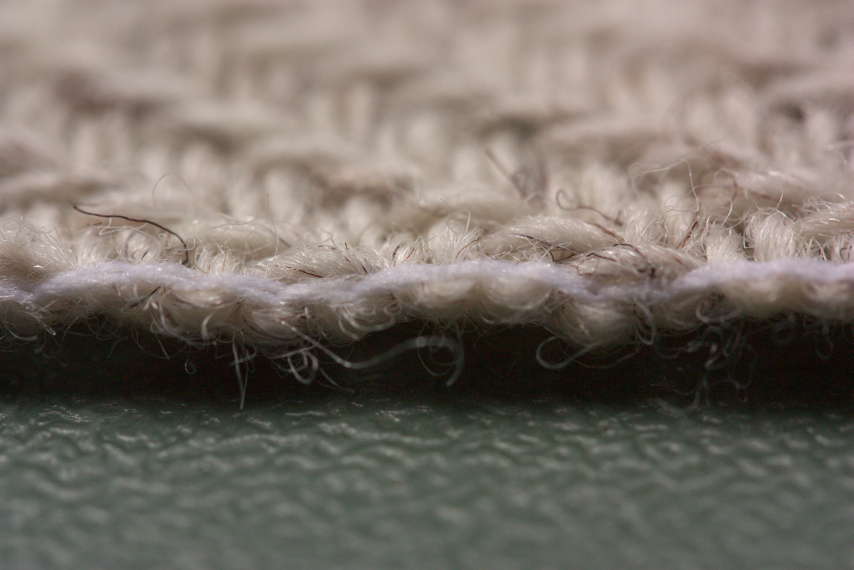
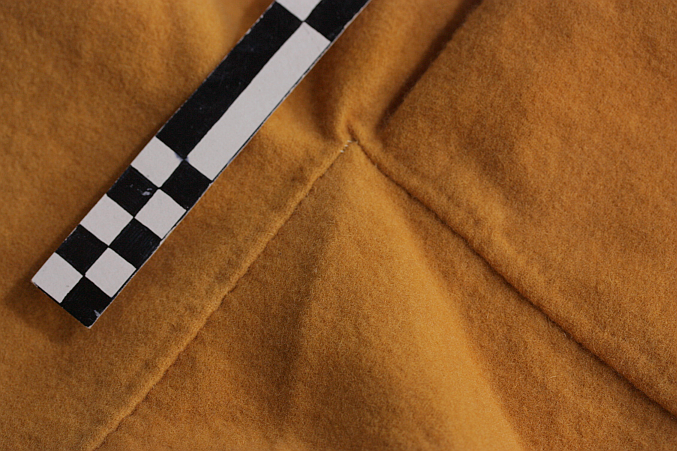
If you want a fabric that meets all the criteria of a historical fabric, you have to have a good old-fashioned selvedge like that. Which also explains why I'm always happy to get something like this:


That is a proper, nice selvedge; a little bit stronger than the rest of the fabric but not too different in weave or density, and there's no plastic strengthening thread added to it. You can join two of these selvedges with overcast stitch just like it was done back in the Middle Ages and be happy.

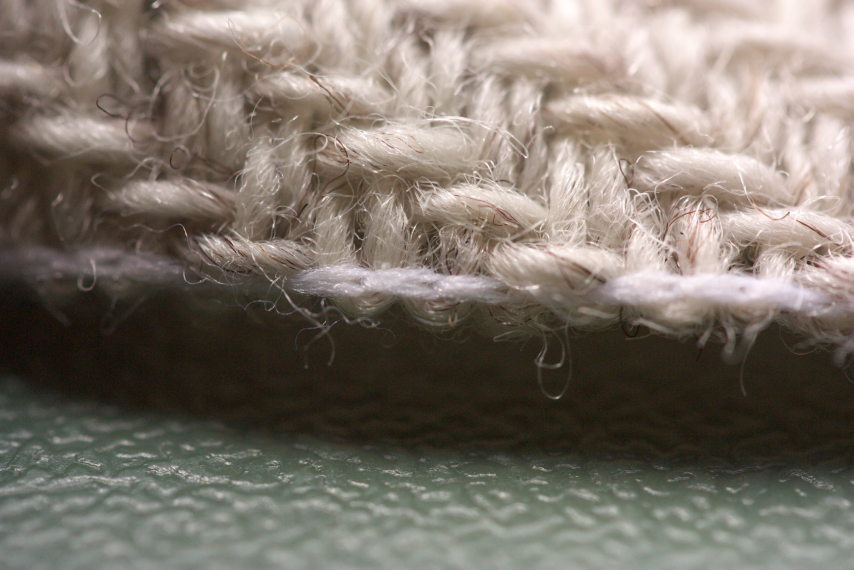
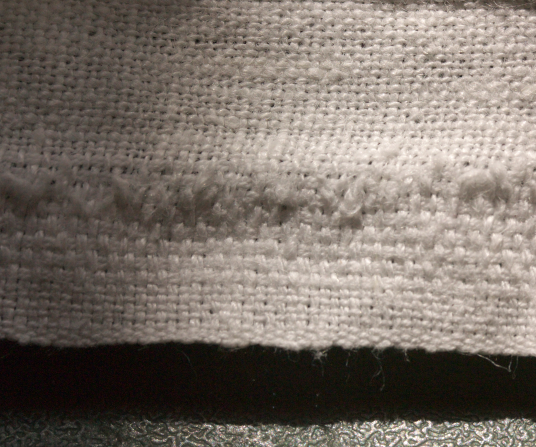
The next best thing, and a type of selvedge more commonly found in modern fabrics, is looking like this:


It's still a proper selvedge, though not as nice and sturdy, and quite wide if you don't want to have the change in weave type show on the surface. There's also often a messy-looking area between the weave proper and the selvedge, also nicely showing in this specimen here. I wouldn't join two of these with overcast stitch if the join will be visible later.

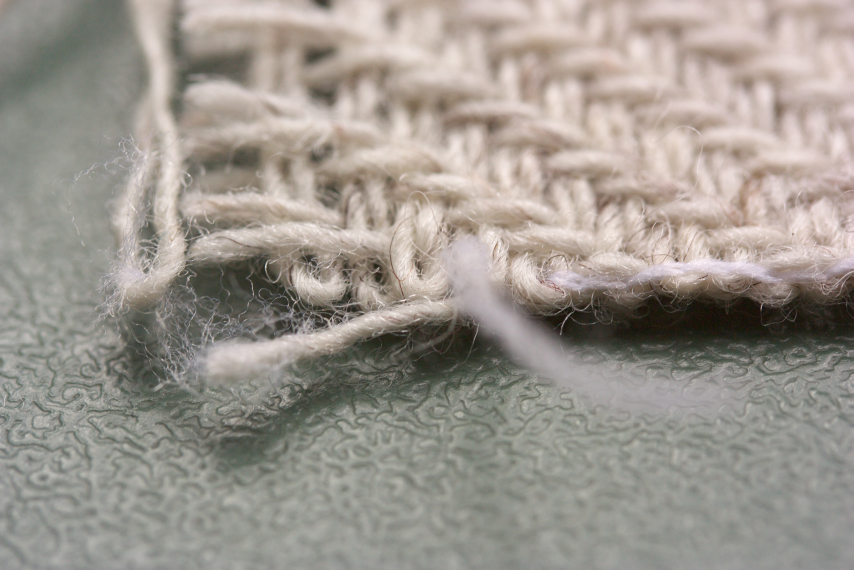
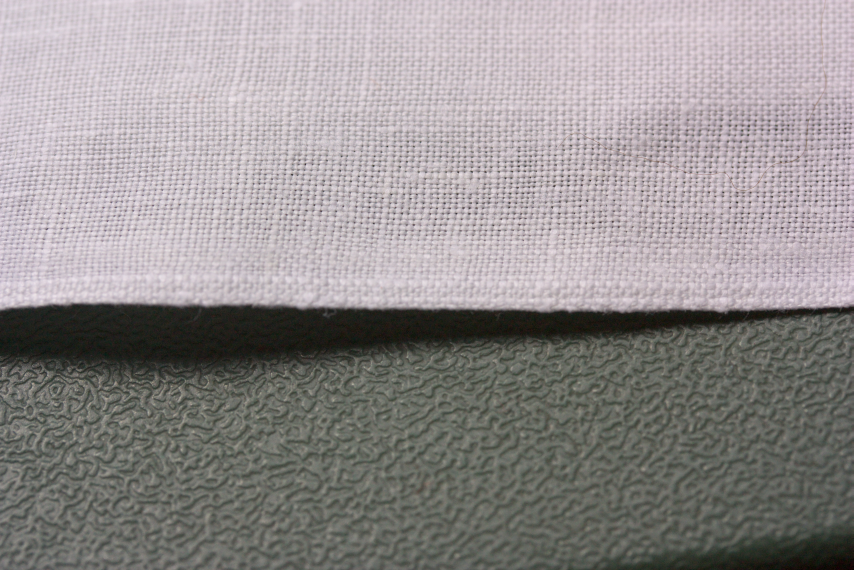
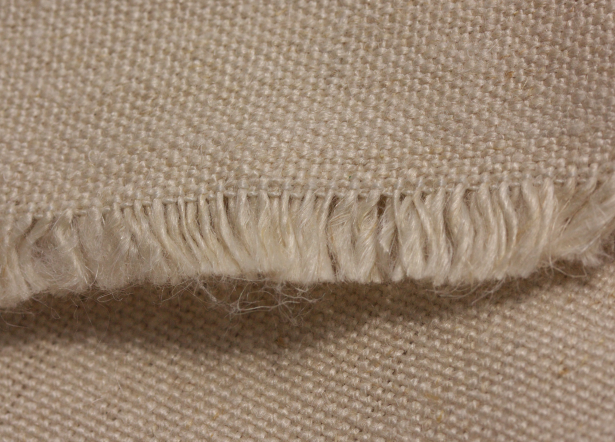
Now let's go a bit more modern, yes? Proper selvedges require shuttle looms. These old-fashioned shuttle looms are slow, and modern industry likes its stuff to be faster - time is money and so on. So there's another type of fabric edge which really can't be termed "selvedge" any more... this one.


These are done with help of jets or projectiles, requiring cut threads as the weft. These weft threads, if fine enough, can be even carried by an air jet or a water jet. The result? A very, very fast loom (these are the fastest type today) but no selvedge whatsoever. The edges are, basically, cut edges with a little fringe and maybe some stabiliser thread along the edge. If you wanted to use the selvedge for extra strength somewhere... you're out of luck with this fabric type. If you wanted it to show somewhere... same thing applies. If you were planning to cut down on your sewing and hemming time with use of the selvedge, you just got a nasty surprise. You will have to treat every edge of this fabric like a cut edge, because that is what it is.

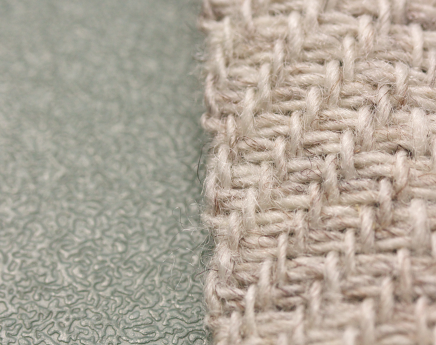
And then there's another little nasty surprise if you are looking for pure wool fabric in narrow widths. One of the two edges is a perfectly fine, normal selvedge, usually not reinforced by a double thread or anything.


The other edge, however... is not a proper selvedge. In fact, it's more like one of the cut-thread edges, only with a fold in the thread instead of the cut. The edge is held together by a fine, tiny crochet chain, usually done with a very fine thread made from man-made fibre.


It's not very obvious, and won't be visible or noticeable to most people, but it's not acceptable in case you want to have an as-authentic-as-possible equipment. If you remove the chain, you also remove the structural integrity of that edge.


If you want to have a pure wool band without that chain, though, you can take a sufficient length of the weft thread, a needle with a blunt tip and a large enough eye, remove the crochet chain and thread the extra thread through each of the edge loops. It might be advisable to remove the outermost warp thread for that, and to stock up on enough chocolate and motivation-enhancing drinks before.

Fun. Right? Thank goodness there are still some old-fashioned shuttle looms running!
0
MAI
08
0

Piccies!

Here are, finally, the long-promised pictures from the last big project - clothing for the newly opened museum at Burg Grünwald, Munich area.

I have not been there yet and have not been able to find photos, but as the museum only re-opened at Easter after extensive work on the castle and a redesign of the exhibition, that is not quite unexpected.

So you are getting the piccies I took before sending off the garments... with kind permission of my (very patient, and very lovely) models.
Let's start close to earth...


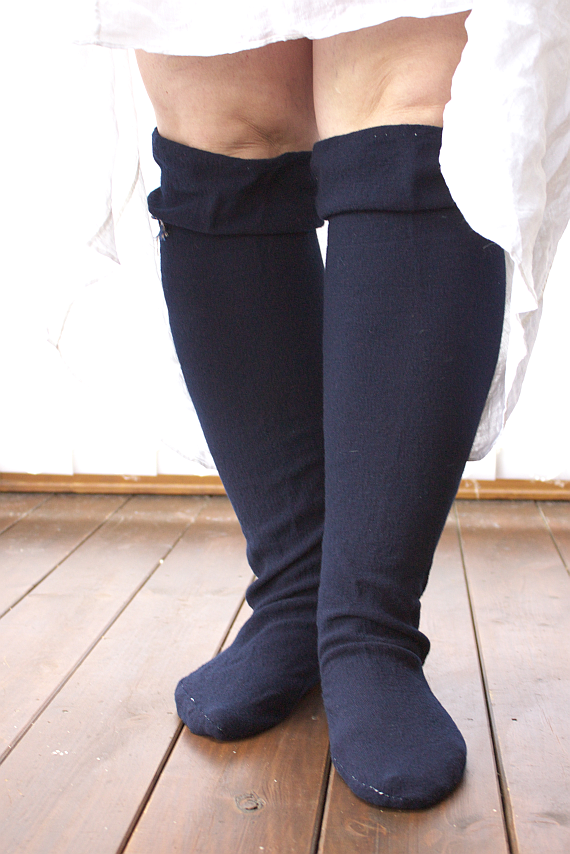
 ... midnight blue stockings for the lady, held with silk garter bands (braided) that you can't see in the picture (but they are there). That was lovely cloth and a pure joy to work with.


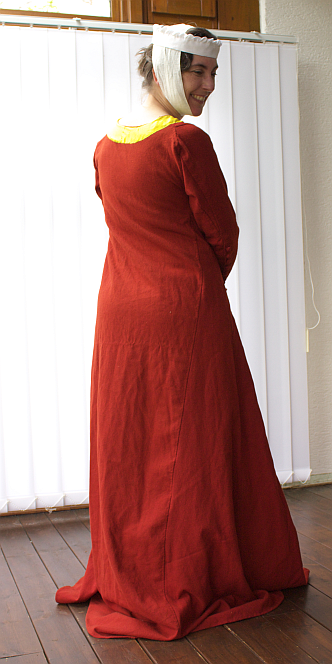
Obviously a lady has to wear more than just stockings - here is the red dress with its yellow silk neckband, and the barbe-and-fillet in the Manesse style.


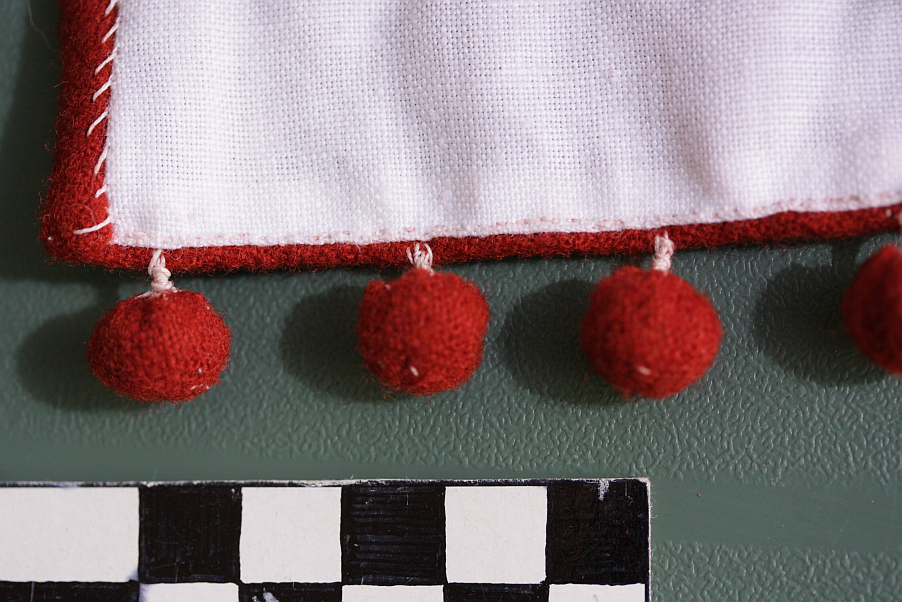
Another closeup of the buttons on the dress. I just like closeups of these guys.
 

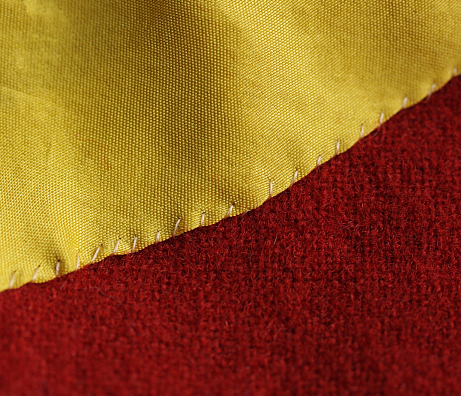
And a closeup of the seam fixing the yellow silk of the neck opening decoration. This cost me a lot more nerves than I had anticipated - but it turned out nice in the end!


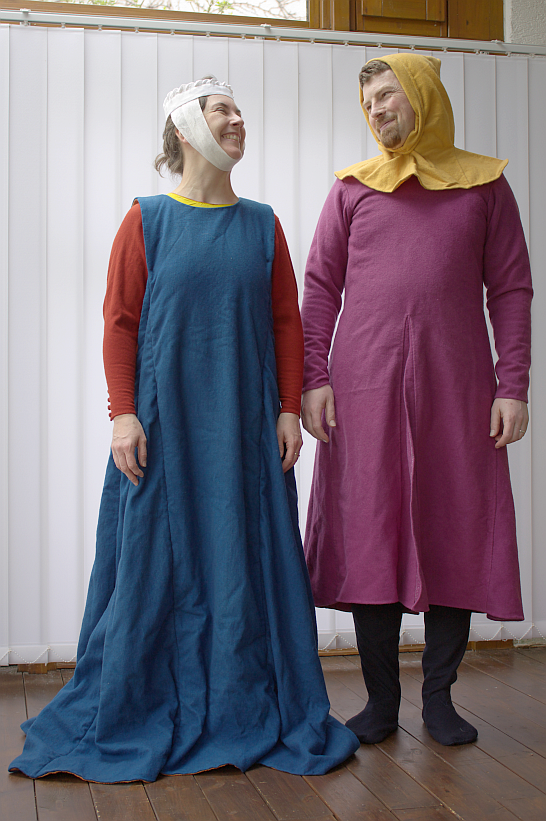
Here are both models, completely dressed with the exception of the man's overgarment, which was not finished at that time.

And finally, a few more closeups of the man's purple tunic:


... and one of his hood:


There. It did happen. Picture proven.
0
MAI
06
0

Back home!

I am back home from a nice and both relaxing and exhausting time at Freienfels. It was, as always, so nice to see all the people again that I know from, oh, ages back; it was lovely to have a coffee and a chat with friends, and to sit and enjoy the fire in the evening.

We also managed to do some shopping (because your equipment is just never complete, right?) and to enjoy some music. I got a few deliveries and some more leads on where to get special fabric, so that was quite successful.

Weather-wise, we were quite lucky, with only one day of light drizzling rain and grey skies. The rest of the time, it was sunny (though with some icy cold wind sometimes), and only the nights were freezing. Now the washing-machine is running, the cat is happy that her humans are back and is sleeping in her bed in the study, most of our equipment is already clean, dry and stowed away again - and I am back to the 21st century with its to-do lists and computers and deadlines and things to do and find out and take care of. Which I shall do, presently.
0
APR.
29
0

Ah the woes.

Collaboration can be a wonderful thing. Collaboration can add new insights, different perspectives, throw up new questions and give answers that one person alone could never have found. Successful collaboration means being able to do something you alone would not be able to do.

Collaboration, if it works well, means less work and less re-inventing of the wheel for everyone involved. More efficiency. Plus the exhilaration that comes with the feeling of, for once, not being alone. Of having someone who pulls the weight with you, that you can carry the load together.

When it goes badly, however, having agreed on a collaboration means nothing but headaches, and heartaches, and the exact opposite of efficiency. There's the added bit of irony that the more a project could profit from collaboration, because each person in the team has expertise and knowledge and a specialty field that has little overlap with the others', the worse it will go and the more heartache it will cause if somebody drops out or does not deliver.

I have had both - the successful collaboration (thanks, colleagues!) and being left alone by drop-outs. It's unfortunate, and bad, and sad, when a collaboration dies. Bad enough when your colleagues tell you straight out that they have to stop working on the project, for a while or forever, because something came up that needs all their time and energy to handle.
It is much worse, though, if you do not get told this. If all of a sudden, communication just... stops, and you feel like you are talking to a wall. With no echo, even. And that is what I hate most about the drop-out thing - the silence. Silence regarding all your mails, all your attempts to get some communication back. You sit there and wonder whether something has happened - an email gone astray, an address going offline, something dire in the life of the other person - or if you really are just ignored, consistently and callously. Because obviously you don't even deserve a short mail saying "I got your mail, things are bad here, please go on without me, sorry."

I know, much too well, that sometimes one bites off more than one can chew. And I believe that either you manage, somehow, to deliver after all - maybe a bit later, maybe a little less elaborate and less brilliant work than your best - or you should own up to not being able to do it. Hell, there's nothing wrong with being honest and saying "sorry, I can't do this now after all". It is unfortunate, and sad, but it is at least some communication and a clear message, and either the project of the collaboration will then die a quiet little death or those remaining in the active team will know that they have to either leave that part of the field untilled or do the work themselves. Letting the others hang, not knowing what goes on? That's unfair.

Having been let hanging rather recently by more than one person, in more than one project, I am not sure when I will do another collaboration. It might be a good while - I am pretty sure, though, that I will not resist the lure forever. For the next time I get into it, though, I will try to remember the following before getting started:

- Make sure you have contact data to reach everyone in your team. Full contact data, as redundant as possible - not just a single email address. Get the full address, at least one alternative email addy if possible, and all phone numbers. You might never need them, and that's fine, but if someone goes MIA - you'll be glad you have them.

- Be clear on communication policies. Also make it clear that whenever in a project that there are problems it will be best for everyone to address these honestly and straightforward - up to and including dropping out or going dormant in the project due to issues of whatever kind.

- Get clear statements on who is in and who is not, and set clear deadlines within the project so everyone will (hopefully) deliver in time.

- Get sorted out, clearly, on who is to do which task, and in what time-frame. Get this communicated to everybody.

- Did I mention getting full contact data? Get full contact data of everybody while they still speak with you. Really.

Unfortunately and as I have learned, even being clear on deadlines and on communication and handing out specific tasks to others is no guarantee at all that things will, indeed, work out. So sadly, but most importantly: Have a Plan B ready for when all this fails, and you are left alone with no communication, no help, and a half-written paper that you don't have the skills, knowledge, or even literature to finish up on your own.

In German, the English term "team" has become pretty much a standard part of our language, and we use it a lot (it's shorter than "Arbeitsgruppe" or something with a similar meaning in German, you see?).
In German, there is also an only half-joking explanation of TEAM as an acronym, standing for "Toll, ein andrer macht's" (Great, someone else will do it). Yes. Well. I think I don't need to say more.
0
APR.
28
1

Winter! In spring!

Just for your information, it's the middle of Winter here, or more like Winter almost at its end. Huh, you say, hasn't she been going on about spring and warmth and stuff for weeks? That's true. And I'm not speaking of the seasonal white-stuff-is-lying-around-outside winter... I'm speaking of the Living History Folks' special "Winter".

You know the oldest and most common joke of LH people, right? "Ah, I'll fix that in the winter". Said "winter" often turns out to be the one week before the first event of the next season - which means someone saying "I will do that in the winter" sometimes gets to hear "And what else have you planned for that week?"

So, season's start is on Thursday, and I will be there. Which means I have less than three days to finish sorting my clothes, restocking my basket of goods, figuring out what to pack, and (most important) take care of all the deadlined and urgent things that are not yet taken care of.

One of these, by the way, is my (still not successful) attempt to source a thread in tabby, 10 threads per cm, white and undyed or naturally grey, not fulled, in garment weight. It would be perfect (I know I am being unreasonable with that) if it were made from high-twist single yarns that are not Merino wool... but I will settle for a cloth that is not perfect. It seems to be almost impossibly difficult to find such a cloth. (If you know of a source, please let me know.)

Well. Off to work, then... Winter's almost over, after all.

(This post should have gone online yesterday, but somehow got stuck as a draft. I'm sorry.)
0

By accepting you will be accessing a service provided by a third-party external to https://pallia.net/

Kontakt