Latest Comments

Guest - Aislinn Dyestuff Citizen Science.
09. Oktober 2026
This is a great project. I look forward to the results. Thanks for letting us know.
Guest - Aislinn Time for...
09. Oktober 2026
Looks delicious!
Guest - Katrin Sprang Discussion
18. September 2026
Hi Rachel, I have looked for more photos of you, but that was not very successful. I found a link on...
Guest - Beatrix Sprang Discussion
15. September 2026
That lozenge pattern element is not a photograph, but a scan. So it should be to scale. But I pinned...
Guest - Katrin Sprang Discussion
15. September 2026
I was not referring to Rachel's reconstruction (is the reconstruction you refer to the one photograp...
FEB.
26
2

More from the hood.


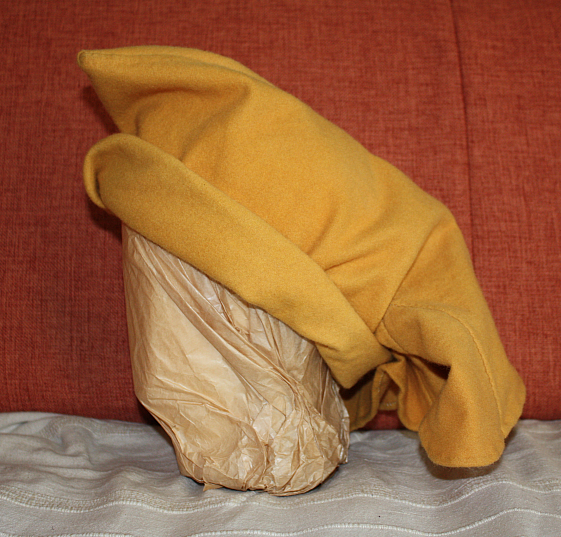
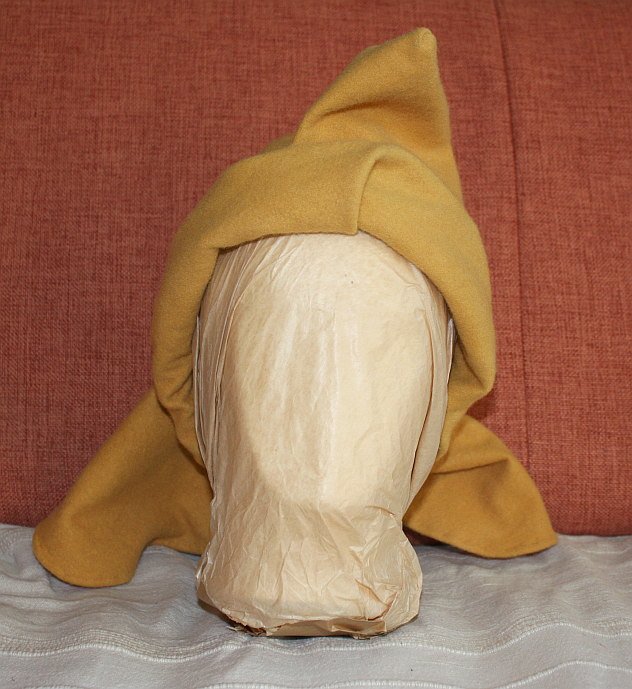
Here are, as promised, the other photos from the finished hood. It's placed with the head opening on my demo head - a popular way of wearing hoods in the late middle ages.


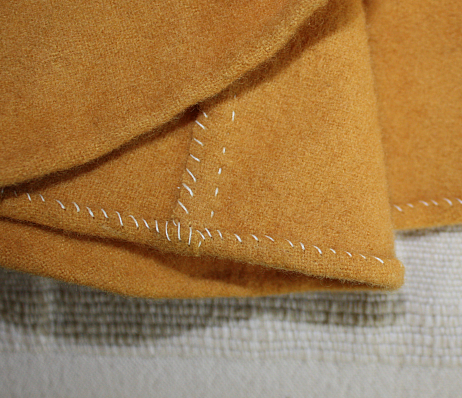
The wool is a lightly fulled tabby, dyed with weld (reseda luteola) and a tiny smidgeon of madder (rubia tinctoria). The seams are running stitches, and the seam allowance is folded to one side and secured/neatened with hem stitches, in some places folded apart and secured to both sides of the seam, also with hem stitches.


The cut is oriented on the hoods found in Herjolfsnaes and London, with a shorter "cape" part than, for instance, the Bocksten find hood.

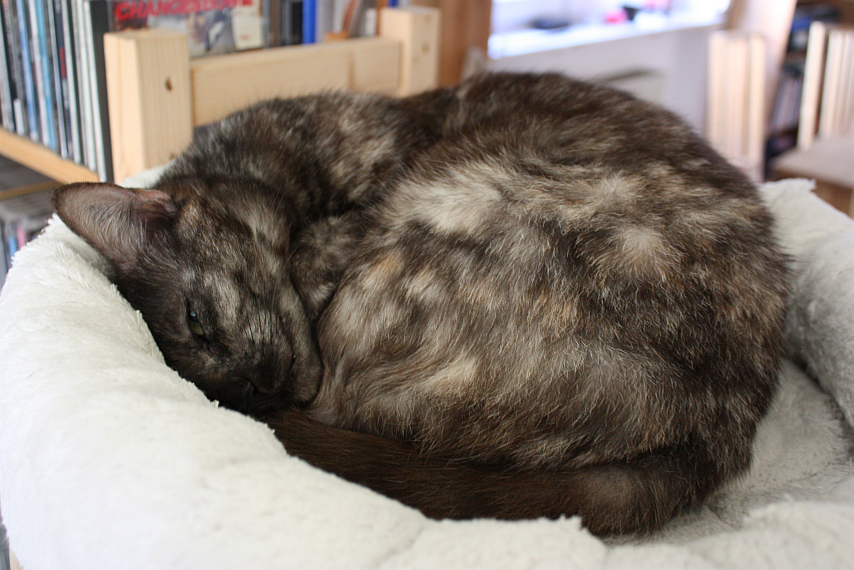
And also: Gratuitous cat pic.


0
FEB.
25
2

Spring is coming.

The sun is shining outside, and while it's still cool in the morning, it gets warm soon. How wonderful to sit in the sun with some coffee and some pleasant work, and do things!

Before I get to go sit in the sun, though, there are a few books that want my attention. Tea and computer, thus, for now; coffee and sun and comfy chair and sewing stuff, later.

Also? Meet the newly finished hood, made from plant-dyed wool cloth, sewn with linen thread, cut in 14th century style:


Just a detail for now, since the blog refuses to upload the other pics. But hey, you'll get your gratuitous cat pic tomorrow, then!

0
FEB.
21
0

Poor little neglected blog.

Back when I was young and foolish, I thought that making an offer for something was easy and quick.

No. Actually, I did not think about it (and why should I?). I didn't even know the difference between an offer and someone telling you what it would cost, approximately. Then I started my own business, and I learned.

One thing I learned is that the more items you have, and the more variations you have available, the longer it takes - and not only a little bit longer. The time needed increases very much non-linearly. Add to this the need to obtain samples, test techniques, source materials, and find the right suppliers for things... and we're not talking a few hours, but more like weeks until a packet of possibilities is done, finished, and embellished with the appropriate price tag. And there's hours going into all that, plus into the necessary research to clear up details as well.

For now, I've got a big block of offer-related work off my desk, which is also the reason for this late blog post - I was so caught up in finally wanting to finish the thing that I completely forgot the time.

So. My stress levels are up, as are my caffeine levels, but the big list is done and now I can relax for a bit (and get back to my sewing work). That was the third request for an offer this year with a time-frame for making the offer that was, uh, let's call it "less than generous". Mind you, I'm not blaming the people who requested the offers - textile stuff and the scope in getting all the information you need is often underestimated in its complexity and time-eating-ness, just like the
textile work itself is often far underestimated. In addition, I know all too well that in many cases time just is that short, and it's no fault of those planning and requesting, since they often have a schedule imposed on themselves as well, and the way things are, that schedule is in all probability also way less than generous. I'm happy to be asked for an offer, and I am excited to do the research and handle cloth samples and try to find the best solution for everybody for these projects - it's the work I love.

For you, though, just in case you should have a bigger project that includes historical textiles to plan for one day, such like a museum exhibition or something similar, and you know it well in advance - please get to planning the textiles, and asking for offers or proposals or at least getting in contact with your prospective textile workers straight away. It may be that you could have the perfect fabric for your plans - but getting it woven takes a few months. Even getting to the point where you find someone to weave something historically correct for you, bespoke, and get a quote for that can take several weeks to a few months! So everyone is served better if you get into contact as soon as you can - you will have more choices, the crafters will have more fun and less stress, and you may get the extra dollop of research as well.

(Same will apply to other crafts, too. Let your crafters know well in advance. We love to offer you choices and discuss them and find the best possible solution together with you - but that, you guessed it, takes time...) 
0
FEB.
20
4

To search on or to stop, that is the question.

When researching, it happens again and again: You run into a dead end, or something that feels like a dead end. That can be due to so many reasons - there's little or no literature about it, you have found about everything there is, or the literature is all really dated, or the topic has only been looked at from angles that don't help for your own project.

And regardless of when you start and how long you planned to research, there will be a point where you are going to stop, or have to stop. Because you run out of time, or out of energy, or both. Because at one point, everything needs to be finished, or it will start to drag you down. Obviously, that cutoff point is coming faster when you are starting with little leeway in regard to time or energy... and I hate it. I don't like to stop, so it can be really hard for me to draw that line and say "no more". Yet that is essential - it's the art of hitting that sweet spot between getting everything you can while still not wasting too much time. You get a similar phenomenon in a lot of design work, where the last 5% of the work tend to eat up 95% of the time. And I've had it time and again that a jackpot turned up when I had already inwardly scolded myself for still going on though it was clear that nothing more would turn up. That's not making it easier to stop.

It's also not made easier by the fact that these searches usually turn up more interesting stuff from the sidelines. Like this article about how tannin and iron dyes eat up fibres. Or this one about identifying dyestuff (unfortunately behind a paywall).

Or the complete original Plictho by Rosetti. Now if only my old Italian were better...

(I'm looking for the bit in the Plictho where lead is mentioned in regard to dyeing textiles. Anyone have that thing handy?)
0
FEB.
19
0

Cooooffeeee..... coooffeeeee...

I spent a good while sewing yesterday, and also poring over the sleeve problem that turned up on the current project dress. I've found, since I have done the attempt at reconstructing the medieval tailoring technique used for dresses such as St. Elisabeth's dress, that my typical method works less well with some body types. I have stumbled across this phenomenon again these days, and now I'm trying to tweak the method so it will accommodate them all. (Insert evil laughter here.) I'm not totally sure on how I will test-run this tweaked method, but cometh the time, cometh the idea.

I also need some coffee now, since there is lots to do but my energy levels this morning are a bit low. (Surely this has nothing to do with my sleeve-tweaking test right after hopping out of bed.)

In other news, also sewing-related, there's a challenge that I have heard about several times now: the "Historical Sew Forthnightly Challenge". Apparently, not only Cathy, but also VixHQ are participating. This led me to go and peek at the challenge list... it looks really nice, it does. If you are looking for a bit of external motivation for your sewing projects, that might be just the thing for you. For now, though, I have stuff to sew that might fit into the challenge, but is work stuff - and that would somehow feel like cheating to me.

Finally for today, here's an article about the use of hemp in Scandinavia, published in nature - you can download the full article for free, and I highly recommend it, as it covers the "linen" terminology problem.

0
FEB.
14
2

Friday!

(I just learned something new about blogger: when you insert a post title, then press return... it publishes. Does that mean I'm supposed to write the title after the text? Novel idea!)

I woke up to a gazillion emails this morning. I also woke up to the very nice and accomplished feeling that only the prepared edge for buttons (or button-holes) can bring:


The basted line has come out, in the meantime. The other line is stab stitches (Punktstich, for the Germans). It's a time-consuming stitch, but it makes the firmest, neatest, and most pleasing edge for anything that gets stress - such as button closures.


And that's the back of it. Lovely, innit?

(I am known to freak out in delight about stab stitch edges. Call me weird... but only after you have seen, and touched, a properly made one and did not freak out with delight yourself.)
0
FEB.
12
2

Tea, anyone?

I'm sitting here with a nice cup of tea, a sleeping cat beside me, and a stack of (library) books to go through for several different projects. The quote I was still busy with yesterday is sent off, and I have a list of questions for the other one, so there's progress on that front.

There's also progress on the sewing - I have tested button sizes and decided on one, and the dress needs one more short fitting session to check and do some last markings if necessary, and then it's down to making the actual seams and hems to replace the current basting. Oh, and button-making, of course.

(If you are curious about how I make cloth buttons, I've made a post about that before - the last time I was making a bunch of them for a museum dress.)

I'm looking forward to the button-making. The thought alone of a little stack of little beautifully red cloth squares, sitting on a table waiting to be stitched, linen thread and wax lying ready beside the needle... it makes my fingers itch. Buttons... buttons are fun.


0

By accepting you will be accessing a service provided by a third-party external to https://pallia.net/

Kontakt