Latest Comments

Guest - Aislinn Dyestuff Citizen Science.
09. Oktober 2026
This is a great project. I look forward to the results. Thanks for letting us know.
Guest - Aislinn Time for...
09. Oktober 2026
Looks delicious!
Guest - Katrin Sprang Discussion
18. September 2026
Hi Rachel, I have looked for more photos of you, but that was not very successful. I found a link on...
Guest - Beatrix Sprang Discussion
15. September 2026
That lozenge pattern element is not a photograph, but a scan. So it should be to scale. But I pinned...
Guest - Katrin Sprang Discussion
15. September 2026
I was not referring to Rachel's reconstruction (is the reconstruction you refer to the one photograp...
APR.
19
2

The Colour Dilemma.

As the longterm readers here know, I frequently work together for all things textile with Sabine from the Wollschmiede, my dyer of choice.

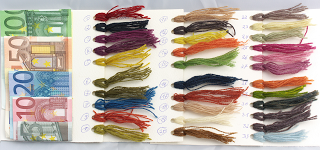
Sabine has been working on colour sample cards for her range of colours this winter, and she is currently at sample colour 68 - with more to come in the future, if I know her at all. And she is now getting the first requests for sample cards.
There's a problem, however. Making a sample card takes yarn - and time. Especially time. And providing a sample card or even a full set of sample cards with the full range would be keeping her from other work - and would have to be quite, quite costly.

The obvious solution is to have a digital photo version of the cards, just like a lot of other shops have, where you can download a photo or a .pdf file to see the colour range. But if you have ever taken a look at one of these, you also know the typical disclaimer - your monitor colours may vary, and there's no way to be sure that the colour you see will really be the colour you get. (Well, apart from the obvious slight changes to colours from dye lot to dye lot regardless of whether you do natural or chemical colours.)

This is due to the nature of the colour system used on monitors. The RGB system has three colours, red, green and blue. Mixing these can get you all the other colours (or at least enough that you won't miss any). You can also adjust your monitor settings - there's usually a menu somewhere in the system settings where you find three sliders to change the values (the saturation) of the three colours. (If you want a longer, in-depth explanation, you can find one here at Wikipedia.)

So while your monitor might not show all the colours correctly initially, it is technically possible to adjust the settings to at least get a good, if not perfect, match. High-end monitors and graphics professionals use a calibration device to make sure that what they see is what they will get (even if they print it), but this is of course not feasible for us ordinary mortals.
Now, if I'm only taking a photo for myself, I can always place something colourful that is mine beside the thing and then adjust the monitor (or the colours in the picture) to match my colour-matchy object. But if the thing is to be sent out... that makes things a bit more difficult.

So Sabine and I thought about things, and I finally found a solution. It's the low-key approach (in German, I would jokingly call it a "Hausfrauenlösung" - the housewife's solution, something that is simple and practical yet very effective). The colour match addition to the photo. Something that almost everybody that will be interested in getting the colour sample cards for an order from Sabine will have, or be able to obtain at no additional cost. The Something available almost everywhere in Europe, where it's used in thousands every day. The Something that comes in blue, red and orange as well as two shades of green (one more easily available than the other). The Something with colours fixed and stable enough that it should be possible to get a good match - or at least see how realistic the colours displayed are.

Euro notes.

So here I present to you the Money Matching Scheme for the colour sample cards - and if you like, give the colour adjustment a try and let me know if it worked for you!


0
APR.
15
4

Do you know Sewer's Block?

Do you? No, I don't mean the nasty clump of crud clogging the pipes. I mean Sewer's Block as in Writer's Block - only with sewing work instead of writing.

I think there must be something like it - because yesterday, I finally overcame the hesitation to work on my dress (that has to be finished for Freienfels, because I want to wear it there). Since my upper body has changed a bit during the last two years (damn you, more-or-less-regular gym visits!), combined with shrinkage of cloth in some of the garments, some of my old dresses do not fit so well anymore. That means it's high time for another of St. Elizabeth's dresses to fit me, and I have a gorgeously teal-coloured fabric for that. So I was looking forward to making a teal-coloured dress for a while, until I finally found the time to sit down and start working on it. And then, halfway into cutting... which I have done time and again before, with no problem... I stopped working on it for a while. Procrastination Wave hit me.

Admittedly, it hit me together with a stack of more urgent things (because you know the effect that season start is always soooo far away, right? until it's just, all of a sudden, like, next week?) so it was not a blatant ignoring of the half-cut dress. Not totally, at least; the more urgent things really were more urgent. And since there was no actual pressure, as would be in a time-critical situation (like season starts tomorrow) or similar, I could just put it aside for a while. But after the embroidery workshop in Vienna and finishing the spinning project, I really ran out of reasons not to work on the dress just now.

So I sat down with it yesterday, I cut the second sleeve (that was already marked out) and set it in, I cut the sleeve gores and set those in, I tried it on, and everything is as it should be. And now I'm wondering why I didn't do this oh, weeks ago? More importantly, I'm wondering whether that only happens to me occasionally, or if there are others out there.
Sewer's Block, anyone? And what do you do to get over it?
0
APR.
13
0

Sheep Farming

Nicely in tune with my wool spinning blog post yesterday, there's a link to an article on medievalists.net today - about medieval sheep farming.

I've only taken a short look at it yet, but it promises to be a very interesting read - a report based on data from pipe rolls:

The Winchester pipe rolls provide sufficient data to allow an examination of five areas of policy associated with medieval sheep farming. These are the provision of sires; the construction and maintenance of sheepcotes; the supply of feed to the sheep; the supply of medicaments and veterinary expertise; and the supply of labour devoted to the care and well-being of the flock.
(p. 140).

If you're interested, here's the medievalists.net page with the link to the .pdf file. The article is by Mark Page, published in Agricultural History Review 51:2 (2003), and called The Technology of sheep farming: some evidence from Crawley, Hampshire, 1208-1349.
0
APR.
12
3

Fair prices for handspun?

A while ago, I mentioned that I've done a bit of wheel spinning again for a change. After a long while (felt like forever) of spinning to more or less fill two bobbins with single, I'm now in the plying stage.

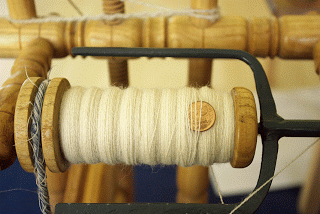
This


is what it looked like after two hours of plying work. After three and a half hours of plying, the bobbin was more than full - it had a bulge in the middle. (Of course I forgot that I wanted to take a picture. Only natural to grab the swift right away, right?) The result is 595 metres of 2-ply yarn, and it's roughly about 28 wraps per inch. Since I gave it a soak right away to relax the fresh ply, I can't weigh it yet, since it's not completely dry this morning.

However, the plying time has made me think about pricing of handspun yarn again. Six hundred metres of yarn took three and a half hours of plying. If I do a very rough calculation and suppose that spinning took one and a half times the work time of plying (I'll time a bit of spinning next time), then that means roughly fourteen hours of work total. That is one and a half workdays for sixhundred metres two-ply! And that's wheel spun with industrially prepared merino wool, so no additional prep time required plus a relatively fast and efficient spinning tool.

Fourteen hours work - now what would you pay for a skein of handspun wool like that? Probably not my normal hourly rate times fourteen, and my normal hourly rate is not very high at that. And if you look at etsy or dawanda or any other shop, stall or market, you can see handspun yarn roughly half the length offered up for less than 20 Euro. (Oh, it's hand dyed as well.) Spinning rates seem to go up to a stunning 20 cents per metre - but you can have it cheaper, too.

Now, my little wheel is not the fastest one on this earth, and I'm not trying to spin as fast as humanly possible. But let's do some maths. One hour spinning and plying time taken together will let me end up with about 42 metres of two-ply yarn. If I sell that for 20 cents per metre, I will end up with the stunning sum of 8,40 Euros for one hour of my work. Plus the material needed - and I also need the tool to work with, of course. So let's say eight of the Euros remain as "winnings".

And now there's the snag. While 8 Euro per hour might sound not too bad at the first second, what you technically are as a spinner is... a freelancer. And that means you will have to calculate so that you can pay everything yourself - your health insurance (where usually your work/your boss will pay half, if you have a fixed job), your working tools, your stockpile, your vacations; you will need to make enough money so you can cover the times you are ill or some time off that you need to recover and recharge your batteries. Oh, and maybe some day you wish to be old and pensioned? Go pay for your own pension account, then. And if you make enough money for all of that, keep in mind that you will also have to shunt off the VAT from your selling price - and that's between 15 and 21% in Europe. (In Germany, those 8,40 Euros would mean 7,05 Euros for you.)

That is much, much too little money for that work. Ask any freelancer. Go read any freelance advice column, or webpage. And too little money for work - that's not healthy, and it's not good for the economy nor society. Plus too little money for textile work also furthers the underestimation and the undervalueing of this line of work that is so widespread today.

So... provided every spinner around that sells his or her own handspun yarn (and I'd bet it's mostly female spinners here) doesn't work at least three times faster on their spinning wheels than I do... they sell their work under price. Vastly under price.

That always leaves me more than a little sad. Hand spinners, please value your work correctly!

This blog post was the starting point for a series about fair pricing in crafts. Read the start of the series here.

0
APR.
08
0

Random-ish updates.

I spent most of the workday yesterday getting back on track with the website relaunch that I had prepared for oh, ages ago - new design, new texts, full German and English version. And then it had taken a backseat (think extralong passenger train backseat here) to all the other things going on.

The good news is: I had some nice progress yesterday. And the bad news... there's still a good heap of work to be done on it.

And now to the randomness part, because if I don't write all those random things here and now, I'll have forgotten about them on Monday.
My IMC Leeds programme arrived - and I was really wondering what I would be getting from the UK in book format. Goodness, it's huge! I already knew the conference was gigantic, but a full book just to list the sessions and papers? That really is a little overwhelming. And since I'm a fan of whelm and sometimes even overwhelm, I'm so looking forward to this thing!

It's really getting summery outside, and there's a few patches in the garden that need some urgent de-weeding. But the rest all does fine - we'll have a lot more of the good mint this year than last year, the first tulips (two real and a lot of small wild ones) are already in bloom, and my little tomato seedlings are also coming along very nicely.

The Spinning Experiment Results article is almost finished and sent off to colleagues to give it a read-through - so I'm happily waiting for their feedback now.

And some of you probably remember my post about the medieval underwear from Lengberg a good while ago - there's now been a little TV snippet about it. It will stay online for a few more days on the ORF page. The snippet you want is titled "Tiroler Tanga". The plugin doesn't work for me, unfortunately, so go enjoy it for me!

Update: There's a little arrow on the top right of the video frame - click on that to view it with an external player (windows media player or the like). That will work even if the plugin doesn't.
0
APR.
06
0

Back from Austria.

I'm back home from a wonderful trip to Vienna - and now I'm relaxing a bit from the hustle and bustle of the last few days before I sit down to do a few necessary things.

Vienna has two drawbacks, if you ask me: One, it is much too far away; and two, it is much too big. Well, I don't mind the latter so much unless I have to go from here to there in the car. But driving in Vienna... uh. It's huge, there's lots of traffic, and there are sometimes very creative road layout details that can really surprise an unsuspecting person.

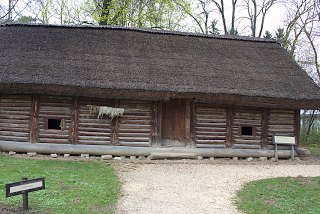
Apart from interesting routes in Vienna and a wonderful workshop with highly motivated participants - that bravely fought their way through brick stitch and couched work - I had lots of coffee, some gorgeous chocolate cake, delightful chats, a heavenly mushroom risotto with garlic bread one evening, and generally lots of fun. Oh, and a little field trip to the museum in Asparn where we'll have the Textile Forum in September. Though I had planned to take a lot of photos there, I sort of did forget while I was on site - but at least I took one picture of the house that will be ours for the Forum week:


And we will be next to this gorgeous reconstruction of a celtic sanctuary:


I'm already looking forward to September - I'm convinced we'll all have a wonderful time in Asparn!
0
APR.
01
0

Busy busy.

I'm busy as a bee this morning, with all the usual last-minute packing and sorting for a workshop to be done. The printer is churning out my workshop papers right now, there's a goodly sized heap of stuff sitting here waiting to be carried into the car, and I'm all but chomping at the bit to go. And really, really looking forward to getting people to play with gold thread, plant-dyed silks and the best quality linen I've seen in ages. Good materials - good feeling while working.

Since I'll be far from here (why can't Vienna be closer to home?) and will be there some days - a meeting for Textileforum is planned for Monday - there will be no blogging until Wednesday next week. However, if you're in Vienna or close to there, you can stop by on Sunday evening, when there's a little "bazar" starting at about 18:00 in the Tympanum (Eulenspiel) in Prinz-Eugen-Str. 6 in Vienna. You will be able to shop in the book assortment that Gregor from buchportal.at is bringing, as well as browse my collection of odds and ends connected to historical textile techniques.
0

By accepting you will be accessing a service provided by a third-party external to https://pallia.net/

Kontakt