Latest Comments

Guest - Aislinn Dyestuff Citizen Science.
09. Oktober 2026
This is a great project. I look forward to the results. Thanks for letting us know.
Guest - Aislinn Time for...
09. Oktober 2026
Looks delicious!
Guest - Katrin Sprang Discussion
18. September 2026
Hi Rachel, I have looked for more photos of you, but that was not very successful. I found a link on...
Guest - Beatrix Sprang Discussion
15. September 2026
That lozenge pattern element is not a photograph, but a scan. So it should be to scale. But I pinned...
Guest - Katrin Sprang Discussion
15. September 2026
I was not referring to Rachel's reconstruction (is the reconstruction you refer to the one photograp...
FEB.
09
1

Tidying up.

I am theoretically all in favor of things neat and tidy (and all put away into their proper place). I have a fixed sorting and packing system, for example, for my stuff that I take to market; there's a fixed place that I get the things from, a fixed spot they take up in the car (though that does regularly undergo a slight change), a certain order in which they go into the car and out of it again. And when I pack up my stuff, I know which bit goes into which basket (and you can occasionally hear me mutter the names of the baskets while sorting). This system has been established for a while, and I really, really appreciate knowing where to go for this or that, and where to put things when packing up, since it cuts down on packup time and packup stress enormously. (That's when having to fiddle is most annoying, because all you want is get everything and yourself into the car and have the journey home over with...)

However for some reason, many of my things tend not to stay in their neat and tidy place, nor the place neat and tidy. So after postponing it often enough, I used a bit of my mostly-off-day yesterday to sort through stuff in my study cupboard and rearrange its innards so that everything has its proper place again and more fits in besides that. It was actually successful, and as usually not as bad as I always picture it. There's still a bit of rearranging and sorting to do before the season start, but at least it is a beginning.

And even more of a wonder, I have actually tackled the heap on my desk this morning and taken it down considerably. And I'm sure that all the rest of the heap will also not be so bad. Which brings me to a continuously amazing (and unfortunately a recurring) thought:

How can it be that things that are not so bad to properly stow away or take care of after all, something very beneficial to the general workflow or style of life, get put away improperly again and again? Even if the person putting off to deal with it has repeatedly experienced the benefits himself or herself and knows that it would be really not so bad to just do it? Is there a genetical quirk I can blame, or do I have to shoulder all the responsibility for being slack myself?

Does anybody have an answer for this? Or, better yet, a trick to make me magically orderly and non-reluctant to do bookkeeping and taxes?
0
FEB.
07
0

Aaah.

I'm back from the weekend stint, which was very, very nice - I met a lot of wonderful colleagues again, got to use my wool beating frame (worked very well), did a fair bit of combing wool (which really trains your hand muscles) and even got to see the Staufer exhibition that is currently running in the evening.

We also were insanely lucky with the weather, with up to two-digits-in-the-plus temperatures - I did not need to put on even half of the additional warm clothes that I had brought. And to top it all off, the visitors all were very interested and very nice - so a thoroughly good work weekend for me.

And now there's the weekend-wrap-up-work left for me to do: Get all the things out of the car and stowed away in their proper spots. And after that... I'll go have a coffee with friends and check out a few books from the Uni library. And relax.
0
FEB.
04
1

Amazingly productive.

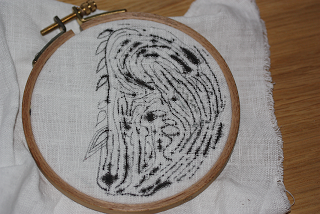
The rest of yesterday turned out amazingly productive - much more so than I would have guessed after getting a severe headache a few minutes after writing the blog. Luckily, a painkiller and a little nap took care of that, and I did finish my building project (though it won't win a prize for beauty) and even a few more bits from my list of urgent things. Plus I somehow felt inspired and curious enough in the evening to do a bit of extra work in preparation of the embroidery workshop that is planned for the beginning of April in Vienna - and I'm really looking forward to that!

And now I am the proud (medium-proud, that is) owner of a frame for beating wool. Willowing wool. Making wool fluffy by hitting it hard with slender sticks. Which is a much, much faster way to get the clumped staples nice and fluffy than teasing it by hand, and I'm really happy to give it the test run on the weekend!
0
FEB.
03
0

Prep for the weekend

Just in case that you are in the region of Mannheim this weekend and don't know yet to do with your time, I'll be at the Reiss-Engelhorn-Museum on Saturdy and Sunday together with Nobilitas. From 11 to 18 o'clock, you can not only see us at work doing historical crafts but also try your own hand at these things.
Now... it's still February, which is usually not the warmest month of the year. Weather forecasts say it will be warmer towards the weekend, with up to 10° C in Mannheim, but I have nevertheless planned to bring cold-weather-compatible work (also suitable for having others try).

Unfortunately, this cold-weather-compatible work means that I will have to build some stuff for it today. So if you're looking for me... I'll be over there, with the saw and the hammer and the drill.
0
JAN.
31
4

Archaeology of York free publications!

York Archaeological Trust has made several of its out-of-print volumes available for free download, including the volumes 17/14, Finds from Anglo-Scandinavian York, and 17/15, Finds from Medieval York. Hooray!

You can download the files from this Resources page of the York Archaeological Trust website. Enjoy!
0
JAN.
28
3

I'm working on it.

January is a good time to stock up wares, resupply and order exciting new stuff - it's already this year, April is looming on the horizon already and with end of April comes the season's start for me.

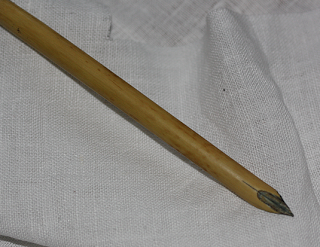
And that means I'm currently working on acquiring yet another craft-related skill: Cutting quills. Those are textile-craft-related because drawing with ink and quill is the traditional way of preparing an embroidery design, and the tools and materials for the full process of embroidery work are something that I wanted to offer for a good while.  After hunting for proper medieval ink for a good while, I have now found somebody that will make it for me and ordered some, so it's about time to hone down my quill-cutting skills.

There are several "scriptorium" suppliers on the market that offer writing implements. Quite often it's a biro tip set with a (brightly coloured) feather on top - which is about as un-medieval as you can get, since the first thing you are going to do is to cut the barbs from the rachis (I looked those terms up in Wikipedia, and so can you) - that is, you cut the interesting stuff that makes a feather look like a feather from the boring central stem. Why? Because the stuff gets into the way otherwise.
A very few suppliers also have proper quills (unprepared, hardened, or hardened and cut), but the cut ones are always intended for writing. What I need is however something else: I need a tip that will reliably (and without blotting) draw fine lines on linen cloth.

So I sat down yesterday and tried several different feathers from different birds, with varying preparation steps. And that's the result:


 I'm still figuring out what makes a cut a successful one, but at the moment, it looks as if I'm getting way better and more reliable results in cutting quills from reed than using feather quills. So what will be on sale next season will probably look like this:


I'm not yet sure whether I will test each quill or not - though I'm heavily leaning towards testing each one even if they will not look pristine and unstained on the table then.
Would you prefer unstained and untested or stained and tested?
0
JAN.
25
2

"Medieval Garments Reconstructed" is out!

Finally the long-awaited book by Else Oestergaard is out: "Medieval Garments Reconstructed" (link goes to bookdepository.co.uk). The official release date is February 2, so you can still pre-order for a few more days, but I have heard along the grapevine that some folks who pre-ordered it when that became possible have already received their copy (mine hasn't arrived yet, though).

Cathy Raymond has already posted a short first-leaf-through review on her blog. I'm very, very curious to see how the team around Else Oestergaard made the garments, and looking forward to good renditions of the original patterns (which I do hope to find in the book). I am a good bit sad, though, to read Cathy's citation of how the garments were sewn (with modern sewing machines) and especially finished - with cotton bias binding.

If you know the original publication, Woven into the Earth, you will know that the original garments are finished with exquisite care and some techniques that have been forgotten in the meantime. Those edges show wonderful detail and beautiful finishings, and of course I had to try these techniques. Since then, I have become an utter fan of stab stitch edges (you just can't beat the neat, crisp line that stab stitches give an edge) and singling finishing (invisible finishing of a cut edge in thick cloth, with no bulky folded-in bit? That's unsurpassed, really). I have become such a fan that I regularly do my very best in courses and workshops to get more people addicted to these unknown and wonderful finishing techniques - in fact, I will still keep them in the programme when it is already clear that there is not enough time for the full nine yards of programme. So knowing that a quick, modern approach with a very modern material has substituted these wonderful edgings is a real letdown for me. I can understand, however, why the team opted to do this - if you've ever tried (or had to try, because I made you) stab stitches or singling, you will know how immensely time-consuming these two methods are. Add to that the expense of time necessary for the finishing touches often applied on the original garments from Herjolfsnaes - tablet-woven edging, footweaving edges or braided bands attached to the garment edge - and you are facing a real hardcore time-sink. In my opinion, those techniques are totally worth the time invested - but they are no quick finishes, and if you are working on a deadline, they might be totally out.

So... now I hope that my copy will arrive soon so that I can get a look at it myself instead of reading other people's first impressions - and I'll post a little more about the book once I have read it.
0

By accepting you will be accessing a service provided by a third-party external to https://pallia.net/

Kontakt