







Latest Comments

Guest - Aislinn Dyestuff Citizen Science.
09. Oktober 2026
This is a great project. I look forward to the results. Thanks for letting us know.
Guest - Aislinn Time for...
09. Oktober 2026
Looks delicious!
Guest - Katrin Sprang Discussion
18. September 2026
Hi Rachel, I have looked for more photos of you, but that was not very successful. I found a link on...
Guest - Beatrix Sprang Discussion
15. September 2026
That lozenge pattern element is not a photograph, but a scan. So it should be to scale. But I pinned...
Guest - Katrin Sprang Discussion
15. September 2026
I was not referring to Rachel's reconstruction (is the reconstruction you refer to the one photograp...
AUG.
27
1

Rainy again.

Those past two weeks, we've had a lot of rain - and after a quite nice day with rain only in the evening, today's gone back to rain starting in the morning. Hey weather! That's not very summery!

In other news... there are not much other news. Yesterday's errand-running was quite successful, and now I finally have the correct version of my PhD diploma (there was a tiny error in phrasing which meant that it had to be re-done), and we bought some other things and stuff that was more or less necessary.

And now it's nose back to the grindstone, fingers back to the keyboard, and eyes back onto the spinning angle measuring stuff. Magnifying glass, here I come!
0
AUG.
26
0

Things.

Contrary to what I planned, I did some entirely different things yesterday, which was a very nice break from winding white thread onto black cardboard - instead, I tried to do some analysing; and the evening was spent partly spinning for the Hallstatt project, with net gain of about 0.7 g thread - very good outcome for the spinning time, which was 20 minutes short of two hours.

And today is another day to relax my eyes from staring at threads and reading out spinning angles, since I have several errands to run and things to do out of house. And I'm hoping that it will be so relaxing that all the rest of reading out spinning angles will go just like a breeze! (And if one of you has any tips or tricks for that... do me a favour and tell them to me.)
0
AUG.
25
0

It's the sprint to the finish.

Now at last the finish line is in sight - if things go smoothly today, the Forum Experiment analysis (the hands-on part of it, that is) will get finished.

I'm already looking forward to squeezing results out of all that data. A few steps of the documentation are still left to do, though - like scanning all the visual survey cards so that they are available for presentations and easy on-screen comparison, and reading out the spinning angle on most of the samples, but the worst and most time-consuming part will be dealt with. And in good time, since I will do a presentation of the results at Textile Forum.

In other news: Some of you might remember Hartenstein and the two knights for the exhibition there. There's something more for that museum in the air... and I'm already looking forward to lots of fun and a heap of work. Stay tuned to read more about it once details are emerging from the project!
0
AUG.
24
0

Time flies like an arrow, fruit flies like a banana.

Time really flies with insane speed at the moment, but things are also getting done hereabouts. There is not too much left to work on spinning experiment-wise - just a few spinners' samples left to wrap, measure, record and evaluate. And then I can try to squeeze as much interesting results out of that dataset as possible.

On other battlegrounds, I have tackled some uninvited private stuff too, like finding a new car insurance (our old one has crashed and canceled the policy for end of August). There is still a bunch of things to do, though - not least of it sorting through my currently quite depleted stock of wares and trying to re-stock in time for the next event. Now that is a nice reason to sort through the stock...
0
AUG.
17
0

Spinning for Hallstatt

To give you more than just text and promises of broken-off thread bits at the Forum, here are a few pictures of the spinning.

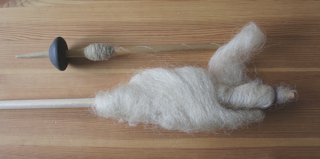
This is the single for the first of the three different plied yarns, on the spindle. That should be enough for the length required, so I will start to spin for the second ply now, with a different spindle stick.


You see the "full" (well, not really, but full enough for my purpose) spindle and the distaff with the fibre stored on it both in the picture. I will not sing the praise of the distaff now, since that would make this post explode. I'll sing it tomorrow for you.

And this is my little comparison card to check if the threads I spin are like they should be:


You can see the three different threads used in the tablet-woven band that is going to be reproduced. Thinnest of the three is the Z-ply on the right, thickest is the one in the middle. I am currently working on the leftmost, medium-thickness S-ply. The little comparison card - the white bit - is an old business card of mine. That should give you a first rough idea about the thread thicknesses.

But I'll make it easier for you. You probably know Gütermann Silk sewing thread? The one on the blue spools, Nm 100/3? Yes?

That's the extra thread meandering across the card in this picture.


I've left the first picture quite big, so you can click it and zoom in quite far. And these are original thread sizes of the thread used in the tablet-woven band.

If you'd like to find out a little more about the band, there's a tiny picture of the original at the bottom of this (German) page, and there's a German text about the project I am spinning for on this page.
0
AUG.
16
5

Wool Spinning

I have already mentioned the Vienna wooly week, and I've been busy doing some more spinning during the weekend. Those of you that know my spinning style know that I have a tendency to do thin to very thin threads, and I have my own theory why that might be as it is (which I won't go into today).

Just like with hand-woven fabrics nowadays compared to those hand-woven (naturally, since there were no automatic or semi-automatic looms) in the middle ages, there's this basic difference in "look you aim for". Today, a hand-woven fabric is usually quite coarse (to keep the price in a somewhat affordable range) and slightly uneven on purpose - because that's how you see that it was hand-woven, right? And if you buy a pricey hand-woven textile, you want people to see it is special because it's hand-woven, right again?
The medieval weaver did surely not aim for the modern irregular look, but for as smooth and even as possible. And we have the same phenomenon in spinning. I have actually been told by people that "you'll want to make your thread a bit more irregular, or nobody will see it's hand-spun". Being a good medieval-minded spinner, no, I do not want that. And then there's this yarn thickness problem, too. Most modern hand-spuns are way, way thicker than yarns used in medieval weaves - which makes the fashionable irregularity of yarn thickness possible.

If you spin a thread that, on average, contains 120 fibres at any diameter, you can easily add or omit ten or twenty fibres and still get a reasonably even yarn. If you add or subtract more - I'll just make up some number here, say 50 - you will get an uneven yarn, but one that will still hold up to the weight of the spindle.
If your starting thread contains, on average, only 50 fibres at any diameter, you don't want a thinner bit with twenty fibres less - that will break your thread because it cannot support spindle weight anymore - and you don't want a thicker bit with twenty fibres more, because that will really show up as a slob. Which means the thinner you spin, the more even you have to spin, because every weakness will show up and every slob will too.

Fighting occasionally with my yarn while spinning those deliciously thin threads used in the Hallstatt bands, I have meditated quite a bit about irregularities. Not letting slobs occur will take quite an amount of concentration, and so does not making thin and thus weak spots. I work with a comparatively heavy spindle, since I like to know that each individual thread in the final 2-ply will be strong enough to take some tension.* The thread coming out of that process is insanely strong and elastic compared to a same-thickness plied yarn made of commercial merino wool** and really, really beautiful to behold - but very slow work. Really slow work. I manage to spin about 0,5 grams of fibre in one hour, and that's fibre spun in the grease, and with the accompanying amount of dirt and dust coating each fibre.
Slow work that needs full concentration, meaning I have to be fit, there needs to be good light, and I don't spin for more than two hours at the very most in one day - but it is very satisfying work as well!

*I have spun on light spindles that many people prefer for thin threads, but I don't like the insecurity - I much prefer to have the spindle earn its name from time to time... and don't tell me that you never thought about why it's called a "drop spindle".

** which finally converted me to an absolute lover of old sheep races
0
AUG.
13
0

I'm back again!

I'm back after having a wonderful time doing all sorts of things: Going on a summer holiday and spending almost three delightful weeks getting stronger legs in pleasantly cool weather (read: cycling trip in Northern England), with a market right before leaving and a market and workshop right after coming back.

And then I spent a wonderful and very educating week in a place close to Vienna, where I met two dear colleagues for a full week and we did fibre preparation tests and spinning tests for four old-style sheep fleeces. That was a wonderful experience and I learned a huge lot about wool prepping for spinning. To top it all off, I get to spin threads for dyeing tests and a reproduction of one of the famous Hallstatt tablet woven bands - so there's spinning work being done here for the next few weeks. Yes, weeks - I don't spin all day, but rather only an hour or so, it is quite a lot of thread, and since the thread thickness of the 2-ply yarn is only about 0.2 - 0.3 mm, it is slow work as well.

And that's not the only thing being done here at the moment - rather (as usual after some time away) I have a huge to-do list with lots of exciting but time-consuming items on it, one of them finalising the spinning experiment analysis and putting it all into words, graphs and pictures for the upcoming talks about it - one at the Textile Forum, which is also drawing near at an insane speed, and one at the OEGUF conference in October in Vienna. Plus there's some other projects coming up, in different stages of pre-planning. And thanks to the many days away from home, I am feeling energised and happy to tackle all these things again. Heap of work, here I come!
0

By accepting you will be accessing a service provided by a third-party external to https://pallia.net/

Kontakt