Latest Comments

Guest - Max Mustermann The True Cost of Driving a Car.
06. November 2026
Great breakdown — the non-fuel costs are exactly the bit most people forget when they compare cars. ...
Guest - Harma Phew. Now it gets involved!
21. Oktober 2026
Have fun at these events.
Guest - Aislinn Dyestuff Citizen Science.
09. Oktober 2026
This is a great project. I look forward to the results. Thanks for letting us know.
Guest - Aislinn Time for...
09. Oktober 2026
Looks delicious!
Guest - Katrin Sprang Discussion
18. September 2026
Hi Rachel, I have looked for more photos of you, but that was not very successful. I found a link on...
JUNI
15
4

Back home...

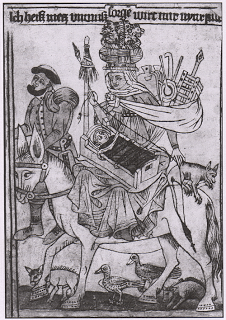
I'm back from our little vacation and working my way through the list of e-mails that arrived during the last few days. While I'm busy getting both my real and my virtual household back into working order, you can amuse yourselves with this picture of a medieval wandering household, complete with baby:


The image caption says it's jugglers/artists travelling. It's a coloured xylograph, single-leaf prints from about 1450. Today at the Herzog-Anton-Ulrich-Museum, Braunschweig.

What I really like about this picture is that it shows a lot of medieval household items. You can see half a kitchen sticking out from the woman's carrycloth around her back... and as a true multitasking female, she's not only travelling, keeping all the household stuff, looking after the livestock (see the chickens on her head?) and looking after the baby, she's also spinning at the same time. Amazing. And modern folks say there's a lot of pressure on women nowadays...

Source: UITZ, ERIKA: Die Frau im Mittelalter. Wien 2003. Page 102.
0
JUNI
08
1

Feeling lonely?

It's been ages since I last posted about the Textilforum, so it's high time. And I have a reason, too: We have extended the deadline for registration to June 30. There are still some spaces left for participants at the museum, so if your occupation includes historical textile crafts - research, reconstruction, analysis, conservation, replicating - you are welcome to join us at the Forum. We also need a few more handspinners (handspindle only) to make the required twenty that we need for the spinning experiment. If you are a handspinner and able to spin an even thread for two hours, you could be part of this nifty bit of science!

If you don't know what I'm talking about: The Textilforum is intended to get people working with historical textile crafts into contact with each other - because it can be a very lonely affair. So we would like to link both professionals and amateurs (like living history folks) in this Forum, where there will be ample time to work, chat, and exchange hints and tips with each other. There will be some programme provided - presentations about research or projects in the evenings - and we'll run an archaeological experiment, the spinning experiment, during the mornings. The rest of time is free; think "gigantic enormous conference coffee break".

You can read more about the Forum on our website, www.textilforum.org, and you can also register there: Go to Call for Papers site, and on the bottom, you will find the link for registration. See you in Eindhoven!

Oh, and you can read me here again next week - I'm off for a few days' vacation, before summer work stress really hits...
0
JUNI
05
0

Productivity things

Yesterday I had to spend some of my work time away from the computer, which resulted in a ginormously long list of things to do - and now I'll see how much of it I can tackle and cross off today, before the week is over. And this has led me to think about productivity and productivity-boosting.

Today I have actually managed to try out one of the productivity hints floating around over the internet: Don't read email first thing in the morning. I think I'll give this another try on Monday, because working for an hour straight before looking into the mail the first time really feels nice - like having achieved something already before taking care of the important and (many more) not-so-important mails. And who would mind a bit more productivity?
0
JUNI
04
1

Feeling expensive today?

I'm feeling like something classy and really pricey today. So here's something for those that feel like me: A fabric photo of so-called "St. Elisabeth's Cloak". It is a silk and gold fabric, woven probably in Sicily, 2nd quarter 13th century. It's in a Elisabethine convent in Klagenfurt nowadays.
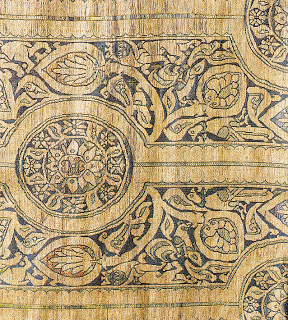

I'm amazed again and again by cloth like this. Something made of rich gold-and-silk must have been worth a fortune, or several fortunes, and still it was woven, sold and made into garments. In some cases, there has been so much gold in old garments that it could be "recovered" from church garments after secularisation - by burning the cloth.

And, as usual, using finer threads or costly materials isn't the only thing for "upgrading". Instead, the fine, expensive materials are usually connected to more work, more complicated patterns - even if halving the thread thickness would already mean more work time, because of four times the number of threads.

But then, textile work seems to always rise exponentially when going finer or more complicated. Thinner threads for weaving? Much more work, regardless of loom type (and it is also true for tablet weaves). Smaller mesh for netting? Much more work. Thinner threads for embroidery? You know the answer. Add an extra pattern weft? Guess what happens. Braiding with fine threads? Uuuuh, takes ages. And it doesn't start with handling and manipulating threads - it starts with making them. Spinning fine will mean more time needed to spin for the same amount of fabric - because half the thread thickness means four times the number of threads. And then, spinning fine makes reattaching the spindle after a break more difficult; increasingly difficulty with thinness. I've tried to go as thin as possible, and sometimes it takes several tries after the thread broke to get a good connection between spun and unspun again. So it really pays to spin a little slower and with more concentration - and once more, it takes longer.

It's the same every time you go "finer, thinner, more" with textile: Work time does not scale up proportional to thread thickness. And that's something to keep in mind when looking at historical textiles, too.

Picture source: TROPPER, PETER (Hrsg.): Hemma von Gurk. Katalog der Ausstellung auf Schloß Straßburg/Kärnten, 14. Mai bis 26. Oktober 1988. Klagenfurt 1988.
0
JUNI
03
2

Oh, do we have a video?

For the exhibition next month in Bad Staffelstein, we have planned to install a TV somewhere in the rooms and show some video snippets of textile techniques there - because if you've never seen a handspindle before, you can probably not imagine how it looks being used and how it works. So today is the day that we will make the video for the snippets - thank goodness for friends who are always helpful!

I'm planning to do spinning, netting, tablet weaving (showing some twill sequences) and a bit of fingerloop braiding. I hope we can get all this done, and I have to get buzzing now to prepare everything so it won't take too long to change technique.

And I still have to decide whether to wear modern or medieval clothing...
0
JUNI
02
0

Business as usual.

Today's blog comes a little later than usual - not because I forgot to blog, but because I had to take care of some other things first after the long weekend.

I'm currently working on the translation of my thesis summary, so that the German book has at least an English summary. There's still a bit to go, and after translating, I'll need some proofreading, but it is progressing nicely. Apart from that, there's not much exciting stuff happening at the moment, at least not in the work part of my life - things running more or less smoothly, if a bit slowly sometimes...
0
MAI
29
3

Netting Needles, hooray!

I've been busy with some scheming, and it looks as if I'll be able to teach netting soon in the future. We have found some material to work netting needles that does not involve hours and hours of hammering a thick rod down into a thin rod, and thus needles can be made that won't cost a fortune. The first two of the new generation are still unpolished but about finished otherwise...

Beautiful tools, made after a proper source (an archaeological find from London), to spread again knowledge about an old, beautiful textile technique - what's not to love?
0

By accepting you will be accessing a service provided by a third-party external to https://pallia.net/

Kontakt