Latest Comments

Guest - Max Mustermann The True Cost of Driving a Car.
06. November 2026
Great breakdown — the non-fuel costs are exactly the bit most people forget when they compare cars. ...
Guest - Harma Phew. Now it gets involved!
21. Oktober 2026
Have fun at these events.
Guest - Aislinn Dyestuff Citizen Science.
09. Oktober 2026
This is a great project. I look forward to the results. Thanks for letting us know.
Guest - Aislinn Time for...
09. Oktober 2026
Looks delicious!
Guest - Katrin Sprang Discussion
18. September 2026
Hi Rachel, I have looked for more photos of you, but that was not very successful. I found a link on...
FEB.
18
0

Blog Carnival!

I got stuck reading a gazillion of medieval and medievalism-themed blogs yesterday evening by following the link to the last s.

In case you do not know it yet, Carnivalesque is a blog carnival (something like a showcase for interesting blog posts), alternating between early modern (from 1500 to 1800) and ancient & medieval (until 1500).

The next Carnivalesque is due for February, 21, and it is hosted by Notorious Ph.D. Now I'm off to look for my favourite medieval-themed post to nominate, before it is too late.
0
FEB.
17
2

Hairnets, part I

I like hairnets. I also like making them - it is a nice thing to do with the hands, without much thinking. My nets, however, are a far cry from some of those medieval ones that are still extant.
A lot of people know the nets found in London - with mesh sizes between 3 and 9 mm, depending on the net. But they are really simple.

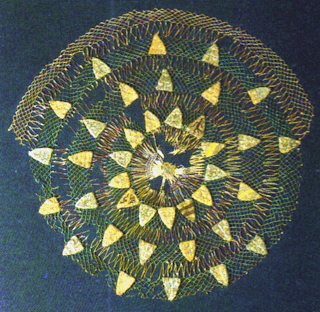
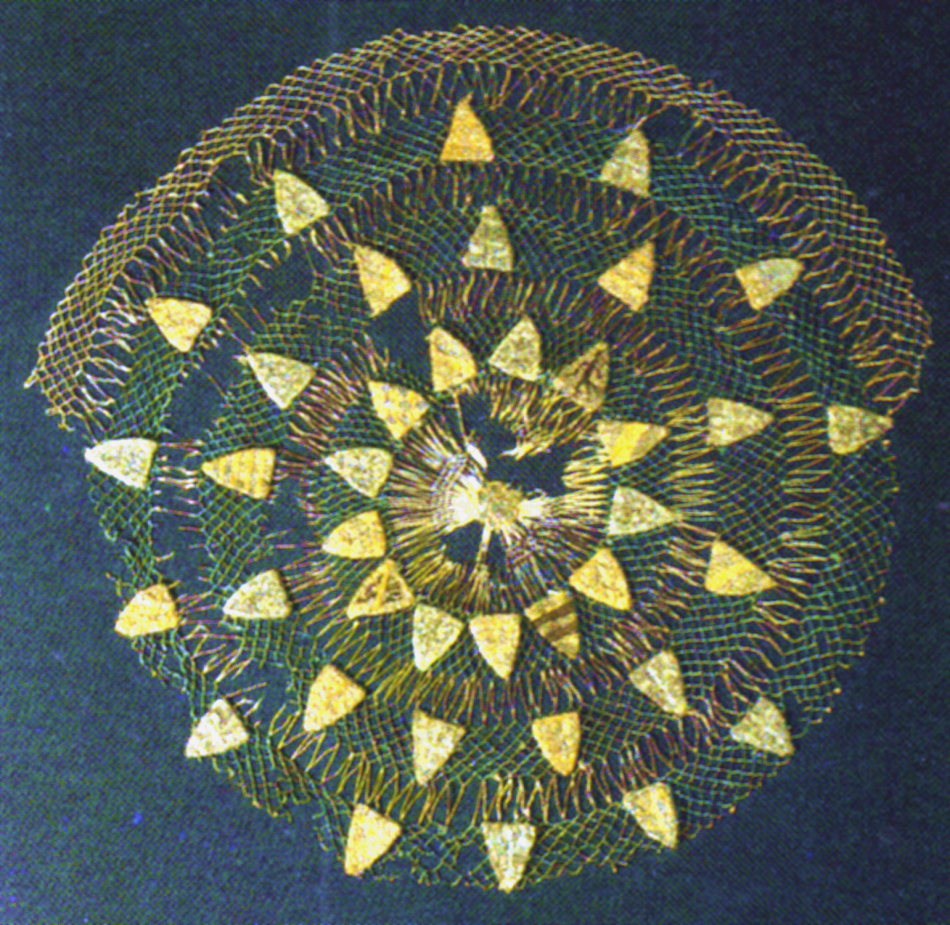
Now take this one, as one of the not-too-elaborate nets. We don't know where it comes from, unfortunately, since it was bought via art trade, but it has been dated to the last quarter of the 13th century. Nowadays, it is in the Art Museum in Düsseldorf.

(picture clickable for larger version)


Diameter is 33 cm, and it has been worked in green and white silk. I had to tune up the colours on the scan, and now it should be easy to see where the green and where the white silk was used. I would have expected the small, embroidered shields-with-arms on a white background. Shame on my modern mind - green it is. The arms are embroidered in spun silk and gilded silver wrapped around a textile core. The ground for embroidering was coarsely woven linen. Some of the arms have been identified: there's six times Sayn and eight times Geldern, pointing to the Middle or Lower Rhine region. The net might have served for a wedding or proposal ceremony. In addition to the 38 arms, there's a little six-petaled rosette in the middle of the net.

The netting should not be too hard to do, using two different-size gauges for the long white and the small green meshes. My rough estimate is 3-4 mm for the small green mesh and about 1.5 cm length for the long white mesh - which is "not very small" for green and "exceptionally large" for white. It would be very interesting to see it close up, and in good detail, to see whether it was worked in spirals or in rounds, and whether the colour thread not in use was cut off or just led down for the next colour change. Any odd joints caused by this could be covered up easily with the embroidery bits sewn on later.

Source for the net picture and information: FANSA, MAMOUN (Hrsg.): der sassen speyghel. Sachsenspiegel - Recht - Alltag. Beiträge und Katalog zur Ausstellung "Aus dem Leben gegriffen - Ein Rechtsbuch spiegelt seine Zeit". Bd. Beiheft 10, Band 2, Archäologische Mitteilungen aus Nordwestdeutschland. Oldenburg 1995.
0
FEB.
16
0

How is that with timing?

Somehow, work with due dates seems to attract other work with similar due dates. While I was not exactly ahead of schedule, I was not too much behind either - until last week, when some additional writing work with a due date came up. Yes, I got a good start on the addition already, which helps.
Still, now I am behind schedule - so no long, elaborate blog post for today!
0
FEB.
13
0

Grocery Box

A few weeks ago, we made an order for something that feels like an everyday adventure to me: We subscribed for an organic produce box. A smallish company in our region offers home delivery every week, with an assortment of fruits and vegetables, organically produced - and you can even opt for regional vegetables only, which leaves you with truly seasonal food.

I love this box. First of all, there's less grocery shopping to be done: We still buy the few things we use in larger quantities, potatoes and occasionally onions, at our normal grocery store. But the big deal about shopping for fruit and vegetables, for me, was always choosing. Having to decide between produce that was grown locally or imported in - or between buying imported food or nothing at all, in some cases. Then choosing what to get. The things well-known, with the preparation down pat? Or something else for a different taste (that might not please)? Since I am one lazy bugger, I ended up on the familiar grounds most of the time.

That is now a problem of the past.

While you can opt out for some of veggies or fruits you don't like, the subscription box will arrive, and there's probably something new in it from time to time - just what I had wished for. They even add a sheet of paper with information and a recipe suggestion for the more exotic things. Before the box, I was looking for recipes in the internet to get inspiration on what to buy. Nowadays, I'm just googling the main vegetable ingredient I want to use and browse through the hits until I find something that sounds appealing. Which has added a touch of adventure to cooking - exactly what I had hoped for. And there is much difference between "not buying something" and "canceling an order for something" - though I usually check a week before what we will get. (Because I'm also very, very curious.)

Is it cheap? No. Our grocery bill has gone up significantly with the box - but so has the amount of fruit and vegetables consumed. And the quality of the foods way surpasses what we can usually get, each and every single piece. There's even a refund should something have gone bad inside, unnoticed by the handlers.

Is it convenient? Well, yes and no. Yes, because the time spent in grocery stores, produce aisles or farmers' markets is cut down to or close to zero. On the other hand, you have to be there when they deliver or have an arrangement, perhaps with a neighbor to receive the box for you (and hand back the empty one).

Is it worth it? In my opinion: Totally. Which is why I write about it here (instead of about medieval garments like I'm supposed to).
0
FEB.
12
3

Word Count vs. Character Count

I've been wondering a long time now about the differences in the writing guidelines in Germany versus those in other (English language) countries.

Did it ever strike you as curious that in the English language, the length of texts (maximum or minimum) is given in words - as in "this novel is complete at 100,000 words", while German regulations for submission are given in characters - as in "no more than 40,000 characters"*.

And so I find myself writing a short and a long text with character count "not more than" in both cases and I wonder why there is that difference. After all, there are long and short words in both languages, and I'd suspect that when the difficulty level of the text rises, so does the average word length. So why count words? Is this better possible in English than in German? Or is it some "historical reason"? Or do the Germans just want it that much more exact?** And why does MS Word include a character count, but not a (complete) word count when that is needed much more often (since there are much more English language writers than German)?***


And, the most important question of them all: Why did I not manage to get my characters counted properly yesterday, in spite of having used "Extras - Word Count" so often before?


*I'm not using the proper German 40.000 here, to avoid confusion - but I think it is funny that 40.000 and 40,000 mean different things in English and German. Talk about confusing.

** Yes, I know, that is so cliché. But did you know that because listing these huge numbers of characters for a text can be daunting, there's a conversion into "Normseiten", standard pages, that are usually worth about 1.500 characters. Which makes those figures much, much smaller.

*** You can of course download and install an add-in for MS Word. It might be useful for you (I only have it for fun - well, mostly). You can find "Complete WordCount" at Shauna Kelly's site - together with a lot of hints for using Word efficiently.
0
FEB.
11
0

Book & Newsletter News

I am spending way too much time staring at my newsletter program (it's Birdigee's Newsletter Manager, by the way). The newsletter campaign I started exactly one week ago is coming along extremely well, and my webpage has never before seen so many people - you are all really amazing!

I have received additional mails with helpful hints, and I have also gotten requests for the table of contents. I'm looking into all of them, and I am happy to announce that I have just uploaded not only the "Inhaltsverzeichnis" (TOC), but also a snippet of the text as preview. So if you would like to have a peek into my (German language) book about medieval garments and tailoring techniques, click over to my webpage and see for yourself if you might want a copy once it is out. And if you do so, please subscribe to the newsletter to let me know!
0
FEB.
10
2

Kruseler and Hairdos, Part III

Now as promised, the problems I have with this version.

First of all, the kruseler. It consists of multiple layers (I think eight layers) of fine silk fabric, woven in tabby. It's the thin quality you can buy for painting scarves, Pongé 05. The "ruflles" consists of the selvedges of the fabric. All cut edges are sealed with beeswax.
The ruffle, to me, does not look voluminous enough. This might be due to not enough layers, or it could be possible to seal/impregnate the edges in the ruffle with (bleached) beeswax and form it, still warm, into the characteristic wavy form. The next one will be better, I hope.

Then, the hairdo. I am pretty content with how it looks on the photos (though the right "horn" has uncoiled slightly), and it is actually comfortable to wear once it is arranged symmetrically and fixed securely. And that is the snag. I find it enormously difficult to do the two lumps of hair, both securely, both similarly tight and starting from the right spot. Then these two horns have to be pinned to the head. I have a lot of experience nowadays with the simple, u-shaped pins that have been used in the middle ages (and are still available today, thanks to the powers that be), but while the first one is always more or less agreeable, the second horn invariably droops. Or wanders. Or uncoils, if it is really cross.

So while putting up the hair in this way is technically no problem for me - the motions for making the horns are easy, and the single-roll-on-back-of-the-head version of the updo is one of my staples (and I wear my hair up all days, all the time, with only a handful of exceptions a year) - it is still a problem to get it symmetrical, and both twin horns secured firmly. That is probably something to come with practice, but the updo without the veil looks pretty... hmm... let us settle for weird, and the same is true for modern eyes when worn with the veil. And that is the reason why I am not running around with this updo every day. (Plus it won't fit under a bicycle helmet.)

And last of all problems, the pinning. Kruselers worn on the pictures are shown either with a rounded look or with an angular look (the one I'm aiming for). While both can be achieved with changing the hairdo, I haven't yet found any pins shown on the kruseler paintings. Some way of holding the veil to the head must have been used, and I'll assume it was not hot glue straight out of the glue gun. So the big question is: Where and how was the veil fixed (pinned, probably) to the hair? Or was there some other solution? I have had lots of problems, and I always need several tries, to find the right place and right angle for the (bronze) pins to really hold the veil, and for more than some seconds. And it's not only holding it down: the veil should cover the hairline on the forehead, show some of the hair bump beneath and then fall down in a nice, straight line.

I'll happily try out suggestions the next time I wear this, so please shoot!
0

By accepting you will be accessing a service provided by a third-party external to https://pallia.net/

Kontakt