
Latest Comments

Guest - Katrin Sprang Discussion
18. September 2026
Hi Rachel, I have looked for more photos of you, but that was not very successful. I found a link on...
Guest - Beatrix Sprang Discussion
15. September 2026
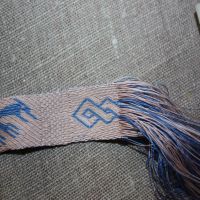
That lozenge pattern element is not a photograph, but a scan. So it should be to scale. But I pinned...
Guest - Katrin Sprang Discussion
15. September 2026
I was not referring to Rachel's reconstruction (is the reconstruction you refer to the one photograp...
Guest - Beatrix Sprang Discussion
14. September 2026
There is something Rachel did not mention. She told me: "Well, I worked with the measurements we too...
Guest - Katrin Sprang Discussion
14. September 2026
Well, this is certainly developing into an interesting discussion. Firstly, going from that lovely l...
MäRZ
10
1

News from Cologne Archive

For those of you who can't read German, here's a short summary of the News from Cologne's homepage:

One of the two missing men has been found dead, but there is still no trace of the 24-year-old student. Search for him is going on, but there seems to be no hope; the tracking dogs have been exchanged for tracking dogs trained to find corpses. Since the desaster has been seven days ago, it would need an enormous stroke of luck for him to survive. About 70 helpers are doing their best to help the specialists. Unlike the heap of rubble of the archive itself, the collapsed houses are unstable, hindering the search and making it very dangerous.

Recovery of the archive material is also done with a lot of hands - and some good news for a change: Some of the objects are in a surprisingly good condition; firemen have recovered a steel locker with old seals almost undamaged. During the night, there have been about 150 persons working to save archive material, including many archivists.
Cologne Fire Brigade says they want to try recovering all the archive material and will not quit before this is done. First predictions say that work on the archive ruins might take up to one year.

And finally, a short video of the place and rescue work:


Link: rheinvideo.de
0
MäRZ
09
0

Cologne Archive is in ruins...

On the 3rd of March, the archive of Cologne collapsed. About 18 kilometres of books, manuscripts, letters and documents now lie in a huge crater in Cologne city - most of it probably mashed to a pulp. Many old documents are lost, and with the damaged paper that can be recovered, a whole generation of paper conservators will find work enough for the next twenty or thirty years.

This leaves me speechless. Go google for news about it and mourn. In the Middle has already posted about it, too.
0
MäRZ
02
0

Conference Time!

I'm on the conference about colours in the middle ages, "Farbiges Mittelalter" in Bamberg. The conference will last until Thursday, but since I'm a bit stressed right now, regular blogging will resume next Monday.
0
FEB.
27
2

Hairnets, part III - Lacis basics

Let's say you could not resist the temptation and started netting yesterday. Now you'll need to know how to do the embroidery, right?

The stitch used for the bird motifs is called linen stitch, because it emulates the binding most commonly found in linen cloth: tabby. It is simple darning, first filling in threads in one direction. Then, in a 90° angle to that, you weave the thread in with your needle, alternately going over and under the threads already in (including the threads of the meshwork).

In case you have never tried darning in this way before, you can have a look at Thérèse de Dillmont's instructions, straight out of her wonderful book "Encyclopedia of Needlework". And if you don't know her book yet, consider getting a copy - either an old one, or one of the reprints. Or go for the online version at encyclopediaofneedlework.com. In any case, don't miss out on this book: If I could choose only a single book for textile crafts to keep, it would be this one.

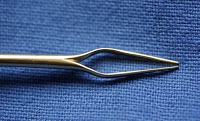
Bonus pic: The netting needle tip, without thread on.

Clickable for larger view
0
FEB.
26
0

Hairnets, part II

Hairnets. Yes.
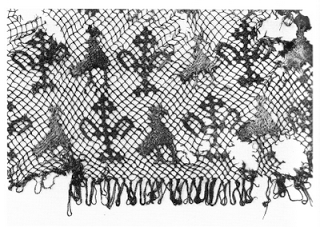
Should you feel that the actual netting of rather large mesh is just not enough, even when combined with a bit of embroidery on cloth to sew on later - you can always do some embroidery straight on the mesh. Lacis, or filet lace, or however you want to call it, has a rather long history. The even ground made by the meshes of the net is a good groundwork for embroidery and allows for a nice contrast between open mesh and filled-in mesh.

A nice example for this is this fragmented net from the 13th or 14th century, with origin in West-Europe. There are two larger fragments and some smaller fragments preserved, with the largest piece measuring 13.5 by 43.5 cm. It is made from red silk for the knotted ground and embroidered with yellow and white silk.
picture clickable for larger version


On the bottom right side the large fragment has larger loops of thread, measuring 1.1 cm. The regular mesh size is 4 mm. If I read correctly, the red silk is dyed with madder, yellow was done with weld (Reseda luteola). The embroidered motif consists of alternating white birds and flower motifs, maybe fleurs-de-lis. Embroidery was done in rows, and three rows are still preserved. The flowers are embroidered by stitches around the mesh threads, while the bird motifs fill in the open mesh squares, using linen stitch.

With rather sparse embroidery, on a mesh that is a whopping 4 mm size, this would be a nice starter for your medieval hairnet collection, don't you think?

By the way, medieval silk nets really have small mesh sizes in comparison to later ones. A pattern book for lacis by Therèse de Dillmont is available on the net (German version of "Filet Guipure": Part 1 and Part 2), and she offers thread weight advice for mesh sizes between 7 and 11 mm.

Source for text and pictures:
DECONINCK, E., GEORGE, PH., DE JONGHE, D., Y., VAN STRYDONCK M. J., WOUTERS, J., VYNCKIER, J. und DE BOECK, J.: Stof uit de Kist: De Middeleeuwse Textielschat uit de Abdij van Sint-Truiden. Leuven 1991. Catalog Nr. 107, page 354.
0
FEB.
25
4

Come on, you must be hungry!

At least after you read your way through the recipes listed on Medieval Cookery. And there's even a blog to go with the site.

If you are at all interested in medieval cooking, go check it out (but have something to snack on ready). There's even a forum, so you can connect to other cooking enthusiasts, should you be one. (Yes, kuechenmeyster. I know where you will spend the next hours. Like they said over at phd comics, in the now defunct blog: "We're not working, so why should you?")
0
FEB.
23
0

Netting Needles, part II

These days, I am in netting needle heaven. I have gotten the most wonderful, enormously gorgeous needle for my birthday, and it is breathtakingly beautiful craftswomanship.
I'm sorry that I can only give you a picture with the needle wound with thread, and thus you won't be able (yet) to see the wonderful finish of the passage from shank to tips - but this is my "no brains needed" craft, and I could not keep from winding it again the evening before taking the photos, when it had run empty.


It is made from brass, after one of the London finds given in "Textiles and Clothing", and it works like a breeze for my normal mesh size of about 4 mm. I'd like to try my hand at smaller mesh sizes one day, but first I will enjoy this utterly wonderful netting needle with the fast-to-work larger meshes, currently on a net that was inspired by the twocoloured one I blogged about here.


Here you can see the mesh size. I tried a new version of casting on, but I had a few problems with it, so there are some irregularities in the net especially in the first few rows. After the long cast-on loops, there are five rows of normal-sized mesh, then one row for doubling the number of meshes. After that I am now continuing with red thread (madder) for a while - I still have to get a feeling for how much thread on the needle will last for how many rounds.
In the picture below, you can also see my normal gauge, which is a shashlik stick shortened and smoothed with fine sandpaper, resulting in the 4mm mesh size.


I have a free day tomorrow (hooray), so the next blog post will be on Wednesday - have a good time until then!
0

By accepting you will be accessing a service provided by a third-party external to https://pallia.net/

Kontakt