
Latest Comments

Guest - Max Mustermann The True Cost of Driving a Car.
06. November 2026
Great breakdown — the non-fuel costs are exactly the bit most people forget when they compare cars. ...
Guest - Harma Phew. Now it gets involved!
21. Oktober 2026
Have fun at these events.
Guest - Aislinn Dyestuff Citizen Science.
09. Oktober 2026
This is a great project. I look forward to the results. Thanks for letting us know.
Guest - Aislinn Time for...
09. Oktober 2026
Looks delicious!
Guest - Katrin Sprang Discussion
18. September 2026
Hi Rachel, I have looked for more photos of you, but that was not very successful. I found a link on...
MAI
05
0

More Alpirsbach.

About everybody who has done reconstruction work on late medieval legwear and used the Alpirsbach pattern as one of the sources has mentioned (if they have written about it, obviously) that the crotch as drawn on the pattern will not work.

I can confirm. It's too pointy, so that you will have the full length for the crotch drawn in on the pattern, but it is not usable in its full length - the little pointy point will be pointless, you could say. So why did I go for the pattern style anyways? Well, because a) I wanted to see how it did not work, and b) I didn't want to make something up before having an idea of what to make up.

I have now changed it to a sort of narrow U-shape for the second leg, and it looks much better. 

I have also mapped all the long and short seam allowances so I can do the felled seam in the right direction. And I have cursed (frequently) my choice of test fabric, which is rather heavy and stiff and needs some wrangling to work with the relatively narrow seam allowances.

Yes, this will be just enough to fell. No, it's not enough to be nice and easy... but the original seams were relatively narrow, too.

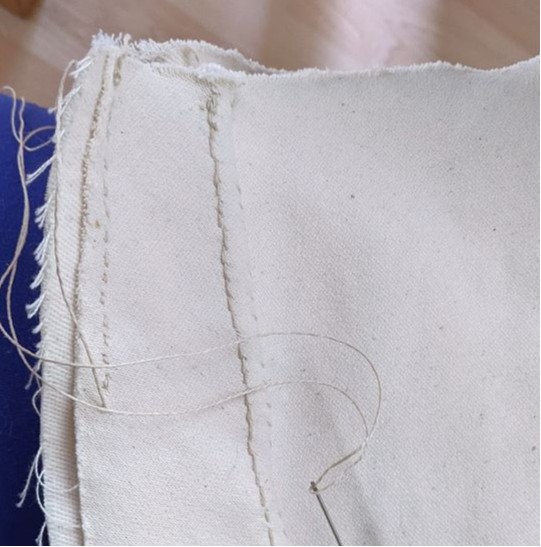
One leg is sewn (though not hemmed) all the way down, the other halfway, and the butt seam is in (that's the one being done in the picture). They have a tendency to twist around the wearer's legs, which is a little weird and may be a) normal and totally okay or b) something that will turn out to be not so good, and will need an adapted pattern making process in future iterations. But it might also be one of the reason why these hose were footed: So that the seam stays where it's supposed to stay. 

Now the only step left (apart from the feet, and finishing the long seams) is to figure out the final version of the codpiece, and cut, sew, and install that. It will also be very interesting to see if the thing really stands nicely on its own or whether it needs to be filled with something.

All very interesting : )  

0
MAI
04
0

Up next...

Things I did on the weekend: Relaxed, hung out with friends, pottered a little in the garden, did some sewing on test hose, and dabbled in some website troubleshooting (a friend's page is down, and we're trying to resurrect it).

I've also managed to order the threads for the sprang workshop I will give in June, and am now pondering on whether to do the setup of the sprang threads together with the participants first, or whether to do the setup prep here so they can get started straight away, and learn how to set up the frame towards the end of the workshop. I am currently leaning toward setting up here, but I'm not fully sure yet. Also there's only about 68 or so more rows to go on my Lengberg cap sprang piece, so it does look like I can have it finished soon enough to free up the frame for the workshop. Yay! It also looks like the lower piece will not be as nice and smooth as the upper one, and they will both run longer than the original fairly crazy tight one.

Up next: Finish the test hose, finish the sprang piece, test the new threads for the workshop. Also finish the updates of my webpages (the cms running them does need updating once in a while). 

And I have still not found out whether there will be a possibility to send internationally without registering in every country once the new EU regulations go into place. I will also probably not be the only one wondering, and not knowing for sure. If there is no de minimus threshold (as in "you are so small we won't even bother looking at you"), a lot of vendors will probably stop sending things internationally.

Which means that in case you are in the EU, and you were planning to buy something from a small fry outside your own country but inside the EU - maybe do it now, or at least soon, and do not wait until August, when this new regulation will take hold. 

0
APR.
30
1

Long Weekend Ahead.

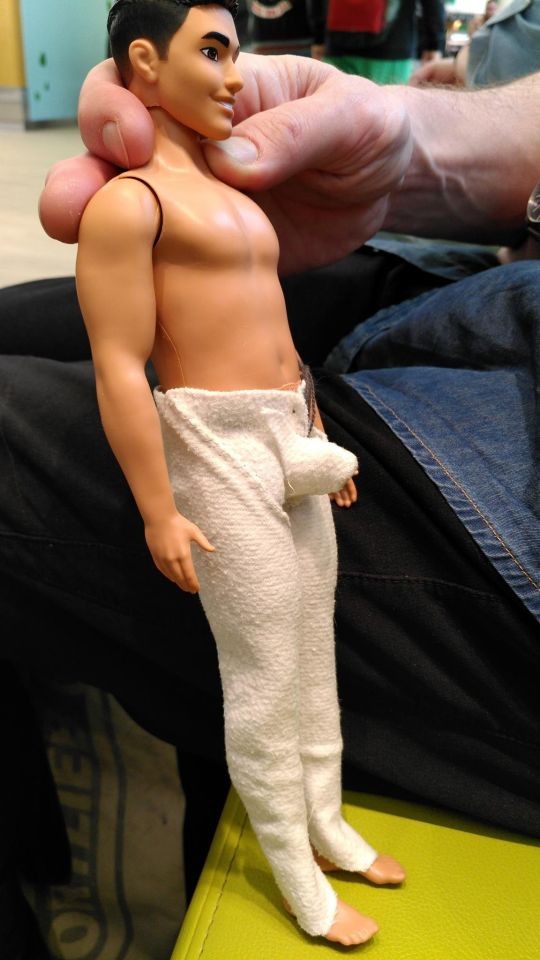
And while I am happily getting ready for the long weekend, here is an image of Barbie doll Ken (with, as they call it, the "broad body type" who is kindly modeling my small model of the Alpirsbach hose: 

It's still lacking the feet and the waistband, but otherwise, well! And you can guess that I was very happy about this happy chance fit! 

0
APR.
29
1

Very Helpful Cat.

The little cat has been helping me type this afternoon, softly purring on my desk (and my arm). Sadly I now have an appointment, so I have to pull out my arm once this blog post is done, and leave her all without her support cushion. Poor little kitty.

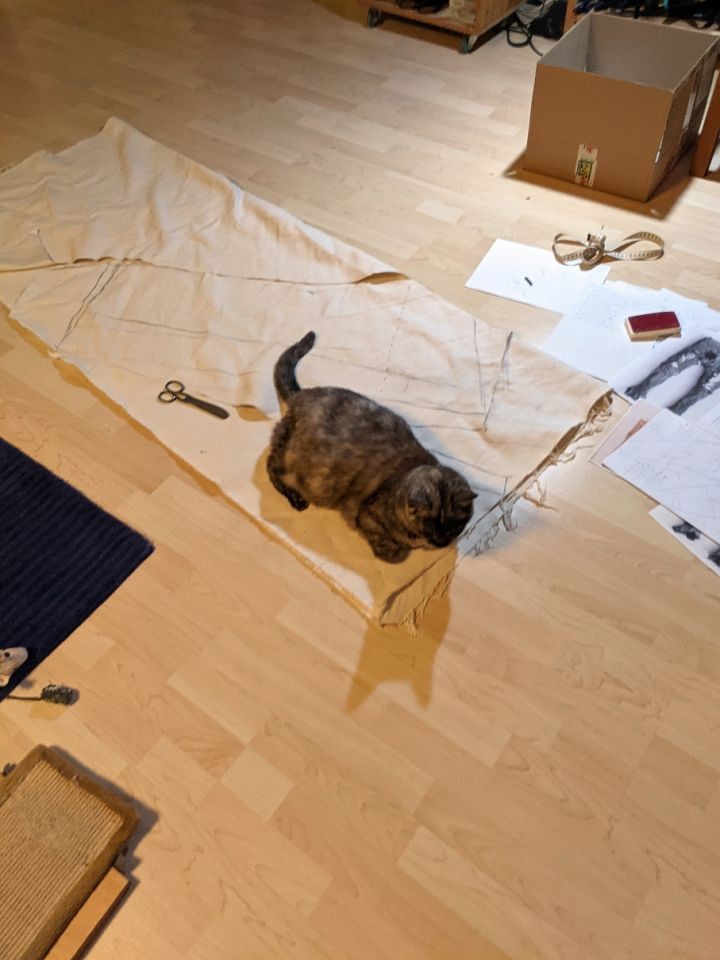
She is very helpful in general with my work. On this photo you can see her encouraging me to take a little break while cutting the first leg for the test piece in actual size, just to make sure I stay hydrated and have ample time to overthink      *------------++++++++++++++++++++++++++++++++ (these are courtesy of the little cat leaving the desk via the keyboard) my pattern-construction decisions.

In other words, I strongly believe that a lot of textile reconstructions contain a certain percentage of cat hair!

0
APR.
28
0

What you see and what you don't.

There's currently a lecture series going on at the Uni Bamberg about wood, and they are so very nice to also stream it online - which means that I got to listen in yesterday. It was very interesting, and it showed again how blind one can be regarding things that were really well researched in a different discipline - just because there is no awareness of that research. Case in point: Dendrochronology has its origins in the natural sciences. Looking at the wood pieces also means looking at their shape, though, and at the pegs that can be found in some of them. The pegs are what remains of the method to secure several logs together into a raft, which was very well researched in historical books and works - but it took a good long while for the dendro folks to realise that. Because... well, because they were not aware of that work, and had not yet stumbled across it by chance, or by research.

This phenomenon of missing something entirely that has been a research topic in a different discipline is not that rare, and while it might not always happen so obviously on such a high (basically the system) level, I have seen it again and again happen with individual research things (my own personal ones included). It's a weird feeling and an eye-opener when you find out that there's a whole cosmos already existing.

The lecture fell in wonderfully with a video discussion I had right afterwards where I had the pleasure to discuss a fabric reconstruction in the works. As usual, it's not really easy to get the appropriate yarns, and it makes a difference on whether they are twisted hard or soft, and which loom is used, and which reed, and so on. This also is a fascinating universe on its own, and I always feel like while I am not able to step across the threshold, I do know just enough to stand in the open door and look inside this other world, and stand in awe and wonder.

It is such a privilege to work with colleagues who step out of their way to open that door for me, and share their insights and their process. 

There also is a plan to do a little bit of a write-up and a publication after the project, about some of the aspects - the tool influence (which was nicely visible already), but also the process of getting to such a reconstruction. I'm mostly involved with sourcing the information (including images) about the fabric, sometimes also with the wool threads, but then most of the pondering and evaluation goes to the weaver, and I can happily stand by and enjoy the ride.

(Until the thing is finished and in my hands. Then it's time for chocolate, tea, and some more chocolate to gather enough courage for the cutting... but that is a story for another day.)


0
APR.
27
0

NESAT XVI announced!

Every three years, there's a NESAT, which is kind of a big deal to me. I've managed to go to all of them since the one in Copenhagen, and I am very much looking forward to the next one: NESAT XVI in Glasgow, Scotland, 2-4th June 2027.

There will eventually be a website, and a CfP, and planning - but for now, I have the date marked up in my calendar, and will be waiting for more news along the line.

0
APR.
23
0

Teeny legs!

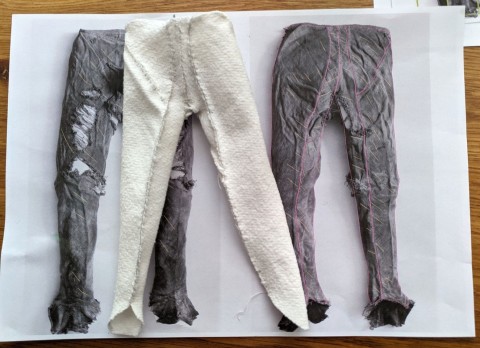
I'm not a huge fan of sized-down models for  testing garment patterns, but sometimes, well, sometimes it is not the worst idea. So it happened today - and the result is, I'd say, not that bad:

I have managed to invert sides (or would need to turn it inside out now), but overall, there's been a few insights, especially regarding the braguette. So... once all the other questions are solved, I might have a better idea of how to attach it!

(Still to crack: The "how to place it on fabric and so on" riddle.) 

0

By accepting you will be accessing a service provided by a third-party external to https://pallia.net/

Kontakt