Latest Comments

Guest - Aislinn Dyestuff Citizen Science.
09. Oktober 2026
This is a great project. I look forward to the results. Thanks for letting us know.
Guest - Aislinn Time for...
09. Oktober 2026
Looks delicious!
Guest - Katrin Sprang Discussion
18. September 2026
Hi Rachel, I have looked for more photos of you, but that was not very successful. I found a link on...
Guest - Beatrix Sprang Discussion
15. September 2026
That lozenge pattern element is not a photograph, but a scan. So it should be to scale. But I pinned...
Guest - Katrin Sprang Discussion
15. September 2026
I was not referring to Rachel's reconstruction (is the reconstruction you refer to the one photograp...
JUNI
30
3

Things are coming together.

There's a couple of things running in the background that are finally coming together - I will be getting different kinds of needles in addition to the ones already in the shop, sort-of-soonish (these things tend to take a while). Other things are in the pipeline, but not in a stage where I can blog about it - yet. But I'm having hopes to post exciting new things here this autumn.

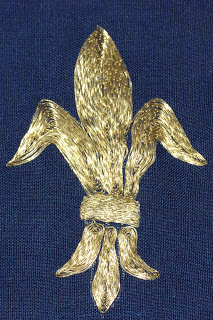
Also scheduled for this autumn, but something that I can already blog about: The Fleur de Lis Gold Embroidery Kit. Here's the finished prototype, finally:

It does look much nicer in real life.

I did the last stitches yesterday in the evening, when the light was already dimming down, but it was still rather light. That minimises the sparkle of the gold thread, which makes the work hard to see.

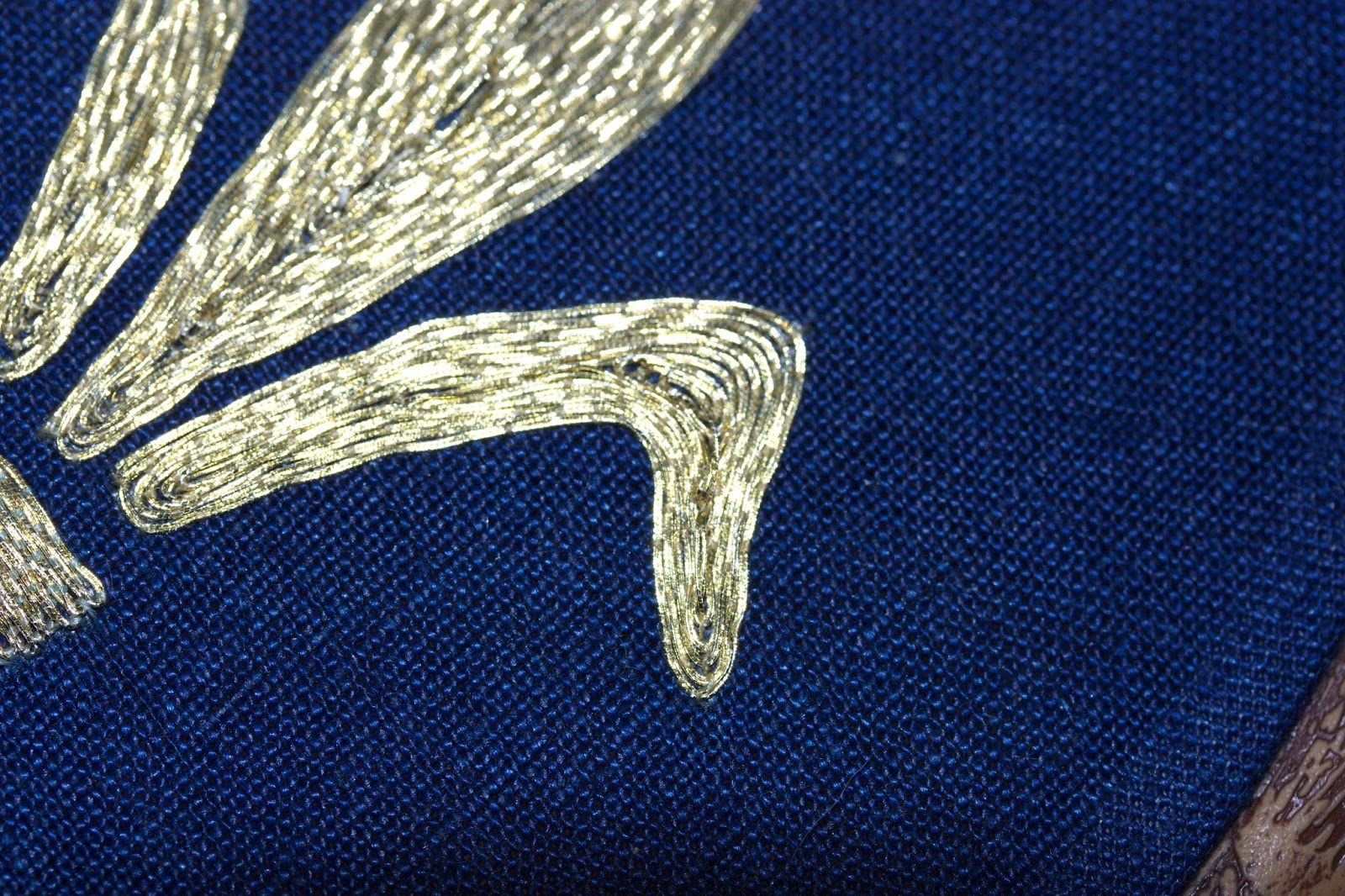
Speaking of hard - gold embroidery is really, really hard to photograph. Especially if you are in kind of a hurry, which I was this morning (and that usually leads to a bad photo day). The trick is to take the picture with underexposure, and with no direct light to avoid any sparkles. Then it can still be tricky to get the thing in proper focus, as the autofocus often has trouble with the sparkly bits; or to get the exposure right because of strong contrasts between the gold and the dark background.

So you're not getting the world's best piccies of the finished prototype yet, but I had the strong urge to share with you. Including these bad closeups:


This, by the way, is how it looks if you take a picture with flash:

Hint: Flash is not helpful...

I had such a bad photo day that I even botched the pictures of the back of the embroidery, which technically should be no problem to take a picture of. So you're getting only this bad detail shot this time (you know, because of the law).


I'm really happy to have this finished, though. The template stencil for the final version is done as well, and looks very much like the prototype here, with only a few tiny changes. The fabric for the final version is off to be dyed already, and as soon as it arrives back here, I'll cut it into pieces... and then I will gild the lily once again, a third and final time, taking photos of the individual steps for the instruction booklet.

(And those photos? I'll take them in a softbox, with the camera on a stand, and with plenty of time planned for that shoot...)
0
JUNI
26
1

And that's why you need maths.

When I was starting to study archaeology, I was happy to leave some of my less favourite school subjects behind me. Those included chemistry and maths.

One of my companion subjects with archaeology was heritage conservation, though, and that included "Bauforschung" - documentation and analysis of historical buildings. For that, one of the things you do is draw an accurate plan of floors, walls, and so on. Which means you will need to measure. Everything.

And then... there was this complex process of taking the distances and the angles you had measured, along your main lines or around the outside of the building, and calculate whether your measurements were accurate enough or not. It included things like sinus and cosinus and tangens, and when the prof explained it, you could hear half the room go "aaaaooouuugh". There I was, thinking I'd happily escaped those numbers and calculations... until said day.

Guess what I needed these days? More of those old and slightly dusty maths skills, especially that stuff about angles. So much of maths skills, unfortunately, that I also needed the assistance of the Most Patient Husband of Them All, who graciously agreed to help me tackle a complex formula to calculate the typical spinning angles of industrially-spun warp yarns from wool. (To my great delight, my calculations were not completely wrong. In fact, all I had not done was an additional, and not-really-obvious step to transform kilometres into metres. That step was so non-obvious that it also took my husband a while to track down the cause of the impossible result and figure out why it had happened.)

Oh, and the result of that formula-cracking? Warp yarn angles run between about 14.7° and 17.1° - while medieval yarns usually are above 30°, and very frequently at about 40°. No wonder modern spinners tend to spin soft stuff, it's the only thing we are used to!


0
JUNI
10
0

Still testing.


There are things that we see, or use, that look easy. Easy as pie, and they are convenient and quickly picked up or quickly used, and nobody ever thinks about how much work has gone into them.

Take a book, for instance. It has contents (hopefully!) and a cover and a price, and there is writing and cover artwork and editing and layouting and printing going on before you can pick it up and settle down for a nice read. Or a film - even if you know that there will me much, much more that is filmed before the cuts reduce it, it's still something different to experience it yourself.

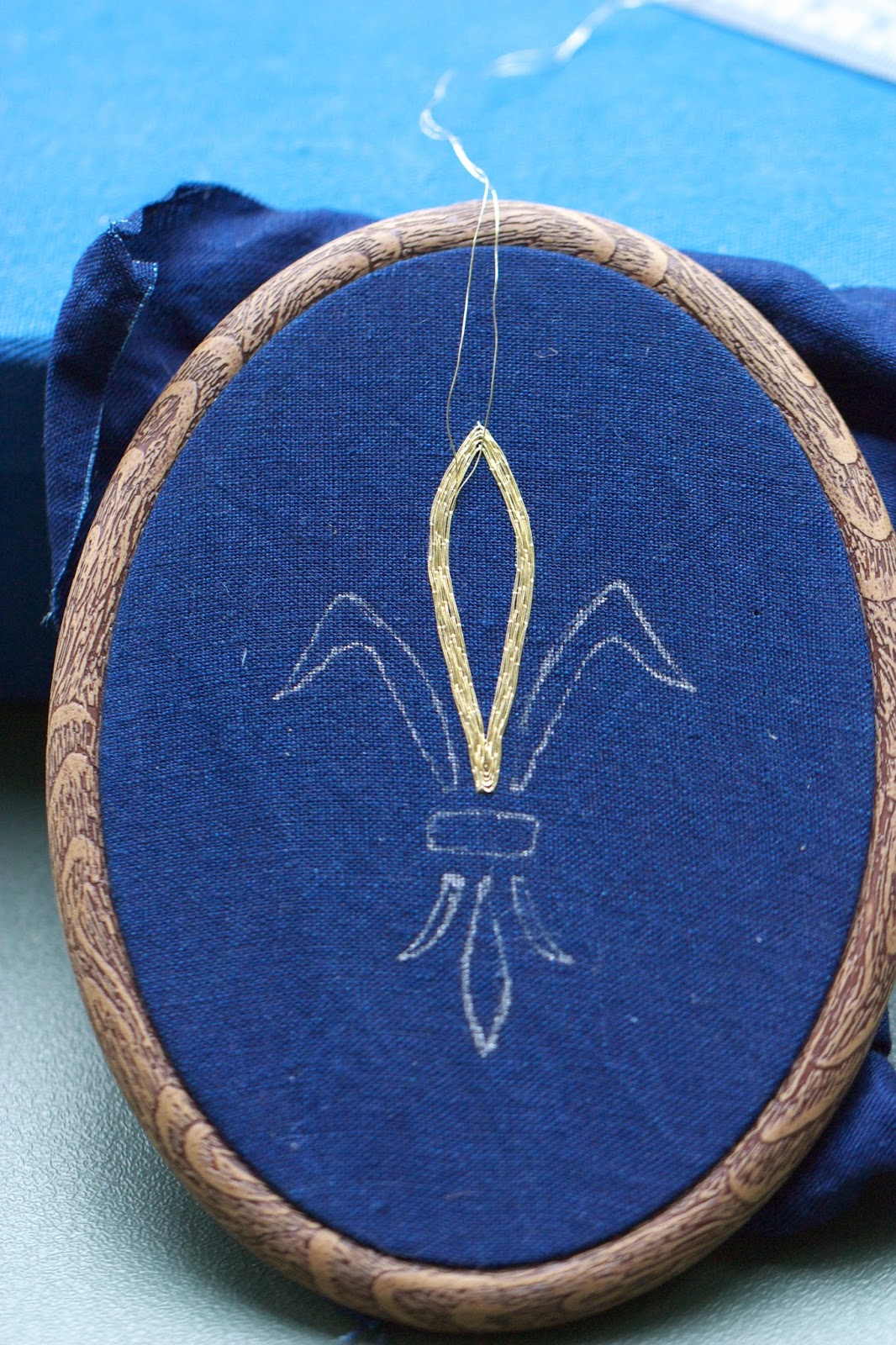
The same is true for something like an embroidery kit. Which tells you that I am still working on it - this iteration, there is tweaking and testing of the pre-drawing, taking still more notes about what needs to go into the instructions, and testing of how well the frame works for all this. I'm also testing the needles that will be included in the kit and making exact notes of how much thread is used for which of the parts. Meanwhile, the fabric for the final version has been sent off to be dyed, and I want to have finished this second prototype by the time it gets back here.


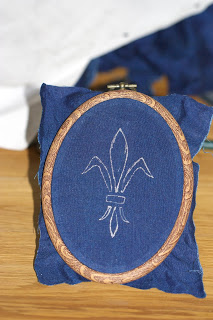
It's not the final pre-drawing, but pretty close to how it will be, both regarding shape, size and placement. The frame on a closer look (and especially upon touch) is obviously not real wood, but it looks very nice in combination with the dark blue fabric. As I want the kit to be so complete that you can get started right away and end with something that can be used as decoration without further ado, this frame is the perfect solution even though it's very modern.

And this is how the embroidery looks at the moment:


As you can see, I have not progressed so very far. I hope to find a bit of time this evening, though, so that I can at least finish the middle leaf!

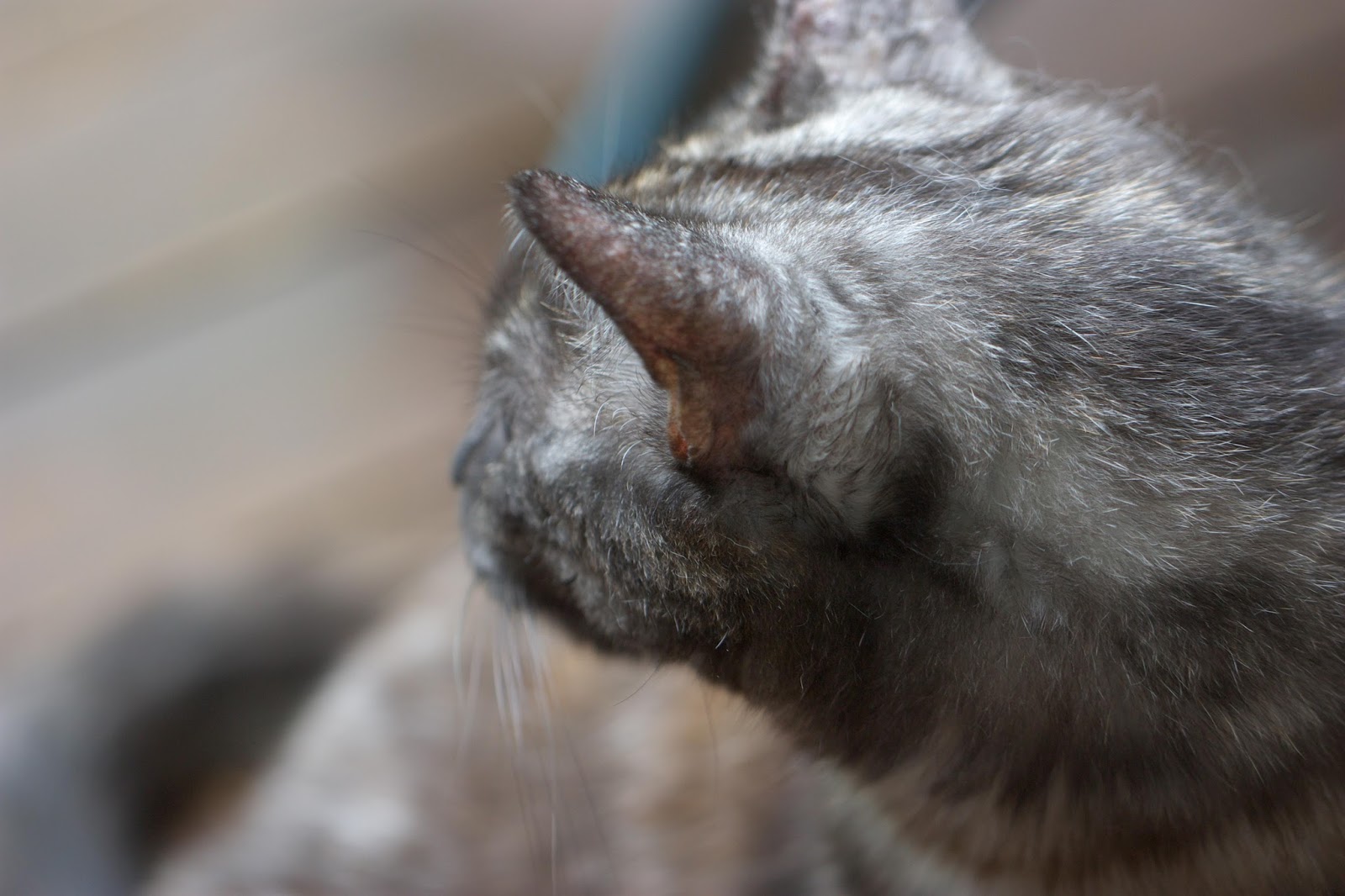
The cat, meanwhile, is thoroughly un-impressed:


0
JUNI
01
0

Gold Embroidery Kit - next stage.

The prototype of the gold embroidery kit I'm currently working on is finished. I documented the amounts of thread needed (though not how long I worked on it), and I made notes for the instruction sheet that will go with the embroidery kit.


It took a little less than ten metres of the gold thread, and the couching thread was used in two different colours, which is much more visible in the original than in the picture. It looks a little wonky in the picture because I digressed from the pre-drawn pattern during the embroidering, and it's much harder to do a straight line if there is no leading line on the fabric. Why did I digress?
I made one single drawing, but you can see that I tested two different possiblilities - one was letting the three leaves run together close to the band (as can be seen in the upper left part), the other leaving a gap between the leaves. Same applies to the leaves where they touch the band - bottom with a gap, top without. I like the gaps between the parts better than the run-together look, so the final version will have a gap between the single elements.

And here's how the backside of the embroidery looks:


You can see the different colours of the couching thread much better here - though the rest, obviously, is by far not as spectacular...
0
MAI
12
3

Spinning instructions!

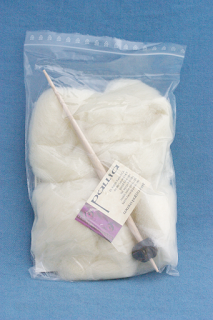
As posted a while ago, I wrote up some spinning instructions to go with a hand-spindle kit.


It did get ready in time for the wool festival at Backnang, and now I have finished translating the instructions into English.

The German version is already available in the online shop - it should be downloadable for free, if there should be any trouble, please let me know. Before I post the English version to the shop, though, I'd like to have a native speaker give it the once-over to catch any stupid bits of Denglish (which tends to happen when translating, unfortunately).

Any volunteers?
0
APR.
13
0

Back home from Backnang.

I'm back home from Backnang - it was a wonderful weekend, and I'm only sad that there was not more time for me to stroll around outside and enjoy the beautiful weather, or take a more leisurely look at all the stalls with fibres, tools, and (of course!) yarns.

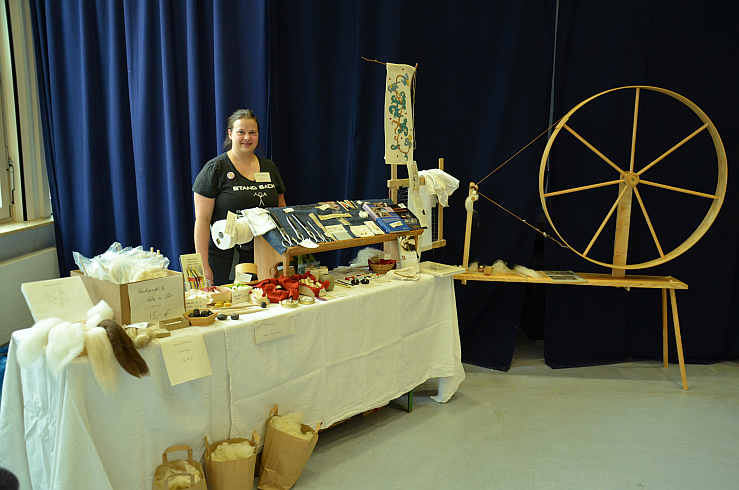
This is where I spent most of my time in Backnang:


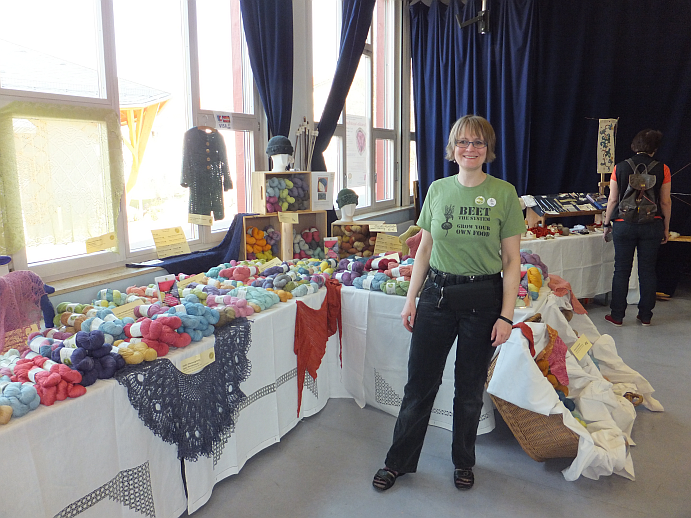
- right beside the table of Margit from Alte Künste:


I also had the pleasure of teaching medieval spinning to a group of enthusiastic and interested spinners on Friday and Saturday, and on Friday there were even two participants who had their very first experience in spindle-spinning. Both courses were sold out in the blink of an eye, a joy to teach, very well received and I'd be happy to offer them again in Backnang in 2017.

Today, though, my mind will have to get out of the wool-mode - I have to finish reading the typeset proof of our new book this week, and I hope to make very good headway today. There is tea, there is chocolate, there is a red pen - and it's nice weather, perfect to sit in the spring sunshine and reading.
0
FEB.
04
0

Reading for me, reading for you.

I'm planning to spend a large chunk of my time today on proofreading - the book has been printed, and I am wielding my Red Pen of Doom and am marking it up. It is always amazing and slightly (or more than slightly) frightening how much of a difference the printout makes. I can proofread someone else's article okay on a screen, but with my own writing or with longer things, nothing can beat a printout and the old-fashioned pen.

While I am reading, you might want to have some words to look at, too. So here are links to provide you with fodder:

First of all, 2015 is the anniversary of the English Magna Carta - and the surviving four copies have actually met for the first time ever. Here's a blog post about their meeting. (And about them.)

Isis at Medieval Silkwork writes about ground fabrics for embroidery. (Those that I know are mostly linen, by the way, with a very few silk ones thrown in. And I've found out that if you are doing counted work, there's a limit to how unbalanced a fabric can be to still have a nice-looking embroidery - distortion, anyone?)

More reading? As in book form reading? Here you go.

Penelope Walton Rogers has her own press now, Pangur Press, and she's starting off with free .pdf versions of some of her earlier publications - including the two volumes from York about textiles and textile production.

There you go. Have fun reading!
0

By accepting you will be accessing a service provided by a third-party external to https://pallia.net/

Kontakt