







Latest Comments

Guest - Aislinn Dyestuff Citizen Science.
09. Oktober 2026
This is a great project. I look forward to the results. Thanks for letting us know.
Guest - Aislinn Time for...
09. Oktober 2026
Looks delicious!
Guest - Katrin Sprang Discussion
18. September 2026
Hi Rachel, I have looked for more photos of you, but that was not very successful. I found a link on...
Guest - Beatrix Sprang Discussion
15. September 2026
That lozenge pattern element is not a photograph, but a scan. So it should be to scale. But I pinned...
Guest - Katrin Sprang Discussion
15. September 2026
I was not referring to Rachel's reconstruction (is the reconstruction you refer to the one photograp...
MAI
21
0

Back from the long weekend.

We're back from the weekend, and we now know that our cat is of the "happy you are back" sort, not of the "you left me so I will ignore you for at least a week as retaliation" sort.

For ten years now, I have gone off to do some book-binding over the Ascension day weekend, and it's usually also a little work-related. This time, I managed to bind three slim copies of book parts for my own library. The biggest bit of work-related binding, though, was something else.

Since I started to carry slate embroidery frames this spring, I have a demonstration frame that is all set up with a small bit of embroidery started on it. This, naturally, means that I am stuffing it into the car together with all the rest of my gear and wares - but a large frame with a fully installed embroidery on it is not something you can just toss anywhere; it sort of needs some kind of protection. So I made a box for my demo frame. It took several sheets of paper and two sheets of cardboard and all the (large) rest piece of extra-sturdy plastified fabric that I had, and a whooping amount of time, but it turned out really nice and is now drying on the living room floor... and I won't have to fear for the embroidery's safety again in the future.

0
APR.
20
0

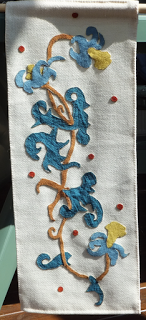
The Flowery Newness.

I am using the time until the Copenhagen conference starts to do my pre-season-start inventory work, which also includes cleaning out and re-filling the many boxes I use to protect and store the wares that I lug along, and other work like dunking my baskets in water to clean and revitalise them.

And I'm very happy to announce that I can do this while sitting in a room with the newly finished Flowery Newness!

This was quite pleasant to work and did not take overly long, thanks to the appliqué technique. The motif is taken from a 15th century manuscript margin decoration; the manuscript is probably from South Germany and is a Book of Hours. You can see the inspiration page in the British Library online thingie, here.

For those interested in the technique: It's wool on wool, plant dyes (with exception of the stems, which are fake onion-dyed chemical dye), edges caught with beeswax and sewn on with plant-dyed silk thread. I had to use a substitute for the gilt leather strip that would usually have surrounded the edges; the substitute is a gilt thread (which should really be called a rope, compared to proper historical gold thread).

This flowery banner will adorn my sales table in Freienfels - and I think it's quite the eye-catcher!
0
MäRZ
02
5

It all comes together... I hope.

Yesterday saw me working on a few open questions at once in the library in Bamberg, including pondering a few spinning wheel questions. There's a lot of speculation abounding in regard to the output possible on a hand-spindle, on a Great Wheel and on a modern treadled flyer spinning wheel. There are also quite a few (modern) depictions, descriptions and interpretations of the Great Wheel that do not at all fit in with the image I have in mind of that Wheel: a specialised, highly productive tool for the textile industry, with some very specific caveats and disadvantages, but also with a significantly higher rate of output than the spindle.

All these ponderings are not only in connection with the wheel project - a part of them will also find a little space in the presentation for the conference in Vienna. And all this research is finally solving a few questions I had for a long time.

One is yet unsolved, though. How do I attach the wheel rim to the spokes (or vice versa)? I don't want it all to wobble or fall apart, but I also do not want to risk damage when the wood deforms a little due to changing conditions. Input and speculation (or description of how your Great Wheel, should you have one, keeps its rim and spokes together) is very welcome.
0
MäRZ
01
0

More thoughts wheeling in my head.

I have not yet finished with the planning for the wheel - I know which wood I will use, I have most of the dimensions figured out, so there's details and unsolved questions left - like "how much tension will my drive band need, and do I have to build in something acting as a brace or stabiliser for the main upright".

Also, there's the question of how I am going to procure the strip of wood necessary for the wheel rim. In contrast to winding wheels or modern treadled wheels, the Great Wheel has a slim but wide, lightweight strip of wood serving as the rim. Which I can either cut out or plane out of a board with normal thickness, or try to buy, saving me the work. So next step in line: find out if there is somewhere near me where I can buy it, at an affordable price and with measurements matching my requirements (and then figure out whether the whole strip, uncut and not yet bent, will fit into the car).
0
FEB.
29
3

One spinning wheel, coming right up.

As you can probably tell from the title of this blog post, I have decided to take a shot at making a Great Wheel myself. I am going to base its construction on the well-known Luttrell Psalter image which will result in a fairly big wheel, standing on fairly long legs, with an upright holder for both the spindle and the wheel.

In contrast to later wheels that are still existing, the medieval Great Wheels never seem to have angled uprights holding the wheel itself or the spindle. There will also be no threaded tensioners; I have yet to decide whether to add a different tensioning mechanism or to just tension by changing drive band length.

The whole thing, in any case, should be
a) done so it can be taken apart easily for transport or storage;
b) not use modern materials or concepts;
c) match the Luttrell wheel as well as possible;
d) function as a proper productive spinning tool.

So the usual, the usual. Apart from the tensioning issue, however, I think I have figured out most of the details - putting together of the parts will be done by using wedges, similar to how my table substruction is held together; the legs will be conical and thus should have enough friction in their sockets to stay in there when the wheel is carried around; the largest single bit will be the wheel itself, and that is non-debatable due to construction reasons.

I am very much looking forward to this!
0
FEB.
27
1

Sometimes, things align.

Sometimes, it just takes a while for all kinds of things to turn towards favourable constellations... and it seems that I might get a shot at a portable Great Wheel, with a little luck and a bit of woodworking.

For those of you not familiar with a Great Wheel: this contraption (also called Walking Wheel or wool wheel sometimes) is the very early form of a spinning wheel - basically, it's a hand-spindle mounted sideways and connected to huge lightweight wheel by a drive band.

Image from British Library Manuscript Royal 10 E IV, f. 147. Dated to last quarter of 13th or first quarter of the 14th century. Link to the catalogue entry with more information.

There are a few common problems with building a wheel like that, especially when it's part of the intended use to lug the thing along to different events: It has to be properly functional, it should be correct regarding materials and construction, and it has to be possible to take it apart enough so that it can fit into the car. Add to this the fact that the images are not always very clear, or have a proper perspective, and that one can build a functional wheel much easier if one has worked with this type of tool already, and there's quite a bunch of difficulties. Plus it's of course necessary to have the wood, the tools, and the crafts abilities to make such a thing.

Well, some of the basic construction and concept problems sort of came up with a few solutions almost by themselves yesterday evening. A woodworking workshop is at the moment magically appearing in our basement, including a gadget necessary to steam-bend wood. There also is a little leftover wood. And I should be able to procure the metal parts for the wheel with little or no trouble, the way it is planned at the moment... so I will do some thinking, and some scheming, during the next weeks. And who knows, with a little luck and some dusty woody work... there might be another wheel in my future.

(Oh. You might have heard that saying about how spinning wheels are herd animals? It's totally true. If you do not want a herd of spinning wheels, you should keep your one and only wheel isolated. Don't get a second one. Don't even lend one from someone else for a while. They will start multiplying then. It's probably best if you don't even leave it alone in another room with a second wheel. They're almost as bad as rabbits. Really. I swear.)
0
FEB.
14
0

This is what happens when schedules are not kept.

I got up earlier than usually today and then sort of got gobbled up by lots of different small tasks (and lots of phone calls) - to the point that I totally forgot I had not blogged yet.

So, with ample delay, here's today's blog post...

You might remember the spinning for the Hallstatt narrow wares reproduction quite a while ago? This has been covered by the Standard, an Austrian newspaper, and the little (German) article is online as well - you can read it here. There's also a special exhibition about the project at the Naturhistorisches Museum Wien, and I'm looking forward to seeing it when I am in Vienna for the 3000 years of colour conference. So much nice stuff coming from that project!
0

By accepting you will be accessing a service provided by a third-party external to https://pallia.net/

Kontakt