Latest Comments

Guest - Aislinn Dyestuff Citizen Science.
09. Oktober 2026
This is a great project. I look forward to the results. Thanks for letting us know.
Guest - Aislinn Time for...
09. Oktober 2026
Looks delicious!
Guest - Katrin Sprang Discussion
18. September 2026
Hi Rachel, I have looked for more photos of you, but that was not very successful. I found a link on...
Guest - Beatrix Sprang Discussion
15. September 2026
That lozenge pattern element is not a photograph, but a scan. So it should be to scale. But I pinned...
Guest - Katrin Sprang Discussion
15. September 2026
I was not referring to Rachel's reconstruction (is the reconstruction you refer to the one photograp...
MäRZ
04
0

Stiches galore... and all the stuff for the prep work.

I'm still up to my ears in prep work for the embroidery course - I am using this as a wonderful opportunity to tackle all those embroidery-related side projects and side questions that had pestered me for quite a while, but that I never got around to occupy myself with.

And one of those eternal projects was getting the proper ink to do authentic medieval preparatory drawings. There's a nice instruction on how to do it in Cennino Cennini's handbook (the extended version; scroll down to CLXIV to read it), but getting the appropriate ink proved to be a bit harder than I had expected. And now I'm finally in the home straight for the ink project - only a few more days until I have that done and finished. Then I will be one step closer to having all the embroidery preparations covered!

(There's still plenty of steps left until that though, so no danger in my getting out of work to do in that area yet...)
0
MäRZ
03
0

Embroidery!

I'm currently spending snatches of time here and there to sit down with some embroidery, all in preparation for the workshop in April. At the moment, I'm mostly trying to figure out whether there was a typical approach to work sequence and turning corners in the counted embroidery that I have in my books. And that means... stitching and comparing.

There are a few things I have already learned (or learned even better) about medieval embroidery. One of the first things, and one of the biggest problems, is the size of that stuff (pun intended). Medieval embroidery... it's tiny. Teeny-tiny. If you buy modern ground fabric for counted work, you'll often get about 12 to 13 threads per cm as "fine quality". Medieval fabrics? 19 or 20 threads per cm. That's about a third smaller, and fabric in that fineness and even weave is not easily available nowadays. (I'm working on it, by the way.)

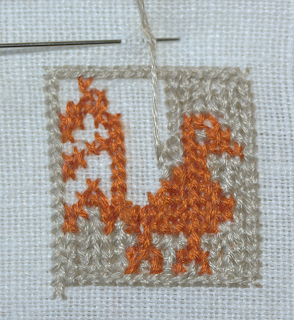
Apart from those little problems, I'm vastly enjoying myself trying out different ways to make transitions from one row to the next, with differring success. I have not settled on one "best" technique yet, and I'm not sure there will be one for me... but my sample-and-try-out-things fat chicken currently looks like this:


It is worked in "Zopfstich", a stitch giving sort of a braided appearance (Zopf = braid), and it's fun and easy to work. I did not get it totally like the original which is partly due to my being bad at counting and partly due to the different thread counts (I have to work over different counts of threads in different directions). As you can see, it's not perfect - but it does serve its purpose as a trying out slightly different techniques.

And plump chickens? I like them.
0
MäRZ
02
1

Guttbye, Mr. Copy-and-Paste!

(Politics first, textile stuff later - please scroll down if you are not interested in German politics.)

At noon yesterday, the German Minister of Defense has abdicated. I think that this is a very, very good thing - it proves that the voters do care about the integrity of their politicians, that plagiarism is still a crime and not a gentleman's crime, and that the Internet community has become an influence big enough to overthrow a person of political importance.

The abdication of her minister does not sit well with the German chancellor Merkel, though - she is actually accusing those not on Guttenberg's side of "hypocrisy and dishonesty" and says that "We do not need to have anybody explain to us what integrity and honour are in our society" ("Wir müssen uns von niemandem erklären lassen, was Anstand und Ehre in unserer Gesellschaft sind", here's the full German press article with those statements).

Well, at least as far as I'm concerned, it was not my aim to harm the CDU/CSU - but that's not how Merkel and her group see things (or state to see things). And now we can all wait and see whether the Fallen One will make a comeback or not... I hope that this time, the memory of Germany will prove to be longer than before. Because yes, I would agree that everyone deserves a second chance in life - but not a second chance to help lead a country.

On to other important things: Old rags. There seems to be a conference in London this weekend, and I'm sorry to pass this on to you on such short notice - I had not heard about it before. It went over the MEDTC-List yesterday, and I'll just repost the whole thing, since I could not find it on the Museum of London pages to link to.

Making it: Textile Technologies in Medieval Europe

Saturday 5th March 2011
Weston Lecture Theatre, Museum of London, 150 London Wall, London EC27 5HN
www.museumoflondon.org.uk

10.00: Doors open

10.30 – 10.45: Welcome: Hilary Davidson [MEDATS and Museum of London]

10.45 – 11.15: Professor Gale Owen-Crocker, University of Manchester,

 ‘Continuity and Change: an Overview of Medieval Textile Production’

11.15 – 11.45: Ruth Gilbert, Independent Scholar and Weaver, ‘Spinning technology in England in the Middle Ages (450 – 1500)’

11.45 – 12.15: Coffee, demonstrations and screening of DVD showing images of medieval cloth production from Semur-En-Auxois, in the Activity Room

12.15 – 12.45: Alan Raistrick, Independent Scholar, ‘Revelations and Calculations; developments in the spinning wheel during the Medieval Period’

12.45 – 13.15: Anna Nørgård, Weaver, author and demonstrator at the Viking Museum, Roskilde, Denmark, ‘The Early Medieval Warp-weighted Loom’

13.15 – 14.45: Lunch (not provided) and demonstrations in the Activity Room

14.45 – 15.15: Anton Reurink, Author, Historisch Openlucht Museum Eindhoven, The Netherlands, ‘The Medieval Process from Wool to ‘Lakense stof’ (Broadcloth)’

15.15 – 15.45: Kathrine Vestergård Brandstrup, Archaeologist,  ‘The Development of the Loom, 1000 – 1500’

15.45 – 16.15: Tea and demonstrations in the Activity Room

16.15 – 16.45: Dr Nat Alcock, Emeritus Reader in Chemistry, University of Warwick, and past President of the Vernacular Architecture Group, ‘Recreating the Medieval Weaver’s House and Loom’

16.45: Discussion

17.30: Close

Demonstrators - Glenys Crocker: warp-weighted loom - Ann Markwick: great wheel - Jo Wexler: tablet weaving
Speakers who will also demonstrate - Kathrine Brandstrup: naalbinding -Ruth Gilbert: drop spindle
Demonstrators Warp-weighted loom: Glenys Crocker, Vice-President of the Surrey Archaeological Society and member of the West & East Surrey Guilds of Spinners, Weavers & Dyers; great wheel: Ann Markwick, the East Sussex Guild of Spinners, Weavers, & Dyers; tablet weaving Jo Wexler, from the Cambridgeshire Guild of Spinners, Weavers,& Dyers.

The researches of some of our speakers demonstrate the contribution of practical experimentation to historical research and, in a museum context, ‘bring alive` many aspects of textile history.  Kathrine Vestergard Brandstrup is the editor, with Marie-Louise Nosch, of The Medieval Broadcloth: Changing Trends in Fashions, Manufacturing and Consumption, Oxbow Books, Oxford, 2009.  Anna Nørgård is the author, with Else Ostergard & Lilli Fransen, ofMedieval Garments Reconstructed: Norse Clothing Patterns, Aarhus University Press, 2010.

What hand tools were used, how were they made, and what practical skills were needed – as well as what changes took place – will be discussed in relation to aspects of the historical and archaeological record. There will be demonstrations of some practical spinning and weaving technologies used in north-west Europe from approximately the fifth to the fifteenth centuries.  It is hoped that a new light will be shed on the production of yarn and woollen cloth.
I would love to go there, but it's too far away and  on too short a notice (and travelling to Britain is, alas, not so utterly cheap and fast). I also don't know if there's a conference fee to be paid or who organises the whole conference, so you might want to call the museum to find out details before you travel there.

I will stay here and play some more with my embroidery, in preparation of the workshop in Vienna that I will give in April. And more about that... tomorrow.
0
FEB.
14
0

Things, randomly written here.

Firstly, for all those of you who are planning to put in a visit to the V&A before they close down the textile study room, a heads-up: I have been sent additional information by two friends who went there and found that, without any further notice, the staff closed the study room at noon.

So they recommend that
any colleagues intending to make a special visit to the collection are *strongly* advised to contact the museum first to check that the room is likely to be open : they probably won't give any promises, citing the usual weasle phrase "lack of resources", but pointing out that the room will soon be closed anyway might help.
So please phone ahead if going to the V&A to save you a disappointment.

Secondly, there are more conferences coming up: The Braid Society meeting in 2012 and the Leeds Congress 11-14th of July 2011. I have made the mistake of looking at the preliminary programme up on the website, and now I'm totally lusting to go there. If only beaming were invented already!

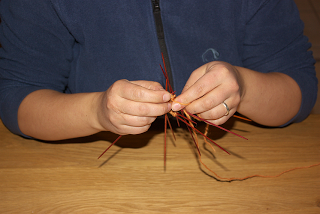
Thirdly, I spent part of the weekend having a load of fun with the new "in" sports discipline, Extreme Hedgehog Wrestling. Here's photo proof of it:


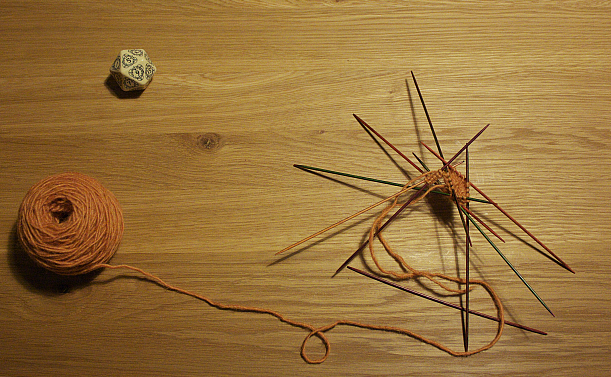
And this is the hedgehog in rest:


The thing lying around on the table in addition to the needles and yarn is a count-down d20* that I use for counting knitting rounds. (For those of you not enlightened by roleplaying friends sharing their dice and knowledge, countdown dice have the numbers arranged so you can easily find the next one in sequence - as opposed to normal dice where you have to hunt for the next number.)


It's a pattern that was published in Knitty a while ago**, and contrary to my usual approach, I actually did not change anything when knitting it. Well, except using dpns instead of the recommended two circs, and messing with the needle size : yarn thickness ratio to get the correct gauge. (Hint: My needles are, to a normal knitter's mind, way too small for the yarn.) After I broke one needle tip during the wrestling session start, I sort of tried to err on the side of caution in regards to the number of needles (and therefor reduced stress on the individual needle).Hedgehog Wrestling then is the natural side effect of this.

* A 20-sided die. Which is plenty for most knitting purposes and a very standard type for a lot of roleplaying games.
** I won't tell you what it is yet, because it's intended as a gift, and you never know who reads this blog. I'll show the finished thing once it's been received, though.
0
FEB.
11
1

Beating Wool

In the comments to my post about the beating frame, Iðunn asked about the procedure - I think, however, that this merits a proper blog post instead of a comment answer, so here it is. I do not have pictures of the beating process yet, but I will post them as soon as I get them.

Beating wool is something I have for a long time wanted to learn or see being done, so please keep us informed with pictures or even a video. Though I have seen those bows on medieval pictures and on a video about a German hat maker (Der Letzte seines Standes, I think it was)I'm still not quite sure how to do it.
There are three basic ways to fluff up wool: By beating it on a frame, by using a bow, or by teasing the fibres apart by hand. The first two methods use vibrations to loosen up the wool fibres, the third method is the straightforward mechanical pulling apart of the fibre staples.

A beating frame is a wooden frame strung with ropes in a lattice pattern; the (thin) ropes are under tension. The frame rests on trestles or some other support, and wool is placed on the rope lattice. By beating the wool (and the rope lattice underneath it) with a smooth, strong and flexible stick, the ropes and stick vibrate and thus start fluffing up the wool staples.

The bow method uses no frame and, according to literature, is better suited to short fibres than to very long fibres. A bow is strung and held or suspended so that its string is inside the loose heap of fibres. By hitting the string with a stick or plucking it, vibrations are induced that start fluffing up the fibres.

I have not yet worked with a bow, but the frame is a much faster way to fluff up fibres than teasing by hand - and they can get much fluffier as well. The downside? You need trestles, a large enough frame (if it is very small, you will hit the frame itself and break a lot of sticks, plus it doesn't work really well) and beating sticks.

Another thing I would like to ask you is about the distaff. I totally agree that spinners MUST use a distaff as it has been done since time immemorial. I have a distaff from Greece but somehow I can't find a proper way to hold it. When I put it in my belt it keeps falling forward. Also I'm not quite sure how to attach the wool to the distaff. I take pains to comb the tog and card the þel but when I wrap it around the d. it looks all messy. My distaff looks like sort of a trident.
I prefer rather short distaffs, and I tuck them under my left arm to hold them there. If you can't get your trident distaff to work, maybe you can try around with some different lengths to find out what suits you best? As for attaching, I just wrap my roving around the distaff-stick I use, and when I get to the end of the sliver, I tie the very end to the stick with a bit of string so that it doesn't slip off. You might try to place the end of your roving through the "fork" bit and then wrap it around the stem underneath - maybe that will help.
0
FEB.
04
1

Amazingly productive.

The rest of yesterday turned out amazingly productive - much more so than I would have guessed after getting a severe headache a few minutes after writing the blog. Luckily, a painkiller and a little nap took care of that, and I did finish my building project (though it won't win a prize for beauty) and even a few more bits from my list of urgent things. Plus I somehow felt inspired and curious enough in the evening to do a bit of extra work in preparation of the embroidery workshop that is planned for the beginning of April in Vienna - and I'm really looking forward to that!

And now I am the proud (medium-proud, that is) owner of a frame for beating wool. Willowing wool. Making wool fluffy by hitting it hard with slender sticks. Which is a much, much faster way to get the clumped staples nice and fluffy than teasing it by hand, and I'm really happy to give it the test run on the weekend!
0
JAN.
28
3

I'm working on it.

January is a good time to stock up wares, resupply and order exciting new stuff - it's already this year, April is looming on the horizon already and with end of April comes the season's start for me.

And that means I'm currently working on acquiring yet another craft-related skill: Cutting quills. Those are textile-craft-related because drawing with ink and quill is the traditional way of preparing an embroidery design, and the tools and materials for the full process of embroidery work are something that I wanted to offer for a good while.  After hunting for proper medieval ink for a good while, I have now found somebody that will make it for me and ordered some, so it's about time to hone down my quill-cutting skills.

There are several "scriptorium" suppliers on the market that offer writing implements. Quite often it's a biro tip set with a (brightly coloured) feather on top - which is about as un-medieval as you can get, since the first thing you are going to do is to cut the barbs from the rachis (I looked those terms up in Wikipedia, and so can you) - that is, you cut the interesting stuff that makes a feather look like a feather from the boring central stem. Why? Because the stuff gets into the way otherwise.
A very few suppliers also have proper quills (unprepared, hardened, or hardened and cut), but the cut ones are always intended for writing. What I need is however something else: I need a tip that will reliably (and without blotting) draw fine lines on linen cloth.

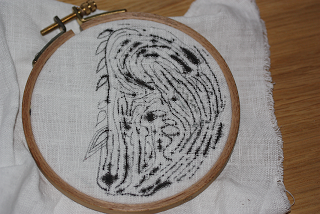
So I sat down yesterday and tried several different feathers from different birds, with varying preparation steps. And that's the result:


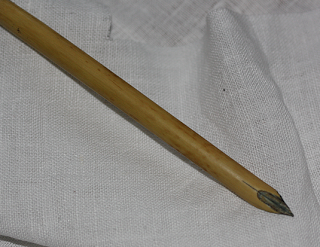
 I'm still figuring out what makes a cut a successful one, but at the moment, it looks as if I'm getting way better and more reliable results in cutting quills from reed than using feather quills. So what will be on sale next season will probably look like this:


I'm not yet sure whether I will test each quill or not - though I'm heavily leaning towards testing each one even if they will not look pristine and unstained on the table then.
Would you prefer unstained and untested or stained and tested?
0

By accepting you will be accessing a service provided by a third-party external to https://pallia.net/

Kontakt