Latest Comments

Guest - Aislinn Dyestuff Citizen Science.
09. Oktober 2026
This is a great project. I look forward to the results. Thanks for letting us know.
Guest - Aislinn Time for...
09. Oktober 2026
Looks delicious!
Guest - Katrin Sprang Discussion
18. September 2026
Hi Rachel, I have looked for more photos of you, but that was not very successful. I found a link on...
Guest - Beatrix Sprang Discussion
15. September 2026
That lozenge pattern element is not a photograph, but a scan. So it should be to scale. But I pinned...
Guest - Katrin Sprang Discussion
15. September 2026
I was not referring to Rachel's reconstruction (is the reconstruction you refer to the one photograp...
DEZ.
17
0

How are flights still this cheap?

Honestly, it's a disgrace - both the insane price differences between plane and train at some points, and the also insane booking procedures in some cases.

Imagine that you'd like to go to, well, let's say Cambridge. That's a bit of a way, yes, but... it would be perfectly possible to do it by train. Quite nice, even, if you happen to travel on a day where you can catch a night train. I'd go to Munich in the late afternoon or early evening, catch the night train there, sleep my way to Brussels. There a little breakfast maybe, then onto the Eurostar to London St. Pancras, and after that it's just a half-hour hop to Cambridge with National Rail.

Easypeasy. Except... well. I can even find the connection I'd like via the bahn.de portal (that is not always the case with more complicated connections), but I can't book it, probably because they are out of contingency tickets for either the ÖBB nightjet or the SNCF Eurostar. So I'd have to book everything separately, which means there's no automatic possibility to take a later train if one of the booked ones is delayed.

It also means making accounts at four different companies, and booking everything separately, which is probably (though not guaranteed) more expensive than having a single thingie. 

While on the other hand, if I'm to book a flight... that is done very quickly, very easily, even if it were with a change somewhere. And it is still ridiculously cheap (thanks to the still ridiculous minimal taxing done on some of the flight stuff). 

So not only is the plane much faster in this case, it is also cheaper, and you have actual hassle and trouble to book a train. Grrr. 

(As you can tell, I am not amused. Even though, in this case, it will probably end up being the plane anyways because of it being much faster, I would really like the two possibilities to be a little more evened up, regarding the ease of booking and the price.)

0
DEZ.
03
0

Weft Carriers.

When you start to dabble into weaving today, one of the standard things that comes up as "important tool" is... a shuttle. And with "shuttle" I mean that iconic piece of wood (or other material, but more rarely) which looks like a little board with two deep indentations at each end. A little like a comic drawing bone, but with less bulk at the ends. I'm pretty sure you know what I mean - it's part of every "learn how to weave" children's loom, after all.

Some are curved a bit, some have a different shape, some are more like netting needles, but - with the exception of the loom shuttles for wider fabric looms or specialised mechanised band-weaving looms - they are everywhere where you are looking for weaving tools.

Unfortunately for those of us who both like this type of shuttle and want to do historical weaving, there's about next to no evidence for this type in medieval artworks. When this form of shuttle is so well known today, it is rather safe to assume that an archaeologist looking at a wood find could identify it correctly. But do we have such finds? Well... nope. With a little nope cherry on top. (At least that's my current knowledge - if you know of any of these "classic" shuttles in the archaeological record, especially the medieval one, please do let me know.)

The thing is, though - as far as I remember reading somewhere, that type of shuttle - the long, narrow board with two indentations at the narrow ends to help hold the weft - is a rather recent (as in 19th century) development. Unfortunately I am still looking to find that source again, but this would explain very easily the lack of this tool-type in the medieval finds.

It's also, if you ask me, rather... impractical in a lot of cases. If it's short, you can easily handle it, but if you want to weave something a little wider, it gets weird - because if you want to have some more weft, you are always getting one full shuttle length worth of weft thread. No more, no less. That might work okay if you have a shuttle about the same length as your weave is wide, but if your shuttle happens to be a good bit longer than your weaving width, it's extra awkward. (Disclaimer: I never liked these shuttle types much, and so I have avoided working with them as much as possible, with the result of being not very practiced in how to handle them, which might make stuff more difficult than necessary.)

And there's so many other ways to carry your weft. You can just have a length of thread that you flick through, and place a new length fairly often. You can do a butterfly (works very well if you have good butterfly-making technique). Or you can use a stick. I am very fond of the general idea of the stick shuttle, as you can unwind as much or as little as you'd like. (I also like to use a reed spool for some instances, especially when I will have the weft dangling from the weave because I have need for both of my hands at other spots, and the reed is lightweigt plus will allow me to cut a notch in it where I can secure my weft. So it, you know, dangles and doesn't fall to the floor. Because that is annoying.)

The Swedish inkle looms, which are made for the rapid home production of bands, are a very nice example where a kind of small stick shuttle is used:

0
NOV.
27
0

The Neverending AI Discussion.

If we're looking for the current pig being chased through the (global) village (and please excuse my crude translation of "die neuste Sau durchs Dorf treiben", a German phrase to point out the current big thing that's being made the Biggest Thing Ever and gets mixed in everywhere) - I'd say it's certainly AI.

Personally, I'm very, very torn on that topic. Yes, it can be a great help, and very useful in specific instances. But then there's so many not-so-good things about it. 

For once, I look with a shudder on the immense amounts of energy that go into generating, running, and using AI. It's slowly approaching a whole percent of global energy consumption, at a time where we'd all profit from dialling down a bit and trying to reduce what we use, so that we can stay within sustainable limits.

Then, a lot of it is just... bad. It already starts with the high-handed decisions of the AI trainers to just use anything that is there to train their models, regardless of copyright. Books, images, music, you name it. I have had issues with piracy of the book I wrote together with Gillian Polack (The Middle Ages Unlocked), which did cost both of us a good chunk of potential royalties income. This AI training - it''s piracy on a whole new level.

Artists complain as they are getting pushed out of their jobs, understandably so. A lot of people seem to think that AI will solve all their problems in the future, and make things, and better plus quicker than people. We will not be able to turn back time and go without AI, so my personal opinion is that it's smart to keep an eye on the developments and not reject all of it in every case, across the bank (even if personally, I'm a little tempted to do that, and please don't ask me why). In some cases, I have used AI to assist me, and I have found that it can be very helpful in some very specific situations. Like when I have a text in a language that I don't really read fluently, and I get translation assistance. (Quality differs between models, and it's always necessary to stay alert to possible hallucinations and mis-translations.) Like when I have a small, very well-defined programming issue where the language and (best case) the problem are rather well-known and have been handled and solved on the Internet somewhere, in some obscure corner, before, and I can describe in detail and very exactly what I need to have done, but am not able to just write out the code. Basically, another translation/language problem with a large pool of knowledge accessible in general. Or when I have a large, multi-page website and I need to find one specific bit of information on it (the case was a search for a VAT number that was not in the imprint). 

In these cases, it has served me really well to use AI. Regarding the translation, it's a really helpful tool for me that aids me a lot, and makes reading texts that I'd stumble on and spend a long while leafing through dictionaries (or typing words into online dictionaries) much quicker and much more painless. In other cases that were close to my successful use-cases, but not quite as specific and well-documented, well, I tried, and it tanked spectacularly. Which means that now I am very motivated to be very specific, and think hard about whether it is an AI-solvable problem, or probably not.

If I could wish for something, it would be people using AI like ChatGPT less for everything. You really don't need it to generate you a recipe for Butter Chicken, there's plenty of them on the web already, written by humans, just use one of those. You can just, well, use a search engine (preferably one with the search function turned off). And while I can somehow understand the temptation of having AI render a photo of you into an action figure, or a cartoon character, or whatever else... I'd wish people would not just use it so freely. It has a high hidden cost, and at some point, the price will have to be paid.



0
NOV.
20
0

Hah. The Heddle is here.

One of my favourite ways of getting new things into the shop is when someone approaches me with the need (or desire, I do not care) for some replicated tool.  

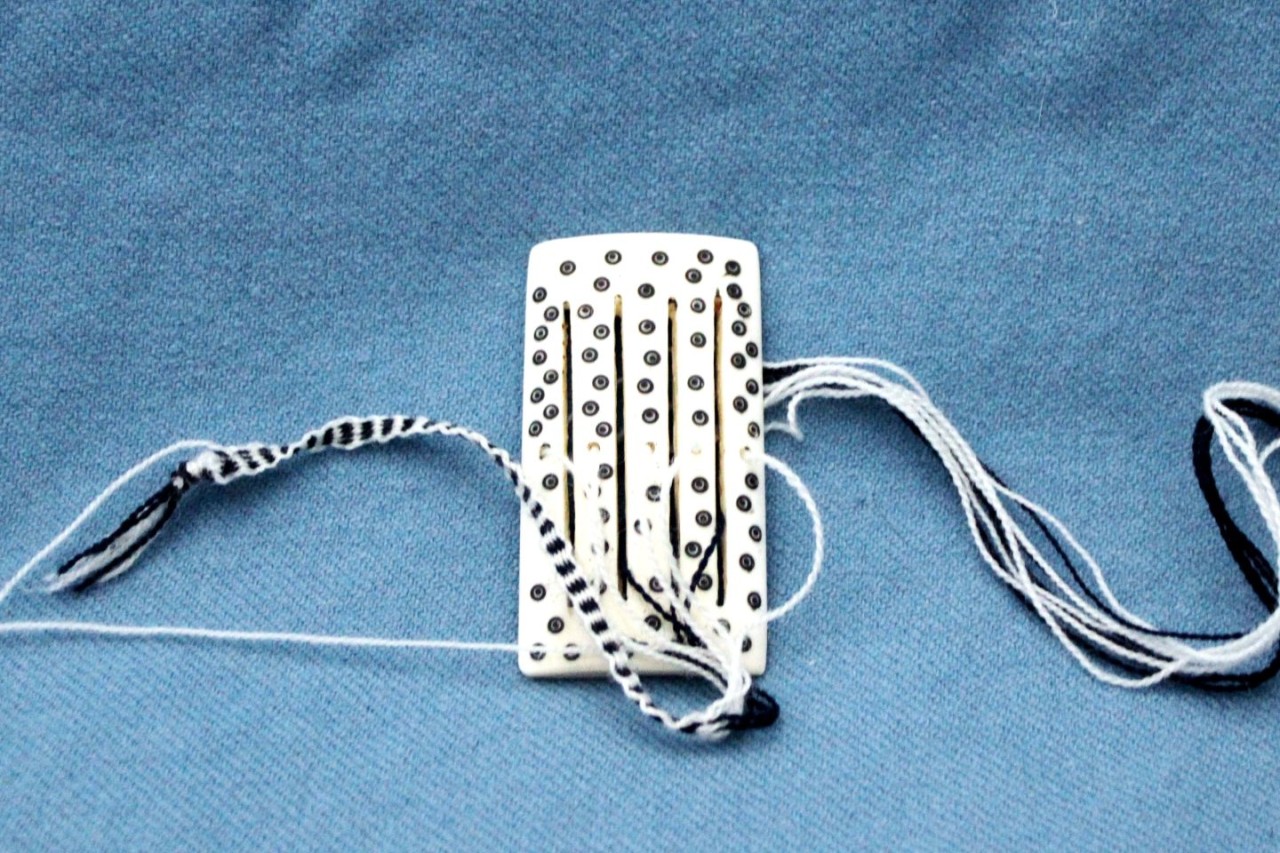
In this case, one of my lovely colleagues had done research about Roman-time rigid heddles, made from bone, and was especially interested in one specific piece, which was found (fragmented, unfortunately) in a man's grave. 

So I got asked the question on whether it would be possible to have reconstructions of this... and to both our delight, yes, it was!

It's small but very, very pretty - and with four slits and five holes, that would be enough to make a slim lace, some narrow band for whatever use, or maybe a starting border for a loom. And of course I could not resist to give one of them a little try with a bit of dark and light wool yarn.

The thing is freshly listed in my shop now - you can have a closer look at it here.

0
NOV.
17
2

All is back, and all is well.

This was a wild ride while I was off the blog - first the conference in France, where I had a wonderful time (and probably ate way too much patisserie).  Then a little time off to relax and think of things completely different, as I met up with friends to go to the game fair in Essen. (In case you are new here - yes, I like to play boardgames, and have been going to Essen, which is the world's biggest boardgame fair, for many years now, and it's a blast every time.) 

After coming back from Essen, I had the pleasure of a video meeting for plans for the future, of filming and editing a short video on how to wear medieval hoods, and then it was already time to finish packing the car for the European Textile Forum.

This year, it was wonderfully uncomplicated to fit everything in, even though the loading started with an easy 40+ kg of wood (for the tablet weaving stands). In spite of that, though, there was not much else needed but a bit of yarn, some tablets, some bits and pieces to help with the warping and the weaving, and the usual kitchen odds and ends that I lug along (most important of which is my late gran's big coffee maker). Usually, the car is packed full and there were years when I had to take photographs during the loading so I could be sure that everything would fit back in on the way back, too. This year, it was half-empty in comparison, which felt a little weird but also, well, easy and relaxing.

The Forum itself was, as usual, wonderful if a little exhausting. I've grown old and sensible though and there was no night when I went to bed insanely late, which also means that my coffee consumption stayed within normal human limits, as did my extra tiredness. We looked at different tablet weaving techniques, worked with different materials, and one of the focus points was, I'm tempted to say "of course", brocading. 

A lot of the historical posh and thus preserved bands use brocading as the embellishment technique of choice, and I'm happy to say that I have come some more to terms with this technique. It's still a little fiddly, and a little boring compared to freestyle twill shenanigans if you ask me, but I have gotten much better at seeing the appeal. 

After the Forum... well. I get a week off after the Forum, by tradition. There was a little bit of things I had to sneak in, including some abstract writing for a conference CfP which had the deadline looming, but I did mostly... not so much. The cat was happy to help me sleep in and snuggle a bit longer in the mornings, and I took care of some of the food leftovers by drying, freezing, or salting, and giving away some to the neighbours (cheese just isn't a big favourite in this household). 

And now I'm back and have a long list of stuff to do, as, well, as always. For you, I also have something else:

I've had the pleasure to narrate another story for Cast of Wonders - this time, it's a variation on the Beauty and the Beast theme. I really liked it - and you can either read the story, or listen to the narration, or both, on the Cast of Wonders website. I hope you enjoy it! 

0
OKT.
09
0

Hah.

So... yesterday was spent with some gardening help at my parents' place (where the bushes were in dire need of trimming), and then doing some wood shopping, more or less last-minute before the shops closed, because of course stuff took longer than it was supposed to take.

The wood shopping was, of course, intended to let me make the tablet-weaving frames. Some of the wood parts were rather long (2.5 metres), so I was quite happy that they did just fit into the car. Now there will be a bit of drilling, and a bit of screwing, and a little bit of glueing, and then I hope they will turn out like I planned. I'm not yet fully decided on whether to use our lovely Japanese handsaw or our friend's mechanical saw (which is loud and has a thicker blade ut is much, much faster than my arm), but putting the frames together is not a task for right now, so I can ponder it a little more yet. (Or swap upon realisation that I'd prefer to try the other thing.)

The shopping was quickly done, by the way, it took me a little more than half an hour altogether. But we had done research before and figured out which of the screws and which of the other metal bits and which of the wood bits, so I did know exactly what to get and where to go in the market to pick it up.

It's not exactly going to be a historically correct stand, as there will be modern fittings used, and it will not be as fancy as the originals on images often are, but the only thing I actually want from them is to hold up warps just like the originals did - and for that, not much more is needed than two stable upright posts.

0
OKT.
06
0

Tablet Weaving Stand Plans.

As you might know if you've done medieval-style tablet weaving before, there's a special kind of contraption usually seen when late medieval women are depicted: Some kind of stand with two uprights, one floor crossbar and usually a second crossbar, or some diagonal stabilisers. The warp is then tensioned between the two uprights, and off you go with your weaving work. 

Like here: 

Years ago, I made a simple, easy-to-take-apart stand for myself, though lacking an additional crossbar or something, and only with 1.25 m between the uprights.

Now, the plan is to make some more - but larger this time, and with bits of wood bought in a normal hardware store, and less glueing plus more screwing (hopefully not screwing up, though). That should hopefully make them even nicer to work with, and easier to take apart and put together again, with less wonkyness.

We shall see if that plan works out!

0

By accepting you will be accessing a service provided by a third-party external to https://pallia.net/

Kontakt