Latest Comments

Guest - Aislinn Dyestuff Citizen Science.
09. Oktober 2026
This is a great project. I look forward to the results. Thanks for letting us know.
Guest - Aislinn Time for...
09. Oktober 2026
Looks delicious!
Guest - Katrin Sprang Discussion
18. September 2026
Hi Rachel, I have looked for more photos of you, but that was not very successful. I found a link on...
Guest - Beatrix Sprang Discussion
15. September 2026
That lozenge pattern element is not a photograph, but a scan. So it should be to scale. But I pinned...
Guest - Katrin Sprang Discussion
15. September 2026
I was not referring to Rachel's reconstruction (is the reconstruction you refer to the one photograp...
APR.
11
0

A bit of weaving.

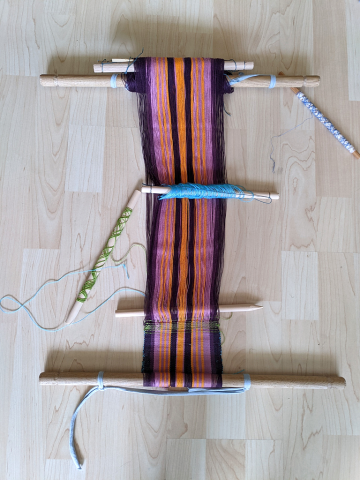
I had the pleasure yesterday to meet up with three lovely colleagues for a little bit of weaving together - working with backstrap loom techniques used by the Maya in Guatemala. 

It was really fascinating for me to see the overlaps and the differences between the other bits of backstrap weaving that I have done. Some things remain the same, some things are done slightly differently, some are very different. I've also managed to do a few of the steps much better than in previous tries - so I was pretty chuffed at the end of the day. 

 I'm especially fond of the super simple way the heddles were made for this variation - they are just loops pulled across the stick, no knots, no nothing, super quick to make. Which was a good thing, because I didn't get the length right the first time around and had to re-heddle, and then there was an error or two so I had to re-do some bits again. And of course there were two errors in the cross (how did they happen, I ask myself, and why did I not catch them?) so I'm planning to do the heddles again next time I sit down with this and return the two stray slackers to the fold. (Also one of the heddles is too long, and despite several tries at adjusting it which is possible in theory, I have been quite unsuccessful.)

So I returned home a very happy lady after that day, and with a few more insights on what is important on a loom type like this, both in regards to the process and the tools. A grand day out indeed!

0
APR.
10
0

NESAT coming soon...

I'm already looking forward to NESAT - this conference is always a highlight of the three-year-period that NESAT takes place. This time, it will be in Warsaw, Poland. I've been to Poland once already, many years ago, for an excavation, and I have a lot of good memories of these weeks, so it will be really nice to re-visit some of the local delicacies. And, of course, meet with the friends and colleagues from all over Europe.

The conference programme looks quite stuffed with interesting things - you can find it on the website, in case you are interested.

0
APR.
04
0

Warp Weighted Loom Weaving

If you're interested in historical weaving, this video by Marta Hoffmann might make you happy. It shows traditional weaving in Norway, recorded back in 1955; the tradition of using these warp-weighted looms there for this kind of fabric goes back into the 1500s at least.

0
MäRZ
28
0

Pretty Spirals!

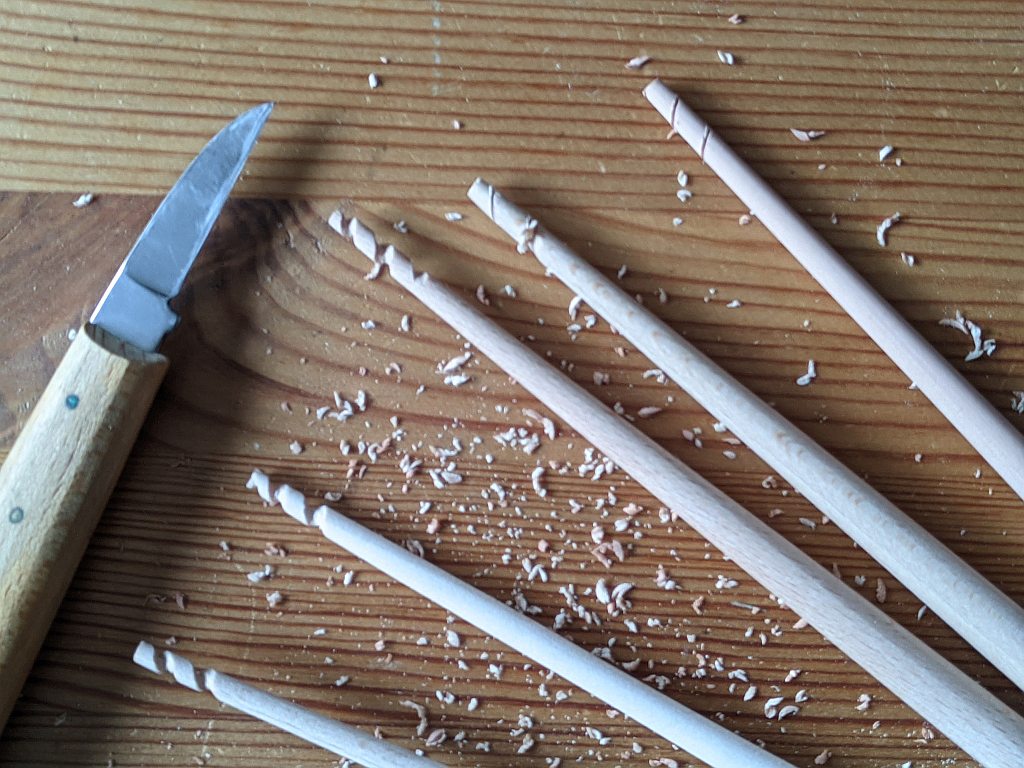
It's not just textile work in the sense of handling fibres here - there's also tool preparation. Such as prepping distaffs for people who order my historical spinning kit with dressed distaff, or cutting notches into spindles.

The latter requires some nice, sharp tools, some courage, and a bit of patience. And, of course, spindle sticks to cut the notches into. 

There's not too many finds of complete spindle sticks from the Middle Ages, and those are usually without notches. However... we do have some finds with notches, and we have plenty of sticks with broken-off ends, which of course happens more easily if there's a weak point in the wood. As in... a notch.

So like in many, many other cases, we have a hard time finding things out for sure.

Personally, I am ambiguous about notches. Having them can be nice, and spinning with them is fun if you just sort of slot your yarn in without the need of doing a half-hitch. They are also very good to have if, for whatever reason, your yarn keeps slipping off otherwise. (When I did the membrane thread spinning, I found that no notch was a no-go for me; this is the one technique where I absolutely want a nice, deep horizontal notch to put my half-hitch in.) But they will limit you in other ways  - a horizontal notch means you can spin s or z, but you still need a half-hitch, and it will hold that securely even when you want to take it off for winding. A spiral or diagonal notch means you can spin without a half-hitch... usually. Unless your yarn is too thick, or you fumble, then your spindle will fall; plus this kind of notch limits you to one spin direction.

But there's plenty of people who will appreciate a notch of this or that kind, and I am thoroughly fine with that. So fine that I will happily provide the notches: 

 In this case, the long spiral ones, worked in the different kinds of wood. They look pretty, don't they?

0
MäRZ
27
0

More spinning.

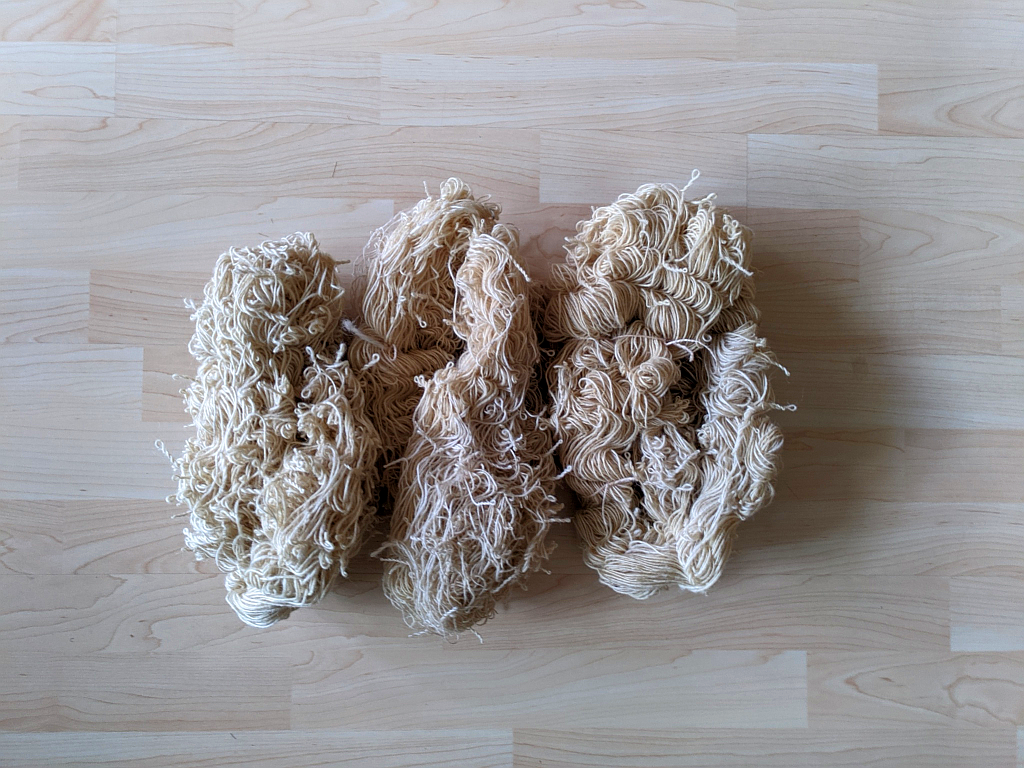
I'm fitting a bit of spinning in every day now - and there's noticeable progress. Or, more precisely: The first three bobbins have been filled, and been reeled off, and now I have the first three skeins of yarn, destined to be the weft yarn for our fabric reconstruction. 

They might not look like much, but it's almost 1.5 km of yarn, with a rather high twist (as you can see from the skeins crunching up). A bit more to go for the weft, and then I will go on to spin the warp yarn, from a different kind of wool and with even higher twist. The warp in the original is actually really, really hard-spun, and it will be interesting to reproduce this. I just hope it will behave on the loom and not be too hard and awkward to weave with!

0
MäRZ
21
0

Conservator Conference "Neu verflechten"

This June, there will be a German conservator conference, called "Neu verflechten", which will even be hybrid - so if you're interested, here is some more info:

27. bis 29. Juni 2024

Neu verflechten!

Textile Netzwerke und Perspektiven im musealen und archäologischen Kontext

Die Fachgruppe Textil und die Studienrichtung Textilien und Archäologische Fasern des Instituts für Restaurierungs- und Konservierungswissenschaft (CICS) der TH Köln laden zu einer gemeinsamen Fachtagung unter dem Titel "Neu verflechten"! Textile Netzwerke und Perspektiven im musealen und archäologischen Kontext" vom 27. bis 29. Juni 2024 an der TH Köln ein.

Die Tagung setzt sich mit den aktuellen Herausforderungen im Umgang mit musealen und archäologischen Textilien auseinander und soll dazu dienen, neue kollegiale Netzwerke zu bilden – zu verflechten. Das Tagungsthema ist bewusst offen gestaltet, um allen aktuellen Themen der Textilrestaurierung Raum zu geben.

Viele der Präsentationen und Poster sind interdisziplinär. Themenschwerpunkte sind vor allem die Textilrestaurierung in der Archäologie, aber auch in der modernen Textilkunst, sowie die Anwendung von Methoden und Materialien anderer Fachgebiete. Begleitend zur Tagung wird eine Ausstellung mit Vernissage (Textiles & Beyond. Positionen zeitgenössischer textilverarbeitender KünstlerInnen. Ausstellung am CICS, Raum 11, 17. bis 29. Juni 2024) angeboten. Bei einem gemeinsamen Abend mit Aperitivo haben wir die Möglichkeit für den Austausch und ein gemütliches Zusammensitzen. Am Ende der drei Veranstaltungstage bieten wir außerdem Führungen durch die Fachbereiche des CICS an.

Wir bieten unsere Tagung in diesem Jahr erstmals hybrid an, sodass auch eine kostengünstigere Online-Teilnahme möglich ist.

Mehr Informationen zur Tagung (Programm und Link zur Anmeldemöglichkeit) hier auf der VDR-Seite.

I will also be there, presenting our membrane thread project - and I'm already looking forward to this a lot! 

0
MäRZ
20
0

Membrane Thread Paper.

Not paper as in paper used to make membrane threads, but a paper about membrane threads - Caroline Solazzo, Cristina Scibè and a couple more researchers have published a paper about their work on membrane gilt threads. It can be found in "Nature", and to my great delight, it's open access.

You can read "Palaeoprotomics and microanalysis reveal techniques of production of animal-based metal threads in medieval textiles." here.

0

By accepting you will be accessing a service provided by a third-party external to https://pallia.net/

Kontakt