Latest Comments

Guest - Aislinn Dyestuff Citizen Science.
09. Oktober 2026
This is a great project. I look forward to the results. Thanks for letting us know.
Guest - Aislinn Time for...
09. Oktober 2026
Looks delicious!
Guest - Katrin Sprang Discussion
18. September 2026
Hi Rachel, I have looked for more photos of you, but that was not very successful. I found a link on...
Guest - Beatrix Sprang Discussion
15. September 2026
That lozenge pattern element is not a photograph, but a scan. So it should be to scale. But I pinned...
Guest - Katrin Sprang Discussion
15. September 2026
I was not referring to Rachel's reconstruction (is the reconstruction you refer to the one photograp...
FEB.
15
0

Yarn!

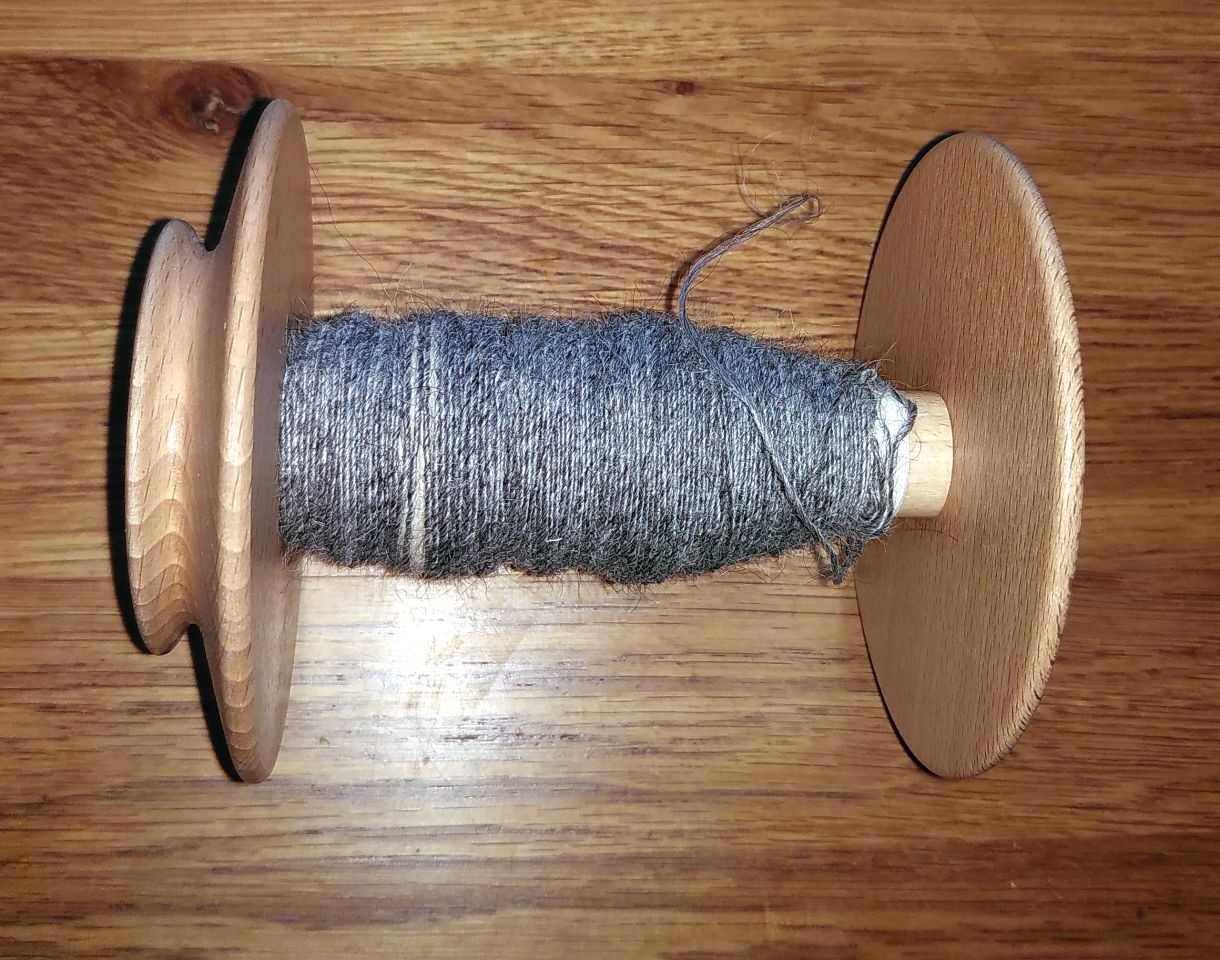
Since I was asked about progress on the reconstruction process... well. Here's a first glimpse of the yarn from the test-spin, still on the bobbin: 

I've done a bit of spinning with both Valais Blacknose and Gotland wool, and though I'd have preferred to like the Valais better... I'm inclined towards the Gotland right now, at least for the warp. It's a bit easier to spin, and it comes closer to my impression of the original warp. The weft, though... it might well be that the Valais is better suited for that. 

The new empty bobbin is already sitting on the spinner, ready for the s-spun weft test yarn. Now if I hadn't gotten sidetracked with a lot of other things to do today... 

Mind you, I'm not complaining. But sometimes juggling all the things that have deadlines, or do not have deadlines but still need attention... well. You probably know what I mean! 

0
FEB.
14
0

Presentation Video (in German)

A good while ago, I had a lovely trip to Vienna, where I gave a presentation which was also streamed online and recorded. So once I returned home, I put "check out and link to recording" on my to-do-list. 

And then, as things go, it took a while for it to be processed and uploaded, and in the meantime my to-do-list did some growing... so the item wandered ever further down the list. There's a stack of items in that part, things I'd like to do or check out but that are neither urgent nor really important, and they sit there waiting, patiently, for their day to come.

Once in a while, I scroll down the list to that half-forgotten part, and sometimes I drag an item back up to the top... and then sometimes-sometimes, I actually deal with it. 

In this case, here you are, the presentation I gave in Vienna:

I hope you enjoy it! 

0
FEB.
13
0

Bayeux Embroidery.

In case you're looking for a bit of embroidery input, my fabulous colleague Alexandra Makin is working on a Bayeux-related project, and her newest update is available on YouTube. She's talking about how to transfer the design in that installation: 

This is right on top of my list of things to watch now - I'm very much looking forward to finding out more about how she will handle this! 

For my own projects, I've usually traced the design, using a window or a table (depending on how strong the lines on the design original were, and how thick the fabric was) and went at it with my iron gall ink. More rarely I did use the pounce method with charcoal dust and then tracing with ink, and even more rarely I've done freestyle drawing with charcoal, followed by tracing what I was happy with in ink. (Or, extremely rarely because of the small project size, just using the charcoal lines.)

I always find it fascinating to find out more about the original tracings on fabric, and especially to see how much, in many cases, the embroiderers just did as freestyle shading. That, however, is often hard to see, as you usually have either the drawing (when the threads fell out and are lost) or the embroidery (hiding all lines drawn on the fabric)...

0
FEB.
12
0

There's a Chosen One.

The fabric reconstruction project I was writing about on Friday? I've seen images of the two (quite similar) textile fragments now that will be our aim, and they are really, really beautiful.

At least to my eyes, that is.

Objectively, they are nothing really spectacular. 2/2 twill, with a hard-spun warp and a softer-spun, thicker weft. The warp, as is usual, in z and the weft in s; the fibres look quite thick and shiny. With only about 5-8 threads per centimeter, the fabrics are not even really fine, which is a good thing in this case - as much as I'm tickled by the idea of one day trying to recreate a really fine fabric (preferably one with a spin patterning, that would be extra cool), as we're a little short regarding the timeframe, I'm happy to have a bit less to spin. 

Next step: Test spinning! With the aim of spinning a yarn as similar as possible to that in the original piece. Which is always including some guesstimation, because the yarn will change when the twist is set, and then again when it's in the weave...

0
FEB.
09
0

Calculations.

It's looking like there will be an exciting fabric reconstruction project in the near future - the very near future, as our time-until-delivery is uncomfortably short. Which, to be fair, is anything less than 12 months for most fabric reconstruction projects.

The issue is that there's a lot of steps involved, and they can take quite a bit of time, plus there's also the lag time for cooperative projects that one has to figure in. And fabric reconstructions are usually cooperative projects, it's rather rare that one single person does all the research, all the spinning, and all the weaving single-handedly. 

Fabric reconstruction projects are exciting, and I love them, but they are beasts. Beasts, I can tell you.

First it starts with choosing a fabric - it has to fit the timeframe, and there has to be enough data available on it. Ideally, it's a large enough fragment to get a good impression of yarn style (thickness and regularity or irregularity, though most yarns are pretty evenly spun), how the fabric looks, and it's a jackpot if there's a selvedge involved, though we're not going to get greedy. 

Fibre analysis would also be nice, because using a different yarn from a different sheep breed's wool will also make a difference. Not all of the original finds had a fibre analysis done, and that is usually "just" a histogram of thicknesses at best, no information about curl, crimp, or fibre length. Because I don't have a microscope that's really suited to do fibre thickness measurements, I'm also sort of depending on help in that department. Which means... time. 

Then there's the first task of finding a suitable modern material, in a suitable form of prep. In theory, one could get the raw fibre and do the prep as part of the project, but then we're talking a few extra months, and a lot of extra hours - probably more than an even generous budget would support. (Unless it's a tiny piece of fabric that is planned to get woven. Once we're in the proper production range, we're quite soon at talking kilograms. Processed, mind you.)

Then there's test spinning, and test weaving, to figure out if things will work out as they are intended to do. Or, to put it better, if there's a good chance they will - if you're a knitter, and have been lied to by one (or more) of your swatches, you'll know exactly what I am getting at. Smaller pieces will give an impression on whether this should be workable or not, or if there's something extremely off, but the big piece will always behave differently than the small test cloth.

Afterwards, there's the spinning - to the specifications that are now more or less fixed, according to the data from the original and the results of the weaving test. And then, as the last step, the Moment of Truth (TM) - the actual weaving of the thing.

Since the last larger project, I have a little excel sheet for calculating the amounts of yarn that I need to spin for a piece with given measurements and thread count, to get a rough estimate of spinning time necessary. Unfortunately, spinning time can also vary quite a lot depending on the yarn style and the fibre, even when using the same spinning tool. (Which in my case, due to time and budget considerations, is usually the e-spinner.) Again, of course I can take the time when I test-spin for the test-weave, and I do - but just like swatches can lie, the test-spinning speed can lie as well. So it's an estimate only, and has to be taken with a grain of salt.

Well, my current calculations say that the fabric might be possible with only about 60 hours of spinning time, plus the test spinning time... that's not too bad, right? 

The data I need for the current project-in-the-stage-of-hope will hopefully come together during the next week, and then I will have to get started spinning as quickly as possible. Because in textile reconstruction terms, September is... tomorrow. Keep your fingers crossed for me that things will work out!

0
FEB.
07
0

More Whorls!

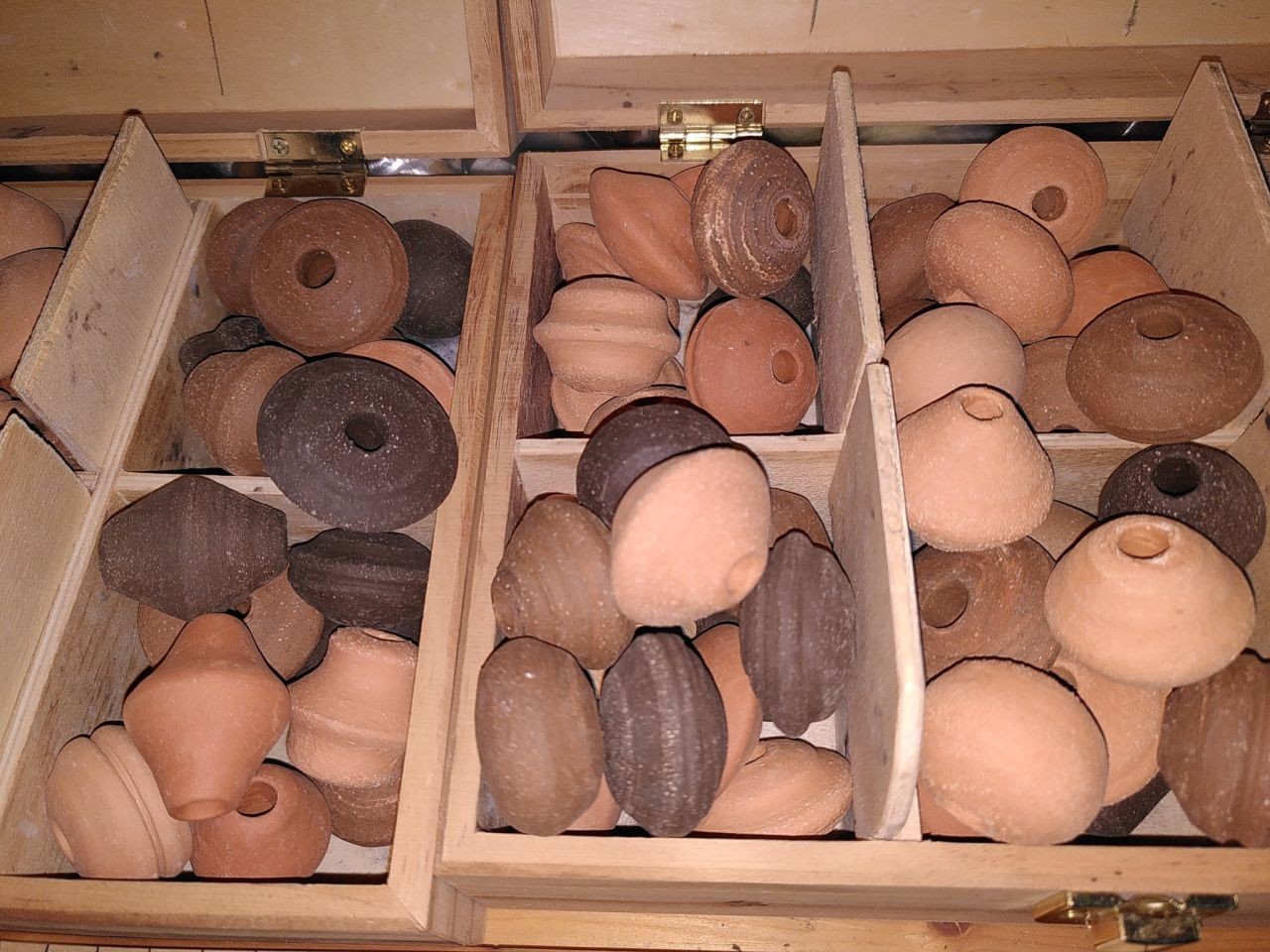
The latest delivery of spindle whorls has arrived - just in time, as I was running low on some of the weight ranges. It's always making me happy to sort the new whorls into stock...

...and then send them off to new homes, one by one, as they get ordered. There's quite often some rummaging when I get requests for a specific shape or colour, or for both - so I might dive into the stash and not just the sorting boxes, but the boxes are very handy, and are also what travels with me when I go to a fair or market. Very handy - and it saves searching through a big box of whorls and weighing them several times!

0
JAN.
30
0

Maintenance.

 Insight of the day? My website is rather large, taken everything together (the years of blogging, with images, have added up, and so do the shop pictures). Which means that if I take backups of the site (a good thing), I should sort of keep an eye on where I put them, and at some point delete them again.

I've been pretty good at doing that on the website/server itself, as there's limited space available there and I would have run out long ago otherwise. Not so good at keeping track of the backup backlog and buildup on my computer itself, where I'll pull older backups (but not so very old) before deleting them from the server, just in case. Or, when there's a larger change on the website coming up or a migration is necessary, I'll pull backups down and do a local install. 

Migrations and larger changes usually mean a generous number of backups, too. And I've been rather happy to close the thing after getting everything up and running when I did those larger changes... which means that the backups stayed in their little corner of my computer. No problem and nothing wrong with keeping them for a month or two, mind you, until it's clear that everything is running smoothly with the new setup.

However... after a month or two, I'd totally forget about having them. Until I've recently come across some, neatly and nicely labelled (as opposed to others) and realised how much space they are eating up, all of them combined.

So I've been doing a bit of maintenance on the side. Just in case you now feel like that might be something you should maybe do, here's my two favourite tools for finding and deleting stuff that has served its purposes:

WizTree - this scans your drive and sorts folders by how much space they take up. There's also a nice visual to quickly show you what you have, and how large individual folders and the files therein are. 

Anti-Twin - this looks for duplicate files and lets you remove them (either by selecting them manually, or by folder, or other criteria). It has not been updated since 2012, but it's still downloadable and does work with Windows 10, and according to the site also Windows 11.

As always, make sure you know what you're doing before deleting things - but don't be like me and hold on to ten year old double backups, just in case! ; ) 

0

By accepting you will be accessing a service provided by a third-party external to https://pallia.net/

Kontakt