Latest Comments

Guest - Aislinn Dyestuff Citizen Science.
09. Oktober 2026
This is a great project. I look forward to the results. Thanks for letting us know.
Guest - Aislinn Time for...
09. Oktober 2026
Looks delicious!
Guest - Katrin Sprang Discussion
18. September 2026
Hi Rachel, I have looked for more photos of you, but that was not very successful. I found a link on...
Guest - Beatrix Sprang Discussion
15. September 2026
That lozenge pattern element is not a photograph, but a scan. So it should be to scale. But I pinned...
Guest - Katrin Sprang Discussion
15. September 2026
I was not referring to Rachel's reconstruction (is the reconstruction you refer to the one photograp...
OKT.
27
0

Template Update.

Planning an experiment is like planning a reconstruction - it's really, really easy to forget something. Where something can be a minor detail or, if one is a bit unlucky, something that seems like a minor detail at first but turns out to be rather crucial. 

 I've also found, in the number of experiments that I've either run, or co-run, or been somehow a part of, that it is quite easy to forget that one had planned to make photos at a specific point, or that something has to be changed and this all results in a number of hectic notes that are scribbled somewhere.

Part of that is just business as usual. Not every experiment runs as planned, and sometimes adjustments have to be made on the fly. But I found that good prep is really helpful... and that having a good template for the planning makes the good prep easier.

I've recently updated the experiment planning template on the Textile Forum website, and if you're interested, you can find it here. In case you are using it, please let me know if you have any comments or feedback - I'm always happy to hear about this!

0
OKT.
25
0

Zoom Presentations in Vienna

If you're interested in clothing and understand German, there's a lecture series currently ongoing, organised by the Art History faculty in Vienna. There will be three presentations about clothes as items of daily life, the next one on Wednesday, November 15.

The presentations will be streamed via Zoom, and you can join in for free. You can find more information and the link on the website. 

0
OKT.
24
2

Freshly Dug Out.

These are madder roots from our garden, freshly dug out. They'll make part of the second part of our experiment on madder dyeing - using different batches of madder with the same water, and see how different they will come out.

Madder is said to get better the longer it matures - first in the ground, then once harvested, resting time of a few years is also said to make it better. But I figure that too-fresh madder may be better than no madder at all...

It will be dried now and then ground up, and I hope for a yield of at least 30 g afterwards (though in a pinch, 10 g would be enough). It would definitely be nice to have some more samples to test. So - do you happen to have a bit of dried madder to spare? Would you be willing to donate 10 to 30 g of it for our experiment?

0
OKT.
20
0

Dyer's Strong Water!

Dyeing recipes are, well, let's say they often are interesting. And usually they will raise a lot of questions. And then some more.

First of all, just like old recipes for cooking, medieval and early modern dyeing recipes go easy on the measurements. Which makes a lot of sense because measuring stuff easily and precisely, like it's possible with modern scales, was not a thing back then. Also, just like with cooking food, variabilities can be quite large, which means that you'd have to gauge by experience if this is too much, too little, or just right.

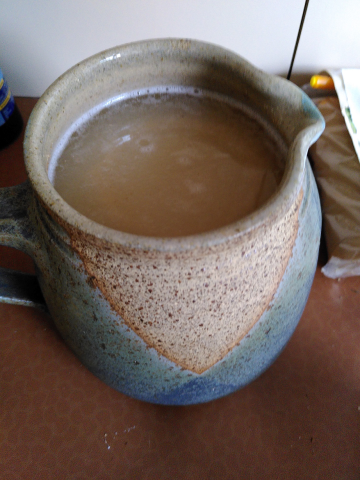
And then there's the question of what is meant by a specific term. Such as... bran. That, it seems, can either be bran (as in wheat bran) just added to the dyebath, or it's fermented bran - if you let the stuff sit in a bit of water, it starts to ferment, turning slightly acidic.

Some of the recipes that we plan to look at during the Textile Forum also mention that as an ingredient - it also goes by the moniker "dyer's strong water" in some cases.

So guess what happened here in the kitchen?

It's fermented bran - I got a taste of it when I was in Romania, where it's called "borș", and it does have a quite pleasant taste. If you're curious now, you can read more about it in Wikipedia, and if you google for recipes, you will get some instructions about it. I tried with added (dry, actual Romanian) bread in the mix first, as many of the instructions tell you to, but I left it for a bit too long and the bread went mouldy. So in the second attempt, I used only bran and water - it took a bit longer for it to turn sour, but it was a success that time.

So now I'm looking forward to trying this in the dyeing! 

0
OKT.
19
0

Weekend Prep: Animal Done.

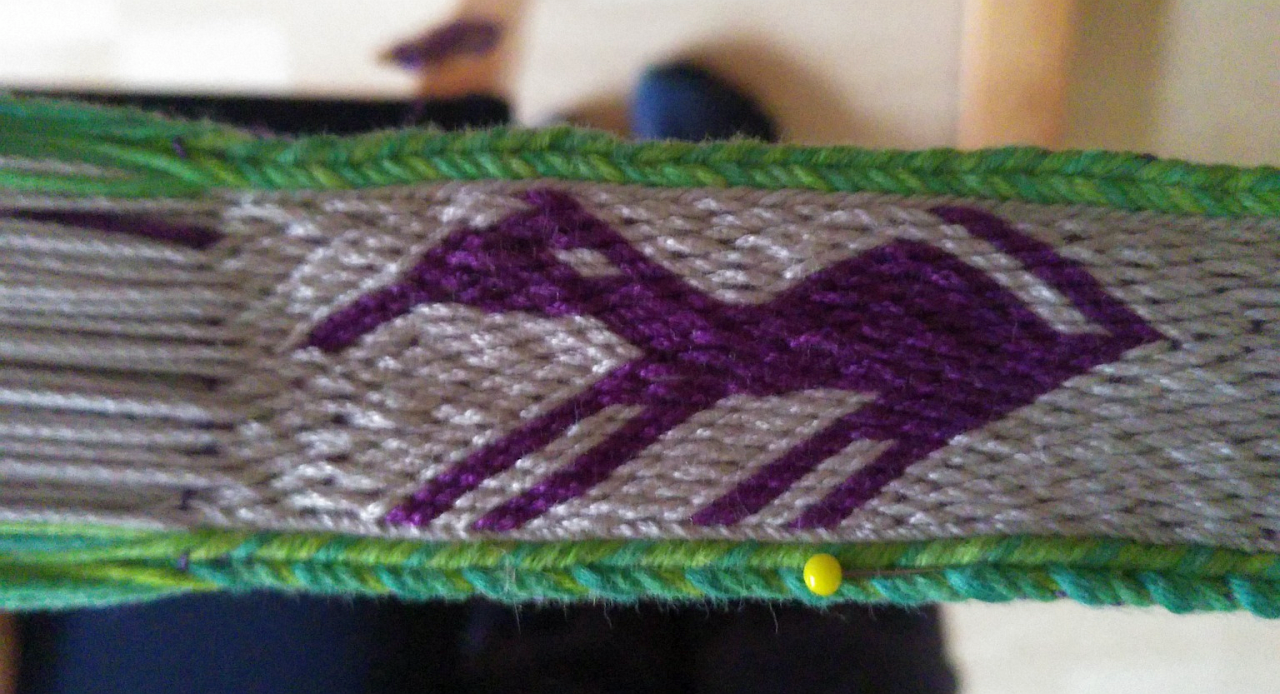
The weekend prep is continuing, and one of the tasks was to get the "show band" ready for... well... the show. Which meant finishing the half-done motif that was currently on there.

Last time I played around with that was way too long ago, and it was trying to freestyle copy the Evebø dog (or whatever it's supposed to be). I can't remember exactly what happened at some point when it was time to split the forelegs, but something must have happened. Maybe I made a mistake, or something came up and I had no more time, or - well. The result, in any case, was me stopping the weave for a while.

A long while.

So I now sat down, undid the last twists to make sure everything was aligned properly, fiddled with the tension, and tried to figure out where I'd been and what to do next. As usual in my attempts to do the doggy beast, it did not work out entirely as I had planned...

...so I have another slightly faulty, slightly weird and crooked animal to add to the zoo. One of these days, though, I'll manage to do one properly. Without weird butts, or weird forelegs, or weird eyes, or weird snouts and foreheads.

Anyway, the beast is done, and now I will add a little bit of white background (just a centimetre or two) before segueing into diagonals, which is what I have planned for the demonstration. 

Go see me in the Stadtmuseum on Saturday 20:00 to 22:30 to meet this little beast in person! 

0
OKT.
18
1

Mmh... maybe a little less wool.

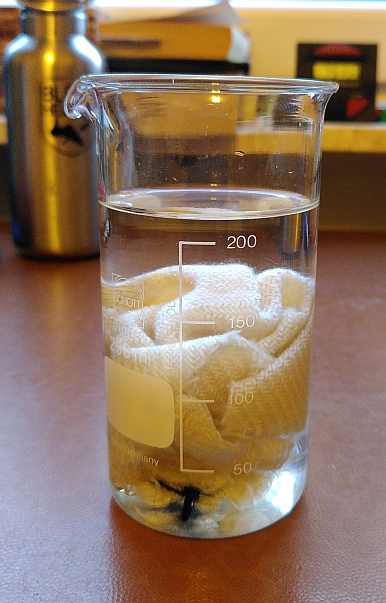
Just in case you were curious on how much wool one can fit into a 250 ml lab glass beaker, it's about 12 g of dry goods in this example, consisting of a small skein of yarn and a piece of fabric about 17 cm square:

tIt fits, but there's not much floating possibility... so it might be a good idea to put in a little less wool. Probably a smaller piece of fabric, and maybe a little more yarn to stay at sort-of-sensible amounts (but yarn will be a bit less, um, stiff?).

It's always fascinating to watch things unfold and questions come up when planning an experiment. There's usually a lot of aspects, and one has to decide on how to handle each one, while knowing that in many cases there's no really good solution that will cover all the possibilities..

0
OKT.
16
2

Collecting Waters...

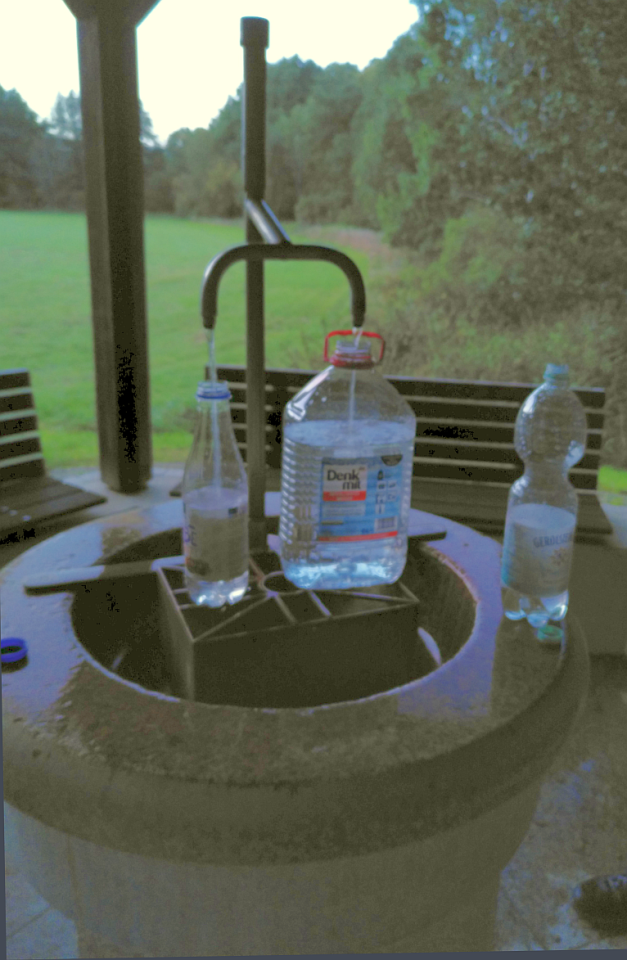
There's an experiment coming up that I'm really, really excited about - we're going to test the influence of different waters at the Textile Forum. It's a truth universally acknowledged by all dyers that water has quite an influence on the outcome of madder dyeing, and that some are better and others worse for getting a good red colour, but as far as I know, there hasen't been a systematic test of that yet.

Aaaand that's what we're going to change, to my great delight! The plan is to mordant and dye some samples in water from different sources (same water for mordanting and dyeing, since we know from the Pompeii experiment that the influence of the kettle material is present both through mordanting and dyeing, and it adds up, so presumably the bigger difference will be seen when using the same water for both). We'll use the same wool, the same madder (ground madder roots is the plan) in the same amounts, and of course the same amount of alum for mordanting for each of the samples, and heat everything together in a large water bath so it is all as much the same as humanly possible. Reference will be done using de-ionised water so we'll also have a sample where there's really only the madder and the alum interacting with the wool. 

And then we will see what the differences are. I've already been collecting some samples of water, including a bottle of tap water from Sibiu airport (my first deed after getting through the security circus), a bottle of tap water from my home town, and a bottle of a spring close to my home town that has a lot of iron in it.

It has a very strong taste - very slightly sour, with a tiny bit of natural carbonisation, and you can taste the iron in it, and I personally find it utterly delicious and love to drink it. I will keep myself from consuming the sample, though, all in the name of science!  

0

By accepting you will be accessing a service provided by a third-party external to https://pallia.net/

Kontakt