Latest Comments

Guest - Aislinn Dyestuff Citizen Science.
09. Oktober 2026
This is a great project. I look forward to the results. Thanks for letting us know.
Guest - Aislinn Time for...
09. Oktober 2026
Looks delicious!
Guest - Katrin Sprang Discussion
18. September 2026
Hi Rachel, I have looked for more photos of you, but that was not very successful. I found a link on...
Guest - Beatrix Sprang Discussion
15. September 2026
That lozenge pattern element is not a photograph, but a scan. So it should be to scale. But I pinned...
Guest - Katrin Sprang Discussion
15. September 2026
I was not referring to Rachel's reconstruction (is the reconstruction you refer to the one photograp...
JAN.
29
0

Petition for Lead.

Lead is, as probably everybody knows, a toxic metal - so it's not an utterly good idea to use it where it's not absolutely necessary. 

It was, however, widely used in a lot of places throughout history, because it's not only toxic, it's also very useful for a lot of things. Lead is soft and malleable, it can stand a lot of stress before breaking (it stretches instead), it makes a nice white (lead white), and it has a very low melting point - all things that led to lead being used for projectiles, water pipes, roofing, ceramic glazes, lead crystal, stained glass windows, and a plethora of other stuff (fuel additive, if you're looking for a rather modern example...).

Today, there's good replacements for lead about everywhere. However, in some instances in conservation and restoration, lead can still be a critical element, without a good replacement. Sometimes matching the original materials is crucial to prevent unwanted reactions between the original and the reconstructed parts. 

However, due to the toxicity, there's the plan to ban lead completely from being used, in all of Europe. This has been petitioned against by conservators. One of the issues is the primary ban of lead, the second issue is the very hard limits on lead "pollution" in the workspace. The petition, which is supported by German conservators, is currently running and on the EU portal. You can support it by signing it (that will require you to register, for free, on the portal) - and I'd be delighted if you would do so, and spread the word to other people too!

The petition on the EU portal can be found here, under 0724/2023. You can read more about the petition in German on the page of the Verband deutscher Restauratoren. 
0
JAN.
18
0

Loomy Thoughts.

It's really interesting, and a little funny, how sometimes things come back into play that were done for quite different reasons, and a good while ago. Just like today, when I had a phone chat with a colleague and it turned to the topic of looms, and building looms.

That is a topic that I would like to get into a bit more, especially the early medieval horizontal looms. I've had chats with a number of weavers over time, and apparently there's a lot of different loom types, and they will behave quite differently and stress the yarns in different ways, so it would be extremely interesting to try and find out what would be best suited for medieval fabrics.

And now I am pondering how much one needs to know about looms and weaving to be able to build a loom. Is it sufficient to have good, exact plans for a functioning loom? Are there good, exact plans for a functioning loom? Or is it more a project where you'd need to adjust things no matter how elaborate your plans are, and have to know exactly what you are doing, and why, for it to work?

I've had issues with getting tools made before, when the tool-maker was good at their job, but did not know enough about the function of the tool. In my experience, it's unfortunately rather common for craftspeople to make adjustments to the instructions or measurements that you have given them, and that is rarely to the benefit of the tools' functionality afterwards. 

For a warp-weighted loom, there's not too many things that are crucial for the function, and I think I could list all of them without too much trouble. It's a relatively simple tool, after all. But I would not be as positive about knowing what to look out for when building a horizontal loom. And now there's that itch in the back of my brain saying... What would it be? How difficult would it be? How many tries would be necessary to make a good one?

Probably a good thing I don't have the space for a loom here, or the ambition to have one. Otherwise, that woodworking workshop in the basement might be very tempting!

0
JAN.
11
2

Happy New Year!

Happy New Year, dear readers of this blog - I hope you had a good end of the last one and a glorious start into this year! Mine was partly spent with a rather obnoxious cold, so there was a bit more sneezing and a lot more sleeping than I had planned for.

Of couse I'm well again in time to get back to work... timing, right? But it's nice and interesting work that I'm getting back to, so that is definitely on the pro side. (Well, mostly nice and interesting - I just remembered there's tax paperwork to file in the next few weeks, too...)

There's also planning for some conferences and events in the current year. I will be at the Nadelwelt again in May, and then there's the NESAT conference in May as well. The museum in Syke plans a Bronze Age weekend event in August, where I will show things... but the next thing coming up is the Knitting History Forum conference on February 3. 

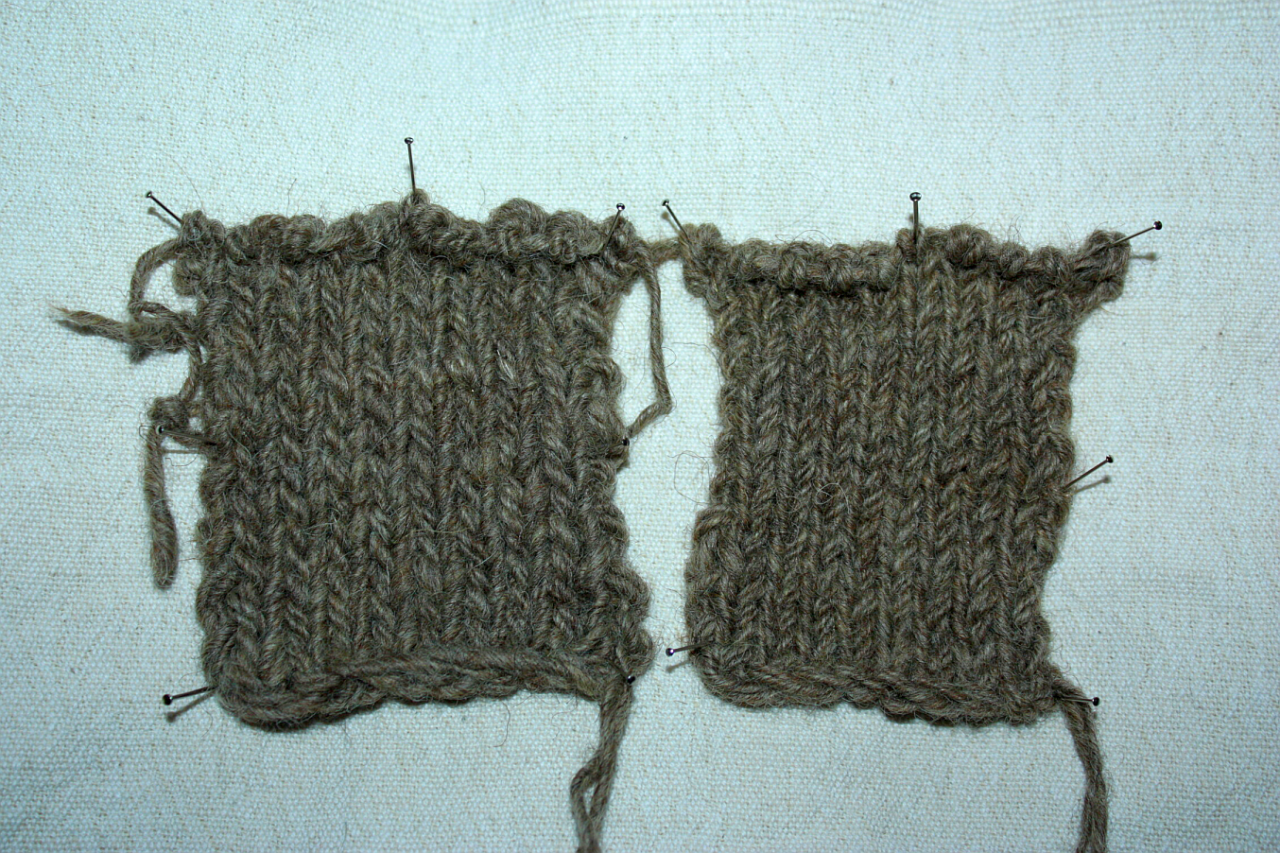
I will talk about spinning, twist, and its influence on knitting at that event, and some bits for that paper are still in the works. So here's a sneak peek for you:

These are knit from the same wool, spun once in z and once in s, with two threads held together (not plied). I've done this before, the not-plied-thing, with rather... interesting results once it got washed. This time, I'm also going to see about the differences in spin direction, including the visual ones. Next up will be the same knitting, but with plied yarns instead of yarns held parallel.

(I was hoping for the two bits to turn out the same size, but alas, the threads of one were a bit thinner than the others, or else I messed up the tension. Ah well.)

If you're interested in the outcome, consider joining the conference! It's online only, so you can attend from wherever you are. More about it, including the programme and the link to get tickets, can be found on the conference website. 

0
DEZ.
08
1

NESAT in Warsaw, May 2024.

NESAT will be taking place again next year - and I'm so very much looking forward to it already! It's always a wonderful opportunity to go somewhere and meet up with old and new colleagues. If you're not familiar with this conference, NESAT stands for "North European Symposium for Archaeological Textiles" and was started to make textile archeologists feel less lonely once in a while.

This means every three years - last one was the virtual conference (due to Covid) in Oulu, Finland, but now we're looking to meet up in person in Poland for the next one. To my great delight, the paper about membrane gold threads that Tracy and I have proposed was accepted, so we'll be able to talk about our project there in May!

In case you're interested, you can learn more about the upcoming conference, and the past ones, on their webpage. Registration is also open now until end of February.

0
DEZ.
06
0

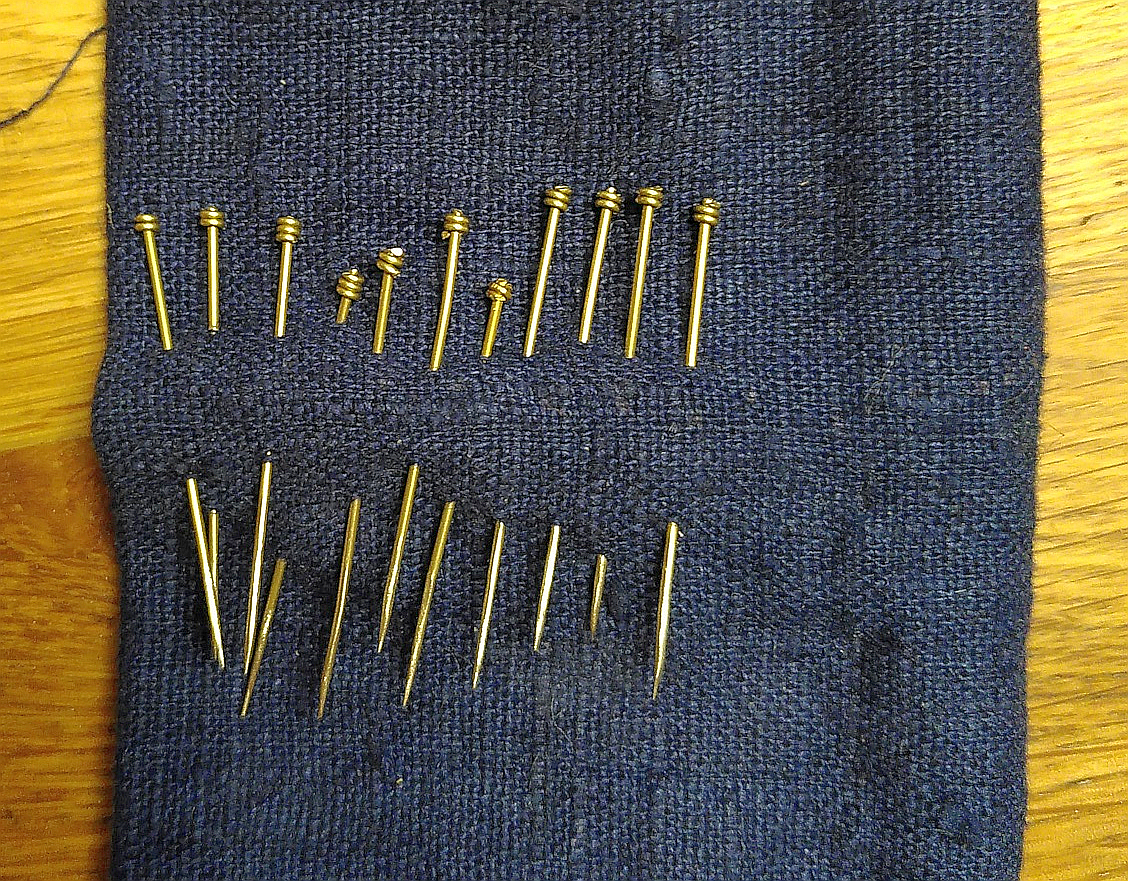
Small, Pointy, Shiny.

Today's been mostly spent with odds and ends - packing away stuff, trying to sort out some more of the Textile Forum backlog (as in doing some colour documentation/checking and putting away the dried lake we made from the used-up dyebaths), packing up things to go into the post... and then realising that I'm about to run out of stock with the brass pins.

So I made some more. 

It's fun to make these, and it definitely got easier with practice. Also I find that getting exactly the "right" amount of windings cut off (which is two, not one and not three) is the optimum for going forward.

More windings are harder to get onto the shaft - and less than two increases significantly the probability that the head will not sit firmly enough on the shaft. So that, for me, is definitely a good set of reasons to try and get them headed just like the originals...

0
DEZ.
01
0

Repositories...

By chance, I've stumbled across a new repository framework - called EUDAT. It's intended to help researchers, both institutionalised and independent, to save, store, publish and share their research and research data. That sounds fantastic, and it's now on my list of things to look at it a little more, and see if that might be a good thing for the Textile Forum data that's been accumulated.

As the documentation and info I've already looked at tells me, it is based on the Invenio software, which, to my delight, is also free and open source... and might be a solution for my (still unresolved) photo database problem. Another thing to look into. Seems like it will not get boring around here!

0
NOV.
29
0

Everything As Always. Mostly.

Well, maybe not completely - we took a little break this noon to watch one of our friends give a presentation. But otherwise - it's cold outside these days, and there's even some snow, as is fitting for this time of year. The little cat likes to hang out on my desk, lying on my right arm and occasionally "helping" by adding a lot of empty spaces, or äääääää, or whatever her paw happens to hit as she stretches (or walks off, across the keyboard, of course). 

While she is chilling, I am trying to keep up with the things on my list - wrapping up Forum stuff and working on the museum projects that I have in the pipeline. And, of course, the shop. As November is almost over, it's high time to send the monthly newsletter... and in theory, being a good shopkeeper and marketing person, I should (have) put in there a lot of things to animate people to buy stuff for Xmas. 

But... well. Just a few days ago, there was all this "Black Friday" and "Black Week" madness, with ad bombardments everywhere and gazillions of "great deal!" newsletters, and I'm already being bombarded as well with reminders that Xmas is coming up and I might want to buy this or that as a present. And frankly, I'm quite sick of all this demand to be a good consumer and buy, buy, buy. It's just too much. 

So I did decide not to do the usual pre-Xmas-extra advertising this year - the newsletter is mostly like any other one during the year. I've never been very good at tooting my own horn for the stuff I sell, but my hope is that it will speak for itself well enough to keep things going. And maybe I'll feel more like "hey! go buy this!" next year again, when the consumerism craze of the end-of-year has passed... 

0

By accepting you will be accessing a service provided by a third-party external to https://pallia.net/

Kontakt