
Latest Comments

Guest - Katrin Sprang Discussion
18. September 2026
Hi Rachel, I have looked for more photos of you, but that was not very successful. I found a link on...
Guest - Beatrix Sprang Discussion
15. September 2026
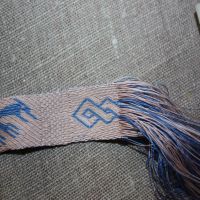
That lozenge pattern element is not a photograph, but a scan. So it should be to scale. But I pinned...
Guest - Katrin Sprang Discussion
15. September 2026
I was not referring to Rachel's reconstruction (is the reconstruction you refer to the one photograp...
Guest - Beatrix Sprang Discussion
14. September 2026
There is something Rachel did not mention. She told me: "Well, I worked with the measurements we too...
Guest - Katrin Sprang Discussion
14. September 2026
Well, this is certainly developing into an interesting discussion. Firstly, going from that lovely l...
AUG.
31
0

Shipping and PPWR Update.

Apparently, the new PPWR rules (because they are still partly under the jurisdiction of each of the EU countries) are not without a de minimis threshold everywhere. (Or even clearly phrased and easily accessible.)

Also apparently,  the Netherlandish institution responsible for their packaging has stated that there is a de minimis threshold of 50 tons of packaging material per year, under which registration is not necessary. They are also interpreting it so that if you don't have to register, you don't have to have an appointed representative.

Which means I am happy to announce that I am re-instating shipping to the Netherlands. (I am also rather miffed about this still. Even if the individual interpretation that I can ship makes me happy, it means that there's even less clarity on the situation. It might be possible that something similar applies to other countries as well, but the research needed to find out about this for each other of the 26 remaining countries is way above what is sensible for me to invest in this, time-wise. It would be really helpful to have sensible rules that are the same for each country, with a central registration, and even more helpful to have an official EU aid that gives out an information newsletter for the businesses in a timely manner, with a clearly worded explanation of what will come up next, who is targeted, and where you can get more information if you need to act.)

So. Shipping to the Netherlands possible again from today.

There also seems to be some movement regarding all this mess. Apparently there was a speech at a conference regarding the EU with clear words that there needs to be changes, or discussion, or whatnot, about these new rules. There's an article here at the EUPerspectives website. I won't be holding my breath, though - and I am convinced that it will be a sensible move to keep pointing out this issue, and keep writing EU representatives about it.
0
AUG.
28
0

Hooray, it's Friday!

And before the week ended, I did manage to do the main cutting for the reconstructed hood with the fancy liripipe. It still needs a bit of decision on how many dagges (probably around 12) around the collar part, and putting together, and making the stuffed face opening ring, but the scariest bit for me is always doing the cutting.

After that, if you've messed up, well, you have to deal with it. But before the first cut, there's still the full range of possibilities, from getting it perfectly right to ruining everything... and that never fails to make me hesitate.

Images will follow once the piece is in a shape to be photographed. At least the fabric is very, very bling-y, so it should look quite fancy! 

0
AUG.
27
0

RIP Harm Paulsen.

A friend messaged me this morning with sad news: Harm Paulsen died yesterday.

If you've been involved in German experimental archaeology, you'll know the name. Harm Paulsen was one of the very, very first experimental archaeologists, back when it was snuffed at and discounted by the "real scientists". He was an expert in Stone Age techniques, and one of the first flintknapping specialists, if not the first one.

I have never had the joy to meet him, but friends of mine have, and they were all full of wonderful stories about this wonderful man. He was a trailblazer for the experimental approach in archaeological science, so I am in his debt as well. He will be sorely missed.

There is a beautiful article about him in English, from an interview that one of his friends did, published in EXARC

Rest in peace, Harm, and thank you for all you did.

0
AUG.
26
0

Germany has AI "art" on a stamp.

A few days ago, I was ordering stamps for my postage needs (or, to be more concise, for the company's postage needs). Among those was a bunch of 1.80 € stamps showing a submarine in the Mariana Trench. Okay, well, the topic was "human as explorers", there was nothing appropriately historical (first choice) or blatantly green and liberal political (second choice), so I went for those.

Without, unfortunately, reading the full description first. Said description tells you who designed the stamp, who made the artwork, and where it was printed - details I usually don't need to know. In this case, though, the artwork was by DALL-E... which is a generative AI.

Have I ranted about the rampant use of AI here already? I think not. Well, imagine a long rant about the incessant use of AI by what seems like everybody these days, from answering simple question a normal search engine could have easily answered, to photo transformation into art in the style of an artist who never consented to their work being used as training material, to having it write up shopping lists and simple emails and whatnot, all the while using gigantic amounts of energy and water. The TL;DR: I can see the uses of machine learning, and I have very much benefitted from using LLMs as translation aids for reading papers in languages I do not read well on my own, but I am very, very suspicious regarding almost all other uses, and especially generative things. (Yes, I also am aware that I might be overdoing it a tad, but at least when it comes to using generative AI for one's own personal amusement, I am out.)

Consequently, when the stamps arrived and I read the small print on them which goes something something interpreted by an AI, I was not amused. At all.

Stamps were always something where some designer got to have a really nice exposure (and hopefully also a really nice wad of cash). They were a glimpse into current design trends, and into interpretations of history, or nice photography. They were a means to highlight activists, scientist, explorers, politicians, architects; of historical events larger and smaller, of places both built and natural.

I am still rather livid about this. I am curating the stamps I use, and now it seems I also have to pay attention not to end up with AI slop. Gaaah. Seems like it's time for an enraged (yet still polite) letter to the post.

(I sent the offending stamps back and ordered others at the same value, by the way. With an honest photograph of a politician who was strongly engaged for social stuff.)

0
AUG.
25
2

Weird ways to put your hood on.

Inspired by yesterday's comment, here's a little elaboration on why I think the red thing Oswald is wearing is a hood.

Around the 1400s and into the earlier part of the 15th century, there's a plethora of hoods being worn, in all kinds of shapes and sizes. There's hoods with no liripipe or a very short one, there's buttoned hoods (sometimes worn open), and there's a number of hoods with a long, wide liripipe, sometimes as long as the wearer.

These are, obviously, not the superpractical functional garments anymore. Instead, they are worn in some rather inventive ways, with the liripipe draped fetchingly across the upper body, the shoulders, the arms. Sometimes the face opening of the hood is stuffed to form a nice shaped ring, like a fabric donut in superlarge, but narrow. Sometimes they also overdo it a bit with the stuffing, like here:

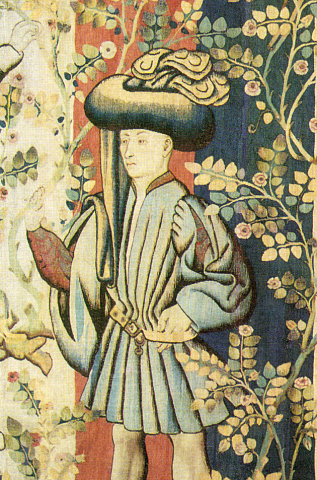
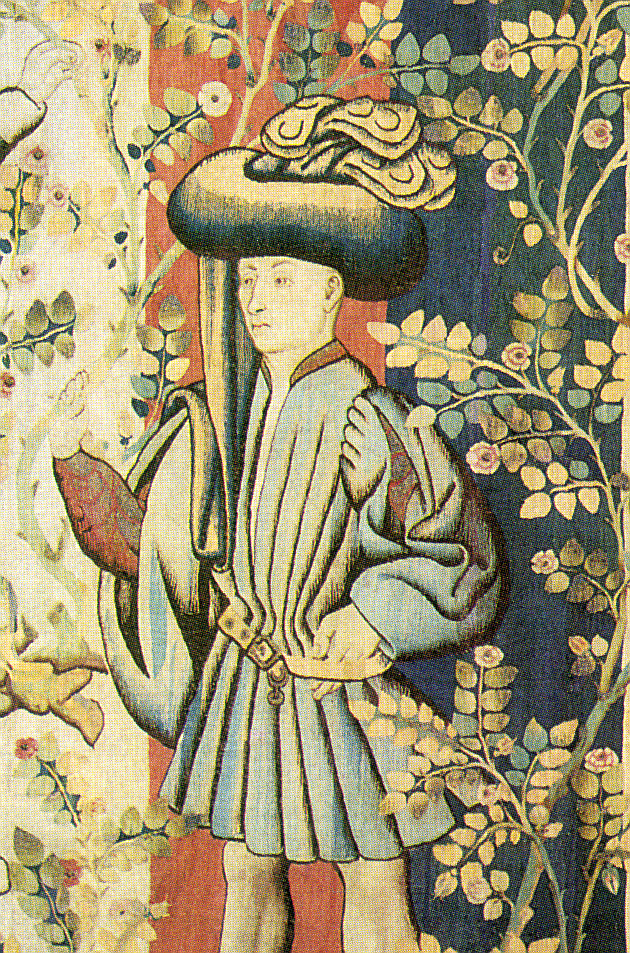
Southern Netherlands, c 1450-1455. Detail from a tapisserie worked in wool, silk and metal threads, 2,89 x 3,25 m. New York, The Metropolitan Museum of Art. Image from Camille, Michael 2000. Die Kunst der Liebe im Mittelalter, Köln, Könemann.

You can see the long liripipe (not dagged in this case) draped across the right shoulder, hanging down in front in a loop and then going to the back. There's the super-overstuffed ring that would once have been the face opening, and it sits on the head, with what would once have been the cape part sticking out on the top with a bit of decorative dagging. 

This is one of the more extreme examples where it's clear that this is not going to function like a normal hood anymore. There's quite a lot more where the modifications have not gone as far, but they do have heavy dagging on the cape, and often a very long and also dagged liripipe.

This long thing can be draped across the shoulder and arm, or sometimes it is wrapped around the head turban-style. There are a few images where it's pulled through one sleeve, coming out near the hand like a decorative fabric waterfall. Unfortunately these are, indeed, rare - but the playing cards from Stuttgart provide several examples, both men and women. You can find the whole series here on the museum digital pages

As the colour and style (patterning) of the thing coming out at the sleeve always matches the hood worn, I am convinced that this is the liripipe being drawn through the sleeve. It works very well; I have a few reconstruction hoods with a similarly ridiculously long dagged tail, and it's quite easily possible to wear them this way, unless your sleeve is super fitted. I have done tests with modern sweaters, and it works just fine. 

On the other hand, while we do have images of extra sleeves being worn by women, these are not, to my knowledge, documented for men; and usually they are also not extra long and spilling out (I only have one layered outfit in mind where it might be the case, that's all). 

My big issue with good old Oswald is thus only the two spilling tails - as a double-tailed hood is not something I have ever come across. However, the Most Patient Husband of Them All suggested yesterday it might be only one, but draped a little weirdly. So can this be?

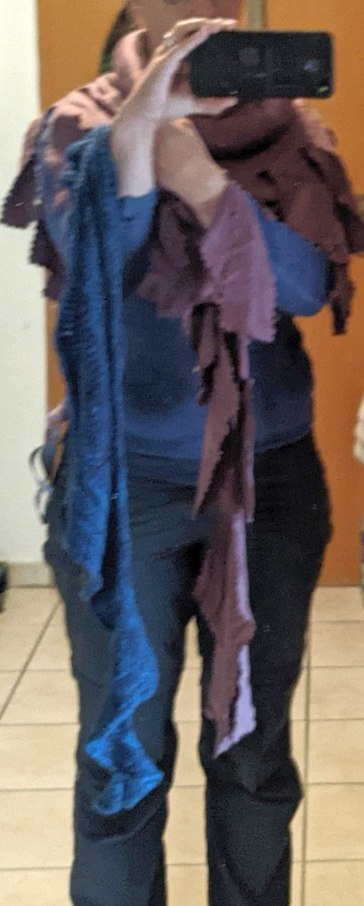
Obviously, this has to be tried out. Unfortunately my hoods do not have the right type of liripipe, so I had to simulate long dagges with a second piece of fabric - but yes, it seems to work. Both the blue scarf and the purple liripipe are coming out of my left sleeve, and one just happens to drape over my right arm. Tree hugging was suspended in favour of holding the phone to make this rather blurry picture, but I hope you can see all the relevant details well enough to be as happy as I am with this possibility!

0
AUG.
24
1

Oswald's Garments.

You might or might not be familiar with St Oswald, also King of Northumbria - I am currently definitely getting to know him a little better.

I have the pleasure to work on a 3D reconstruction of Oswald as he's portrayed in a Garden of Paradise dating to the early 15th century, and like these projects often are, there's a lot to discover and at least as many questions.

The digitised version of the painting can be found at the Städel Museum website, and the guy in question is the one to the right, hugging the tree. There's quite a lot of things going on in the image, but if I only sort of concentrate on Oswald, the primary problems are: What kind of fabrics were used? Especially the red-gold hood is rather unusual; this time saw quite a fancy for hoods with a long, dagged liripipe, and there's a number of illustrations where the liripipe is drawn through a sleeve, but Oswald... has two. That's a new one to me, definitely. (Should you have seen anything like it, please do let me know!)

The cloak could be silk or wool, but I'd lean towards some nice, fulled wool as a practical coat. Then the hose, which I would assume to be joined already, have some gold decor at the shins; the fabric could be either silk or wool. Gold ornaments re more something that makes me think silk, however, wool would be the easier and more budget-friendly choice. In addition, modern silks tend to be quite different from medieval silk fabrics, so I am not sure where I'd be closer to the mark regarding the fabric. (Modern wool is also different from historical wool fabrics. We're basically going for the looks here, trying to get as closely as possible without going for a full fabric reconstruction, as that would not be in the budget in any way, so it's compromises in each case.)

For the whatever he's wearing on his upper body, I'm planning to use some relatively heavy modern silk. Unfortunately, there's not much visible apart from the right sleeve, which looks rather baggy. As there's a teeny tiny bit of mail armour visible on the top of his leg, it can also be supposed that the garment was rather short.

So here we are. Timeframe is in the 1410-20s, so the dagged hood is definitely very nicely fashionable. There's no surviving man's garment from that time exactly, though we have two complete (with a little damage) from mid-14th century (Charles de Blois and Chartres); there's also the garment of the Black Prince, so at least there's some basis to put conjectures on. 

Still, this leaves quite a bit of guesswork, or of interpretative decisions. Which, by the way, is something that is going on so much and all the time with these reconstruction projects. (One of them is also what to start with - the upper garment? The hose? The hood? Hmm...)

0
AUG.
21
2

Aaargh. Or: Digitisation is The Thing.

I mentioned the hose rabbit-warren, right? What I did not mention is that I am also trying to tag, sort, and order all the images that have not been tagged, sorted, and ordered yet (and no, you do not want to know how many there are). Some are doubles that I can delete, some are easy to sort as a chunk (party photos, for example) and some... well, some are tedious.

One of the images was without a caption, date, tag or anything, and it has been hanging out there since it was used as one of the images in my thesis. The original manuscript is the Codex Vindobonensis 1857, or known today as signature Cod. 1857 HAN MAG in the Austrian National Library.

Back when I was writing my thesis, there was digitisation going on, but it had not progressed as far - so in some cases, the way you'd get to see pictures was through facsimiles. They are intended to be as much as the original as possible. For the thesis, I thus took the image from the book in the library in Bamberg; if I remember correctly, I requested the scan, got it on a CD, and used the image.

So picture my surprise when I wanted to tag this image today and thought the nicest and easiest way would be to find the entry for the now-fully-digitised manuscript in the Austrian Library... and found this:

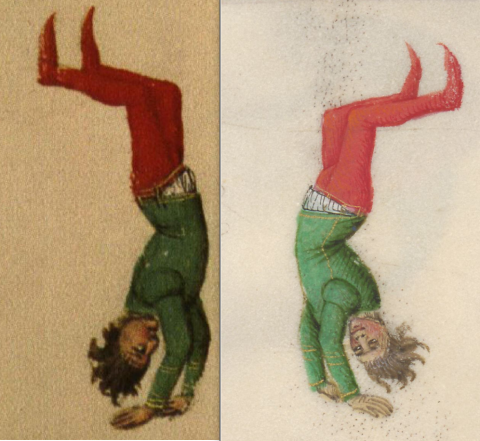
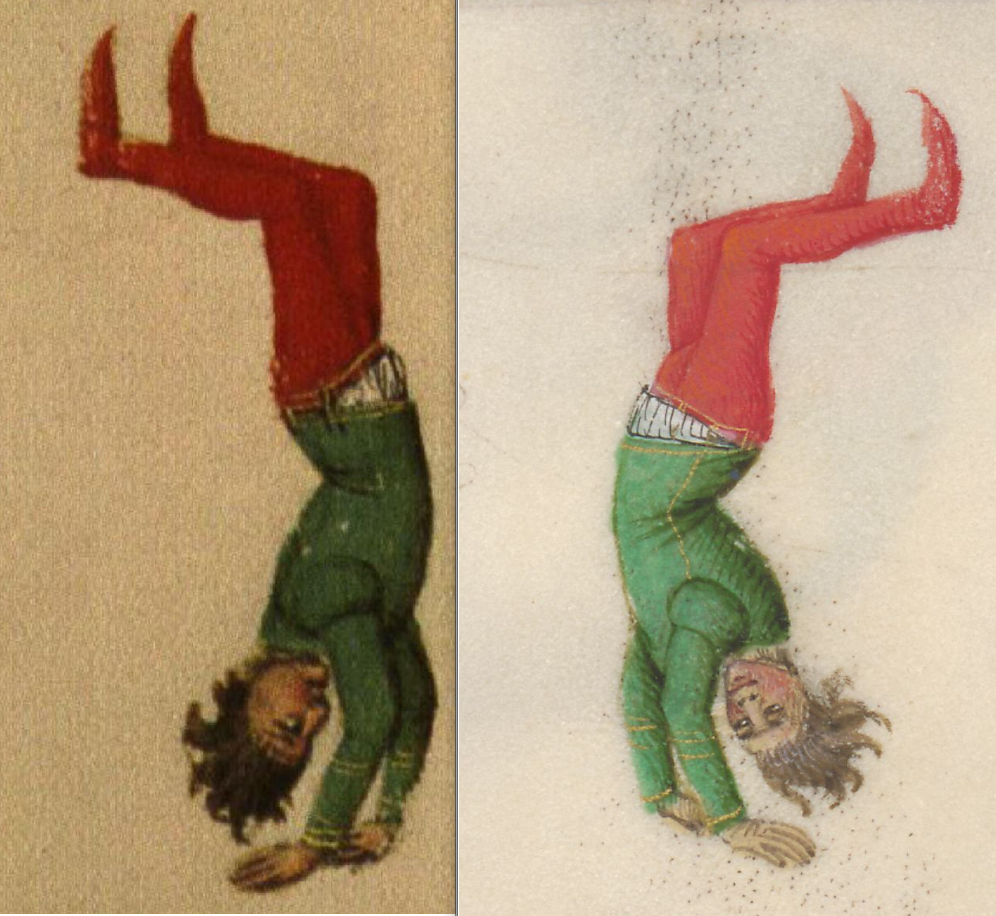
Left: Taken from the facsimile, Gebetbuch Karls des Kühnen vel potius Stundenbuch der Maria von Burgund. Codex Vindobonensis 1857 der österreichischen Nationalbibliothek, 1969. Graz, Akademische Druck- und Verlagsanstalt. Right: Taken from the digitised manuscript on the website of the National Library Austria, https://viewer.onb.ac.at/100B8410/217

This is... clearly not the same guy. First thing, my copy apparently got flipped at some point so I have the mirror image. And then - the position is almost the same, but the face is quite different; the hands are different. The folds in the garments are different, with the shirt or braies especially obvious. The leg position is a little different. And the points, the whole point because of which I was using this image, are different too. They are  much darker and much more obvious in the facsimile version.

Now I am really wondering. Wasn't the facsimile supposed to look exactly like the original? Was there a second version of the manuscript? But then, why would the images be so close and yet different? How much egg do I now have on my face because of this? Questions over questions. I'm now planning to go back to have a look at the facsimile at some point to see if at least the flip only happened with the scan transferring to me.

And this, dear readers, is why one should never fully trust anything but the original itself, no matter what. Sigh. Also it's why digitisation is The Thing, because it means there's at least a few less steps inbetween - it's digitising the object, and then you can look at it, and if it's high quality you can look at it right down to the level where you see the pores in the parchment. So if you're pointed to a re-drawing*, or a reconstruction without access to the original... be wary.


*Re-drawings, in German "Umzeichnung" used to be a really big thing in archaeological publications, as you don't need a good quality image to use for your print prep and, even more importantly, you don't need to go and ask for publication rights. I don't know whether it was just laziness, or whether it was much more difficult than it is today (it was surely more involved than shooting an email!), or whether it was a cost issue either in printing the image or in procuring the rights, and it was probably a mix of those with varying proportions of the individual ingredients. Anyways this means that a lot of older archaeological publications are full of image references to show things related to the find in context, rendered as a little black-and-white line drawing (which admittedly was much, much easier to print in the text part). If you see these, I heartily recommend trying to find the original before believing all of it. Quite often, a digital image is available today with a little use of the search engine of your choice, and you can see how it really looked... because even if you try really hard, and do really well, a line-drawing will still be an interpretation.

0

By accepting you will be accessing a service provided by a third-party external to https://pallia.net/

Kontakt