Latest Comments

Guest - Max Mustermann The True Cost of Driving a Car.
06. November 2026
Great breakdown — the non-fuel costs are exactly the bit most people forget when they compare cars. ...
Guest - Harma Phew. Now it gets involved!
21. Oktober 2026
Have fun at these events.
Guest - Aislinn Dyestuff Citizen Science.
09. Oktober 2026
This is a great project. I look forward to the results. Thanks for letting us know.
Guest - Aislinn Time for...
09. Oktober 2026
Looks delicious!
Guest - Katrin Sprang Discussion
18. September 2026
Hi Rachel, I have looked for more photos of you, but that was not very successful. I found a link on...
NOV.
23
0

And even more links!

Continuing from yesterday, for your amusement wants and procrastination needs - more links! To things!

The Atlantic has a piece about how the current incentives and structures make science worse, not better - The Inevitable Evolution of Bad Science.

Textilis has a post about Appliqué embroideries on medieval textiles.

If you're looking for a bit more to read, Isabella von Holstein's thesis "A light stable isotope (C, N, H, O) approach to identifying movement of medieval textiles in North West Europe" is available online here.

A Scottish lacemaking company is using modern computer technology to keep their looms running - CAD instead of punch cards.

If all that makes you want a sonic screwdriver, here's a knitting pattern for one. Functionality not guaranteed - unfortunately!
0
NOV.
22
0

Link drop.

Can you guess what has accumulated during the last two weeks? Right. Links. Lots and lots of links about various topics... which means my browser has so many tabs open right now that it even scares me (and I'm nigh-undauntable by lots of open tabs).

So, here you go, in no particular order whatsoever:

A (short) history of pockets in women's clothing.

What archaeologists say about Trump's election. (Text of the post on Archaeologik is in German, but the links point to English pages.)

A 3D-Model of the medieval mikvah in London.

Aarhus Uni Press has Danish Medieval Castles as their free e-book of the month.

The Importance of Being Scared: An article about fairy tales and fear.

And that's it for today - more linky things tomorrow!
0
NOV.
21
0

Settling in, winding down.

I'm settling in again, and starting to take care of all the things that should be dealt with before the year ends - getting the last of the madder roots out of the soil is on the list for right after this blogpost, as the weather is okay at the moment. There's also some sorting and de-cluttering going on, mostly on the computer (it's amazing how backup files can add up and multiply, with several duplicates in some cases).

The cat is happy again, as her bad paw has healed and she is allowed to roam outside again. The Most Patient Husband of Them All and I have celebrated our wedding anniversary this Sunday, with a nice little hike in the sunshine and lovely cake and coffee afterwards. The bills are paid, my sleep deficit is about gone, and it feels really, really good to be home again, and get on top of things again.

Time to take care of all that stuff that has been postponed, and get the stock sorted out and stuff re-ordered. There's some editing work waiting, the Forum results to sift through and get ready to write them up, so it doesn't look like it will be boring anytime soon. It is also the time of the year to start planning for the next one. And, of course, it is the season to start baking Christmas cookies - something I'm really looking forward to!
0
NOV.
18
1

Textile Forum 2016 - Pompeii Dyeing Experiment.

Back in 2012, we already did a dyeing experiment at the Forum, investigating the influence of kettle materials on the colour outcome. Our outcome showed a significant difference between the kettle materials that we tested - which were lead, copper, and iron. The results of this experiment were published in EXARC journal (you can read the article here).

In 2013, I was able to do an add-on to this original experiment, investigating whether the influence was larger in the mordanting or in the dyeing process. Sadly, I omitted the reference (NEVER leave out the reference!!) so there was no way to compare the original experiment and the add-on with each other. (Any comparison would have been limited anyways, as they were two different runs with different batches of birch leaf - but having two references to compare would have given good information about the similarity of the dye batches. Well.)

And ever since 2012 and the original experiment was done, I've been looking for somebody who would like to repeat the experiment... but nobody took the bait.

So this year at the Forum, we did the repetition ourselves. We did the full run this time around, though, combining the original experiment (metal in both the mordant and the dye) with the add-on (metal only in the mordant, or only in the dye). This caused some serious brain-bending and thought-knotting in the preparation as I was trying to make the run as efficient and as sensible as possible while avoiding any contamination between the skeins and any other issues.

There were two reasons for this re-run: One, to see how the three different batches (metal in mordant only, in dye only, in both) compare to each other. Two, to finally have an archaeological experiment repeated (something that, to my knowledge, has never happened before).

So things happened. Skeins were wound...

IMG_9733
...and mordanted...

IMG_9769
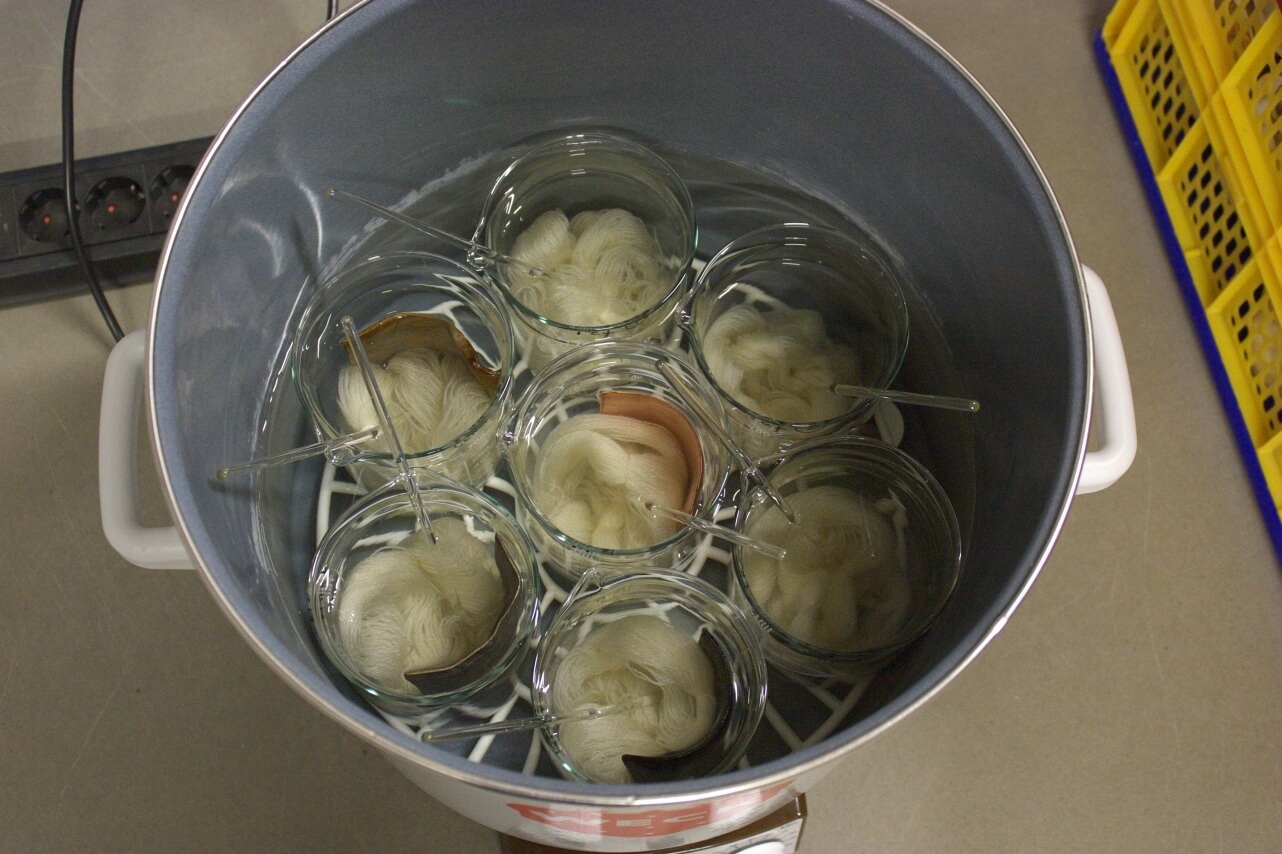
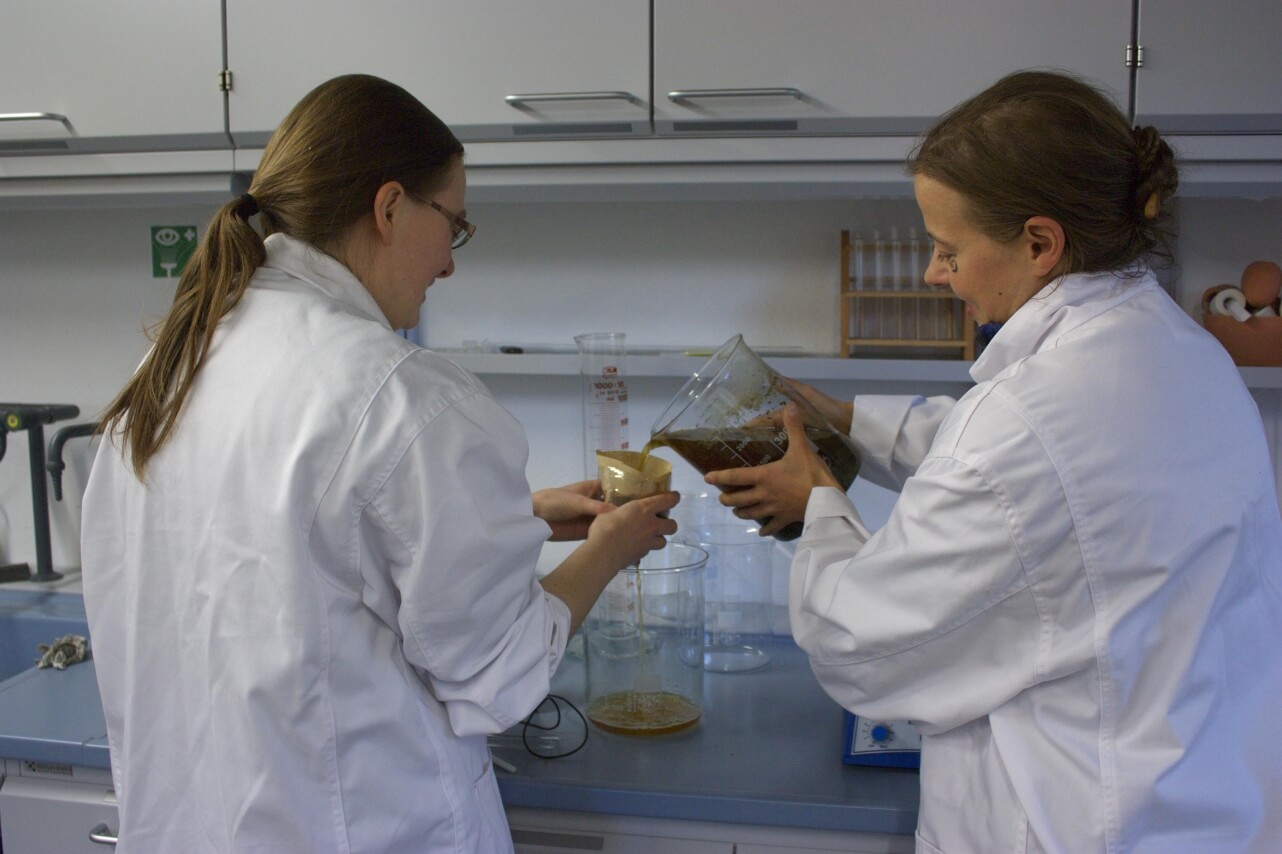
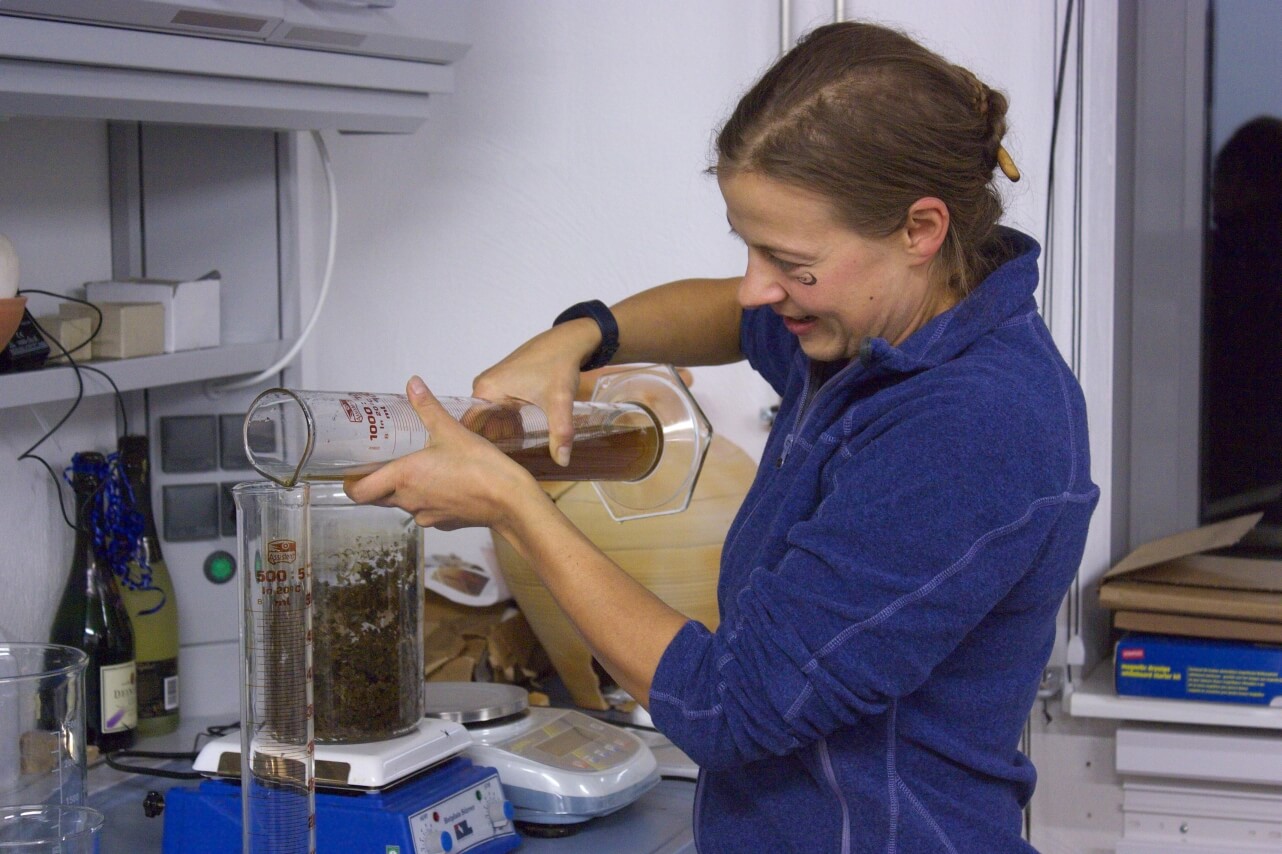
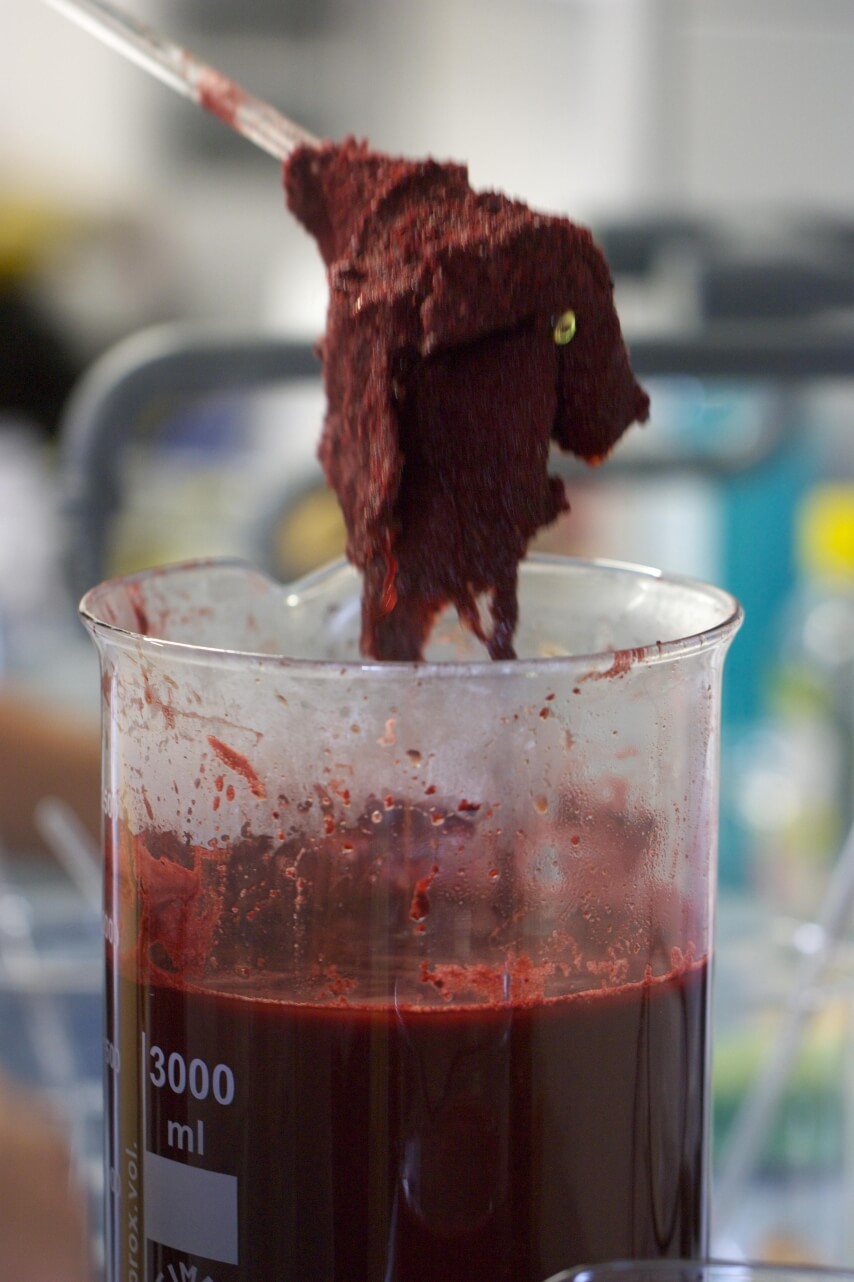
... dye liquid was boiled, and filtered off...

IMG_9926
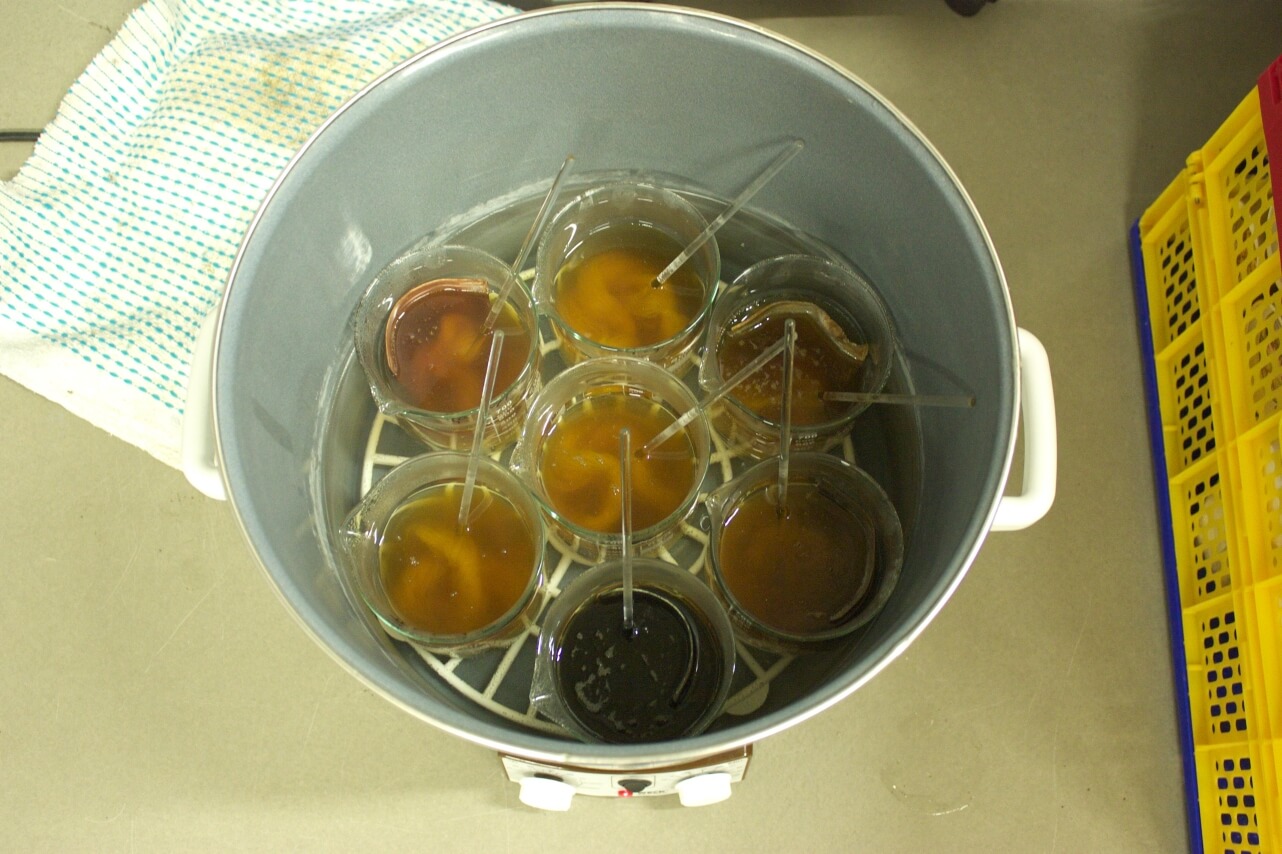
...and split up between fourteen pots.

IMG_0087
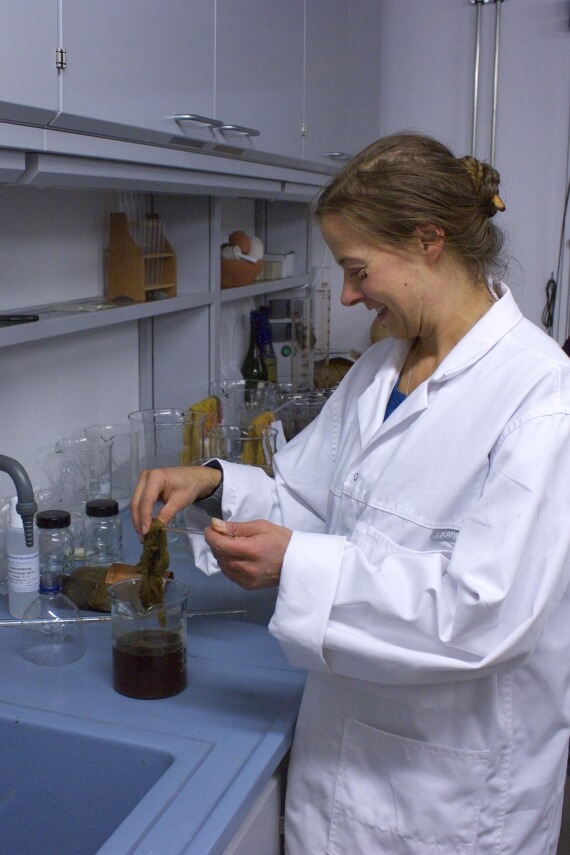
Then, skeins were dyed (that was a long night!).

IMG_0108
They were rinsed, and labelled, and dried.

IMG_0700
IMG_0605
And, of course, they were discussed!

IMG_0816
So, the outcome?

Our experiment was successfull on both counts. One, it does show that there is a more pronounced influence of the kettle wall when dyeing than when mordanting, and that it adds up when the metal is present in both. Two, that it is really important to repeat archaeological experiments, because the natural stuff that is part of almost all of them can result in weird outcomes, or in huge differences.

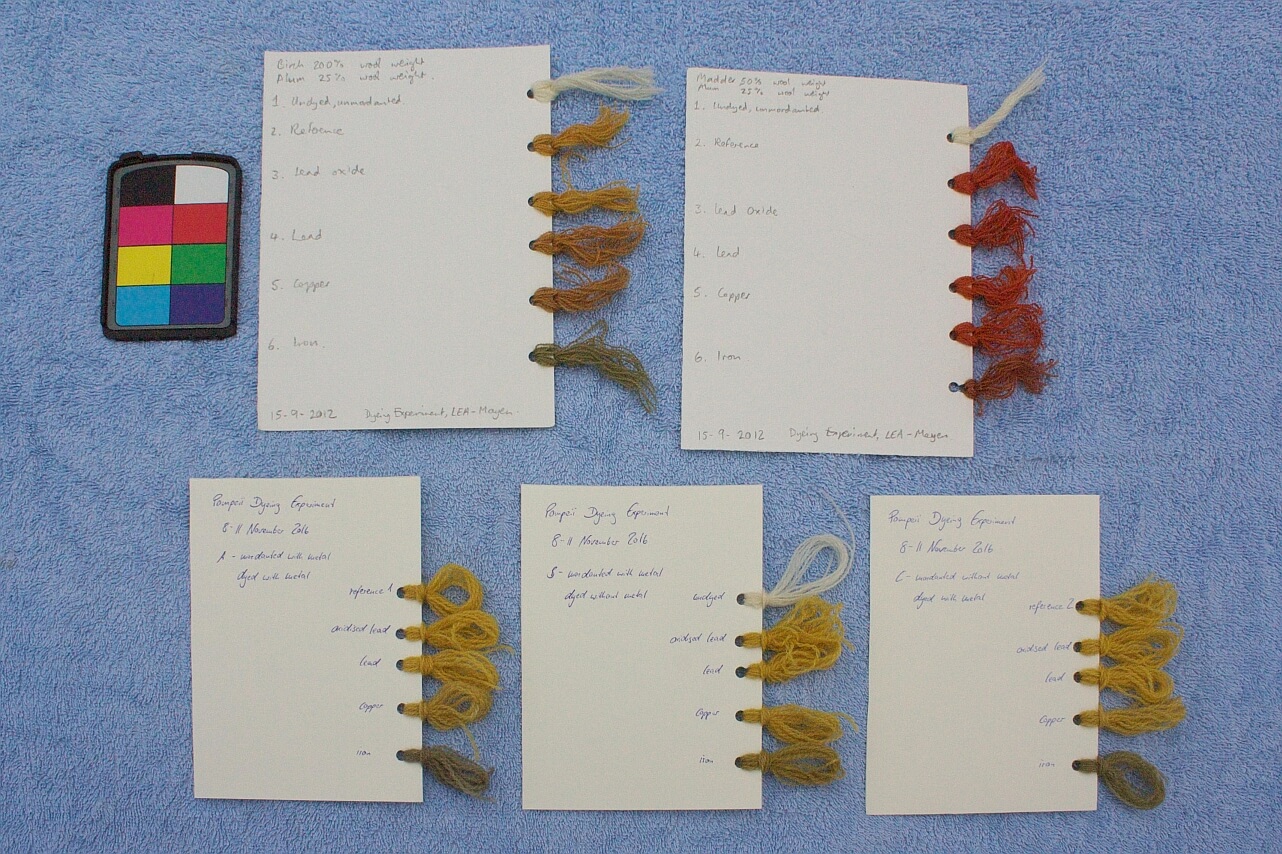
You can see the differences here - top left is the original experiment result in birch (top right was a madder dye run). On the bottom left, metal was present while mordanting and dyeing; bottom middle, metal only when mordanting; bottom right, metal only when dyeing.

IMG_1462
Time well spent, I'd say.
0
NOV.
17
1

Textile Forum 2016 - Dye Penetration Experiment

I'm back home!

It was a wonderful time away - both the Nobilitas-Akademie and the Textile Forum were amazing experiences, and I had a blast at both. I'm equally happy to be home again now, though, and ease myself back into the familiar routines in my familiar surroundings. A full week of intense work (which the Forum always turns out to be) really does make a person tired!

It was well worth getting tired over, though. This year's Forum was very, very heavy on experiments, with two full-fledged ones and two additional runs of tests, all of them involving dyeing. Which means we had a lot of work being done for those experiments, by a good number of people... and I learned again that experiments take an insane amount of time. Every time.

One of the experiments was dubbed "Dye Penetration Experiment", and it is exactly that which we were testing.

Dyeing can be done either in the fibre (in the fleece), in the yarn (in the skein) or in the cloth (in the piece). All three have their advantages and disadvantages, and there is evidence pointing towards all three methods having been used in historical times (though there is not always evidence for all three at a similar time in one region).

This has led to quite a bit of debate on which method was the most common one - and it is very hard to tell without knowing how well a method can be seen on the textile. If there are white spots between threads in a fabric, it must have been piece-dyed. If there are white cores in yarn, it must have been dyed in the skein. But what if the dye can penetrate completely? Then it would be impossible to tell whether the textile was dyed in the fleece, in the skein or in the piece.

Which leads to the question at the core of our experiment: How easily does dye penetrate the fabric?

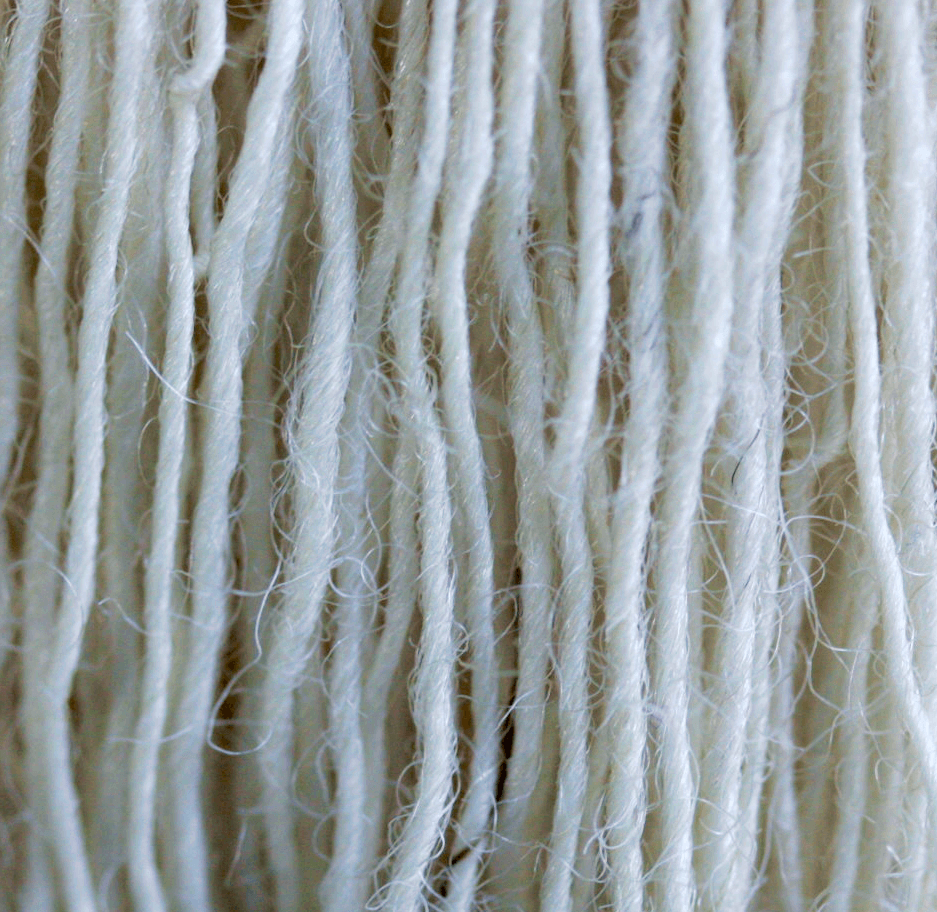
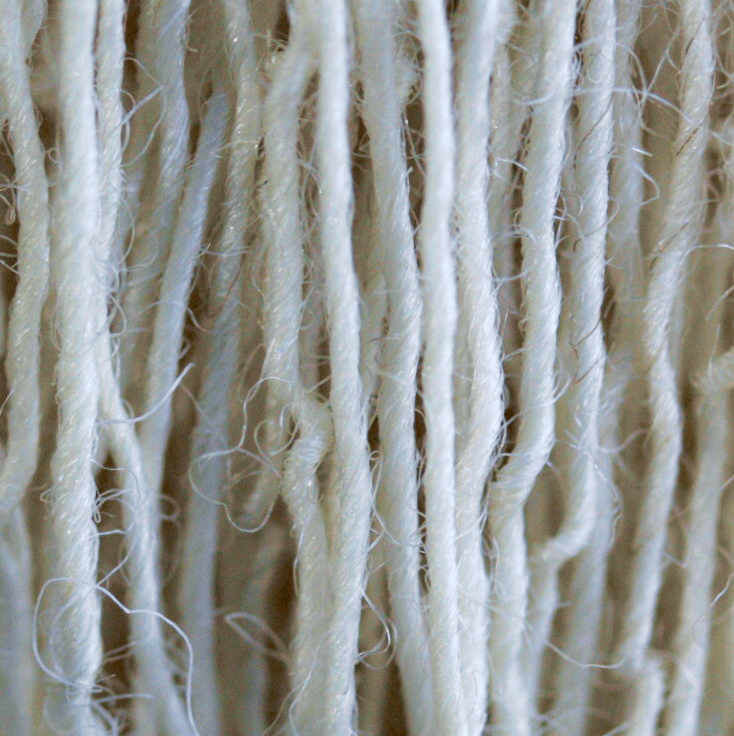
We had two possible influences on the permeability of the fabric - yarn twist (yarns with higher twist are denser) and fabric density. Which resulted in the setup of having three different yarns hand-spun, to about 0.5 mm thickness and with three different twist angles (c. 20°, c. 30° and c. 45°), and three different fabric densities (12, 10 and 8 ends/cm in the warp).

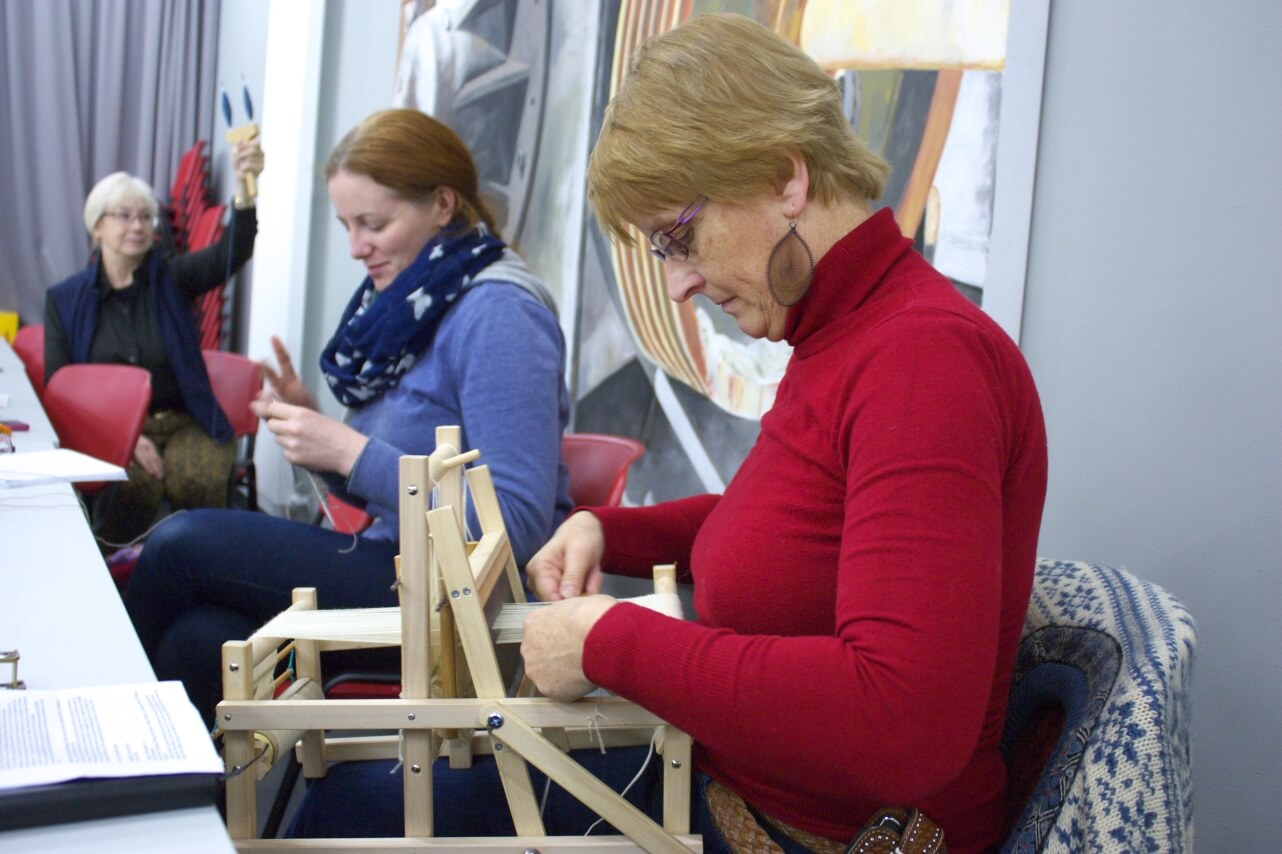
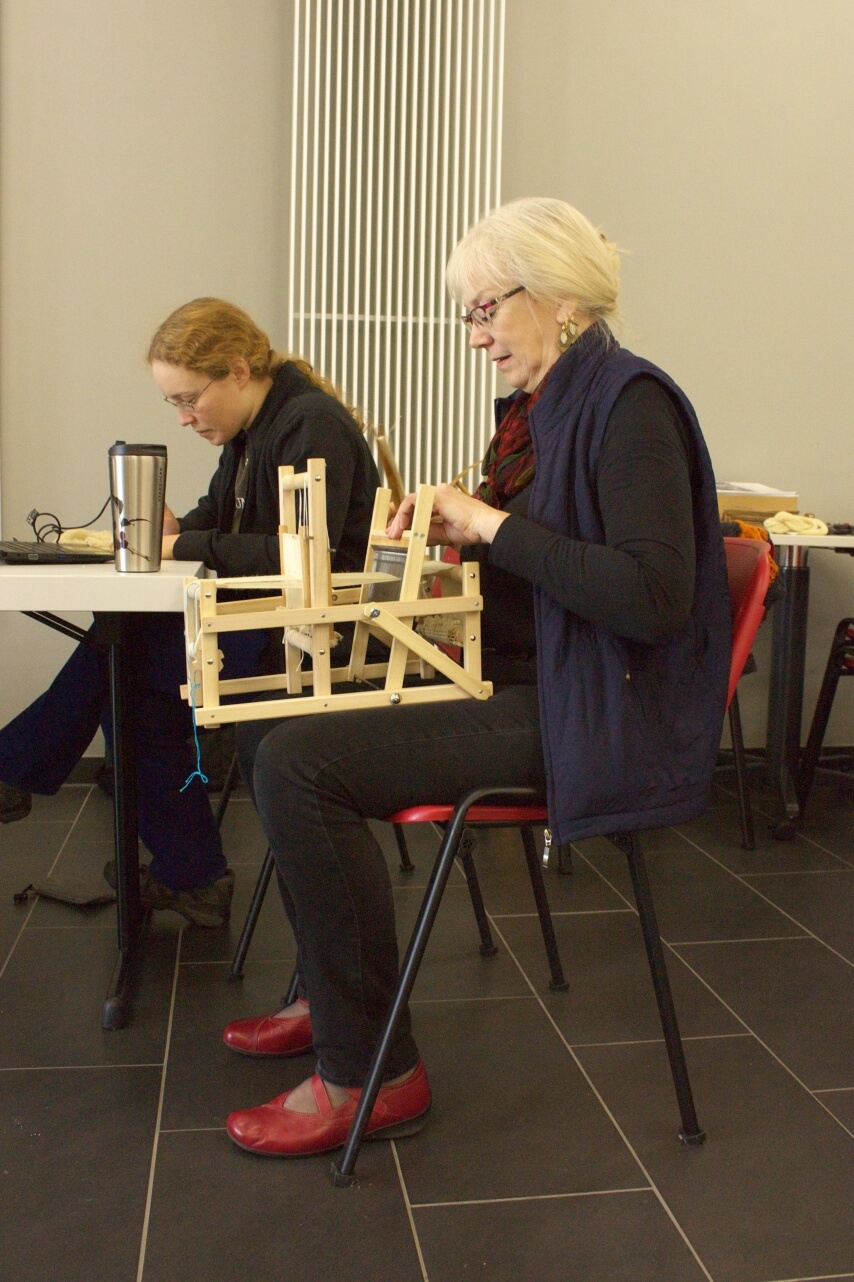
The spinning was finished before the Forum, but there was a lot of weaving being done during it, by Harma Piening and Ruth MacGregor:
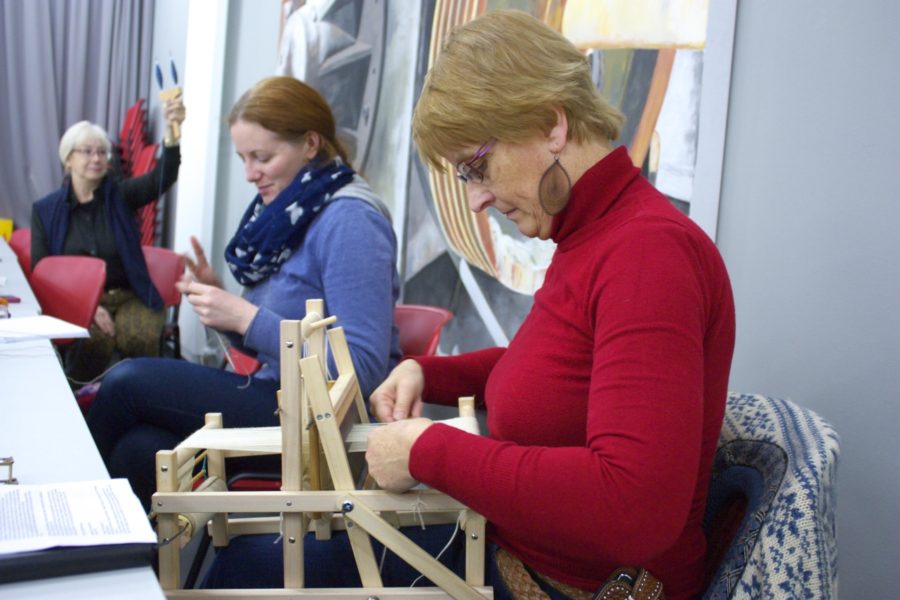
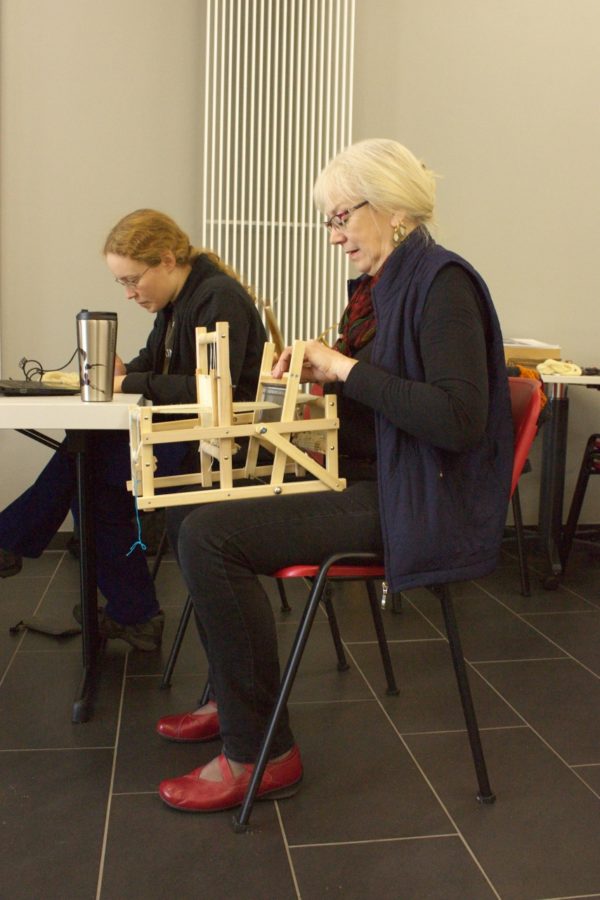
IMG_0072 IMG_0783
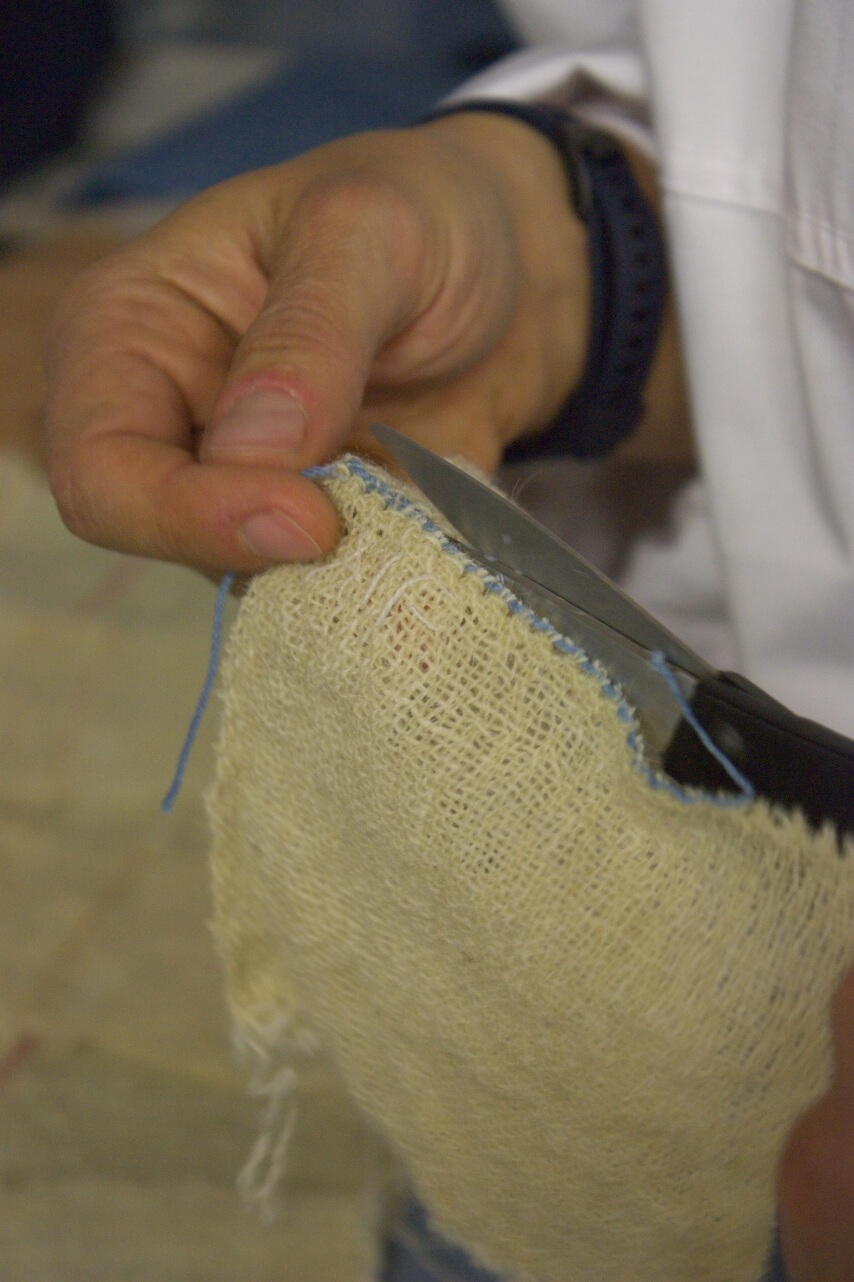
... followed by careful finishing of the fabrics. Then I got to cut them apart:
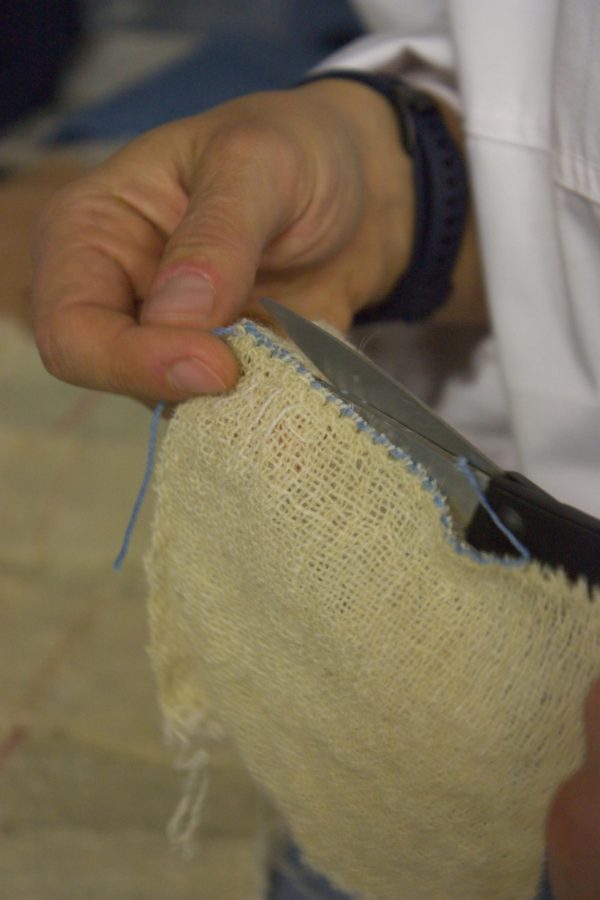
IMG_1141
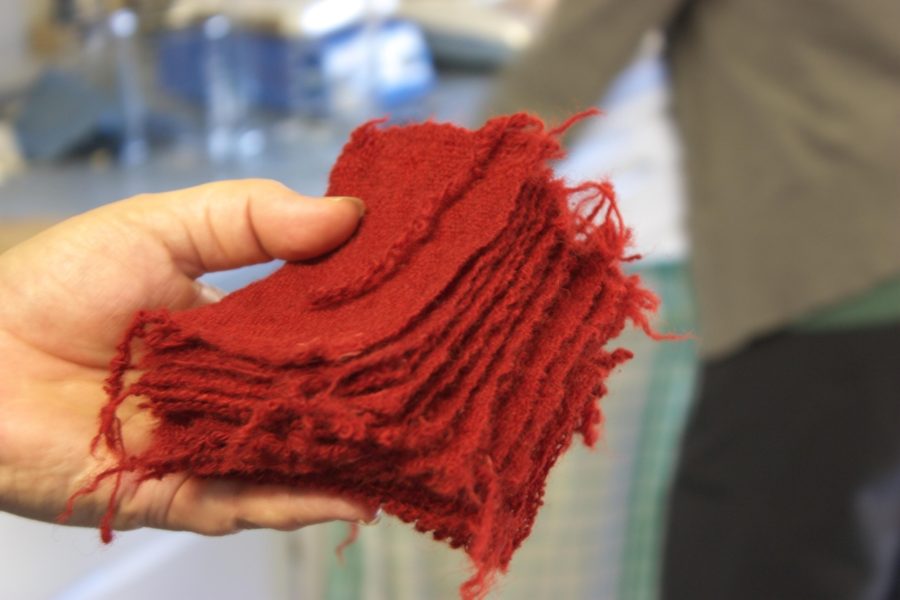
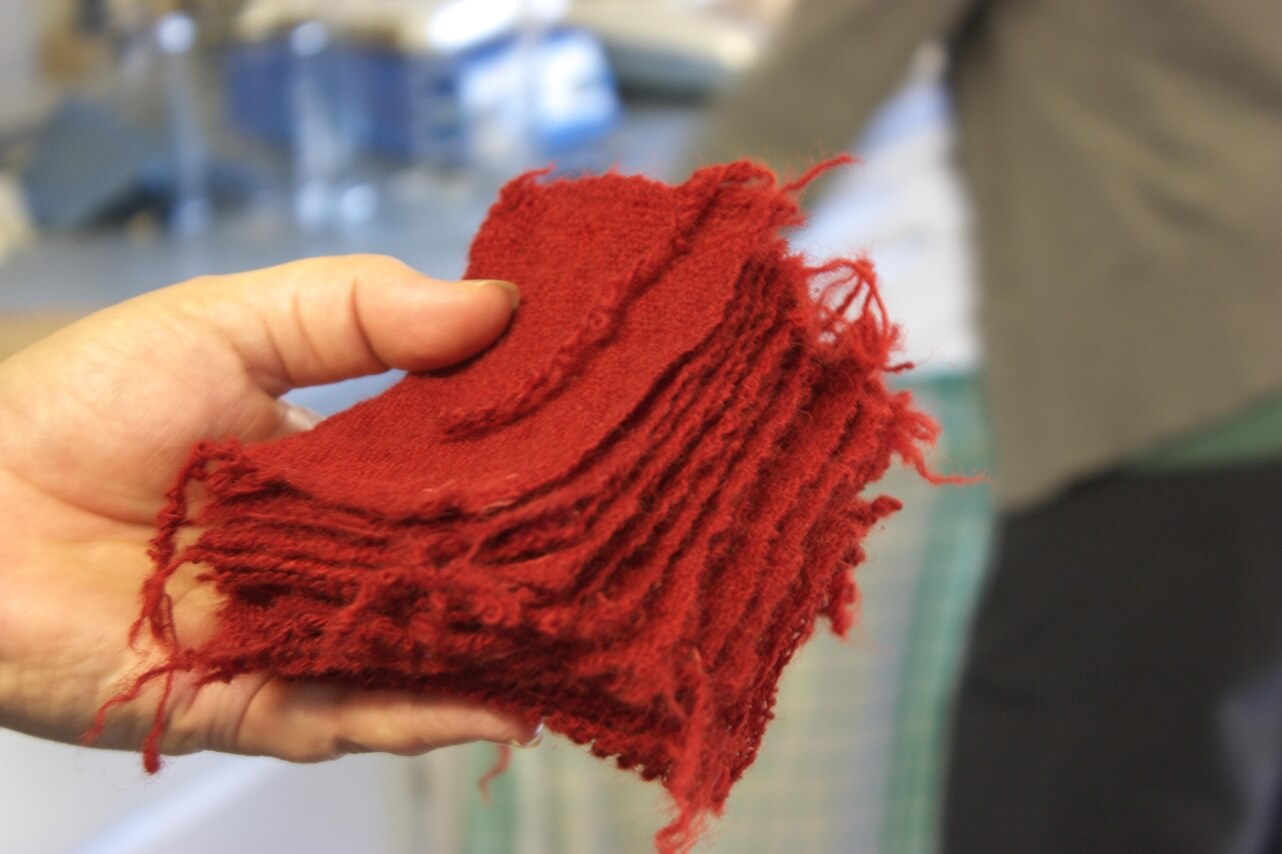
... and then some of them were fulled, and most of them were dyed madder red.
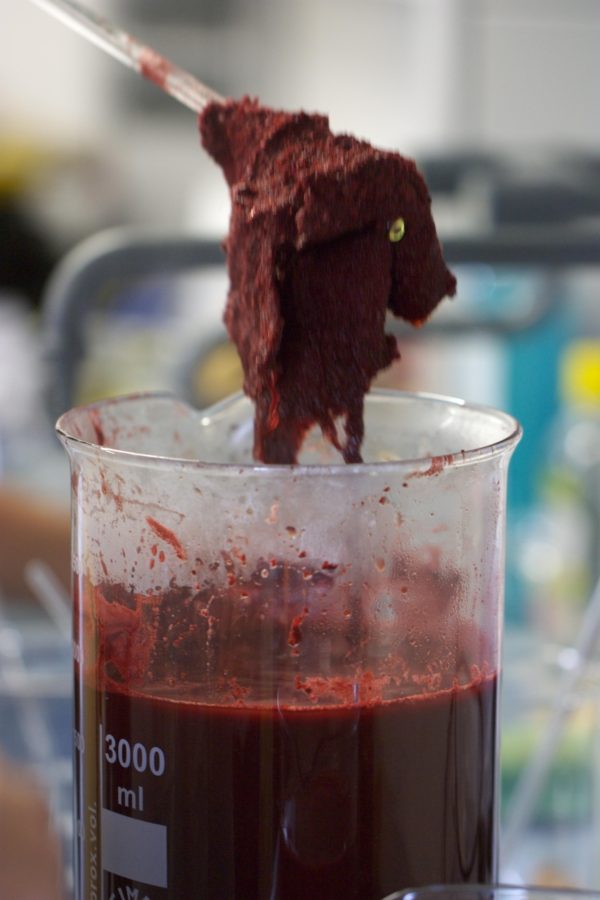
IMG_1310 IMG_1326
This meant that I got a bonus lesson in how to dye with madder from Sabine Ringenberg - and her speciality from many years of working as a professional historical dyer is red. Small wonder the colour turned out quite nicely!

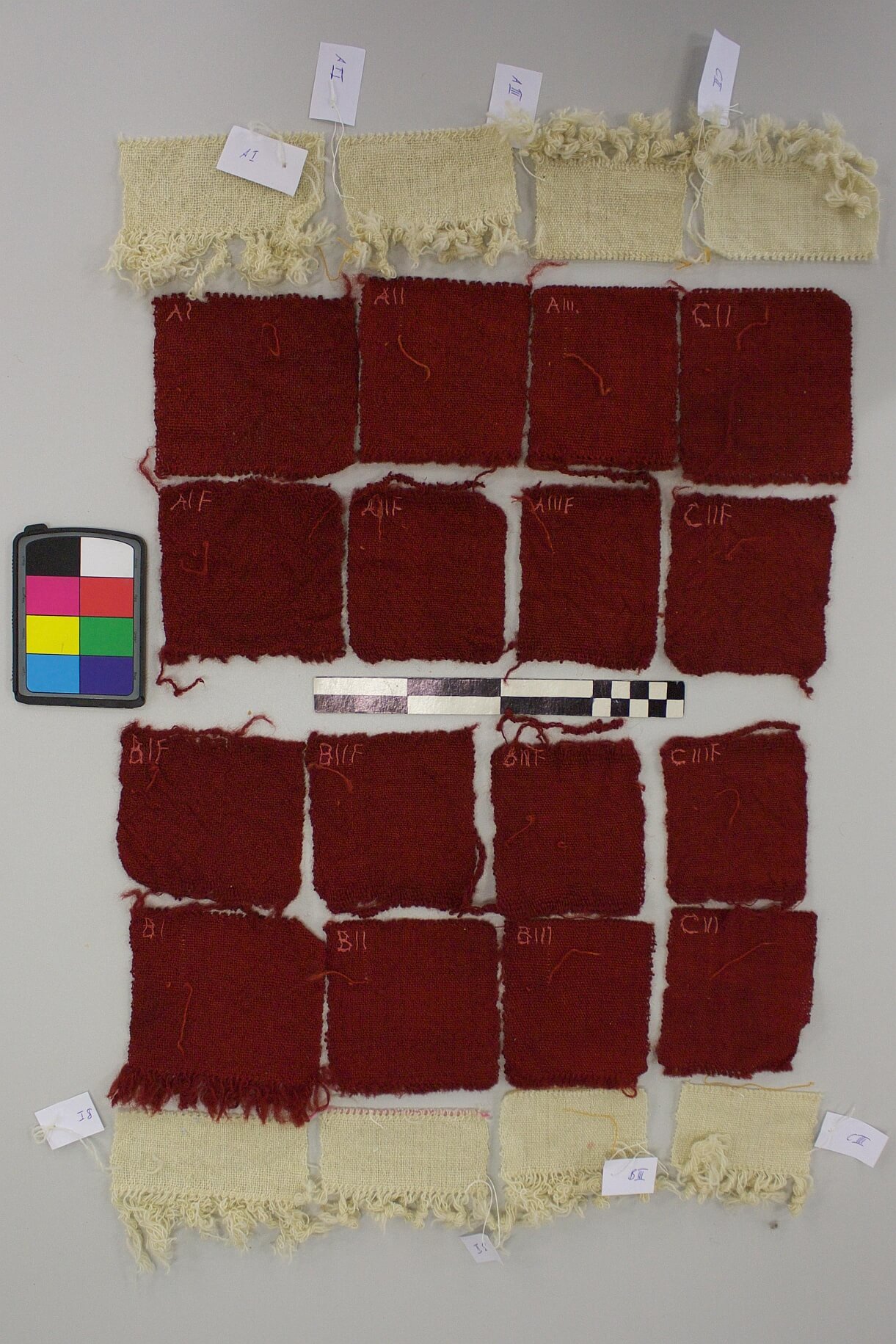
In the end, we had a load of samples to be catalogued and analysed:
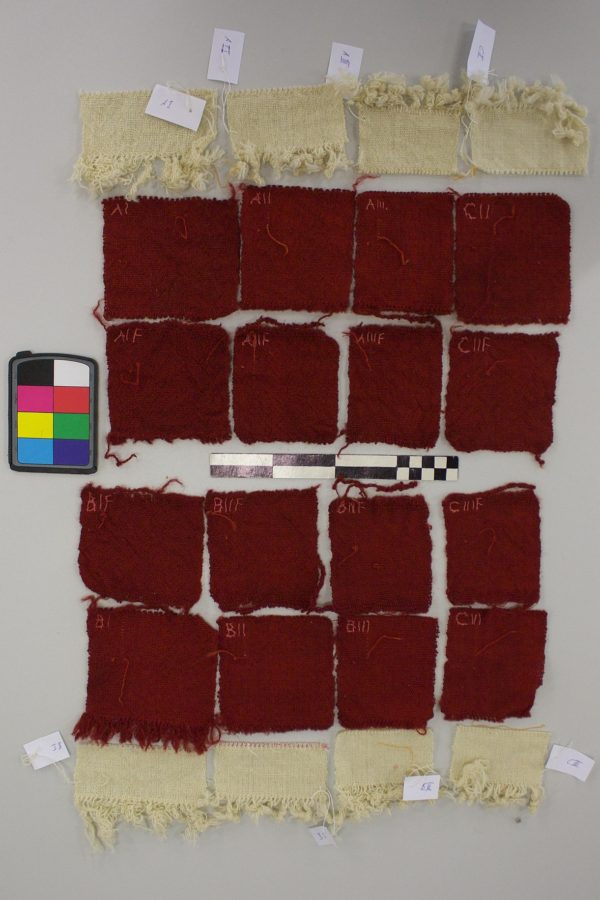
IMG_1460
I'll have to take a careful look at the photos, microscope photos and measurements before giving a real conclusion - but I can tell you at this point already that none of the fabrics was completely dyed through, there were white spots between the threads in all of them.

We also found that the twist angle I was aiming for (with regular checks on my spinner's little helper) was not what the yarn ended up having, and that the angle fluctuated a lot over the length of the yarn. It will be interesting to see whether the angles read out differently in the yarn and in the fabric - one of the things on my list to test in the future.

It was definitely a really interesting experiment to do, and I got a good number of surprises (I'd have suspected at least the looser fabric with the soft-spun yarns to dye through, and my spinning to be a lot more regular than what it turned out to be). It is of course not the ultimate answer to the question whether things were dyed in the skein or in the piece - but it does hint that we might expect white spots when dyed in the piece, and that would be a good thing to know. (As all experiments, this has already generated more ideas, such as making tests with yarn skeins with different twists and thicknesses to see about how well it dyes through...)
0
NOV.
03
1

Packing.

Here I am, sitting between a stack of boxes ready to go into the car, surrounded by a few lists to check and check off - preparing for going to the Nobilitas-Akademie and the Textile Forum.

Like every year just before the Forum, I'm all excited and hope that everything will go smoothly; and like every year, I will be taking some time off the blog for the Forum. This year is the year of back-to-back events, as I'll be going from the Akademie straight to the Forum and from there straight to my Granny, who will turn 95 this year (and obviously, this has to be celebrated!) so I won't be back on the blog until November 17...

...when I will hopefully be able to tell you about interesting results from our Forum experiments!
0
NOV.
02
1

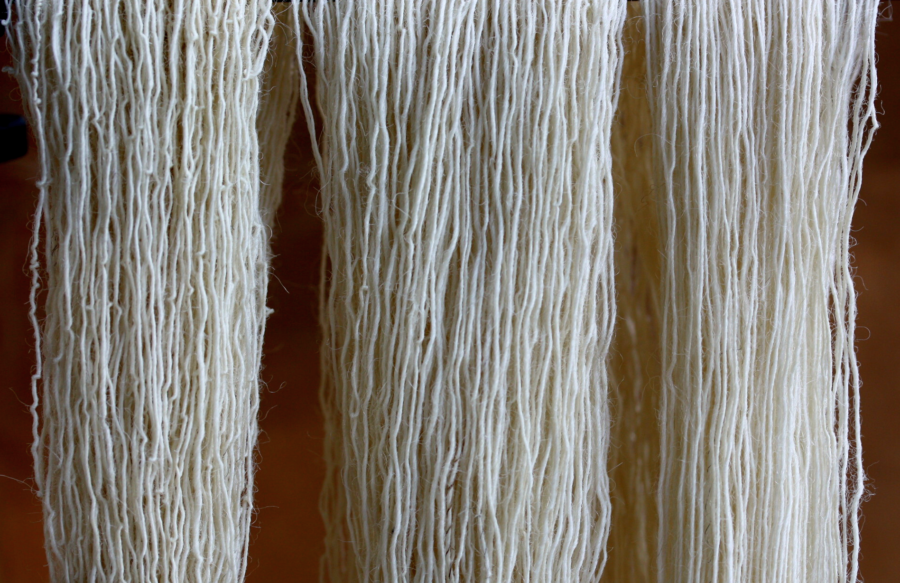
Three skeins.

My spinning for the experiment at the Textile Forum is done - and here's the result:

three_skeins
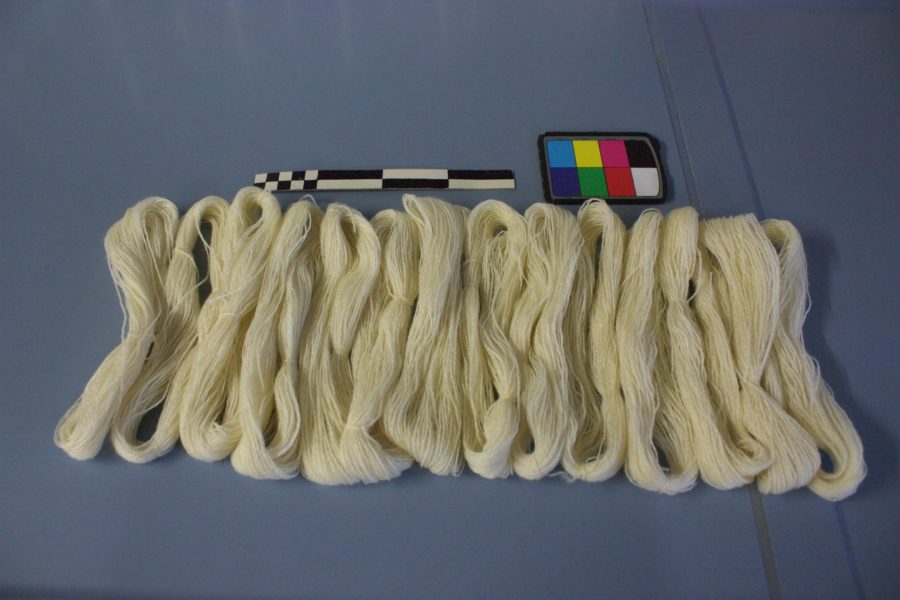
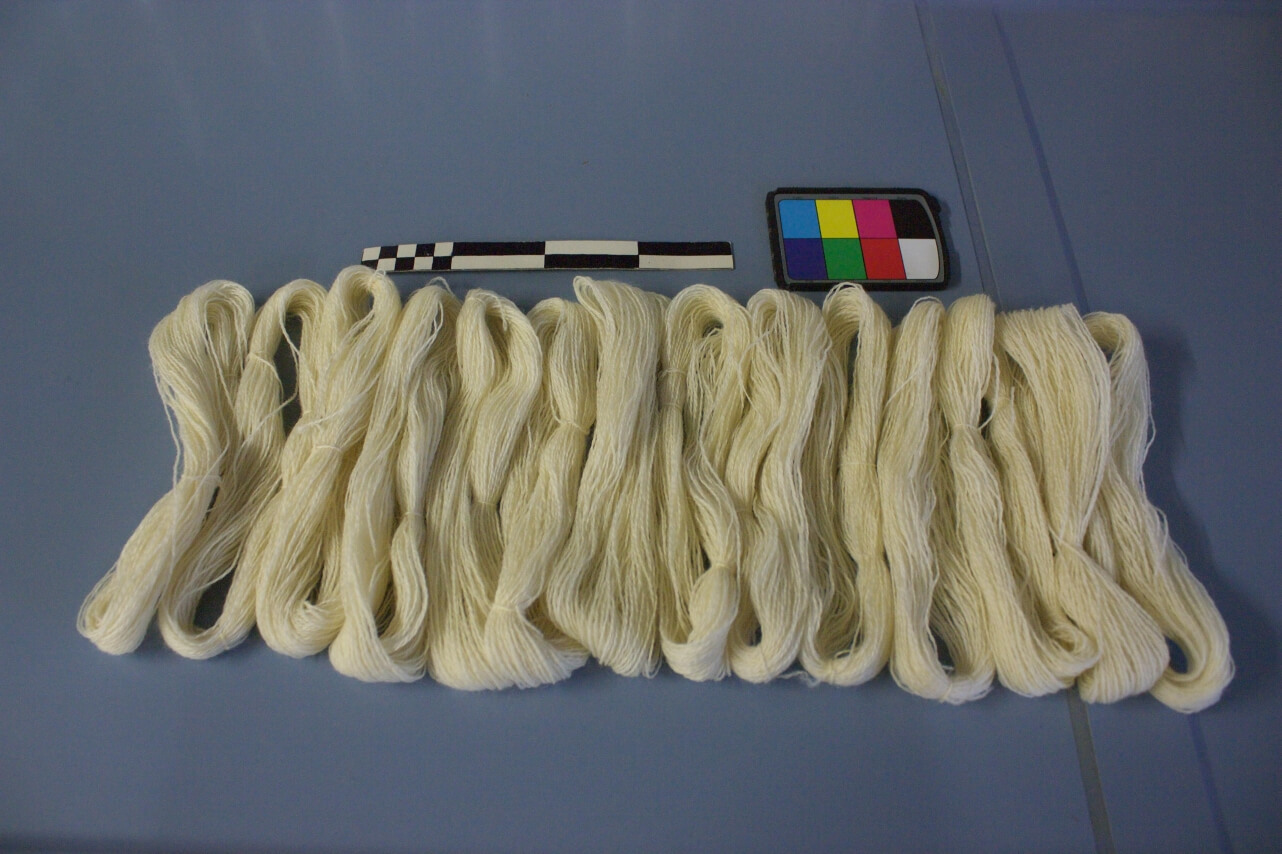
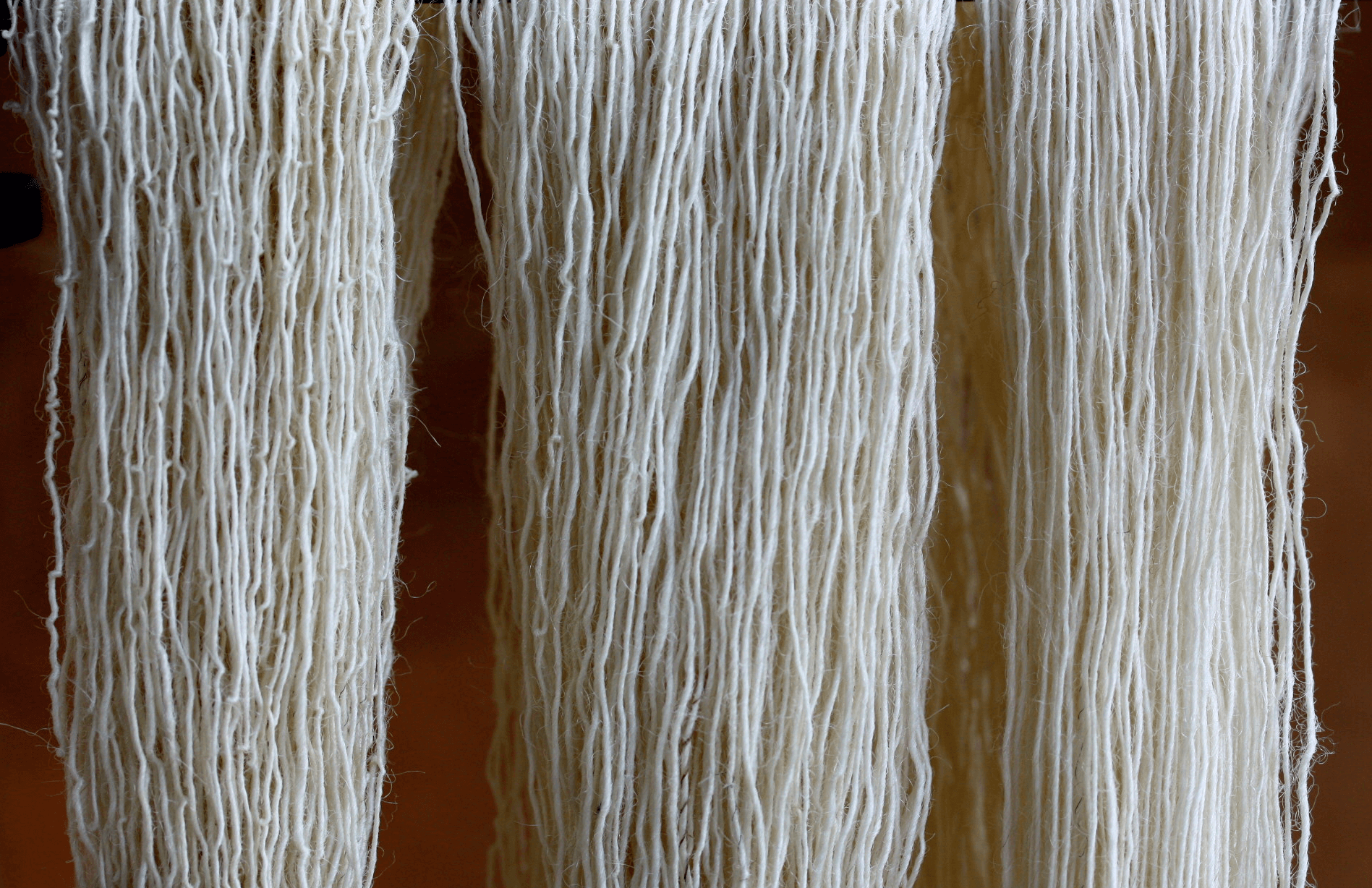
Three skeins, each with 230+ metres of yarn. Each from the same wool (Eider wool, I love that stuff, it really spins up beautifully), each in the same thickness of 0.5 mm, give or take a smidgen (even the evenest handspinning is not completely even!) and each finished in the same way (placed into a bowl, boiling hot water poured on top, left for 10 minutes to soak, then stretched out, then hung to dry with 1418 g of weight tied to the bottom end of the skein).

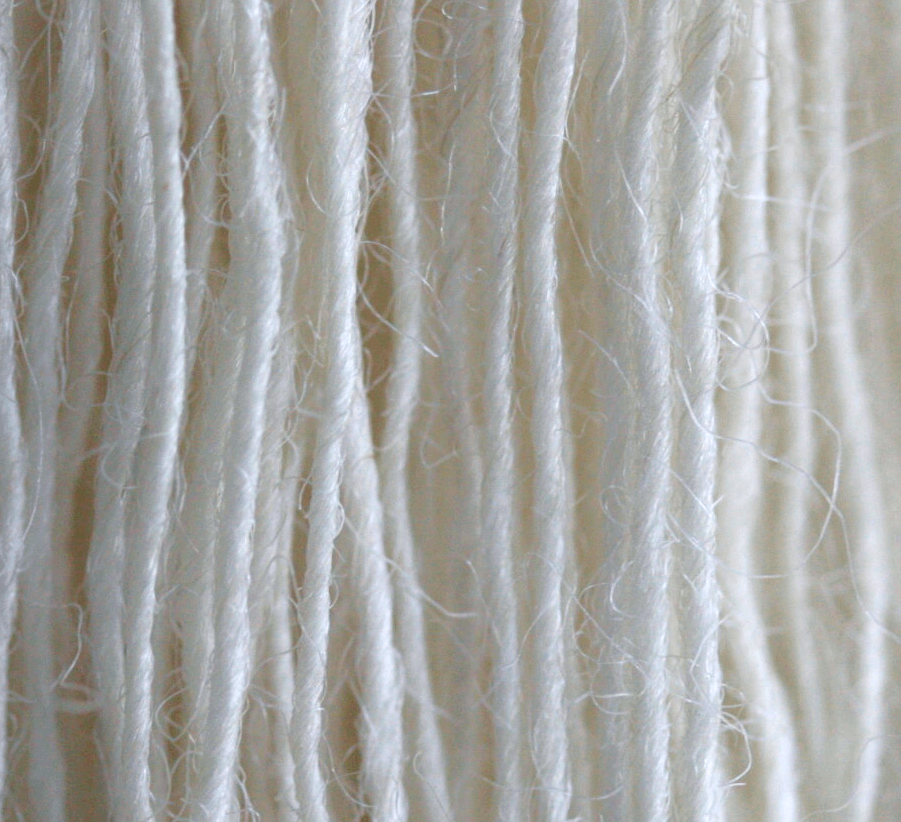
The only difference is the amount of twist between these three. The skein on the left has a spinning angle of about 45°, the one in the middle about 30°, and the one on the right about 20° - give or take a smidgen...

As you can see in the close-ups, the angle does make quite a difference. You can also see that it is not all the same everywhere in the threads, even though I always try to spin really, really evenly and really, really neatly.

[caption id="attachment_2718" align="aligncenter" width="196"]20angle 20° spinning angle


[caption id="attachment_2719" align="aligncenter" width="206"]30angle 30° spinning angle


[caption id="attachment_2720" align="aligncenter" width="204"]45angle 45° spinning angle


However, they should be regular enough for our purposes - and next week, during the Forum, they will turn into small bits of fabric, and that fabric will be dyed, and then we will see the differences between the three fabrics. Plus whether the dye penetrates them all equally well, or whether there are differences!
0

By accepting you will be accessing a service provided by a third-party external to https://pallia.net/

Kontakt