Latest Comments

Guest - Aislinn Dyestuff Citizen Science.
09. Oktober 2026
This is a great project. I look forward to the results. Thanks for letting us know.
Guest - Aislinn Time for...
09. Oktober 2026
Looks delicious!
Guest - Katrin Sprang Discussion
18. September 2026
Hi Rachel, I have looked for more photos of you, but that was not very successful. I found a link on...
Guest - Beatrix Sprang Discussion
15. September 2026
That lozenge pattern element is not a photograph, but a scan. So it should be to scale. But I pinned...
Guest - Katrin Sprang Discussion
15. September 2026
I was not referring to Rachel's reconstruction (is the reconstruction you refer to the one photograp...
NOV.
30
0

Weird day...

Today is one of those weird days where a lot of small things come up, and are dealt with, and bits and pieces get done on larger projects, and suddenly it is late afternoon and it feels like nothing has been achieved at all - except, of course, for coffee consumption.

This is especially true (the feeling of non-achievement) as part of today's work was searching for and watching youtube videos about different spinning techniques - which I need to do for a presentation in the future and a course I will be teaching in spring. So yes, that was actually work - although my brain and the whip-wielding part of my conscience somehow have not realised that yet and keep telling me that I have not done any work. At all. Sigh.

And just in case you'd like to spend some time looking at all those different fascinating spinning techniques too - here you go, a long playlist called "Spinning around the World":


0
NOV.
23
0

And even more links!

Continuing from yesterday, for your amusement wants and procrastination needs - more links! To things!

The Atlantic has a piece about how the current incentives and structures make science worse, not better - The Inevitable Evolution of Bad Science.

Textilis has a post about Appliqué embroideries on medieval textiles.

If you're looking for a bit more to read, Isabella von Holstein's thesis "A light stable isotope (C, N, H, O) approach to identifying movement of medieval textiles in North West Europe" is available online here.

A Scottish lacemaking company is using modern computer technology to keep their looms running - CAD instead of punch cards.

If all that makes you want a sonic screwdriver, here's a knitting pattern for one. Functionality not guaranteed - unfortunately!
0
NOV.
02
1

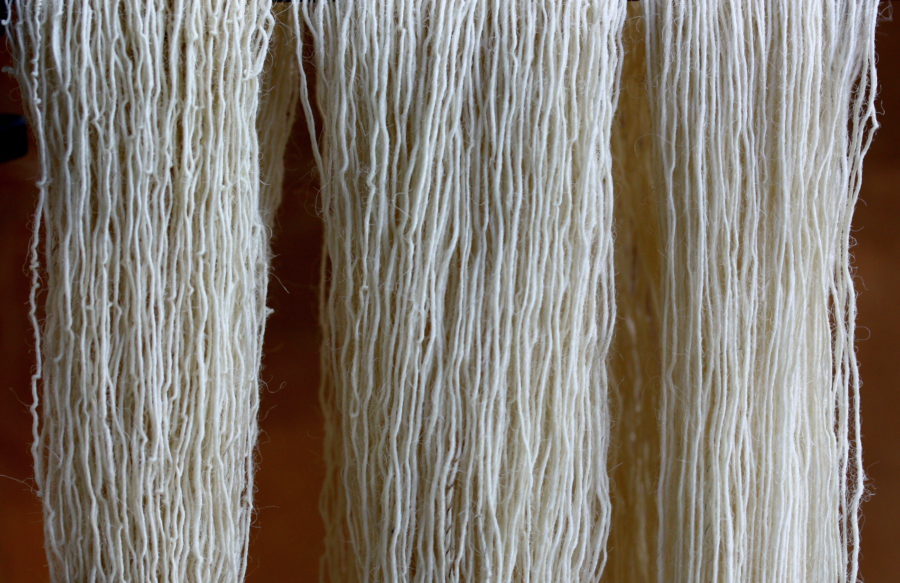
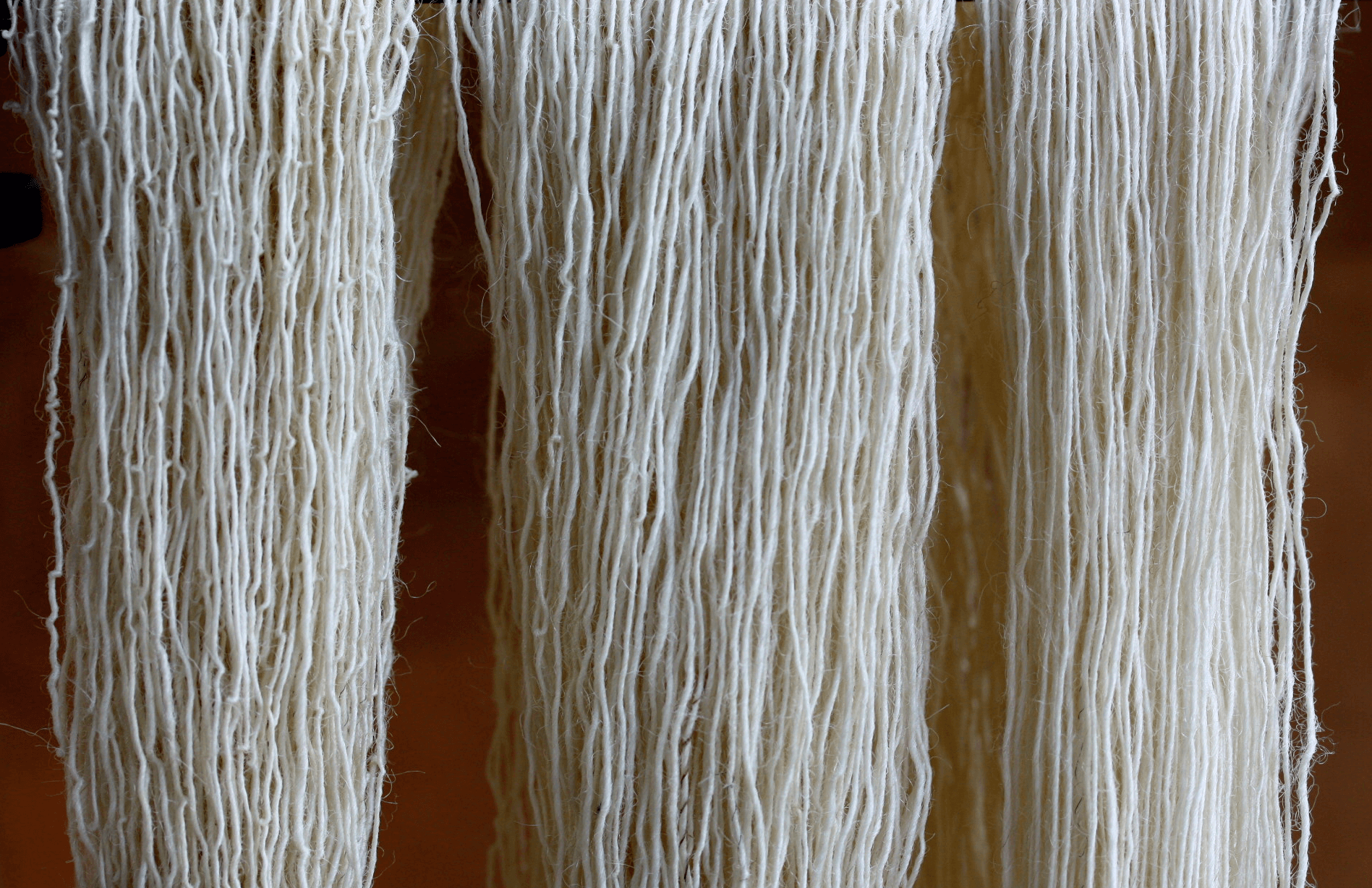
Three skeins.

My spinning for the experiment at the Textile Forum is done - and here's the result:

three_skeins
Three skeins, each with 230+ metres of yarn. Each from the same wool (Eider wool, I love that stuff, it really spins up beautifully), each in the same thickness of 0.5 mm, give or take a smidgen (even the evenest handspinning is not completely even!) and each finished in the same way (placed into a bowl, boiling hot water poured on top, left for 10 minutes to soak, then stretched out, then hung to dry with 1418 g of weight tied to the bottom end of the skein).

The only difference is the amount of twist between these three. The skein on the left has a spinning angle of about 45°, the one in the middle about 30°, and the one on the right about 20° - give or take a smidgen...

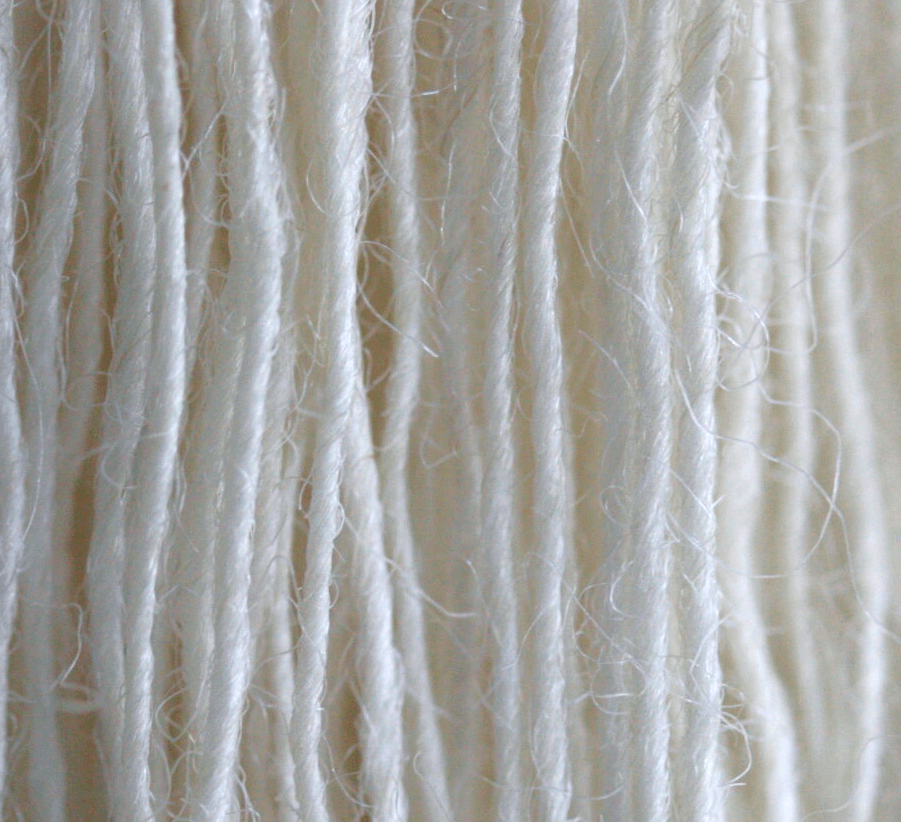
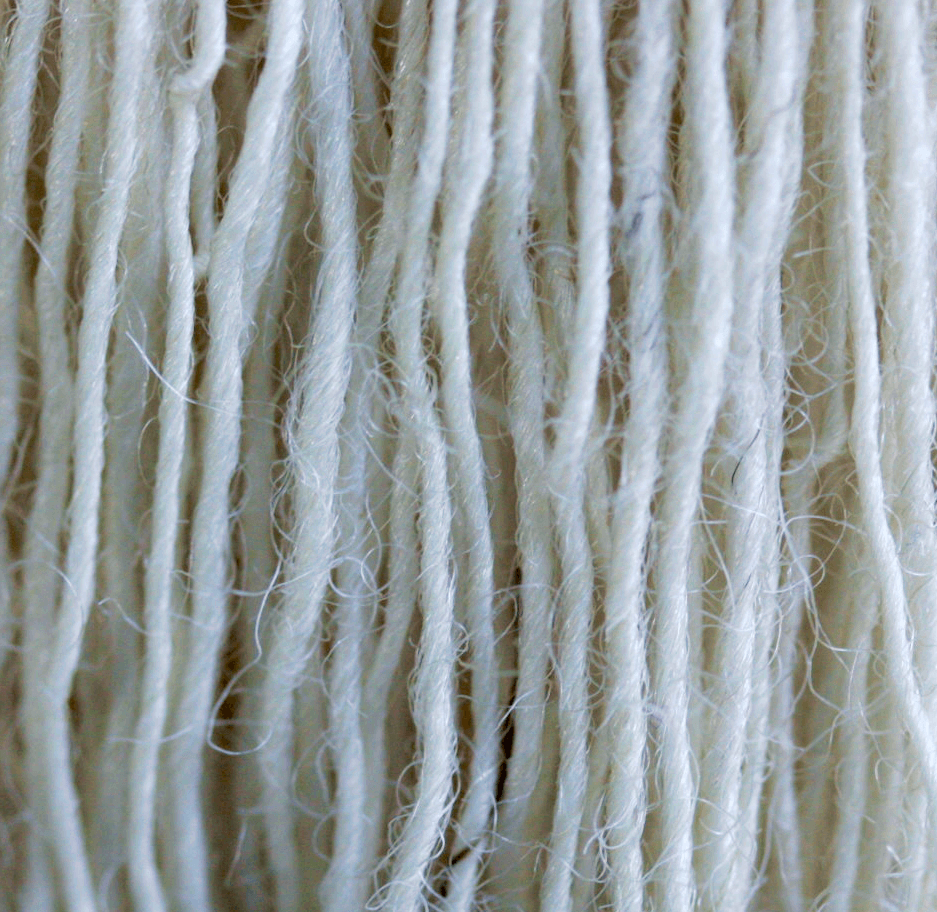
As you can see in the close-ups, the angle does make quite a difference. You can also see that it is not all the same everywhere in the threads, even though I always try to spin really, really evenly and really, really neatly.

[caption id="attachment_2718" align="aligncenter" width="196"]20angle 20° spinning angle


[caption id="attachment_2719" align="aligncenter" width="206"]30angle 30° spinning angle


[caption id="attachment_2720" align="aligncenter" width="204"]45angle 45° spinning angle


However, they should be regular enough for our purposes - and next week, during the Forum, they will turn into small bits of fabric, and that fabric will be dyed, and then we will see the differences between the three fabrics. Plus whether the dye penetrates them all equally well, or whether there are differences!
0
NOV.
01
0

Spinning Demonstration on the Great Wheel.

First of all, sorry for the blog silence yesterday - I was away from the computer most of the day, and during the time I did spend physically close to it, we had internet connection issues. These do happen here occasionally, and they are normally no big deal when they do, as they will be over after two or three hours at most... but yesterday, it did mean no access during the time window I had for blogging.

Today is a holiday in Germany, so I had planned to blog yesterday and tell you there'd be no blog post today. Well, plans and how they work out... anyway, this means you are getting this picture today instead of yesterday:
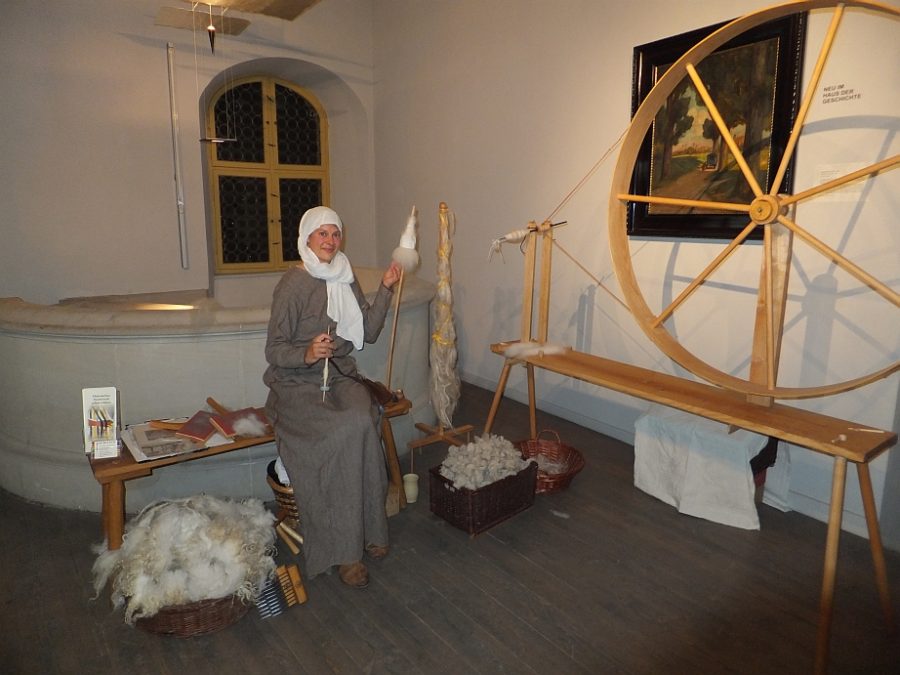
dinkelsbuehl
That was my setup on the Long Night for spinning in Dinkelsbühl. It was a wonderful evening with many, many people stopping by for watching the spinning and asking questions. The picture was taken during one of the rare and short moments when there were no visitors there, right at the end of my presentation.

Time really flew by, and the evening was over before I knew it! I loved all of it, and it gave me the opportunity to demonstrate how much of a difference the fibre and the fibre preparation made when spinning on the Great Wheel. I had rolags made from Eider wool (industrially combed, smooth medium-staple wool that I just rolled together with the cards), from Bergschaf wool (industrially carded, crimpier wool with a shorter staple that I rolled together with the cards similarly to the Eider stuff) and from Rouge de Roussillon wool that I carded up from the washed fleece myself. The differences were astounding, with the smoothest, most even thread coming out of the Eider wool and the clumpiest, least even one out of the Rouge. That was partly due to my bad sorting and carding of the Rouge fleece I brought with me, though, and I am sure that with a bit more getting used to that specific fibre, the thread would also have improved a lot.

Demonstrations like these always yield some thread, but they rarely result in wheel spinning output that I'd find acceptable or even good quality. Talking to people to explain the spinning takes away some concentration from the spinning itself, and while I can happily chat along when making my standard yarn on the spindle and distaff, the wheel does take more concentration for me to get a good thread. Another factor is the quality of the rolags that I work with during those demos.

Even though I explain to people during these demonstrations that textile work takes time, and patience is oh so important, I usually skimp on the preparation of the rolags to speed things up a bit. I also make a rolag or two, then spin them up, then explain something else, then make rolags again - and that results in differences each time, which also has an impact. Finally, the combination of explaining and trying to show off the spinning speeds possible with the wheel means I'm not making the best possible thread out of the fibre I have, and switching frequently between spindle and wheel plus carding and combing means it is hard to find the rhythm and workflow for any of these tasks - because obviously, explaining and demonstrating the individual steps and how they work together is much, much more important on these events than making the best yarn possible.

So in case you are at a crafts demonstration one day and have somebody demo-ing with a lot of explanation, you might get to see slightly sloppier work than they normally do, because the priorities have shifted - from working towards the best result possible with the tools and materials available to giving the best explanation and demonstration for you. And that, I'd say, is one of the best reasons that somebody can have for not working up to the usual standards!
0
OKT.
28
0

Tomorrow: Even more spinning.

I'll be spinning tomorrow night again - though not for a Forum experiment this time. It's Lange Nacht (long night) in Dinkelsbühl, and the museum Haus der Geschichte is participating.

Which means I will be there, spinning with my handspindle and the Great Wheel, from 19:30 to 22:00 h. The wheel is already in the car together with my spinning bench, there's a box of wool standing ready to be taken along, my spindles are lined up and eager for a spin - so everything is prepared for tomorrow.

And I'm looking forward to some happy spinning time in the utterly beautiful town of Dinkelsbühl!
0
OKT.
27
0

I'll be spinning.

Among the things on today's list: Spinning. Which is what I shall do now, amused by some nice audiobook (The Princess Bride, just in case you're curious. As opposed to my usual rule of consuming English fiction in English, it is the German translation - but the reading is very, very entertaining).

Meanwhile, here's a link for you about how knitting needle material may affect your gauge.

While we're at that topic, here's the Knitting Reference Library from archive.org... which shows, nicely, that tastes in shapes have changed quite a bit over time!
0
OKT.
26
0

Still preparing...

Things are going more or less as planned here - every morning, I make a list of the things I want to get done during the day. Every evening, I find that I have not been able to get all of them done; partly due to mis-estimating how much I can fit into a day, partly due to not being able to finish them off because of missing information, or waiting for something, and partly because other things got into the way, or I decided to split the work over two days for a reason.

Still, progress is being made. This year at the Forum, we'll have not one, not two, but three tests/experiments (plus some extra dyeing with a fermentation vat that does not count for these) and they all need preparation. So I have wound skeins with 5 g of yarn each, and I'm working on putting the plan and protocol together for the repeat of the Pompeii dyeing experiment plus its add-on (I blogged about that here). It's proving to be not so simple to get all three batches done in a sensible way, so there's a good bit of thinking and checking and double-checking involved in making that plan (which is not yet finished, and probably will not be completely finished today, since I will want to go over it once again with a fresh brain...).

For the second experiment I'm deeply involved in, I have been spinning yarn - one batch with really high twist (a spinning angle of 45-50°), which is already finished, and has its twist set, and is now waiting for its partner. Which is a second batch with less twist (spinning angle of about 30°), about half-finished; and that is another thing I did today, some spinning. With the fabulous Zwirnzwerg! I'm really happy that I have this e-spinner now, it does help immensely especially when going for high-twist yarns. I could never have spun the 50° yarn in that time with any of my spinning wheels.

Why the yarns? We will be testing dye penetration in different fabric densities and with different yarns to find out how reliable the white spots between yarns are to indicate whether something was dyed in the piece or in the yarn/fleece. Which means spinning, and weaving, and then dyeing, the latter two done during the Forum.

There also has been ordering of supplies and materials for the Forum, and there will be more lists of things - things to bring for the diverse activities, lists of when what part of which experiment will take place, lists of meals planned by the catering service, and so on. Good thing I like lists!
0

By accepting you will be accessing a service provided by a third-party external to https://pallia.net/

Kontakt