Latest Comments

Guest - Aislinn Dyestuff Citizen Science.
09. Oktober 2026
This is a great project. I look forward to the results. Thanks for letting us know.
Guest - Aislinn Time for...
09. Oktober 2026
Looks delicious!
Guest - Katrin Sprang Discussion
18. September 2026
Hi Rachel, I have looked for more photos of you, but that was not very successful. I found a link on...
Guest - Beatrix Sprang Discussion
15. September 2026
That lozenge pattern element is not a photograph, but a scan. So it should be to scale. But I pinned...
Guest - Katrin Sprang Discussion
15. September 2026
I was not referring to Rachel's reconstruction (is the reconstruction you refer to the one photograp...
OKT.
25
0

New things in the shop!

Right in the middle of the preparing-for-November madness that is going on here, I have finally, finally managed to take photos of things. New things. For the shop.

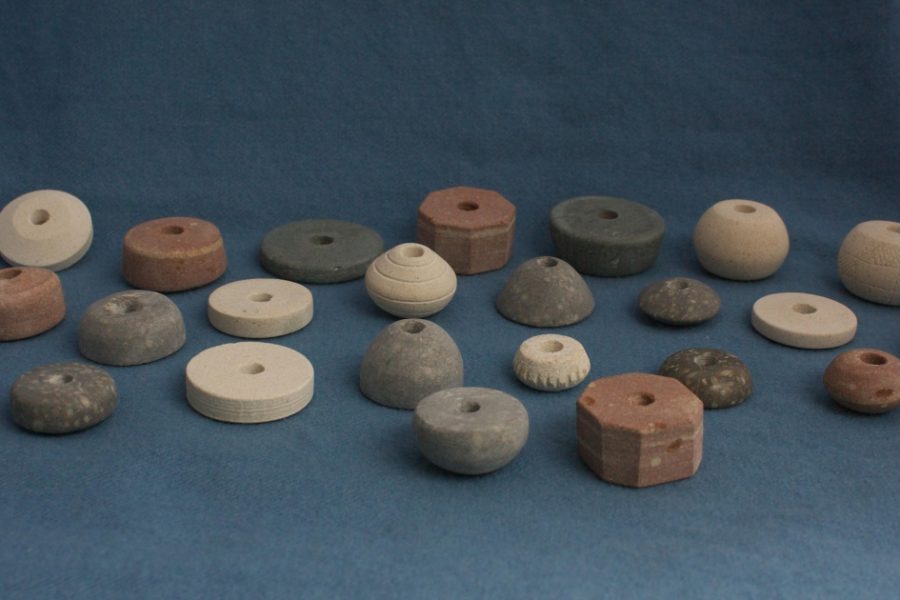
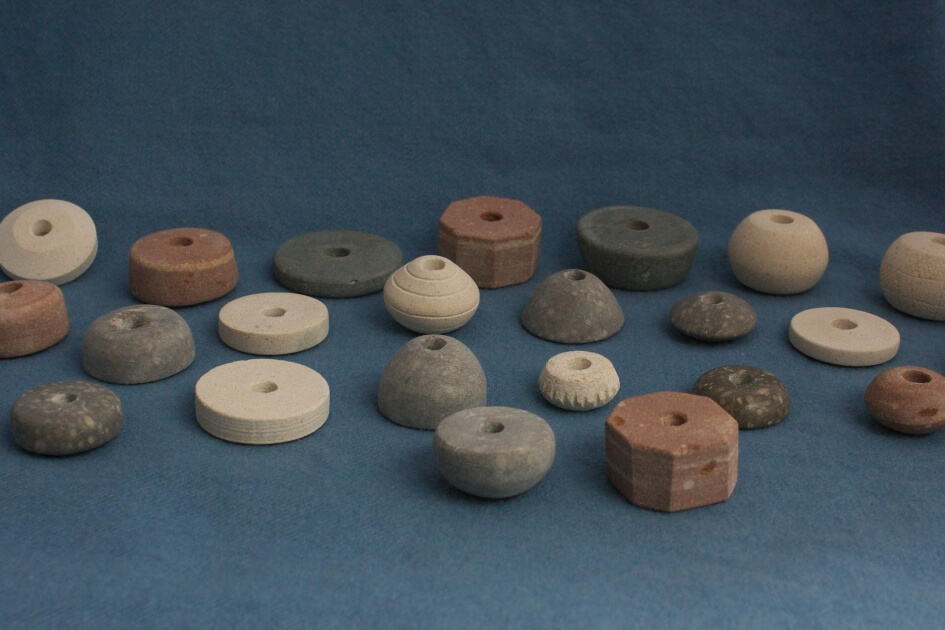
Exhibit A:

IMG_9657
Stone spindle whorls. These have been on my wishlist for oh, so long, and finally things came together: finds to base the whorls on (from Coppergate, York, dating to the 9th to post-12th century), and somebody willing and able to make them. I'm very happy with these, and I hope I won't be the only one!

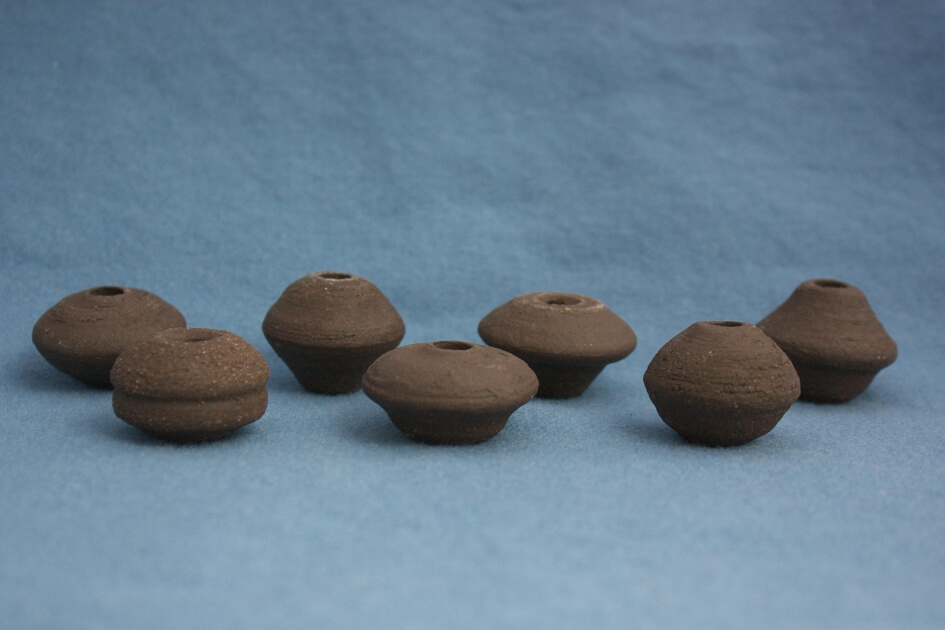
There's even more whorl-y goodness. The lovely potter who makes my wheel-thrown whorls has made another batch, and has made more different forms this time: biconical, roundish, and the conical/discoid form I had before. So, Exhibit B:

IMG_9681
I'm all in love with all the new whorls, and sorely tempted to diminish the stock by sneaking some of them (or, to be fair, a lot of them) into my own personal toolbox...
0
OKT.
19
0

Upgrading my Knitting Counters.

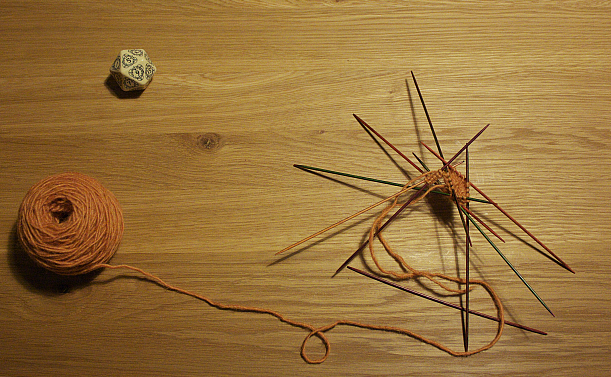
Occasionally, I am knitting things that require some row-counting. I'm usually not in a state of mind to go down a list of rows without some aid to help me keep track of which one I'm in, so I have been using dice to keep count for me.

IMG_55241
Usually this was a special die, though - it's a countdown die, which means the numbers are arranged in a way that you can easily find the next one in sequence. (It also has 20 sides, which is enough for most sequences.) Normal dice have the numbers arranged differently, and I was using a normal D10 (a ten-sided die, for those of you not familiar with this) which always meant some searching for the next face to move up.

Recently, though, there was the Spiel fair in Essen. And, as usually, I went there and had a glorious time and looked at lots and lots of games and game-related things... which includes stuff meant for roleplaying.

Now when you are roleplaying, it can happen that your character gets into a fight. You throw some dice, someone else throws some dice, and suddenly, your character gets hurt and you need to keep track of its health points... and while you can do so with a sheet of paper and a pen, or some other way of counting, there's a new gadget around for this: a life-counter ring.

As in: something you can wear on your finger and use to easily and conveniently keep track of which number you are at.

Are you thinking the same thing I was thinking?

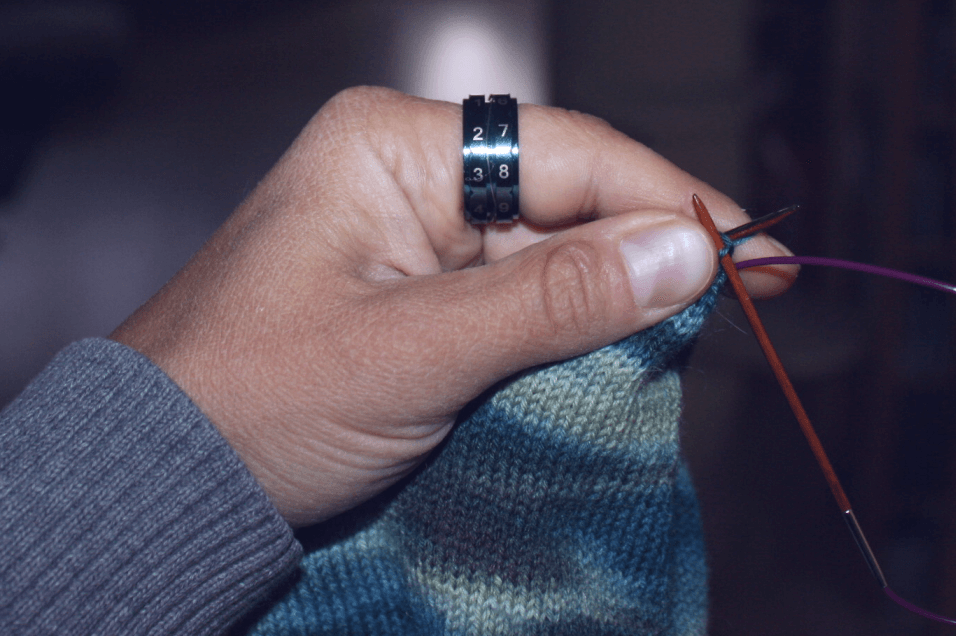
[caption id="attachment_2685" align="alignnone" width="640"]counterring This knitting action is obviously missing the hand I need to hold the camera. Also, the ring should be turned to another spot - it has a clearly marked area for the current numbers somewhere behind my index finger.


Right. New counting thingummy for knitting. I haven't used it in earnest yet (my current knitting project is not in the row-counting part yet), but have tested it, and it works fabulously. There's a little spring wire between the two numbered rings that makes sure the count only changes when you want it. For that, you gently press the ring towards the middle and then turn it. It's made from stainless steel, about one cm wide, and comes in blue (my colour), rainbow, gold, or black. It will also count up to 99, which should be plenty for all knitting purposes.

If you want to have one, too, the company making it is called CritSuccess, and they do ship worldwide. They also have a lifetime exchange policy - if your ring gets damaged, doesn't fit anymore, or you have any other issues with it, you can exchange it for a new one.

Now if I didn't have such a heap of work waiting to be done, I could go do some knitting...
0
OKT.
17
2

Weaving Preparation: Wool yarn testing.

One of the things in frantic preparation right now are the experiments for the Textile Forum this year. We'll be having a rather experiment-heavy Forum, and all three planned things involve dyeing - one of the experiments will be a repeat of the Pompeii dyeing experiment exploring the influence of kettle metals, one will be a test about linen mordants with protein, and one will be looking at dye penetration in woven fabrics of different densities.

The lattermost requires appropriate yarns, and I will get to spinning tonight - a few hundred metres of yarn need to be done for weaving several samples. The weaving will take place at the Forum, and since the weaver lives in the Netherlands and I live in Germany, she will only see the yarns right before having to use them.

Most modern weavers use machine-spun, plied yarns, at least for the warp, because they are (usually) stronger than singles. Of course a plied yarn is stronger than just one of its singles, and modern yarns are often soft-spun, which means they are not very strong. So modern weavers tend to be a little nervous about using singles in the warp.

Just to make sure that the yarn is suitable for weaving - as in "strong enough" - I was sent instructions for testing, taken from "Inventive Weaving on a Little Loom: Discover the Full Potential of the Rigid-Heddle Loom, for Beginners and Beyond by Syne Mitchell (Storey Publishing 2015)". The two tests are the snap test and the drift test. For the snap test, you take the yarn between your hands so that about 10 cm are slack and then "snap your hands apart sharply"; for the drift test, you apply even, slow tension.

The instructions in the book say that if the yarn survives the snap test and "stretches and then stops" in the drift test, it's suitable as warp yarn. Can you guess my problem?

"Sharply" is not a very quantifyable thing. So if I take my yarn and pull my hands apart sharply, it will break. The same is true if I take a four-ply Regia sock wool yarn. In the drift test, my yarn will stretch and stretch and stretch and eventually snap... so according to these instructions, it would not be suitable for weaving.

I think the problem here is that you'd need to be a weaver and know the amounts of tension or snappiness in your own weaving process to really make these tests helpful. For non-weavers like me? Or for "remote testing" yarns? It needs to be more quantifyable.

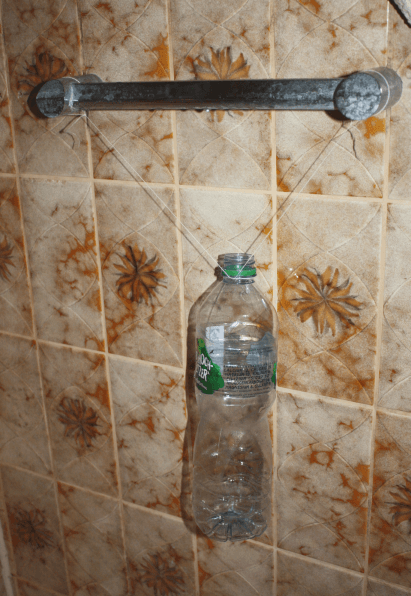
So here's my equivalent to the drift test: Tie an empty plastic water bottle in the middle of a piece of the yarn to be tested, then tie the two ends somewhere so that the bottle hangs in a suitable way to be filled. (Hint: A shower or bathtub, or someplace outside that can take a splash of water would be good places.)

[caption id="attachment_2677" align="alignnone" width="319"]Setup for the drift test. Please do admire the typically Germany-in-the-Seventies tiling in the background. Setup for the drift test. Please do admire the typical "bathroom-in-Germany-in-the-Seventies" tiling in the background. The white spots on the handgrip also tell you that we have really hard water here.


Measure out a certain amount of water, such as one litre, which will be one kilogram. Then, slowly and with as evenly a stream as possible, pour water into your bottle until the yarn snaps. The difference between the amount of water you filled into your pouring container and the amount still left is the weight the yarn could take - in my case, about 880 g.

Now the equivalent to the snap test: Tie a weight to one end of your yarn to be tested, then measure out one metre of yarn plus a bit to hold, starting above the weight. Take the end of the yarn securely in one hand, the weight in the other, hold them side by side high enough, then drop the weight. If the yarn bounces back, it has survived the test. If you are not sure on how much weight is necessary for the thread to pass the weaver's requirements, add more weight until it snaps. (Obviously, the smaller the increments of added weights are, the smaller your squishiness factor will be. My yarn snaps somewhere between about 60 and 100 g of weight.)
0
SEP.
27
0

Rainbow Wool.

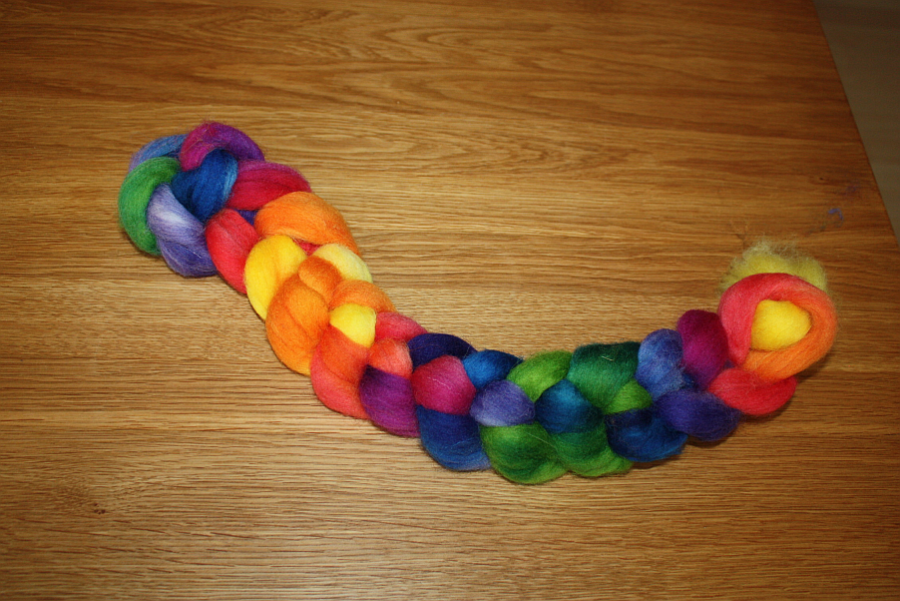
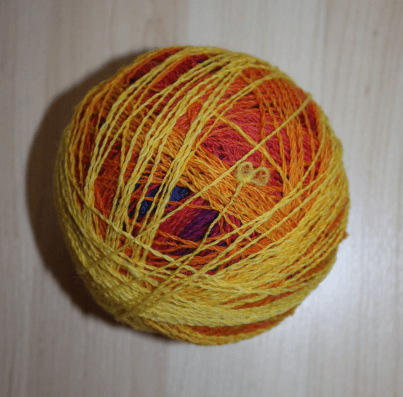
The lovely colourful skein of wool which originally started out as this:

rainbowwool
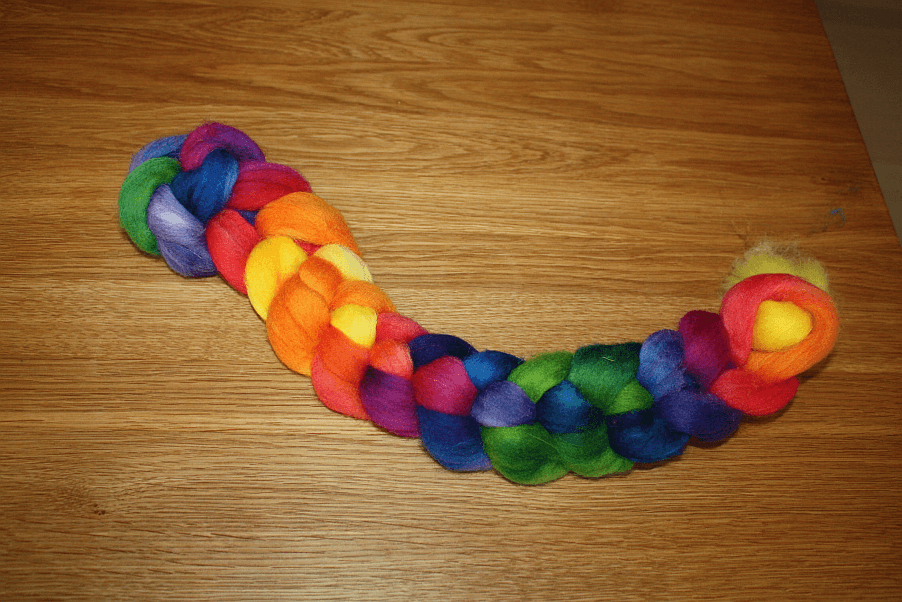
has turned into a ball now:

rainbowwoolball
I'll have a good, long think about what I will do with 745 m of this fine two-ply rainbow. Currently, the thing that sounds most attractive is to take some dark yarn in a similar thickness and eventually knit something wearable in a mosaic pattern.

In case you don't know mosaic knitting - it's a slip-stitch technique where you work with two colours, making incredibly complex-looking patterns that are fairly easy to knit. There's a nice tutorial in a back issue of Knitty to get you started, and if you want more patterns, Barbara Walker has published a whole book called "Mosaic Knitting".
0
SEP.
26
0

Opus Anglicanum Exhibition coming up

Twitter can be really useful sometimes - I learned there that the V&A London will open its new exhibition "Opus Anglicanum, Masterpieces of English Medieval Embroidery"  on 1 October 2016, and the exhibition will run until 5 February 2017.

There's a programme of events related to the exhibition here, and the main page about the special exhibition is here. It looks like a  spectacular line-up of gold embroidery, so if you can manage to get to London during the exhibition, it is surely worth a visit!
0
SEP.
22
2

First Times.

I'm a late convert to knitting - I only learned how to knit when I was 30. Though we were supposed to learn how to knit in school, I only got taught the basics of crochet. In my middle teens, I had asked a great-aunt to teach me, and she dutifully did - she loved knitting, and did a lot of it - but I ran out of steam, and interest, about 30 square centimetres in. (That's about 6 cm length of a 5 cm wide headband, if you want to know.) It was... boring. Drab. Slooow.

When I got into historical textile stuff, my excuse for not doing knitting was that a) a lot of people already know about it and do it, so it's not in danger of becoming forgotten, and b) it's a rather young technique, only coming up into its own in the early modern times, with sparse bits starting in after about the 13th century. So no need for me to get into knitting... at all.

Two things did change my mind: My friend, who gifted me with hand-knit socks (my first pair, that fit totally perfectly, and I fell in love with hand-knit socks at that moment), and one of the colleagues-since-turned-friend at the first Textile Forum, who knit 17th-century long stockings from very fine yarn on homemade wire needles (because you don't get needles that fine anymore). A technique that is used for something as crazy as that? I definitely need to learn it.

So learn I did, while knitting the thing I really wanted to have: Socks. From there, I moved on to more socks - patterned socks, socks knit two-at-a-time on dpns, socks knit two-at-a-time with magic loop (I suffer from a specific variety of second sock syndrome, in which the second sock ends up being two sizes smaller than the first one if I don't knit them simultaneously), hats and lace stuff.

What I never did yet, though, is a sweater. Or pullover. Or (what I like best) a cardigan.

In the end of 2015, I finally had decided that I really want to knit one now, and I picked out a pattern and took my measurements and bought a ton of yarn for it (you remember that "before" photo from a few days ago, right?). I knit a swatch, and washed and petted it, and I was good to go... and then came that book debunking the diet myths. No use in knitting a sweater in a size I won't ever wear again, especially with the incredible speed I knit (read: I do knit moderately quickly, but in the end, it is quite slowly as I tend to put it aside and not work on it for longer stretches of time). I was also not willing to guesstimate any measurements - so the wool went into storage.

It's still in storage. I got a new pattern, though, and new wool (it's not my fault, these skeins just sort of ended up coming home with me, and yarn that comes home with you while you technically have a yarnbuying embargo in place only doesn't count as new yarn if you have a project in mind for it and cast on sort of immediately, right?) and yesterday... I cast on Vignette.

vignette_back_bottom
I'm totally excited. My first upper body garment thing. I really, really hope it will turn out well!
0
SEP.
20
0

Have an old embroidery book.

The next few events are drawing nearer - the European Textile Forum and the Nobilitas-Akademie, so I'm rather busy preparing for these. While the cat, helpful as ever, is sleeping in her cat bed beside my desk, making small adorable sleepy cat noises... that are more an incentive to cuddle her or curl up for a nap than to be as busy as I should be. Oh well.

Since I'm working on the presentation for the Akademie right now, I'm looking at embroidery-related stuff... and I have stumbled across a very early Italian pattern book that is freely available on the net: Alessandro Paganino's book "Il Burato". The book was published in 1518 and contains lots of patterns, plus the famous picture on how to transfer patterns to the fabric.

While you're at the website of the Textile Research Centre in Leiden, to get that pdf, do have a bit more of a look around - there is a lot of content, embroidery- and other textile craft-related, that is really worth exploring!

 
0

By accepting you will be accessing a service provided by a third-party external to https://pallia.net/

Kontakt