Latest Comments

Guest - Aislinn Dyestuff Citizen Science.
09. Oktober 2026
This is a great project. I look forward to the results. Thanks for letting us know.
Guest - Aislinn Time for...
09. Oktober 2026
Looks delicious!
Guest - Katrin Sprang Discussion
18. September 2026
Hi Rachel, I have looked for more photos of you, but that was not very successful. I found a link on...
Guest - Beatrix Sprang Discussion
15. September 2026
That lozenge pattern element is not a photograph, but a scan. So it should be to scale. But I pinned...
Guest - Katrin Sprang Discussion
15. September 2026
I was not referring to Rachel's reconstruction (is the reconstruction you refer to the one photograp...
OKT.
23
1

More rants (not mine this time, though).

If you're interested in old textiles, you might have caught the thing with the Viking tablet-woven band that, according to Annika Larsson, spells "Allah".

The Guardian and Heritage Daily, among other places, covered this "staggering" find. Then up sprang the debate on whether it really was possible that the band has Arabic script on it, and spells "Allah" - one prominent voice against it was Stephennie Mulder, an associate professor for Medieval Islamic Art and Architecture. She did it on Twitter (of all places!), in a brilliant string of tweets you can see here. (Go look at that link for pictures of medieval tablet weaves with stunning patterns!)

Apart from the Square Kufic style being significantly younger than the textile and other script issues that are covered in that tweet string, Carolyn Priest-Dorman also has a few things to say about the pattern. Especially that the square-ish things at the side, shown in the images in the articles, are... not actually in the band itself.

The Guardian's article has since been updated to include the academic debate.

The Atlantic also covers this discussion, as does The Independent.

I'm not sure what brought Mrs Larsson to go forth and invent extra bits for a band just to read something Arabic into it, but I'm not happy about it.

I'm much happier about the fact that there were quick and well-founded counter-arguments for it. It's a beautiful band, it is a stunning piece of work, and it does deserve proper study, but it's not a prop for inventing an alternate history, thankyouverymuch.
0
OKT.
17
0

So many colours.

There are so, so many open questions left around the man found in the Bernuthsfeld bog. Who was he? What was his job, if he had one? He definitely wasn't rich, but how poor was he?

There's also plenty of questions regarding his tunic... one of them being the colour question, as usual when some bog-brown textile is found. There was a dye analysis done, but the results were rather sketchy, with only quercetin found as a definitive dyestuff ingredient.

Well, we have a tunic that is put together from a lot of different pieces of fabric, most if not all of them already in their second, maybe even third or fourth use. Chances are very, very high that there were not only all kinds of fabrics, but also all kinds of colours... which we don't have definitive proof of.

Quercetin is, however, found in many different plants - among them woad (isatis tinctoria) and birch leaf. So for the reconstruction, we decided to leave some of the fabrics undyed (especially those with interesting natural wool colours), and to use birch and indigo (the latter rather sparingly) on others.

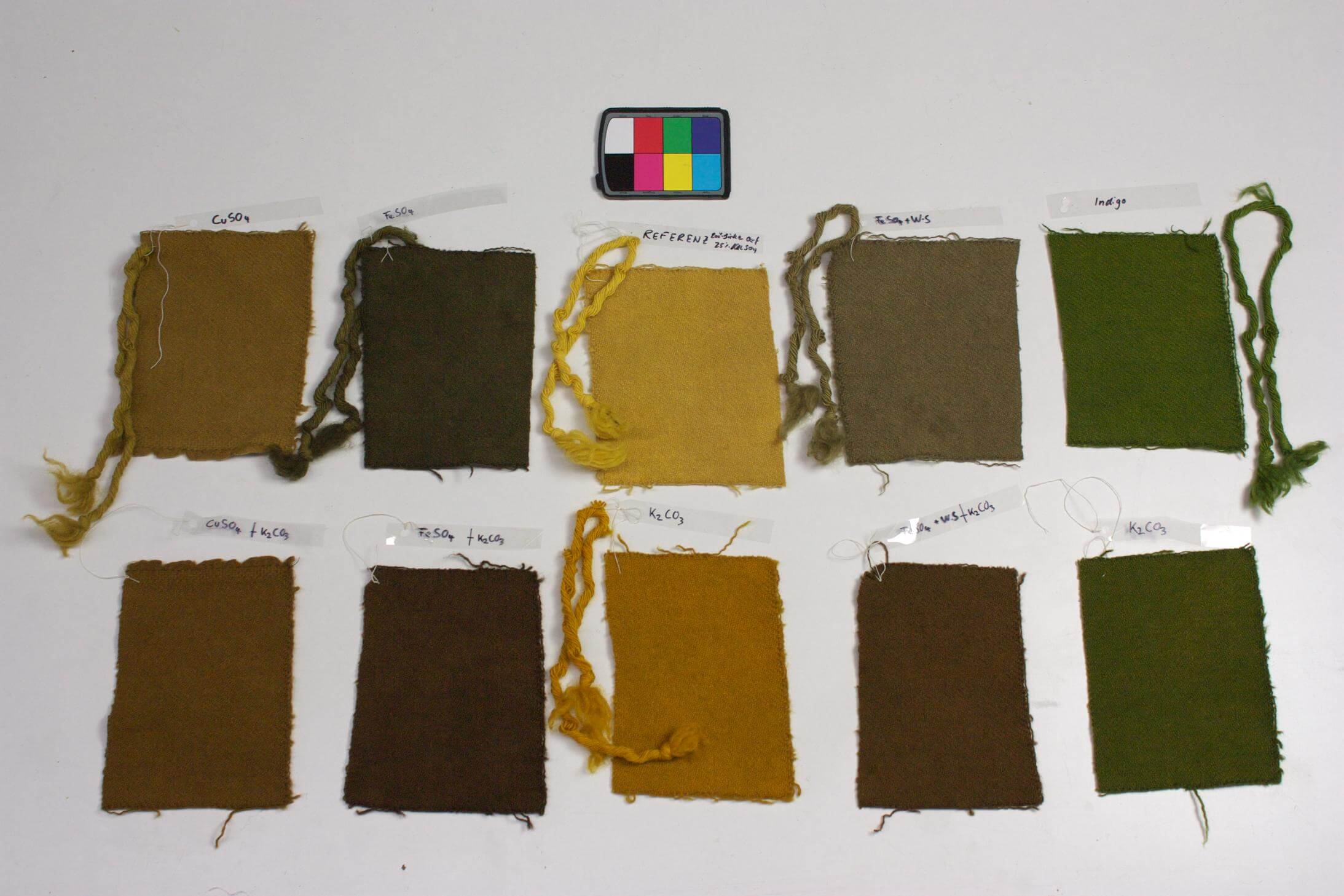
The nice thing about natural dyes is that you can get so many different hues from one plant that it won't be boring at all. So we were, after a lot of discussion and brainstorming and thinking, going for two different hues of blue, one double-dye of green (birch yellow with blue), and several different colours made with birch. For that, we did a nice little test run with pieces of fabric, all mordanted with 25% alum, then dyed in 200% dried birch leaf, then nuanced with iron, copper, iron plus cream of tartar, and potash. One of the yellow bits was dipped into an indigo vat, and then all of the candidates (except the yellow bit that went into the potash right away) were rinsed, split and half of them thrown into the potash brine over night.

The results were rather spectacular:

birch_colours

As usual, it's very hard to give a good impression of the colours on a photograph - natural dyes look very different in reality than on a picture, and they can even change hue depending on the light angle, let alone depending on light colour and quality. So you'll have to believe me that the green achieved by iron sulfate nuancing looks really green (until you hold it next to the indigo-on-yellow green, when it looks like someone dropped it into a mud puddle), that there's beautiful soft browns to be gotten with copper and that nuancing the yellow with potash gets you an orangey colour that is utterly, utterly beautiful.

Also as usual, the actual dye run yielded slightly different results to the test run - but we were both quite happy with the outcome, and the tunic reconstruction will look colourful enough to give an impression of the many colours in medieval times, yet will only have used two dyestuffs that we have hints for in the analysis.

Also also? Dyeing is fun.
0
OKT.
10
3

I'm off doing things... exciting things!

You might remember that a while ago, I posted about having a project for a reproduction of the tunic worn by the man from Bernuthsfeld.

Well, it's time to get the project into the next stage - which means I'm getting to see the original, and will be starting work on the actual tunic-making together with my colleague. So I'll be off doing exciting things to cloth for the next few days, and thus be taking a break from blogging - I will be back on October 16.

Meanwhile, I will leave you here with a picture of the fabrics that were woven for the tunic and a small mantle-like cloth:

[caption id="attachment_3429" align="alignnone" width="1632"]Fabrics woven for the Bernuthsfeld-Project - lots and lots of different ones, many of them just small patches... Fabrics woven for the Bernuthsfeld-Project - lots and lots of different ones, many of them just small patches...


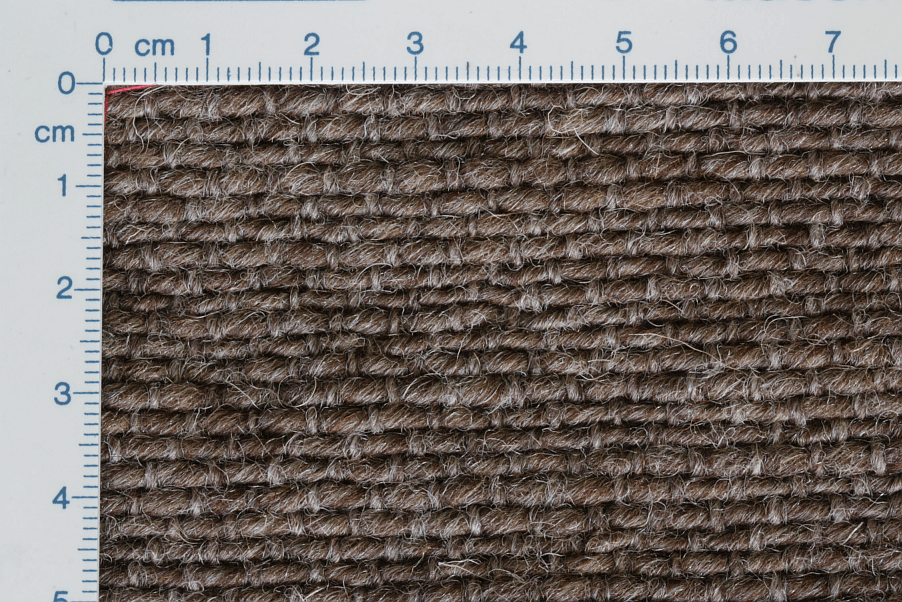
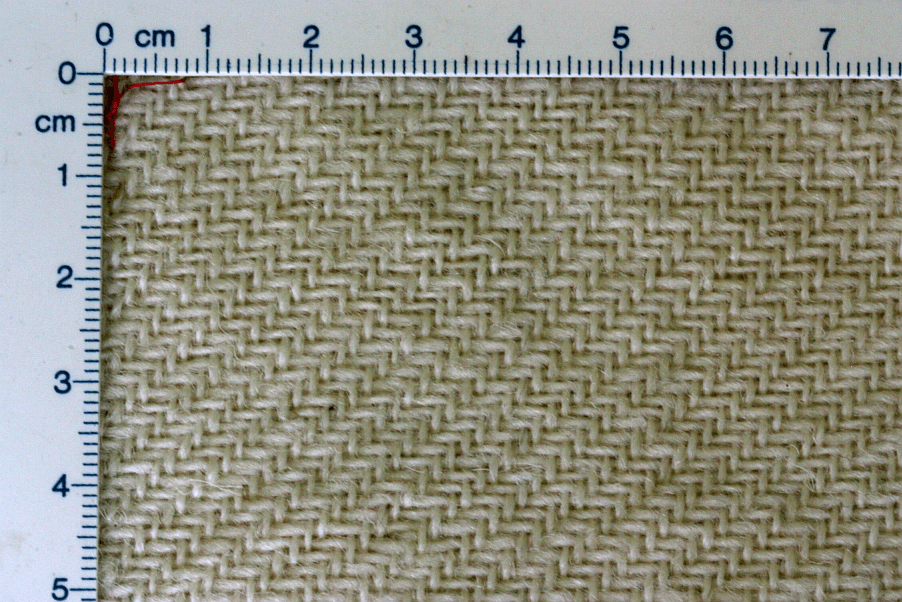
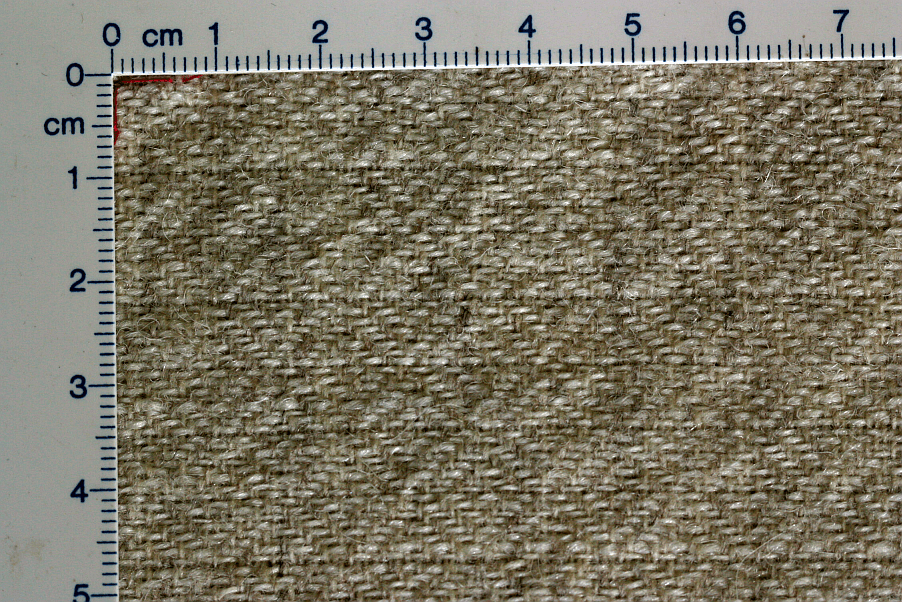
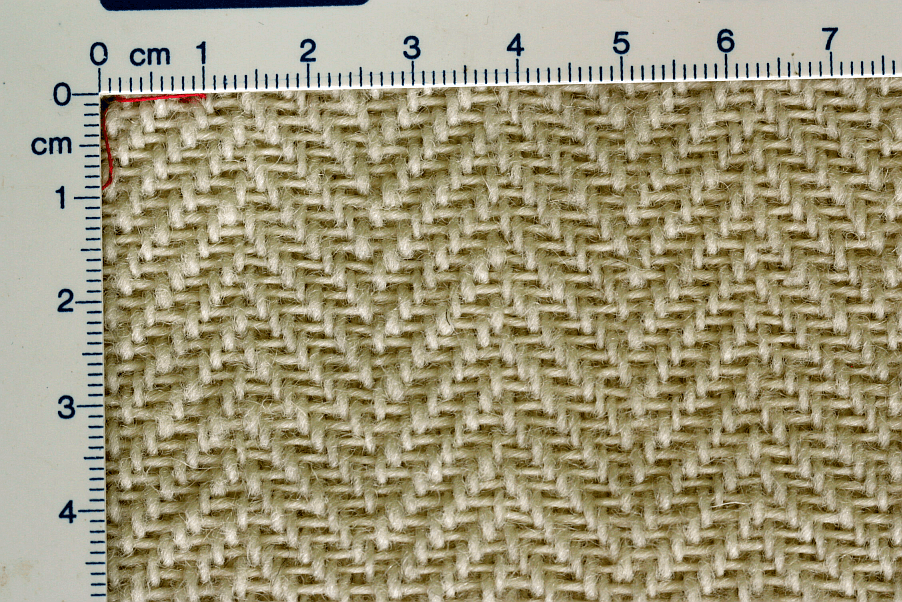
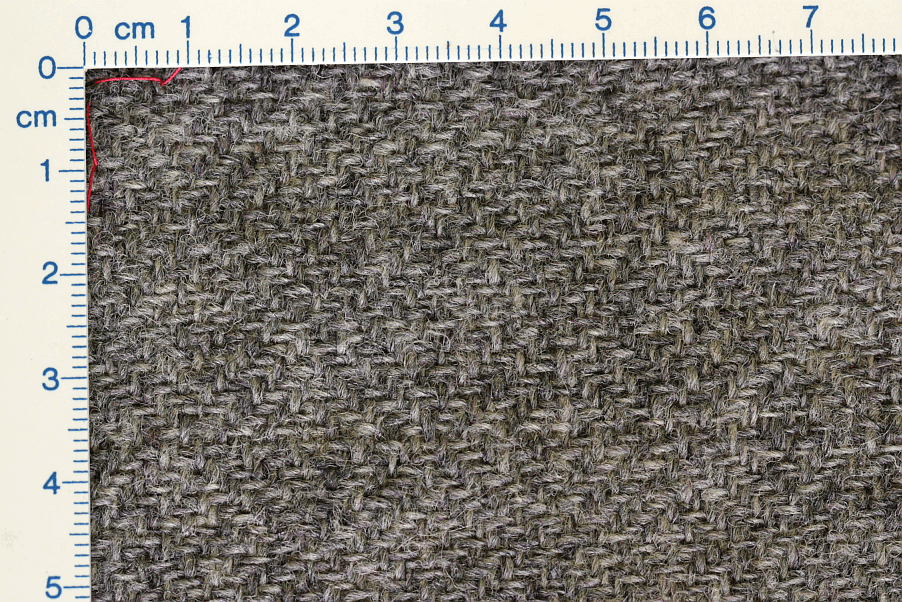
And just because I have them, here are a few more pictures of some bits, close-up:

bernie_b
bernie_a bernie_c bernie_d bernie_f
It's going to be so much fun to dye a selection of the fabrics, then cut everything up, roughen them a bit to simulate use-wear, and stitch them together into the tunic!
0
OKT.
03
0

York Archaeology - Fascicule 17/5 and 17/11

If you're a numbers person (as in somebody who easily remembers numbers, lucky you) and a textile archaeology nerd in addition to that, the two numbers in the blog title might ring a bell for you.

If not, let me bring you up to speed: York Archaeological Trust has been publishing a lot of very nice, very helpful shiny books about various aspects and find groups of all the digs done there - and York has a lot of history, and has had a lot of digs, and consequently there's oodles to research, and to tell. York also boasts a number of textile finds and textile tool finds, which is a delightful thing.

To make all this good stuff even better, they've decided, once they run out of the printed copies of their books, to make them freely available as pdf online. I've posted about this at least once before, but that was a good while ago. Back then, I had downloaded those of interest to me, though the really, really yummy ones - about textile production and textile finds - were still available in print and thus not as pdfs.

Just recently, though, I searched for something else, and the engine threw me a link to one of these two books on the YAT website. Off I went - and to my great delight, both 17/5 Textile, Raw Fibre and Cordage from Coppergate 16-22 and 17/11 Textile Production at 16-22 Coppergate are available now. (Direct links to the pdfs - but do go and visit their page listing the rest of the volumes of Archaeology of York, there's many more.)
0
AUG.
03
0

Mixed Links.

The online EXARC journal has a short article about bronze spiral decoration in textiles.

Kitty Lux of the Ukulele Orchestra died about two weeks ago, here's her obituary. I'm really sad - and feel very privileged to have seen and heard her live a few times.

The major Roman roads, drawn in a subway map style.
There's a new podcast around: Ask an Archaeologist. (I have not found the time to give it a listen yet, but it's definitely on my list.)

Heritage Daily reports on a Roman bronze figurine that might leave Britain.

Gillian Polack has a post on how to peel oranges... with a fork. Which is intriguing and makes me a little sad that we are currently far from Orange Season here - but it will come, and I will definitely try that.

And that's it for today - I hope there's something of interest for you!
0
JUNI
09
2

More about the Bernuthsfeld Man.

The Bernuthsfeld Man's tunic is really a rather special affair - a very, very simple cut, but it is put together from only patches. It's not a heavily worn tunic that was patched up.

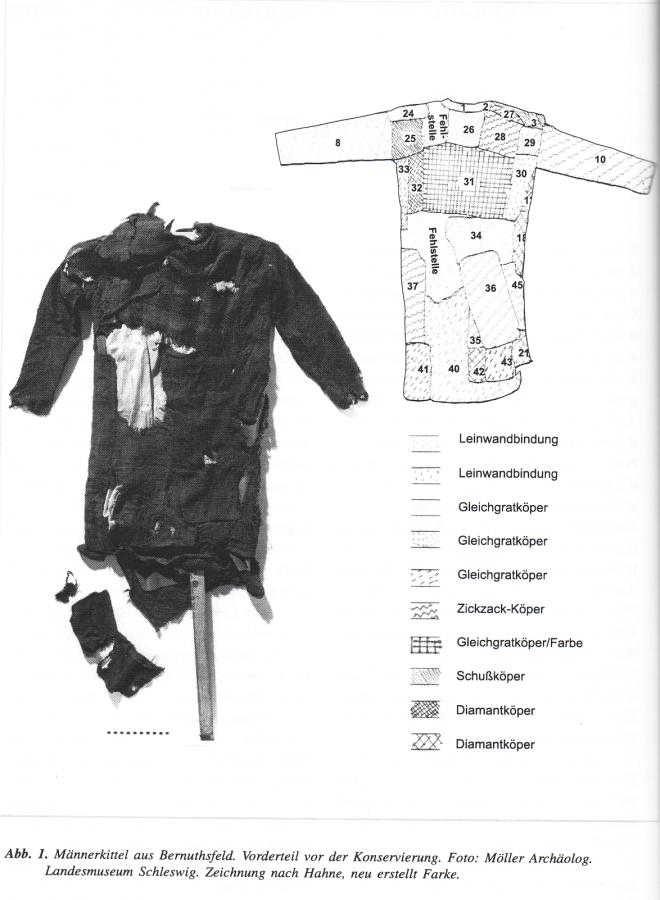
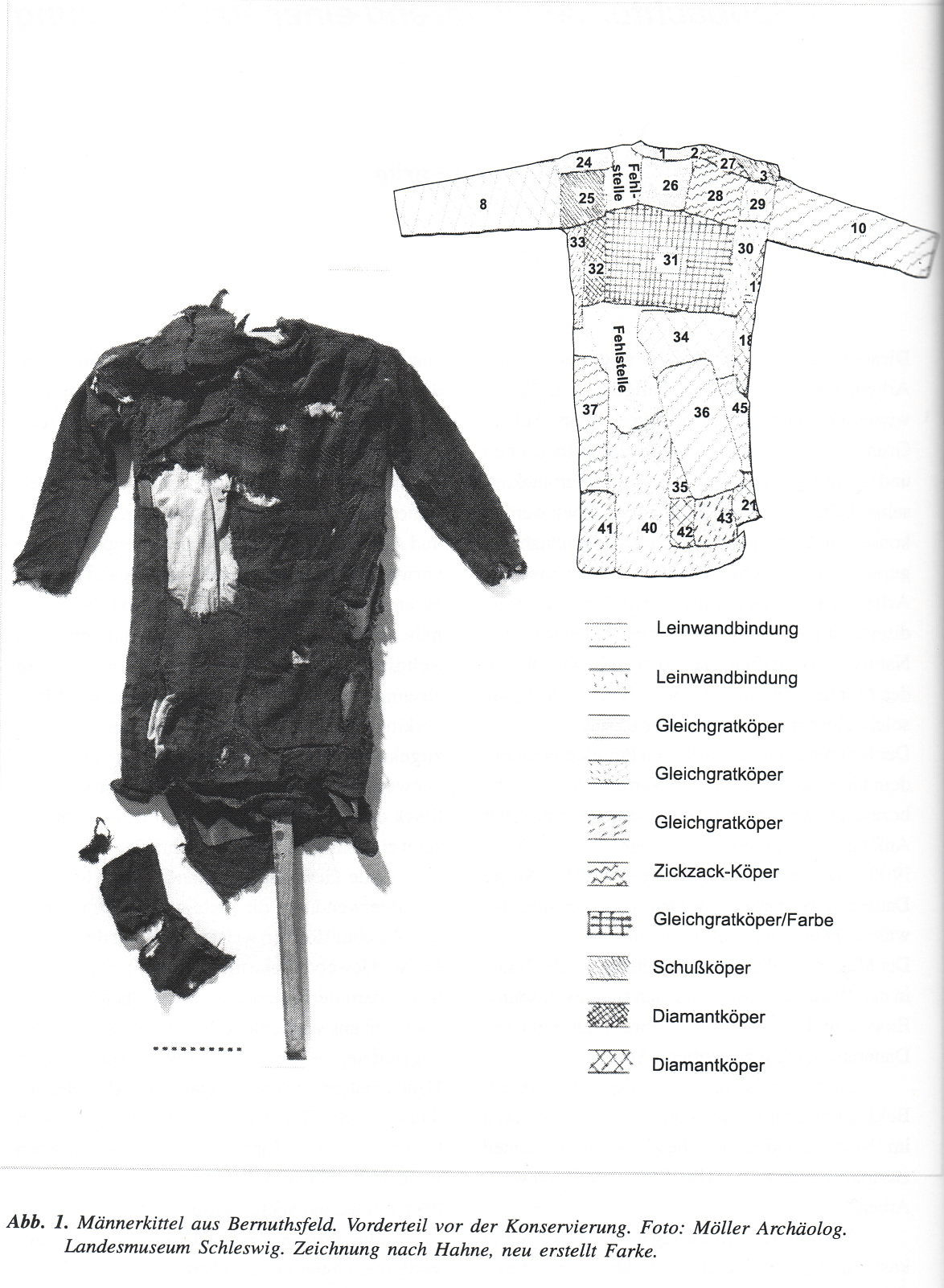
Most publications about the tunic are in German, including one published in one of the NESAT proceedings, which includes this overview picture of the tunic's front:

[caption id="attachment_3151" align="alignnone" width="640"]nesat6_100 Picture from: Farke, Heidemarie. "Der Männerkittel aus Bernuthsfeld. Beobachtungen während einer Restaurierung." In Textiles in European Archaeology. Report from the 6th NESAT Symposium, 7-11th May 1996 in Borås, edited by Lise Bender Jørgensen and Christina Rinaldo, 99-106. Göteborg, 1998, p. 100.


As you can see, it's rather... patchy. The individual bits of fabric all show marks of wear from previous use, possibly in garments; there's lots of twill variations and only rather few plain weave bits. My count is 19 different fabrics, used for 43 patches. Some of them are folded double, others are used as single layer. The "cut", if you can call it that without there having been proper garment cutting, is as simple as possible.

Why that tunic looks like it does? Nobody knows - it is a singular piece (alas, like quite a few textile finds). With its patches, possibly in different colours, but at least in very different kinds of fabric, all looking old and worn, and with the very conspicuous checkered fabric #31 right on the breast in front, it would have been very obvious that this was not a "normal" member of society, though. There are a few late medieval images that show beggars dressed in very, very patched garments - so maybe this tunic was a beggar's work clothing?
0
JUNI
07
5

Spinning!

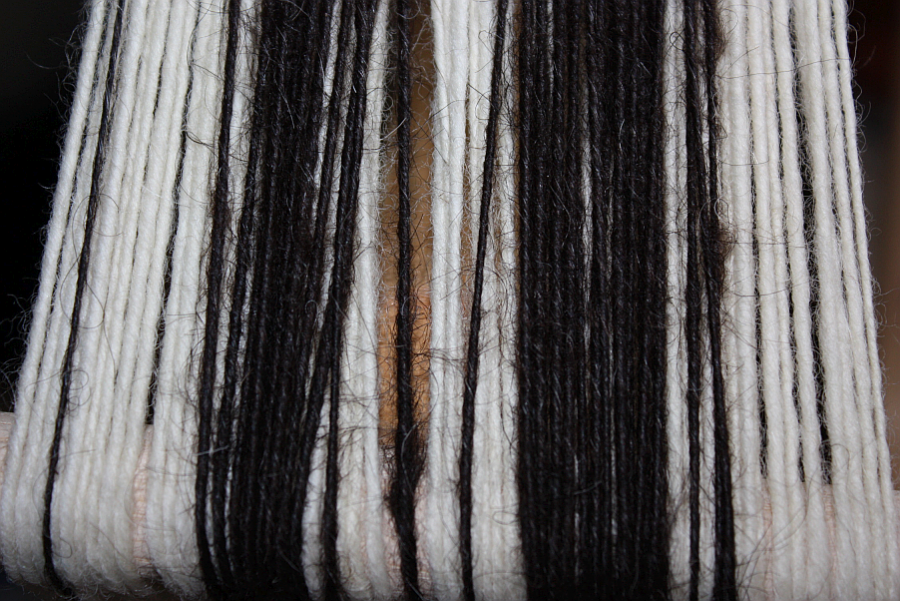
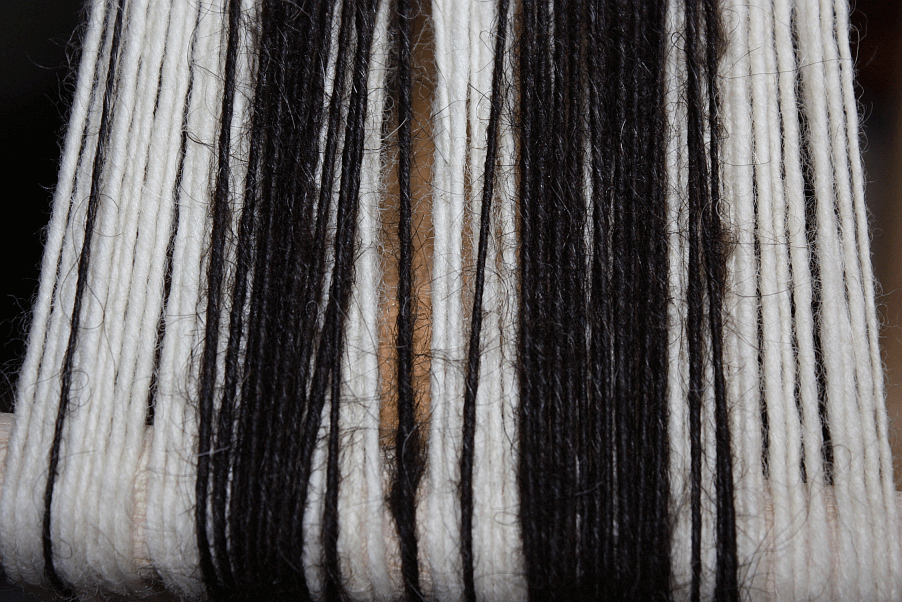
There was some spinning today... in both black, and white. The reason for this is the exciting new and large project - recreating the finds (including the garments) that were found with the bog body of the Man from Bernuthsfeld (Wikipedia has an article about him, but only in German).

The body and the finds were off for research since 2011, but have returned last summer to the Landesmuseum Emden. The wish to show a better picture of the man, and how he might have looked in his lifetime, has led to this reconstruction project of the finds... which is totally awesome, and means a lot of (partly quite fiddly) work.

First step, after the extensive planning, is getting the fabrics. And, you might have guessed it - they are not your common garden-variety pieces, available without a problem in the next fabric shop. The tunic is put together from patches - more than 40! - and these patches are mostly from already worn fabrics, more than 20 different kinds.

Weaving small bits of fabric (a patch here, a patch there, patches, patches everywhere) is much less efficient than weaving a proper, large piece - which means that a lot of the planning was figuring out how large the individual pieces have to be, and how they can be woven without driving everybody involved utterly crazy.

The yarns are partly also a problem - which is the reason that I did a tiny bit of spinning. The rest of the yarns will be machine-spun, but as close to the original yarns as possible, and the weaving has already started. So exciting!

[caption id="attachment_3143" align="alignnone" width="442"]bernie_yarn The yarn, dark and light - it is for a checkered patch that sits prominently on the breast of the tunic...
0

By accepting you will be accessing a service provided by a third-party external to https://pallia.net/

Kontakt