Latest Comments

Guest - Aislinn Dyestuff Citizen Science.
09. Oktober 2026
This is a great project. I look forward to the results. Thanks for letting us know.
Guest - Aislinn Time for...
09. Oktober 2026
Looks delicious!
Guest - Katrin Sprang Discussion
18. September 2026
Hi Rachel, I have looked for more photos of you, but that was not very successful. I found a link on...
Guest - Beatrix Sprang Discussion
15. September 2026
That lozenge pattern element is not a photograph, but a scan. So it should be to scale. But I pinned...
Guest - Katrin Sprang Discussion
15. September 2026
I was not referring to Rachel's reconstruction (is the reconstruction you refer to the one photograp...
DEZ.
15
0

Glorious Painting Pictures!

I think I may have blogged about this before, but I can't really remember - and that means it's not a bad idea to revisit the "Projekt Tafelmalerei" of the Germanisches Nationalmuseum in Nuremberg. 

The GNM has a very large collection of late medieval paintings on wood, and there's a project to research these paintings and make the information about them accessible on the Internet. The whole thing can be found at tafelmalerei.gnm.de and features 148 paintings, starting in 1260 and ending in 1520. So if you're interested in late medieval artwork, you might want to check it out.

The platform is German only; you find the paintings under "Objekte", and then there's preview images for all the items.

Especially interesting: There's a painting by the Meister von Uttenheim showing the Birth of Mary, and there's a lady dressed in a green gown that has a similar cut to one of the Lengberg dress fragments. Plus she's wearing a headdress with a geometrically ornamented inset - maybe something similar to a cap like that also found in Lengberg?

0
DEZ.
01
0

December is Here!

I don't know about your email inbox, but mine contained today several mails informing me about advent calendars. Most of those are not really interesting to me, as they're telling me to buy things at a discount every day.

There's one advent calendar I'm really looking forward to every year, though, and that is the one made by Maria and Amica from Historical Textiles. The two (self-declaimed) textile nerds show some of their favourite textiles every year, often with links to more pictures on the corresponding museum page. It's a true gem, and every year I admire them for all the time and effort they invest in that count-down.

Here's the link to their December 1 calendar blogpost. Enjoy, and I hope you will enjoy the following posts as well!

0
OKT.
25
0

More on the Cloak.

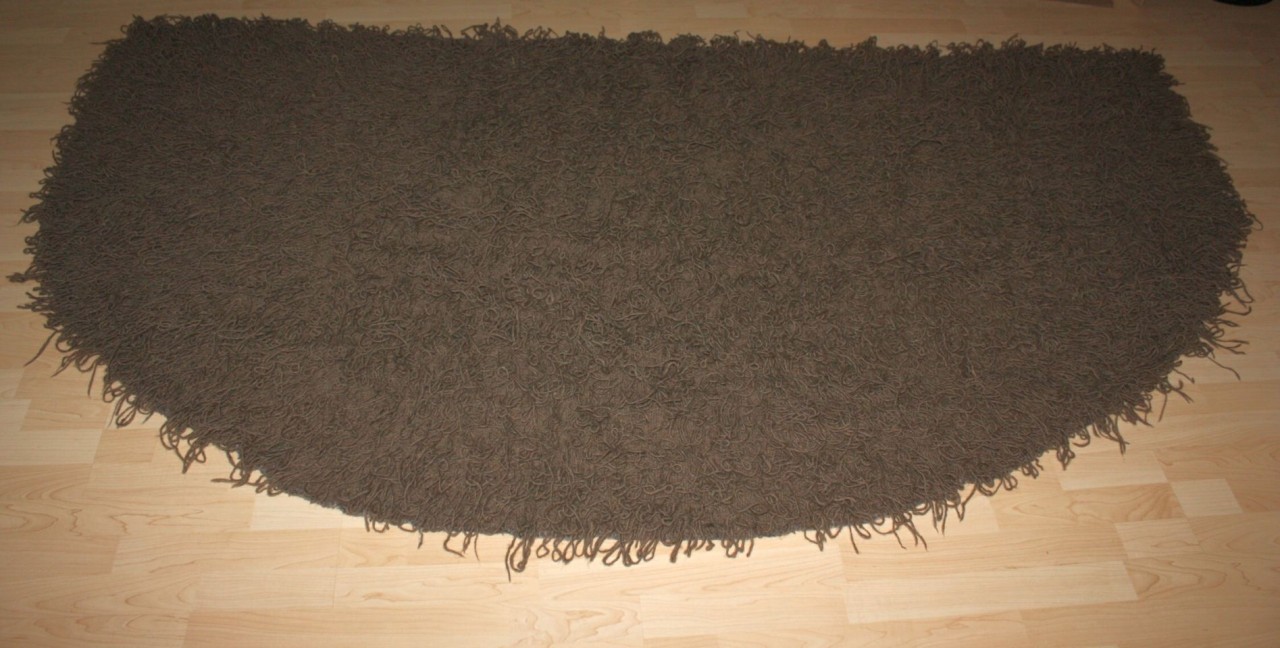
With all the many things going on, I never got around to posting a photo of the Trindhoj cloak after sewing on the many, many, MANY loops of thread.

Did I mention there were a lot of them? There were a lot of them. The cloak is rather large, with about 3 m width along the straight edge, and it is all over covered with these loops. Oops. (Sorry. I still get a little silly when I am reminded of all the loopy stitiching.)

The original cloak shows the remainder of stitched- on threads, spaced apart but not very widely spaced. There's not too much left, and it's not described in detail in Hald's publication, so I mostly went by the image available from the Danish National Museum website and some photos I was sent by a colleague. 

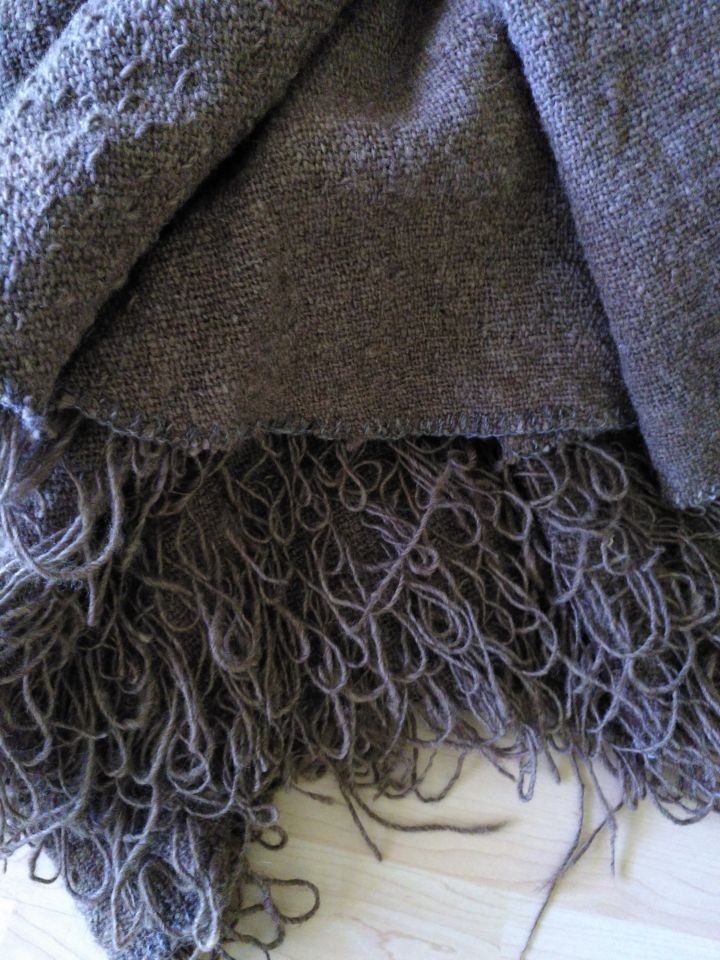
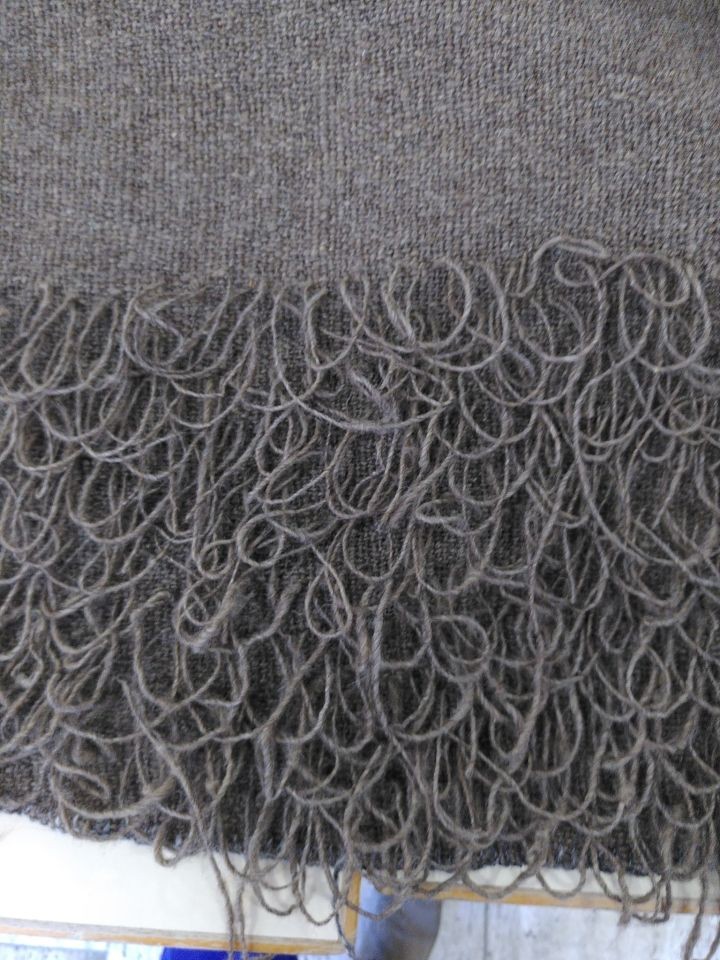
Because there's only bits of the threads next to the stitches left, we don't know if they were loops, or individual threads, and we also don't know how long they were. I wound the thread around my hand when stitching to have a similar length for all of them, and to have the loops long enough to overlap the next row below.

A test piece that I made, with loops cut open and loops left closed, looked quite differently after washing in the two parts. The opened loops had acted like you could expect of single yarns and fluffed up considerably, but also lost a good bit of their twist, so they seem quite vulnerable to wear and tear to me. The loops that had remained closed had mostly plied together, keeping the individual loops stable.

The photo above shows the cloak after finishing the sewing work, but before its final bath. It looks a bit like one of those shaggy carpets that were in fashion a few decades ago... 

It's also, not-really-surprisingly-but-still-surprisingly heavy. Unfortunately I completely forgot that it might be interesting to weigh it before and after stitching all those loops, but I used up almost all of the extra yarn that I had spun, which was a generous amount, and it's quite heavy now. It will settle nicely on shoulders, though, and I can absolutely imagine somebody showing off his (or her, maybe, though this item was found in a male grave) riches.

It is a lot of spinning time and a lot of weaving time that went into this piece, and then a lot of stitching time as well. We know from weft crossings in the original that several weavers worked on this together, and I can well imagine that several spinners worked on the yarn for this (or one spinner for quite a good bit of time).

0
JUNI
15
5

Loop Stitching.

Sometimes, when chatting about work in historical/medieval/prehistoric times, especially the very time-consuming textile work, somebody says "ah, well, but they did have more time back then". 

Did they, though? 

My usual answer to this comment is that back in history, days also only had 24 hours each. Not all of these hours were light, and there was less artificial lighting available than we're used to today, both in quality and in quantity. Some of the dark hours were, of course, spent sleeping - so let's just say, for simplicity's sake, that after 8 hours of sleep, there's 16 hours of time left to do things.

To do... all kinds of things. Especially those that were directly connected to sustaining yourself in some way, either by farming directly or by doing some other work to earn money to buy the things you'd need, or a mixture of both. Sounds familiar? Because that is, basically, what we're still doing today.

So depending on what your work is and how long it takes, you might have resources left over to spend on luxury goods in the wider sense, or you might not. That, again, is something that remains the same no matter what era we're in. There's people who have more resources and people who have less, and those with more resources can invest them in stuff that serves as status symbol, and those who don't... they have to make choices.

Time-consuming manufacture of things means that you either have the surplus time yourself and can spend it on making something fancy, or you have the money (or bartering means) to buy somebody else's time. If the rest of your social environment knows the worth of the item made, it can serve as a status symbol. (That won't work if you get something very pricey and fancy but nobody can appreciate it, because it's not common knowledge. A very fine hand-knit sweater would take a lot of time, but most people won't realise that when you pass them on the street - something like a fancy designer hand-bag, though, would be more widely recognisable.)

I am a firm believer that "back then", people did not have so much more time than we do have now. They'd also have had distractions, and days when things did not go as planned, and they'd have hung out with friends and family in their leisure time and not worked all the time on something. (Well, not more than modern people do.) That is also what I try to explain when the comment comes up.

Sometimes, though, I feel like going "oh my goodness, someone had waaaay too much time", too. Like now, when I am doing the stitching for the pile on the reconstruction of the Trindhøj cloak.

That is a lot of stitching. A LOT. 

Don't get me wrong, it's a quite nice task, and each single stitch goes rather quickly, but a lot of quick actions will still take a long time. I also hope that the yarn I spun will be enough, and I won't run out before I finish the loops.

Maybe it helps to work faster? So I'm finished before the yarn realises that it's not enough?  

1
JUNI
02
0

More Bronze Age Stuff.

There is still some Bronze Age stuff going on - stitching, to be precise.

Because, well, after the Egtved things have been all wrapped up (and literally wrapped up and sent off to the museum), work went on with the men's garments, modeled after the find from Trindhøj. 

One of the pieces is a cloak, shaped like a half-oval. That, by itself, does not sound very spectacular. However, what makes it spectacular is both the size of the woven fabric. The cloak is approximately 126 cm long and 243 cm wide, and it's cut out, so the minimum size of the woven fabric must have been larger still.

The other thing making it special and rather spectacular? It was finished with a sewn-on pile made from yarns. And this is what I'm working on right now:

It's rather pleasant work and each stitch does not take very long, but it's a large piece, and I am not yet at the thirdway point, according to my estimates. So... more stitching to do.

Also, there's several things that itch me in this: Because there's not much left of the pile, it's hard to tell how dense it was, how long the individual pile threads were, and if they were loops or cut open after being sewn on. There's also no good documentation or analysis of the stitch used to apply them that I could find. Which means I'm sort of making it up as I go along - or, in other words, I've tried around a bit after orienting myself after the reconstruction attempts done before, and analysis of another stitch used for pile, and found a process that feels good to me. Which I'm now sticking with.

All this is, again, a nice example of how one may have the impression that everything is known about a given textile... but once you start to re-create it, all the small and large gaps in our knowledge emerge. It's fascinating, and it's humbling, and it's always, always the case.

0
MAI
06
0

Egtved Update.

Here's a little bit more about the Egtved project - which is sort-of-half finished now. Sort-of-half because there are the men's garments to be finished, and they might be more than half the complete work time altogether. I strongly suspect that, actually. (I also should probably get them their own tag, as it's not Egtved but Trindhøj, and it would be a little weird to list them under Egtved.)

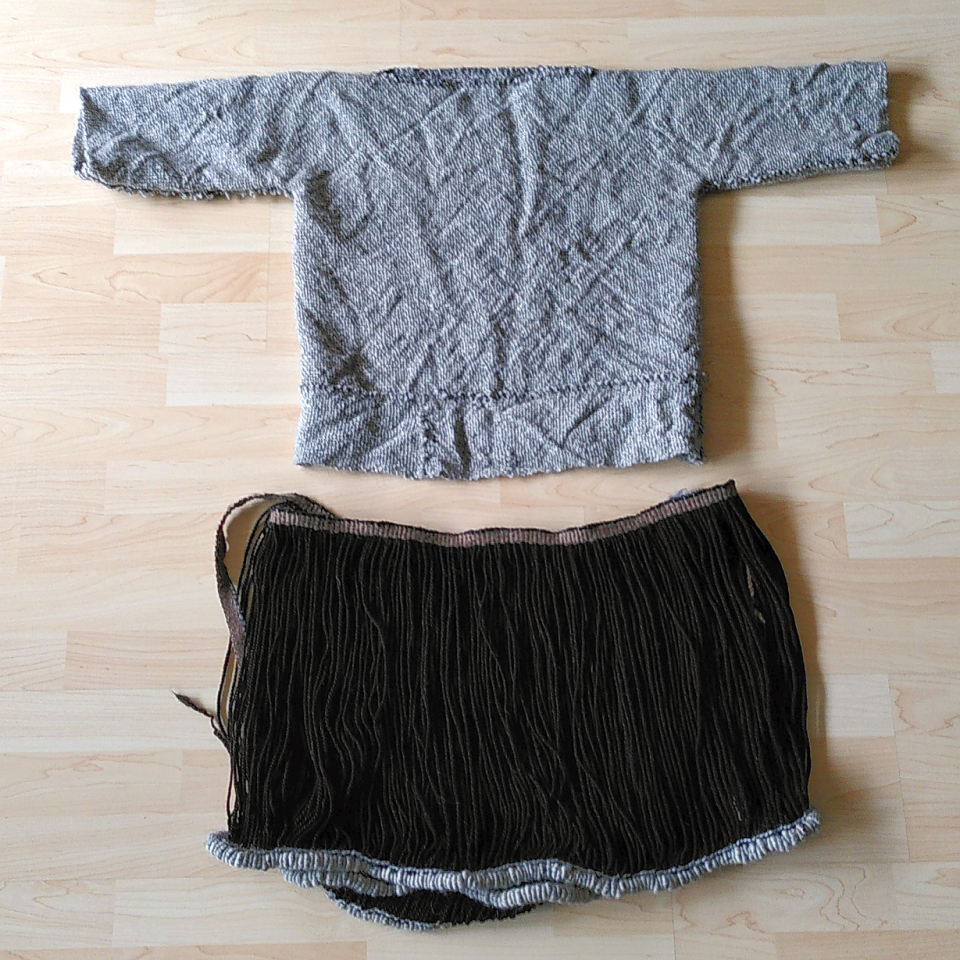
So... the blouse is finished, and with that, the whole set of garments is ready to be photographed for a final documentation, then packed up and sent off to the museum. It's been very interesting to sew that blouse, and it's also interesting to wear (because of course I tried it on...)

I had gotten all ready to cut the piece, with the measurements taken off the Egtved documentation, and then that nagging feeling got the better of me, and I cut and sewed a mock-up first, using the original measurements. Turns out it was a good thing I did, because the Egtved girl was just that: a girl, aged 16 to 18 years according to estimates from her dental status. Meaning that she was not so tall, and also must have been quite slender, appropriate to her age. 

She's estimated to have been 160 cm tall, and I am 163 cm. I can just fit into the mock-up blouse, though it takes a bit of wiggling to get in, and it's not wide enough to comfortably fit me, especially since my breast circumference is a bit more than the approximately 86 or so cm the original has. (It will squeeze in, as breasts are squishy to a good extent, but it's not really fitting well that way.)

That means the piece would not be wearable or try-on-able for a lot of people... and comparing it to the two other finds of similar blouses, the one from Egtved is by far the smallest. The other two have about 98 cm circumference in the torso part. So after checking back with the museum, we decided on using the Skrydstrup measurements as basis for the piece, making it large enough to fit a German size 42, approximately. I stayed with the slit-like neck opening, though.

The wool is somewhere between soft and scratchy to me, and that is also how the fabric feels when worn on the skin. When I was younger, I used to wear wool sweaters from Iceland on bare skin, though I might be somewhat, um, hardened against scratchy stuff. I'm also quite able to ignore a bit of scratchy feeling. What I'm not able to ignore is a neck opening that is close to the front of my neck, I find that really uncomfortable and irritating, so that would be one reason for me, personally, to not wanting to wear the blouse for an extended amount of time. (Or, if it were mine, I'd just make the neck opening a little bit deeper in the front.)

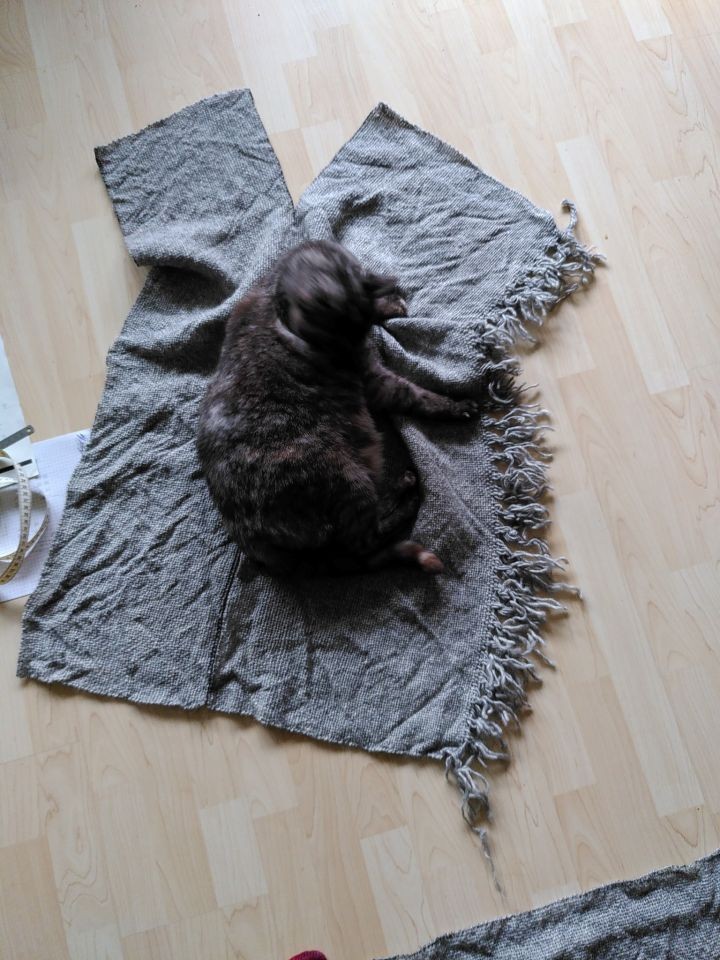
Of course there was assistance provided when I was cutting the fabric...

Sewing the garment was an interesting experience. The seams, according to documentation by Hald and Broholm, were about 1 cm wide, with the two layers of fabric simply overlapping and whip-stitched together from both sides. Now we only have a few threads per cm here, about 3 to maybe 4... which is not much to anchor stitching. 

I solved this problem by stitching through the threads of the fabric instead of between them, which was easy to do with these large and relatively soft yarns. Made like this, the seams feel reliably sturdy. 

Sewing the blouse was overall also the part that took least time - spinning the yarns, weaving the fabric, weaving the skirt, these all took a lot longer than the actual cutting (not much) and stitching.

Overall, I'm rather happy with all of this - even though, like always, there are quite a few compromises that had to be made...

0
MAI
05
0

Phew, and Phew.

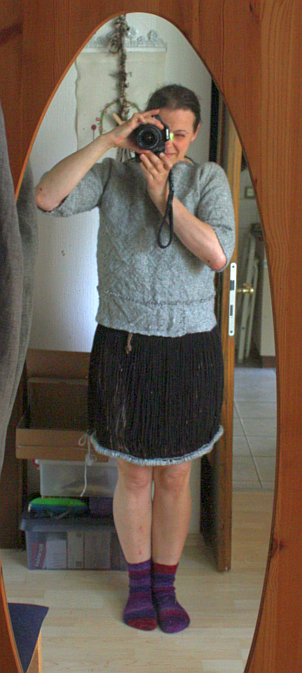
I may or I may not be sitting here dressed in the Bronze Age women's clothing - trying it out (or on) before it goes on its happy journey to its final work place. I may also have taken a quick mirror-selfie before sitting down here to write this blog...

I may also have managed to resurrect the Textile Forum website, and wait for all the mails to go out (there's a restriction on how many mails can be sent in a given time, to avoid spamming and hogging of resources that you have not paid for, so sending out a few hundred mails takes a bit of time). 

  Just in case you're wondering, by the way: I managed to kill the Forum website by clicking the wrong button at the most inopportune moment ppossible to do so. Which removed the database (not good!) and some of the files. Resurrection was mostly a question of finding the correct set of files (that matched the re-uploaded database) and getting them back into their proper place.

Now things are running again, though it still does not look pretty - the site still suffers from template issues, which have been unresolved due to the need of getting a new one anyways, with the switch to Joomla 4. Which is on my schedule to do once the mails are all sent out, and then, hopefully, things will be easier to look at again, and the photos will also come back.

For now, though, the most important, and most urgent, bit was to get the date and time for the next Forum online. Which will be November 7-13, and we'll be in Mayen, Germany, at the Laboratory for Experimental Archaeology again. Our focus topic will be making yarns and threads: "Simple, Special, Spun or Spliced: Yarns, Threads, and Their Making". You can find out more about it on the website of the Forum.


0

By accepting you will be accessing a service provided by a third-party external to https://pallia.net/

Kontakt