







Latest Comments

Guest - Aislinn Dyestuff Citizen Science.
09. Oktober 2026
This is a great project. I look forward to the results. Thanks for letting us know.
Guest - Aislinn Time for...
09. Oktober 2026
Looks delicious!
Guest - Katrin Sprang Discussion
18. September 2026
Hi Rachel, I have looked for more photos of you, but that was not very successful. I found a link on...
Guest - Beatrix Sprang Discussion
15. September 2026
That lozenge pattern element is not a photograph, but a scan. So it should be to scale. But I pinned...
Guest - Katrin Sprang Discussion
15. September 2026
I was not referring to Rachel's reconstruction (is the reconstruction you refer to the one photograp...
JULI
05
0

Very Interesting Velvet.

Sorry for the unannounced blog silence yesterday - I was off on a field trip, and I had planned to blog on the journey in the train either going there or coming back, but both trips were spent doing other work-y things instead.  

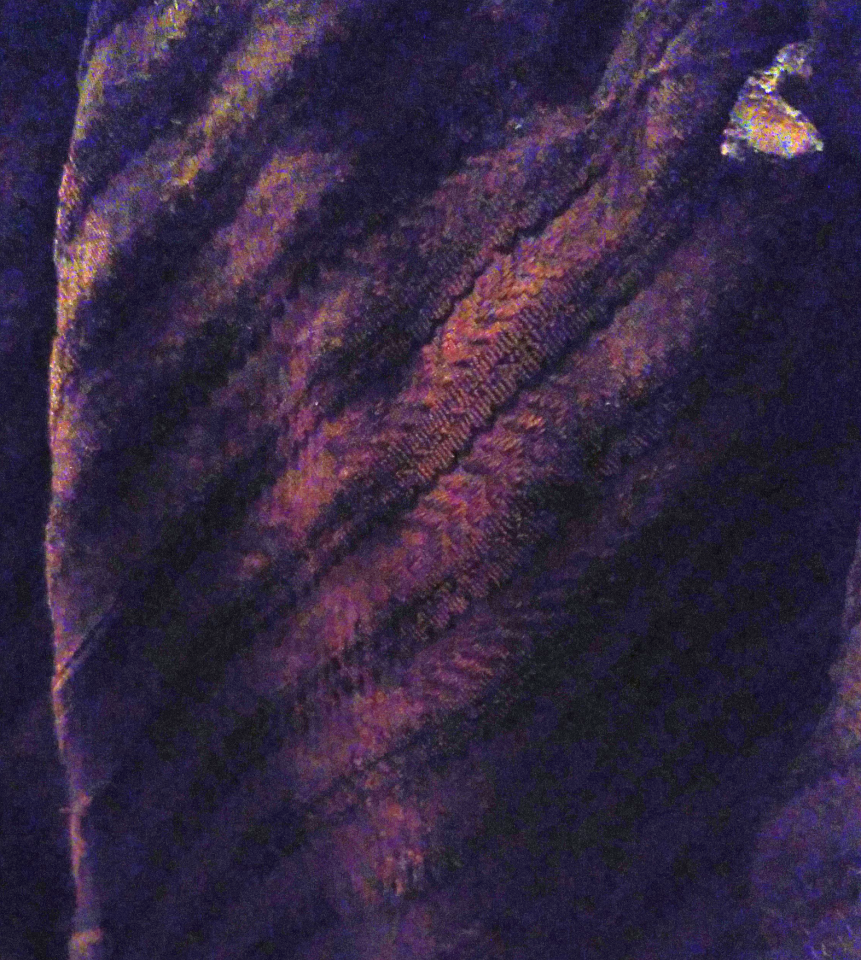
It was a lovely trip, and it included a brief but intense visit to the BNM - where we had a look at the garments from a noble grave crypt in Lauingen, dating to the 17th century. The textiles are very well preserved, and they are rather spectacular due to a number of reasons - but what fascinated me most was the fabric used for the garments worn by Pfalzgraf Philipp Ludwig.

The fabric looks a little like a herringbone pattern fabric with a lot of bands sewn on - but it's woven in one piece, and the bands are a kind of uncut velvet, construction-wise. Here is a very bad close-up picture:

It is beautiful, and fascinating, and the three of us spent a good while in front of it trying to figure out how it might have been made. I'm again and again intrigued by the creativity used to make so, so many different kinds of fabrics...

0
JUNI
30
0

Textile Finds from Late 16th Century Groningen

The Tudor Tailor is pondering the translation of Hanna Zimmerman's book about the Groningen textile finds "Textiel in Context". The finds date to the late 16th century, and they have been published in Dutch in a relatively small print run. The plan is to translate the text into English and supply new, better photographs of the objects in the translated version.

In case that sounds interesting for you, you can learn more about the project (and signal your interest in a survey) on the Tudor Tailor webpage here.

0
JUNI
28
0

A Hat!

Medieval hats are something that we mostly know from images - the finds are, unfortunately, very rare. At least that is to my knowledge... should you have a treasure trove of medieval hats somewhere, let me know!

So I was very delighted to hear about the find of a medieval hat that is in the Västerbottom Museum in Sweden. And there's even information about it online, you can find it here.  The images directly in the web entry are not too good, but there's a colour photo in the pdf that can be downloaded on the site. I'm a little sad that the dating is only "medieval", which is not very precise... but I'll take a non-precisely dated hat over no hat anytime!

0
JUNI
13
0

Manuscript Curtains.

Just in case you'd like to see some medieval textiles... there's a 9th century manuscript, written in Mainz and in the care of the Bayerische Staatsbibliothek that has been digitised.

The really nice thing about it? (Well, apart from the fact that it's a really beautiful old book, with miniatures.) This book still has its curtains. That are pieces of fabric sewn to the pages to protect, or maybe hide, or maybe both, the illuminations - reminding me a bit of the spidery translucent paper that is used in photo albums. (Except in this MS, it looks to me like the fabric is not attached, but only placed between the pages. Hm.)

Anyways - this book still has its curtains (a lot of them were removed at some point from manuscripts, and have either gotten lost or are kept separately), and they were also digitised, and that means you can zoom in on beautiful medieval silk fabrics. 

Here, for example. There's a number of pages with curtains, and it all seems to be the same fabric. It looks like a selvedge at the top and the bottom, which would make it a relatively narrow strip of woven fabric, and there's hems with sometimes discernible stitches at the right and left side. 

0
MAI
31
0

EuroWeb: Digital Atlas is Online.

One of the goals of EuroWeb is making it easier to research textile heritage, and one of the steps for this was the development of a Digital Atlas. This has been launched recently, and you can now take a look at the Atlas here. 

It's of course a work in progress - and contributions are welcome.

And here is the launch, as the recording of the livestream:

0
MäRZ
01
0

The Syke Presentation is Online.

If you'd like to watch the presentation I gave in Syke - here you go! It's all in German (sorry English-only speaking readers).

It wasn't possible to do a livestream, but I'm delighted that there was the possibility to make a recording, and put that online. I hope you'll enjoy it - I certainly did!

0
FEB.
15
0

Tassel Threads.

I'm still working (of course) on the presentation for Syke, and it's really nice to revisit all the things that went on in that project. As usual, I'll have to cut some (or what feels like a lot, actually) of the things I'm putting into the draft of the presentation. There's so much that I could probably speak about it for half a day...

One nice thing about looking back on a project like this is that it's easy to remember all the fun bits and sort-of-forget about the annoying ones. At some stages, things just felt like they would never ever end... it was a lot of cords, and a lot of rings for the ends of the cords, and a lot of loops to sew onto the cloak. But it did end, eventually.

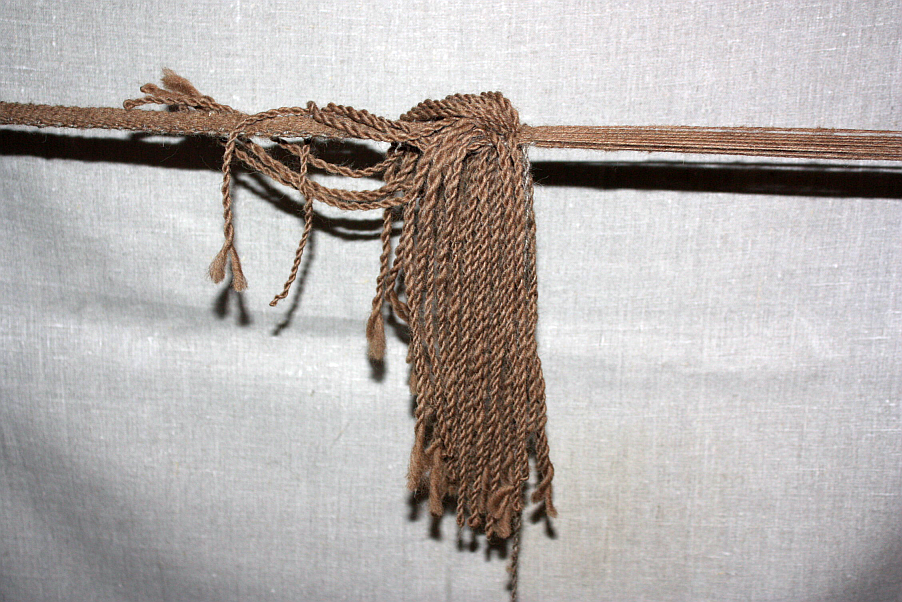
And because I've been revisiting pictures, here's one for you from the selection going into the presentation.

This is the end of the belt reproduction from the Egtved find. It has a tassel at the end, formed by cords finished in (you guessed it) rings. These rings are then gathered together so the whole thing forms a cone shape - surprisingly stiff, and quite stunning. The puny number of just 20 warp threads would, of course, not be enough for a nicely sized tassel like that, so the weaver solved the problem by adding in some more cords at the end of the belt weave. That's exactly what can be seen in this photo: The extra threads inserted, and there's already a few more wefts done to keep them in place.

After finishing the belt weaving, they were then corded, and then the belt provided me with the opportunity to get into ring-wrapping... but that's another story.

0

By accepting you will be accessing a service provided by a third-party external to https://pallia.net/

Kontakt