Latest Comments

Guest - Aislinn Dyestuff Citizen Science.
09. Oktober 2026
This is a great project. I look forward to the results. Thanks for letting us know.
Guest - Aislinn Time for...
09. Oktober 2026
Looks delicious!
Guest - Katrin Sprang Discussion
18. September 2026
Hi Rachel, I have looked for more photos of you, but that was not very successful. I found a link on...
Guest - Beatrix Sprang Discussion
15. September 2026
That lozenge pattern element is not a photograph, but a scan. So it should be to scale. But I pinned...
Guest - Katrin Sprang Discussion
15. September 2026
I was not referring to Rachel's reconstruction (is the reconstruction you refer to the one photograp...
MAI
03
1

The Skirt!

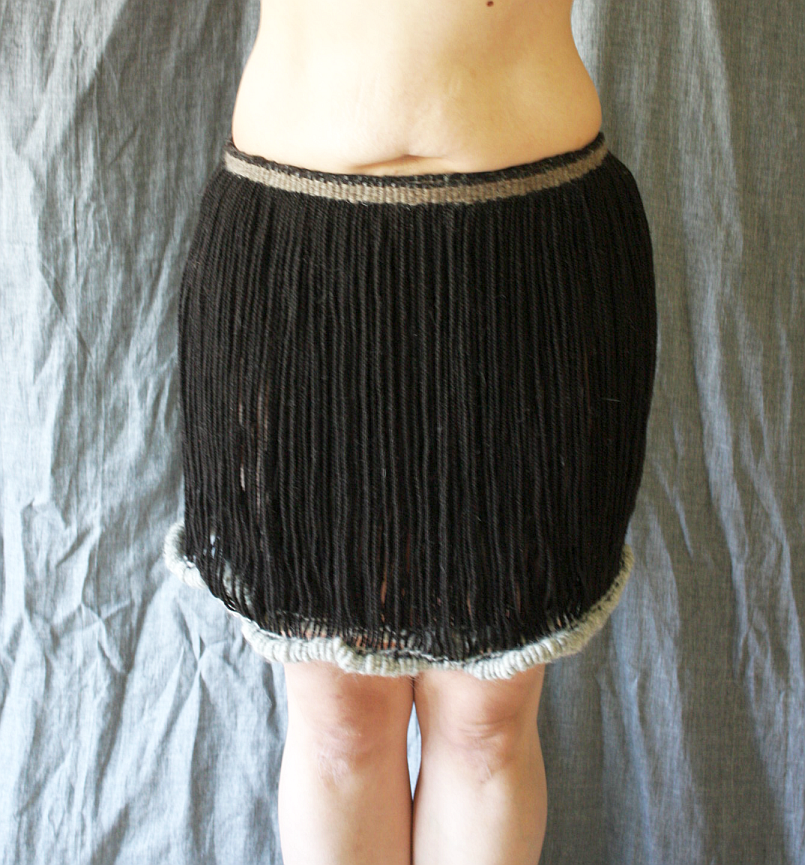
You're due an update on the Egtved skirt, I think - this has been finished a bit ago, but I haven't gotten around to posting a picture of it for you. So, finally, here you go: 

It is a really, really interesting garment. Where the skirt is double-layered (which is most of the way around), it's covering everything rather well. Especially close to the waistband, where the strings are fixed, there's not much see-through effect even when moving, so if worn on the hips (as is usually postulated for this find), the relevant bits of the female anatomy would be covered well and quite securely. When moving, as in lifting the legs, the front is still covered well, but you can see the leg at the sides, where the strings then fall apart - quite similar to a skirt with a high leg slit.

This kind of garment thus does play with the concepts of covered and uncovered, but it's not necessarily very see-through, or very daring. Also - this was a bog find, and there may have been additional linen clothing items worn that did not survive due to soil conditions. 

There's one last knot for me to make, and then hide the ends of that string (it's the one keeping the rings at the bottom together, and I wanted to be able to adjust that just in case it should be necessary), and then it's completely finished. I haven't added up the work hours yet, but it was a lot, even using more modern tools as a shortcut at some places.

Also, even though I tried very hard to match the thread type and thicknesses of the original, I ended up with more cords than the original garment had. Textile reconstructions are bitches!

Making the twisted cords and finishing them off with the rings are definitely the most time-consuming parts in making such a garment. The weaving itself was, in comparison, rather quick once I had established a workflow. A simple tool for measuring off and temporarily holding the wefts/cord threads was all that was needed in addition to the heddles for opening and closing the shed. Oh, and one of my feet to hold the tool and hold one of the loops from the previous shed on a toe. That was making it extra fun to weave.

0
APR.
05
2

Middle Gores and Riding Slits, Continued.

...but wait, there's more!

Florence commented on the post about Herjolfsnaes 42 (with some issues thanks to the blog software, it seems it is very non-mathematic-symbol-friendly):

I agree that if a person is buried wearing a garment does not prove that they also wore it in life - just that their family or community deemed it proper for them to be buried in them. And then, as you mentioned, there are the Greenland finds, where the corpses were wrapped in the garments and are not wearing them, so that's another thing altogether.


My point is: Proving a negative empirically can only be done on a large amount of data. Women never wearing short garments: Sure thing, loads of pictorial evidence for that. Women not wearing garments with a riding slit: Also loads of pictorial evidence, including the pictures of women riding astride. Now, women never wearing long gowns with a closed (as in sewn shut) middle gore: I cannot tell from a picture if there is a closed middle gore or not, could you give me a few examples?
In extant garments, we only have a few examples where we are quite sure those were worn by a woman. So, out of less than 5, none have a middle gore. But that's not a lot of data.


(Granted, I'm a physicist, a sample size of n=5 tells you nothing in my field)

I don't even know an extant long garment with a closed middle gore that is a associated with a person/corpse of any gender.


..

First of all - yes, that is not a lot of data I am working on. Unfortunately, we do not have a lot of data to work on, and I completely agree that a sample size of five or less is very, very scant. 

When I looked for garment evidence for my thesis, I got about 175 items altogether, from most of Europe (with limited things from Finland, and next to nothing from Eastern Europe) and for the timespan of 500 to 1500. I tried to include extant pieces that could give information on how something was tailored, so no pieces that have just a piece of seam or hem. There's probably some more that I missed, and in the years since, some more pieces have been found (Lengberg for instance), but I'd surmise that we haven't gotten up to significantly above 200 items.

Garment finds are really, really rare.

And now for the really juicy bit... is it possible to tell from the medieval images whether there's a middle gore sewn in, or not?

There is, to my eyes, a subtle difference between how folds in women's dresses and in men's tunics are shown. It's really subtle, though, and it took me a while to sort of put my finger on it. The difference gets less pronounced when the dress is wider, and it's not visible if the dress is tucked up into the belt as to fall in different folds.

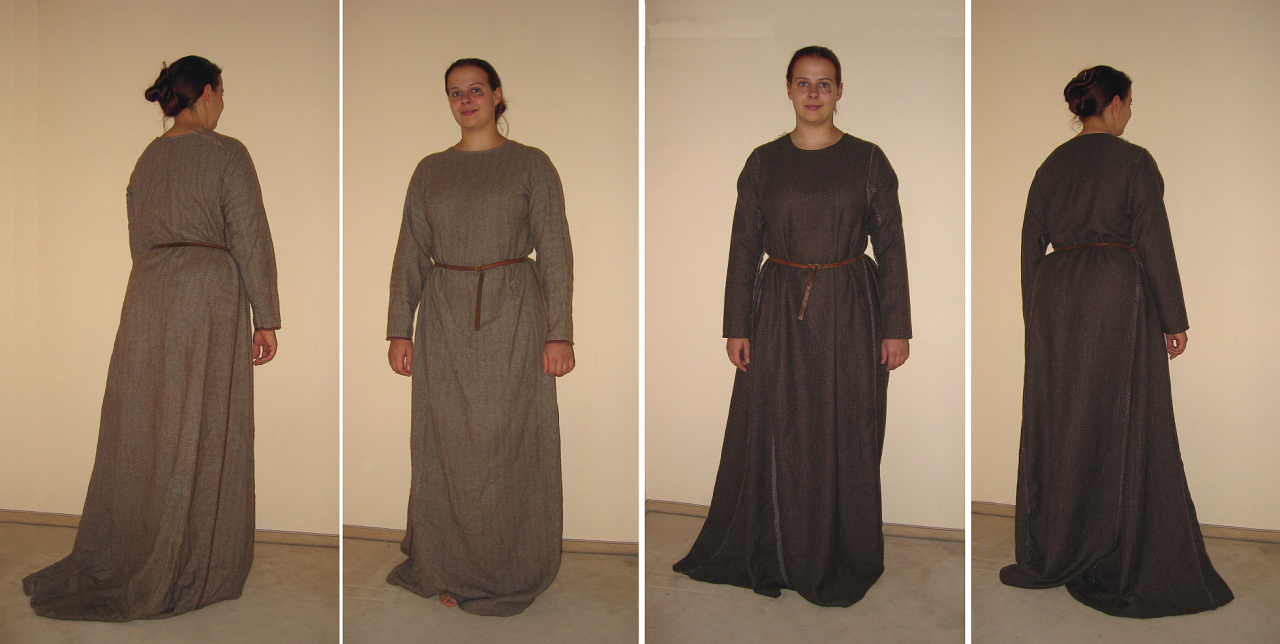
What I have only seen shown on women's dresses in artwork is the V- or U-shape of folds in the front part of the dress. These can both be seen on my dress reconstructions of St Elizabeth's and St Clare's dress, here:

You can see the U-form of the folds on the left dress, and a more subtle version of the folds running together in the front on the right. In comparison, the folds on the Herjolfsnes 42 look like this:

The folds are running straight downwards to outwards here. 

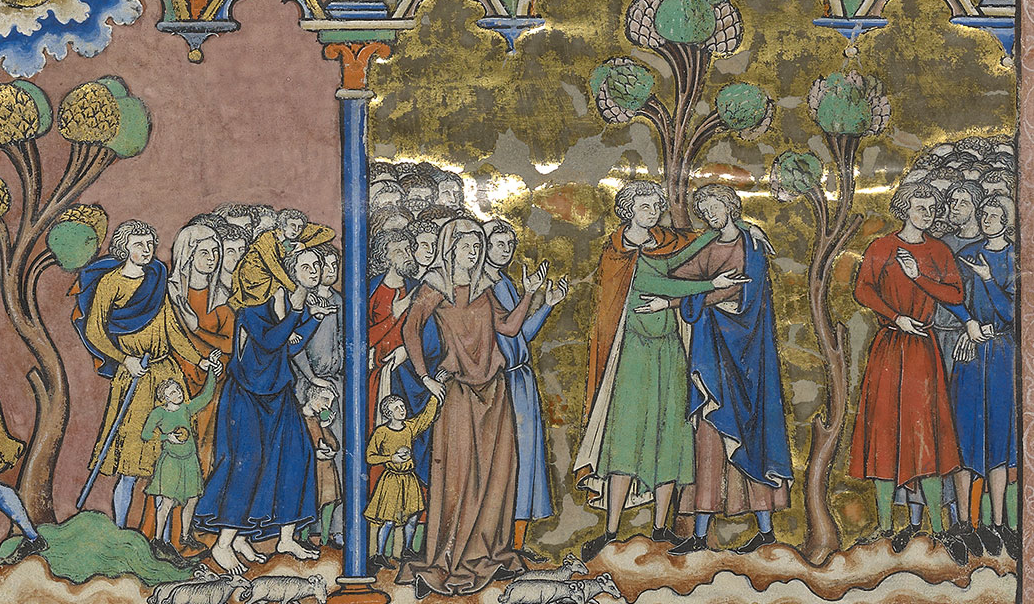
So how does this compare to medieval images? Here's one example:

Maciejowski Bible, The Morgan MS M.638, fol. 4v. See it in full size here: https://www.themorgan.org/collection/crusader-bible/8

On the men's tunics, the folds go straight down. On the women's dresses, the folds run towards the middle. At least that is how it looks to me - and yes, I will say again: the difference is subtle. Similar fall of folds can be seen on the other folios of the Maciejowski. (I'd like to go and hunt for more similar things in other manuscripts now, but unfortunately I'm running out of time for today.)

On many of the images that we have, it's not possible to tell how the folds run, or if there is a distinct difference between the male and female dress. Female dresses are often tucked up into the belt (not just drawn up, but a side fold of the dress taken up and stuffed in), and that will severely change how the fabric drapes and hide any "natural" front folds. Quite often, some mantle or cloak also hide what goes on in the front, for both men and women.

So in conclusion... I would not call what I see on the images as hard evidence, but to me, this impression of a subtle difference between how the women's dresses fall and drape, and how the men's tunics, especially those longer than knee-length fall and drape, is a very strong hint towards a different cut, and I would interpret that as the middle gore for the men's garments and no middle gore for the women.

What's your impression? Can you see a difference?

0
APR.
01
0

Riding Slits, Part 2.

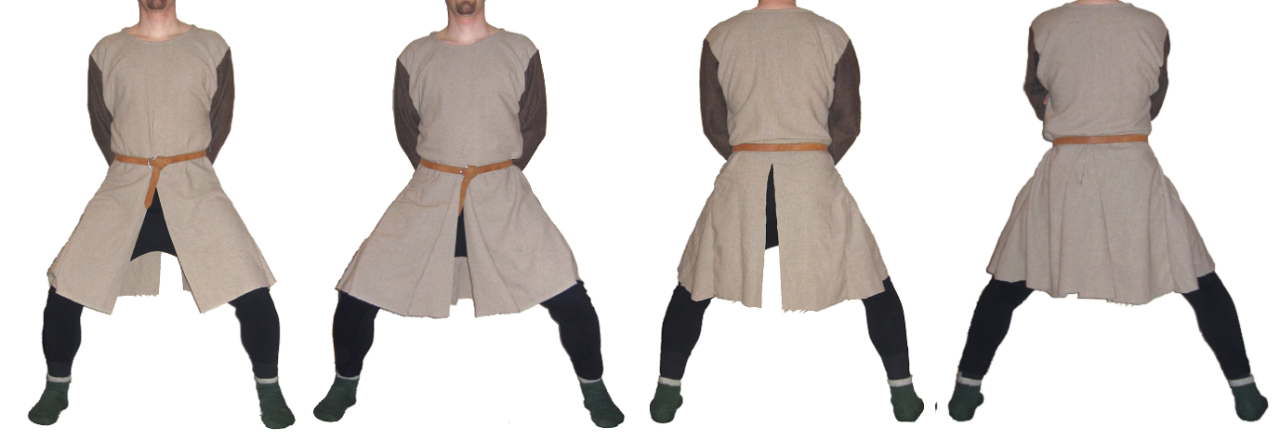
Here's a comparison of a mockup tunic with slits cut in, with and without middle gores around those slits: 

Simple tunic with riding slit cut in, from left to right: front view without middle gore, with middle gore, back view without middle gore, with middle gore.

Well, the horse is missing from those images (due to lack of handy horses around here), but you can see that the slit functions, of course, in both instances - with and without a middle gore. However, the version with gores remains much more "closed" even in the riding position. Especially noticeable in the view on the back, where the slit is not visible even in this leg position.

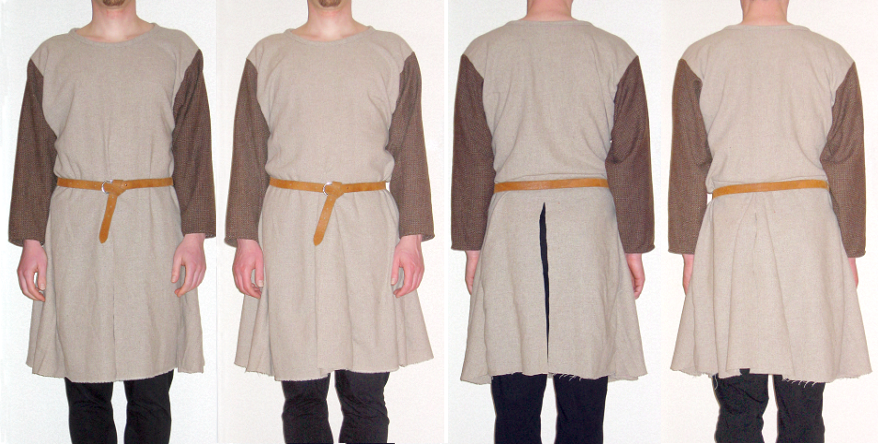
The whole issue gets properly interesting, though, when you are standing normally:

From left to right: front view without gore, with gore, back view without gore, with gore.

As you can see, the tunic does not close properly at the back if there's no middle gore inserted. This is standing position; the slit issue gets worse, and more noticeable, once the wearer starts to move - when walking or running, the slit will gap open, unless you insert the middle gore.

So that's something you'd definitely want to do for your coverage. Not only to avoid flashing your undies, but also because the slit, staying open, will make things rather drafty in cooler weather!

What you can also see in those standing position pictures is that the fall of the tunic changes with the insertion of the gores. This is significant because riding slits are closely related to riding, which means horses, which is an expensive and status-y thing to have not just today, but also in the Middle Ages. Owning a horse that is used for riding is not something everyone can afford.

Consequently, if you're wearing a tunic with riding slits, that indicates that you have a certain amount of wealth, being a horse-rider. If that changes the fall of your tunic... it's not a big thing to insert a middle gore, with or without slit, leading to the same fall of the tunic regardless of being a horse-rider or not. So that could be an explanation for the middle gore to be found in men's tunics, whether slitted or not, but not in women's dresses. 

From the archaeological record, I know of no garment that is certainly associated with a woman with middle gores set in. There's piecings for panels in some of the later dresses (like the Golden Gown of Queen Margaret) that sit in the center front, but they do not change the fall and drape of the garment away from the straighter, more slender silhouette in the front. The fall-changing middle gore is never present. There's also no example of a slit tunic without a middle gore. 

To me, this makes perfect sense - you do not need a riding slit in a woman's dress (the bunch-up problem is solved differently, if the woman does ride a horse), but you want the slender look that is easier to achieve with a straight front and back panel in your dress. In men's garments, if you cut in a slit, you definitely need the gore to cover up the unmentionables; that changes the tunic to give it a different fall and drape. That, in turn, may have been associated with a "manly" look, or with higher status, or both, and said associations probably led to the universal adoption of the middle gore in men's garments.

2
MäRZ
31
0

Riding Slits, Part 1.

My recent crossdressing post has provided some confusion to Kareina - and since it's a really interesting topic, that riding slit thing, I'll try to make things clearer here.

I wrote: 

You need middle gores in the front and back to keep a riding slit closed when not in use (and there are no riding slits without gores in any archaeological find).

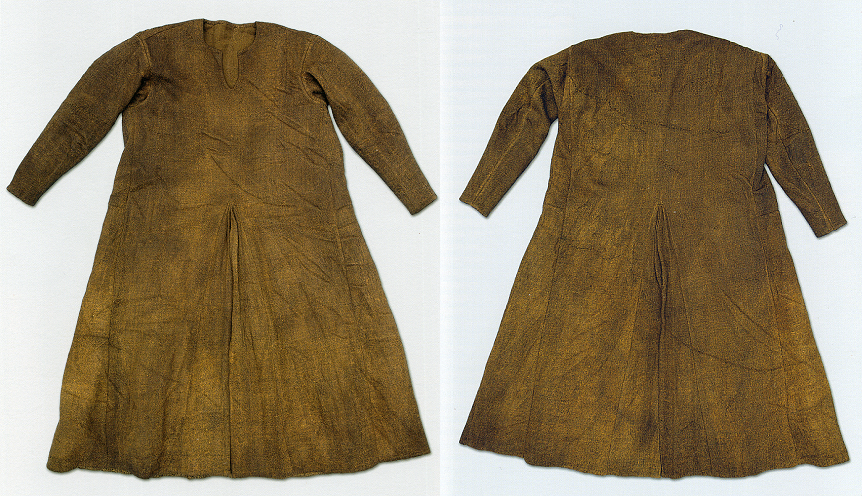
In the archaeological record, we have men's tunics both with and without a riding slit. What they have in common is the middle gore set into the front and the back.

The tunic from Moselund, Denmark, dated to c the 12th century. Image courtesy of the Danish National Museum; find the large images here: https://samlinger.natmus.dk/dmr/asset/217385 and https://samlinger.natmus.dk/dmr/asset/217384

The gore on its own would not provide enough room to sit astride a horse without the fabric riding up the legs, at least not in most cases. The Moselund tunic, for instance, is rather long, so it would have to be very, very wide for that to work. If you look at artwork from the Middle Ages, you will notice that the existence of the slit is made clear, but it's always "closed", as in there is no underwear shown. 

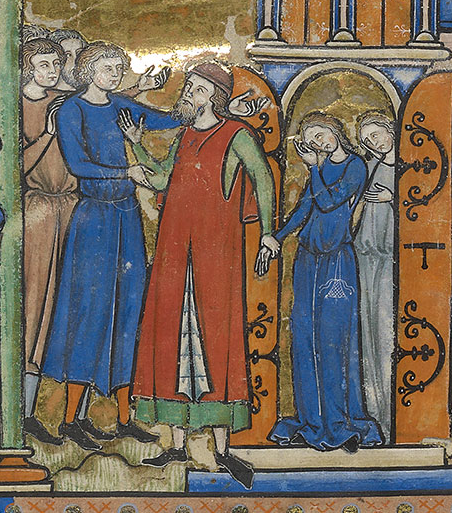
Detail from MS M.638, fol. 3v, The Morgan Library. The Morgan Picture Bible, Paris, France, ca. 1244–1254. Persistent URL: http://ica.themorgan.org/manuscript/page/6/158530

The way we are shown that there is indeed a riding slit is rather ingenious: There is a vertical line, and because that is usually rather inconspicuous, often the edges of the lower part of the slit are shown turned outwards, with the lining of the garment clearly visible contrasting with the outer fabric. This is the case in the image above, where a fur lining is shown. The two men next to this man have simpler slit tunics, but you can also clearly tell they are slitted: the corners at the bottom of the slit overlap, and are slightly mis-aligned. The same goes for the green garment worn underneath the red fur-lined one on Main Guy. 

A riding slit, for it to work properly, also has to be long enough. A lot of the modern interpretations in Living History have a slit cut in, but it does not reach up far enough - it has to come up to about crotch level, front and back, if you want to avoid bunching of the tunic. That, of course, is a problem if you do not have the middle gores set in, because a simple slit will inevitably stay open (especially if you hem the edges, which is the smart thing to do) and thus, if it's cut up far enough, expose your underwear. Which, back in time as today, was not something you'd usually go for.

0
MäRZ
30
0

Links (again).

I've made the mistake of doing a bit too much doom-scrolling in the past few days, including this morning. There's still war in the Ukraine, there's still really high Covid numbers in Germany, and there's still a lot of bullshitty stuff happening regarding energy and preservation of nature and sustainability here as well. It makes me feel sad, and helpless, and more sad, and that is not a very good thing. 

The little cat, however, is determined to brighten up my day by snuggling up to me on the desk, purring loudly, and I have the Vienna trip and presentation to look forward to. There's hot tea sent by a friend (well, not in its hot brewed state, obviously, but the tea bags), and finally a little light rain outside. While sunshine is nice too, the rain is much needed and appreciated, even if it means there will be fewer bees and bumblebees around today. 

I hope you have your own doom-scrolling under control, and enough nice things to brighten up your day. Maybe some links can also help? Here you go.

  • A German company is developing something like a cross between a pedelec bike and a tiny car - it seats up to two people, no driving license needed, and it has solar panels on the roof to help with battery capacity. Here's an article on Heise, and here's the manufacturer's website (both in German only).
  • The virtual convention "Flights of Foundry" is taking place on April 8-10. You can join in from anywhere in the world, for free.
  • It's a well-known fact that some plants thrive next to each other, and one of the prime examples are the Three Sisters. I tried a sort-of-doing-this last year, planting beans next to sunflowers (though with rather limited success - neither beans nor sunflowers usually thrive here, due to the rather poor soil in the garden bed I put them in). Here's an article about current projects on this on The Conversation.
  • In case I have not linked that before - the world's oldest pants were found a while ago, and have been analysed, and there's a nice article (with pictures) about them here.


And now I will return to getting something resembling work done...

0
MäRZ
25
9

Crossdressing! Well, Sort Of.

There's currently a challenge going on in Instagram for Women's History Month: IG 14 from Austria has set out a list with a keyword for each day in March, and ask people to post something Living History or women's history related.  

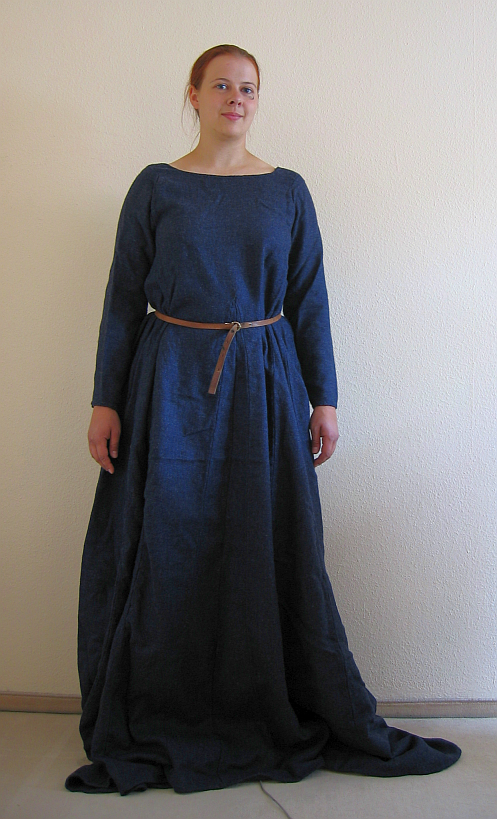
Today's topic was "gender", and, well... here's a picture of me crossdressing, sort of:

I made that dress after Herjolfsnaes 42 (in Norlund's counting) way back, a long time ago. A good while later, having looked at more surviving garments, I realised that middle gores are a men's thing, and not to be found in women's dresses.

Why? You need middle gores in the front and back to keep a riding slit closed when not in use (and there are no riding slits without gores in any archaeological find). This changes the silhouette of the garment. That change, and the status associated with the riding slit, may be the reason why there are also men's tunics without a riding slit that still sport a middle gore, such as the tunic found in the Bocksten bog in Sweden.⁠ That, to me, makes a lot of sense. The dresses without a middle gore, by the way, make a slimmer seeming silhouette, and slenderness was - as we know from medieval epics - one of the aesthetic ideals for women.⁠ So this, too, does fit the picture nicely.

The dress, by the way, is very comfy and nice to wear, but would be the same without the middle gores. They don't really add anything (apart from some width...) 

0
MäRZ
10
0

Skjoldehamn Find Pics.

The Skjoldehamn find is a set of clothes (two pieces for the upper body, usually referred to as shirt and tunic, and a pair of trousers, plus some bands and a hood) dated to the 11th century. There's been quite a bit of debate about this find, as it's probably from the Sami culture, and oh, modern politics came into who might or might not research this. It's also apparently not clear whether it was a man's or a woman's clothing.

No matter who these pieces belonged to, however, it's an absolutely fascinating find in a quite good condition, with even some of the colour still visible.

Dan Halvard Løvlid, who has studied the Skjoldehamn textile find and has written his Master's thesis about it, has a website with photos and some newer articles about that find. The articles include a reconstruction of the starting border of the blanket and of the warp setup of the ankle bands. The photos were taken by Dan, and he has put them online in full resolution. Go and enjoy some old textile porn - and thank you, Dan, for putting this online!

0

By accepting you will be accessing a service provided by a third-party external to https://pallia.net/

Kontakt