Latest Comments

Guest - Aislinn Dyestuff Citizen Science.
09. Oktober 2026
This is a great project. I look forward to the results. Thanks for letting us know.
Guest - Aislinn Time for...
09. Oktober 2026
Looks delicious!
Guest - Katrin Sprang Discussion
18. September 2026
Hi Rachel, I have looked for more photos of you, but that was not very successful. I found a link on...
Guest - Beatrix Sprang Discussion
15. September 2026
That lozenge pattern element is not a photograph, but a scan. So it should be to scale. But I pinned...
Guest - Katrin Sprang Discussion
15. September 2026
I was not referring to Rachel's reconstruction (is the reconstruction you refer to the one photograp...
APR.
03
0

Lightfastness Tests - with pictures!


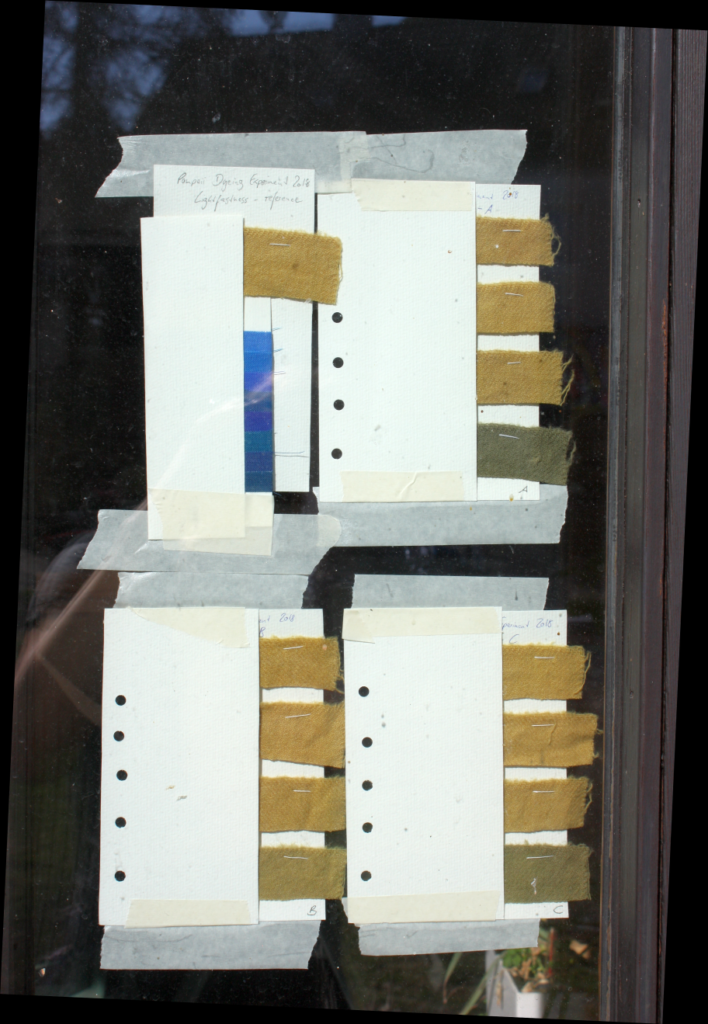
For those of you interested in the lightfastness tests, here are pictures!


This was how the setup looked at the start...


I covered the parts to be protected with cardboard and stuck the whole shebang into the window of our wintergarden, facing south. After 7 days, I took it all down and checked the fading.


On the blue wool scale, each reference strip takes about two to three times longer to begin fading as the next lower strip in the scale. As the Material Technologies Limited website states:


Under normal solar testing conditions, reference 1, the least permanent, will begin to fade in 3 hours to 3 days, depending on geographic location, season, cloud cover and humidity; reference 3 will fade in 5 days to 2 weeks; reference 6 in 6 to 16 weeks; and reference 8, the most permanent, in 6 to 15 months.) These scales are used for paint lightfastness testing under international standard ISO 105-B, and are also used by gallery curators to measure the accumulated amount of light received by museum displays of paintings, textiles or photographic prints. 


This fits in fairly well with the speed of fading that I had, with reference strip 3 already noticeably faded after the 7 days that I took it down for the check. And this is how the birch looked:
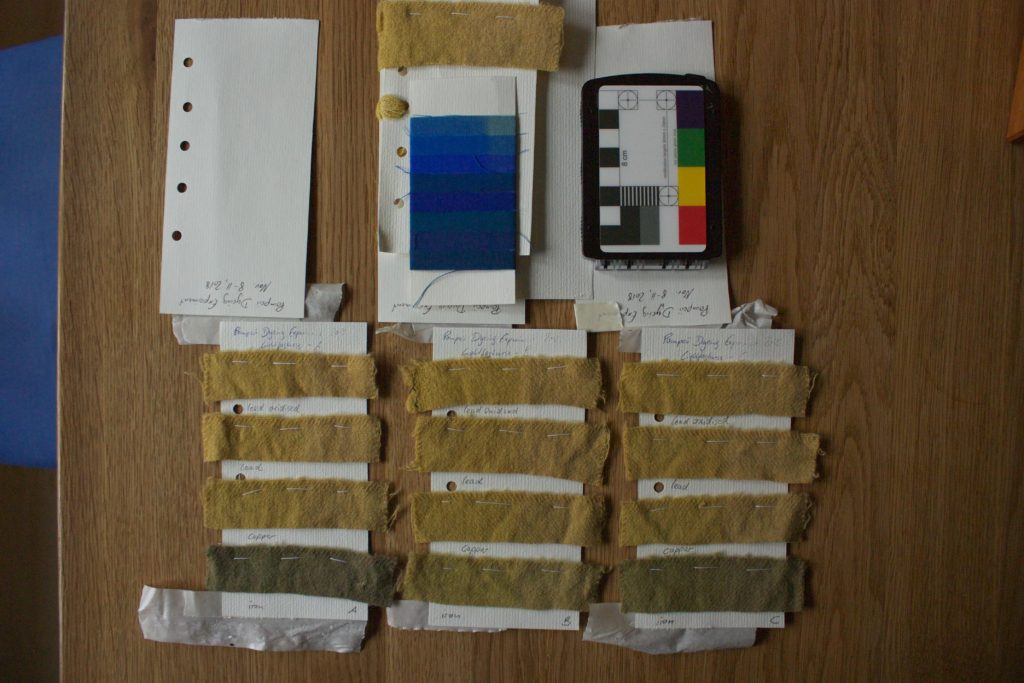


As you can hopefully see, there's distinct fading on the first blue strip, and there also is fading on the second and third one. It is not so easy to see on the photograph, but in actual natural daylight, there also is a little fading visible on the birch-dyed cloths. That would place the colour fastness regarding light of these strips somewhere between strip 3 or 4 - not too bad, seeing that modern recommendation for clothing dyes is to have 4 or better.


This, by the way, is another example of it being rather difficult to document nicely and clearly - not everything is easy, or even possible, to show on a photo.


After taking these pictures, the strips were covered again and went back into the window. I'll take them down once more soon, and see how things look then.

0
MäRZ
27
6

Wenn einer eine Reise tut...


There's a German saying which goes "Wenn einer eine Reise tut, so kann er was verzählen" (if someone goes on a journey, he has stories to tell). Well, that's definitely true for the trip I had to Oberstdorf...


On about halfway to the fair, I made a stop to re-fuel the car and have a potty break... but when I wanted to drive away from the fuel pump, my trusty (not-so-)little car refused to do it. The engine started almost normally, but died again at once... so I finally got to use the breakdown cover that we got back when we got the car.


Which was when I stuck the little card into my wallet. Which was not yesterday - and accordingly, the number was not working anymore. So a little bit of internet searching and phoning later (thank goodness for having a smartphone), I was able to tell a friendly young man what had happened, where I had planned to go, and a little bit later, I got told that a pickup would be coming to get me and my car to the next associated car workshop, where I'd get a rental car to continue my trip.


And that is exactly what happened. So I got to handle all my stock and fair booth stuff once more, after loading it into the car early in the morning, now cramming it into the rental car (which was quite a bit smaller than mine). After that was finally done, off I went - to arrive in Oberstdorf a few minutes before the hall was due for closing. Margit had in the meantime set up her own part of our booth, and prepared as much as possible for me - figured out where to place the workshop table and benches, where we would place my tables, and gotten my paperwork and parking permit sorted out.


Then we spent about twenty extra-exhausting minutes running to the car and transporting my stuff inside as fast as possible, so we'd have it in there to finish setup in the morning. We just managed to get it done before the hall closed... and I got to enjoy speed-booth-setup in the next morning.


It all got done in time, if only just, and I remained a little confused as to what of my things was where throughout the fair, as I had had to re-pack (and consequently re-order) things when changing cars. Nothing crucial had been left behind, though.


Needless to say, I was extra tired in the evenings... what a good thing that I could fall into bed nice and early. Apart from the car calamity, though, we had a really good time - nice weather, nice customers, and nice colleagues. I actually managed to catch up with two of them - Renate from Wollstube Wollin (who stood opposite us, and who is to blame for my going home with more yarn to knit), and the lovely Solveig from Alice im Wunderladen, who spent her break with Margit and me.


Meanwhile, I am back home, the car has been repaired and is also back home, and all that remains is - as usual - to re-fill things that have become low in stock and to do the fair homework... and then the next fair will be the Nadelwelt in Karlsruhe. I'm looking forward to that, and hopefully to a smooth trip there and back!

0
MäRZ
22
0

Fair Season has started!

Well, for me it starts today - I am on my way to Oberstdorf for the Allgäuer Nadelstiche.


There will be yarns, and nalbinding workshops at our booth, and there will be mountains in the background and coffee and good times with Margit.


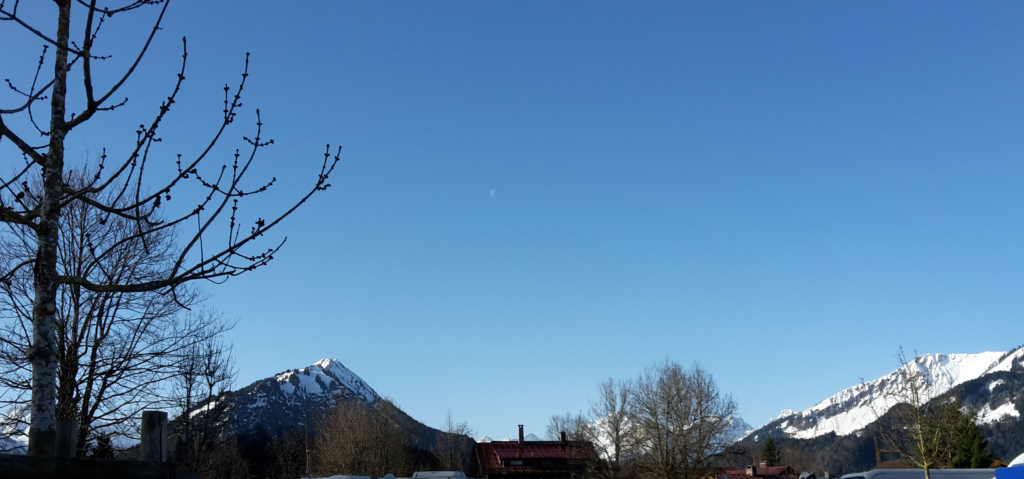
[caption id="attachment_4389" align="alignnone" width="640"] Last year's view of the mountains... I guess they will still be there this year.


The car is loaded, my trusty thermos mug is filled with delicious coffee, and tomorrow and Sunday, I'll be at the fair - drop by and say hello, and have a look at the delightful brand-new things I am bringing along with me!
0
MäRZ
06
0

Fibres in Early Textiles Conference

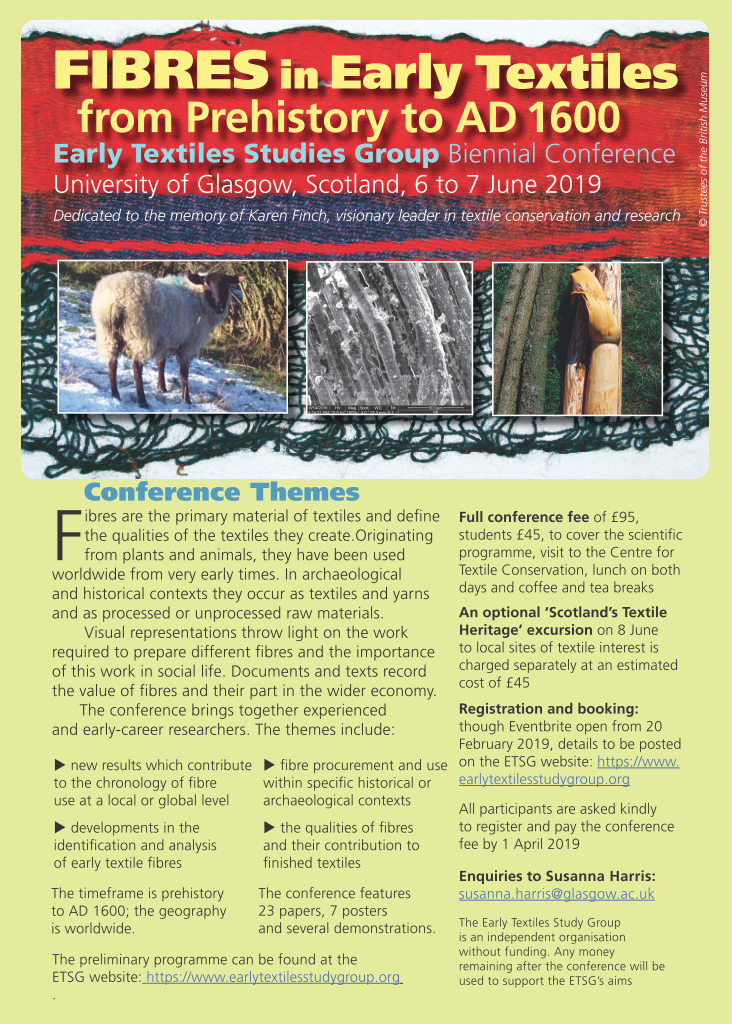
If you're interested in attending the Early Textiles Study Group conference "Fibres in Early Textiles" at the Uni Glasgow, 6-7 June 2019, registration is open - and places are limited, so you might want to register as soon as possible.

0
FEB.
28
0

Stoned?

Just in case you are not into textiles, but more into stones - or know someone who is: The ArchaeoParc Val Senales is having a Flint Knapping Symposium on May 29 to June 1. It's a conference for experts, museum professionals and hobbyists working with flint knapping techniques, intended as an opportunity to gather and share experiences.

I've been to the ArchaeoParc (we had the wonderful opportunity to hold a Textile Forum there), and it is a wonderful place with spectacular scenery, incredibly nice people and utterly delicious food. So if you needed an excuse to go there, this conference might just be it.

You can find more information about it here on the Museum website. Be aware that it is taking place during the main travel season of South Tyrol, so if you want to go, try to arrange registration and booking as soon as possible!

(And if you do go, please say hello to Johanna for me!)
0
JAN.
31
1

Finishing Stuff.

One of the things about archaeological experiments is that they always take longer than expected... and then, in the aftermath, there's... the aftermath.

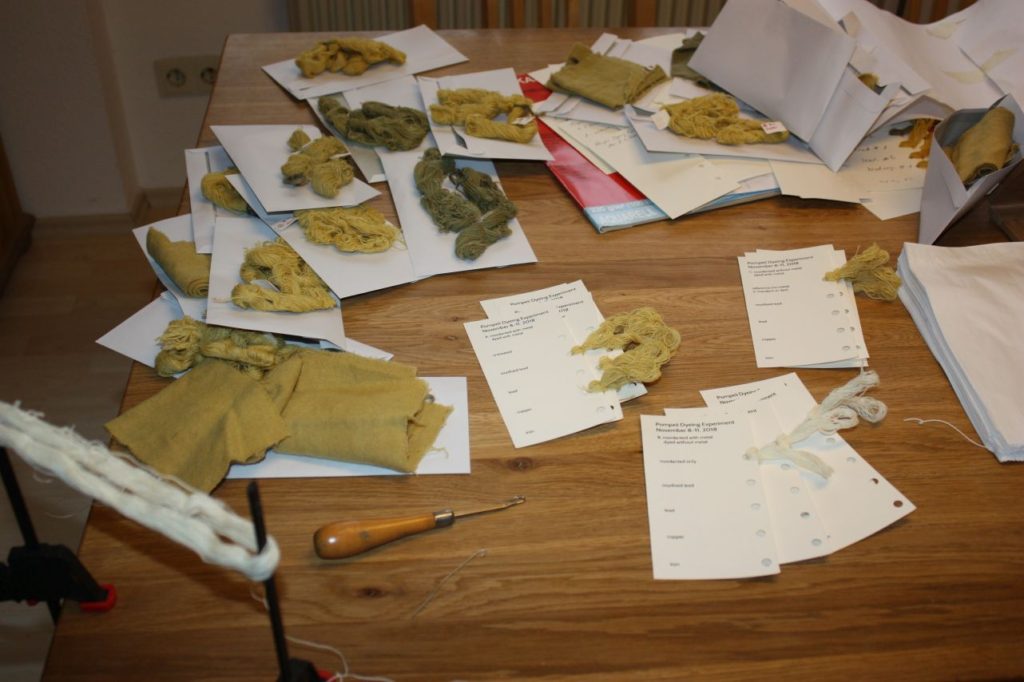
Which, in the case of the Pompeii Dyeing Experiment, involves making reference cards for the different dyeing results. Which means labeling sheets of cardboard, punching holes next to the labels, and then winding off tiny skeins of yarn which are in turn pulled through these holes and fastened.

If you have never done something of the sort, let me tell you: it takes a ridiculous amount of time, and it is stunningly boring work, and I can totally, utterly understand if a dyer does not do yarn colour reference cards (which are only an indication of what colours are possible anyways) and even better why they are not handed out to customers.

[caption id="attachment_4258" align="alignnone" width="640"] Work in progress - I'm less than halfway through here. Altogether, it's four sets of three cards with five skeins each, so it's sixty samples to wind and attach. Can you feel the boredom oozing through the picture?


Now, though, it's finally done, and I can send off the cards to their respective owners (among them the Lab for Experimental Archaeology, for their archive of experiments done at their place). And then, some samples will go into a different lab for testing - so there's a post office run in my near future, which will be followed by a deep, heart-felt sigh of having finally finished that part of the Textile Forum Aftermath!
0
JAN.
30
0

Back from the Nähtreff Weekend!

I'm back, and now there's the usual things that need to be done after an event which included the shop going for a little travel: Putting everything back into place, for one thing, and re-filling stuff, plus re-ordering, in some cases.

I had a wonderful, wonderful weekend, with a group of lovely people. There was chocolate, and tea, and coffee; there was a large table full of books to browse; there was a nice, light, large room to sit in and chat and work on projects brought along; and then there was the workshop room, where I spent most of the time.

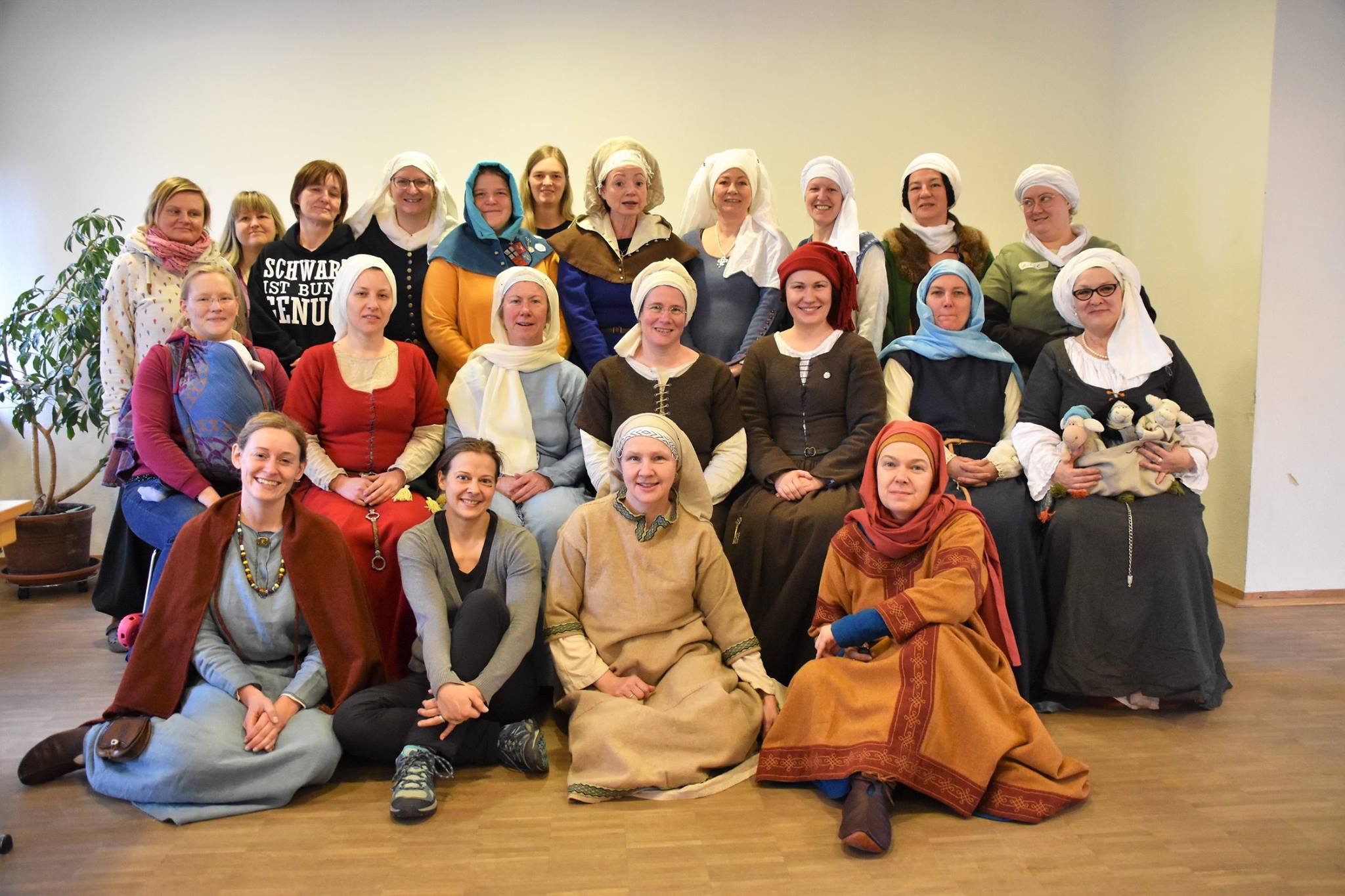
[caption id="" align="alignnone" width="960"] Our group - as you can see, it was a mixed bunch, doing Living History of a good number of different times! (I was one of the people opting for modern clothing - it's easier for me to put on and take off layers as I need to when I'm hopping around the room teaching.)


I had a lot of fun teaching a variety of courses - though, as sometimes happens, one of the courses went a little bit different than I had planned for. Apparently, my method of explaining how to sprang does work for some people - and for others, it does not work at all, and causes more confusion than clarity, which is not a good thing. (The workshop taking place on Saturday afternoon may have had something to do with it, too - with all the talking, book-reading, sewing and cutting, plus the other workshops taking place before, and the night probably not being too long for most people, learning something new is a tad more difficult than when you're all fresh and rested.)

There also were a few bouts of frustration about threads not going quite where they were supposed to be - and that is one of the category 2 problems, the ones involving motor skills and only being solved by practice.

In spite of all the pitfalls, we got it all figured out by the end, and all of the participating ladies had a nice bit of sprang to show for their efforts when we ended the workshop, with some of them even making holes where they wanted them to be. So the next time I'll give a sprang workshop, I will change things a bit, in hopes it will be clearer and easier for everybody.

"While we teach, we learn", said old Seneca the Younger - and he's still right about that...
0

By accepting you will be accessing a service provided by a third-party external to https://pallia.net/

Kontakt