







Latest Comments

Guest - Aislinn Dyestuff Citizen Science.
09. Oktober 2026
This is a great project. I look forward to the results. Thanks for letting us know.
Guest - Aislinn Time for...
09. Oktober 2026
Looks delicious!
Guest - Katrin Sprang Discussion
18. September 2026
Hi Rachel, I have looked for more photos of you, but that was not very successful. I found a link on...
Guest - Beatrix Sprang Discussion
15. September 2026
That lozenge pattern element is not a photograph, but a scan. So it should be to scale. But I pinned...
Guest - Katrin Sprang Discussion
15. September 2026
I was not referring to Rachel's reconstruction (is the reconstruction you refer to the one photograp...
OKT.
23
13

Guinea Pigs needed.

I need some guinea pigs. Or, as the Germans call it, "Versuchskarnickel".

I have mentioned I was planning to make a video workshop on the pattern-free tablet weaving method, right?

Well, the "planning to" has progressed to "I have a script, and a camera, and I am getting started". Which is nice. However, since this is the first thing in that line of work, and since I want to make sure that what I am doing is going to work for those who will be watching the videos, I need some guinea pigs to give me feedback on the test runs of the lessons.

What does that mean? It means I will send you download links to the videos I have made, taking you through the course from start to finish, with probably some wait times inbetween as things get into the way or I get sidetracked or have technical issues. You will be getting test run videos that are probably badly cut (I will not invest oodles of hours into the test run) and contain the occasional verbal blunder. Some of them will not be made with the final materials.

Your task, if you are joining the merry band of furry victims, will be to watch the videos, follow the instructions, and tell me everything that was not good, not clear, not helpful, or otherwise shitty. (And yes, I fully expect to hear a lot of "this was shitty" - after all, it's first steps in many regards for me.) That starts with the instructions themselves, obviously, but goes on to camera work and camera angle, lighting, or maybe just the fact you find that my beheaded upper body is twitching too much while holding shears and bits of yarn into the camera. (I will also ask you to provide your full contact data, and sign an agreement form that you will not pass on or publicise the videos or parts of them in any way.) I'm not keen on hearing that I am doing a lot of things badly, but I much prefer hearing about them from a band of testers with minds steeled against weird takes than from the paying customers later on.

What do you need to join in? Basically, just the will to do it, and enough time for doing the tablet weaving according to the instructions. It will eat some hours, as it is a slow task, but if you are interested in this, you will probably find it fun and not tedious. You do not need to be an expert in tablet weaving - in fact, I'd be happy to have one or two absolute beginners in the group, and you will be able to follow along just as well, as we're doing the system from scratch.

You will also, apart from your general willingness, a way to watch the downloaded videos, and the time to do stuff and then give me feedback, need 30 tablets plus yarn to weave with... and two points to tie your warp to. There will be a video bit about tools and materials, so you'll be informed properly. (Or so I hope.)

I am aiming for about a dozen folks. So... if you are interested, let me know via mail, or contact form, or through the comments here - preferably with a short summary of your previous tablet weaving experience, so I can get a basic idea, and I'll get back to you with further info!
0
OKT.
22
2

Update on Current Things.

I'm currently busy preparing for the European Textile Forum - which mainly means writing lists, writing even more lists, and dragging things into heaps according to the lists to minimise the risk of my forgetting some crucial tool or material.

Also - last-minute ordering of things I've run out of, or that will be necessary. We will be doing another run of the Pompeii dyeing experiment (looking at the influence of metal kettles on the dyeing outcome), as we've found somebody willing to do an analysis of the mordanting and dyeing liquids to see how much metal ions are in them, so I've harvested birch leaves (currently residing in the freezer), and I will need to make sure we have enough yarn, fabric, and alum for the dyeing experiment.

And on top of all this, I should actually be sitting down, finalising my bits of presentation. Which includes having my tablet weaving test band set up so I can use it at the Forum. Fortunately, the warp is already done, so I only need to get some initial wefts in. I have a few additional plans for that test warp, though (and you will hear about this soon), and if I can in some way manage, I want to do the associated weaving before the Forum too.

Can someone hand me an extra day, maybe, please? Or two?
0
OKT.
19
0

Proofs!

To my and Heather's great delight, we are in the very, very last stage of getting Ancient Textiles, Modern Science 2 all done and set - the last proofs have arrived, and it's only a matter of giving the book a very last read, catching the very last typos, before it's all good to go to print.

Yay! Getting this book done was a string of pitfalls and delays, due to all kinds of things - crashing computers and illnesses only being two of them. So I'm really happy to get this to a close, and consequently proof-reading is what I am doing now!

If you want to have a look at what the book will contain, it's already listed on the Oxbow website, and you can even pre-order at a special price!

 
0
AUG.
21
0

Back home, and the usual.

I'm back home, and as usually after a fair, today was spent puttering around cleaning, re-ordering and putting things away. With most of the stock loaded into the car, after-fair-time is the perfect time to give the storage areas the once-over, or to use the temporary extra space to get some sorting of other things done - and this is what happened today. Together with some drinking of coffee, of course, and some time taken off to relax.
Now there's the rest of things to be brought in from the car, getting the re-orders finished, and then it is the return to peace, quiet, and the stack of other things - such as prep for the next Textile Forum!

The fair was wonderful, by the way, with absolutely splendid weather and lots and lots of nice people who stopped by for a chat. There were lots and lots of spinners around, many of whom did demonstrations, so the "Fummelkasten" with my fibre samples could enjoy a good number of questing hands.

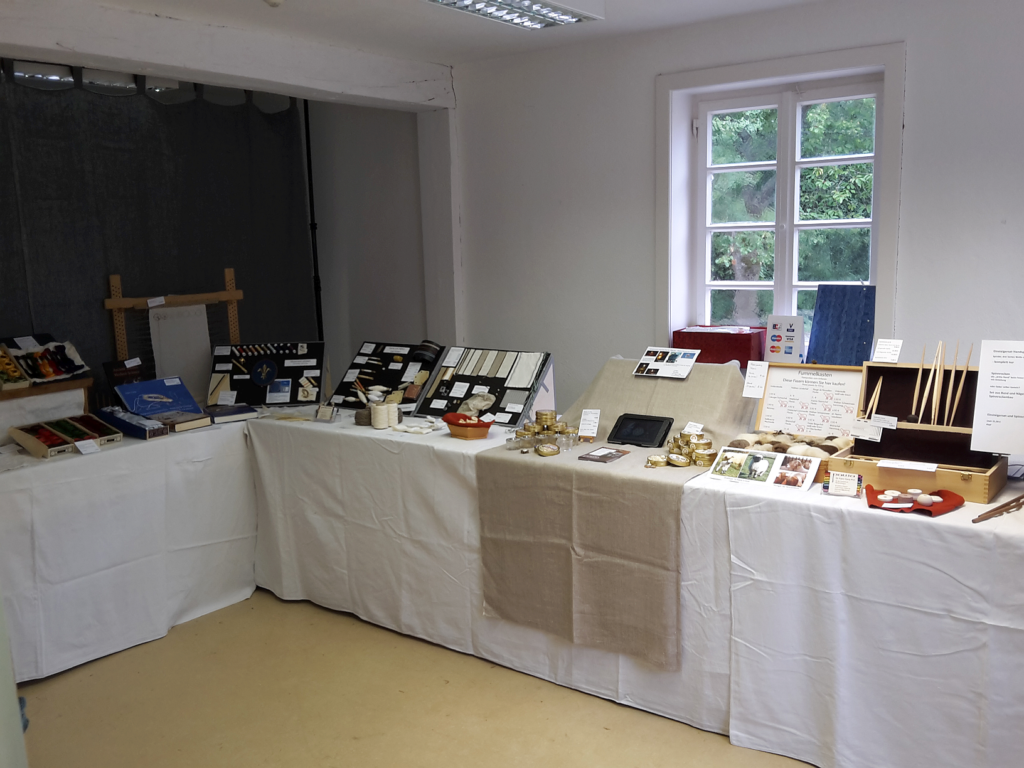
This was my place in Haus Ewersbach, by the way:


Plenty of space for all my things, lots of light (including lighting for my storage area behind the curtains) and, also important for someone on her own behind the sales tables - a toilet very close by!
0
JUNI
21
0

CfP for IONA sessions

I've received a CfP for a conference part that sounds a lot like the European Textile Forum, only on the other side of the Pond - and if it were not so far away and only for three day, I'd be very, very tempted.

You might be closer to the action, though, so here's the CfP for you - and as always with these things, do spread the word to anyone you think might be interested. Conference news, as a rule, reaches way too few people, and everyone passing on infoto others helps make the conference a better one!

Call for Participants for the sessions
"From Fiber to Decorated Textiles in the Early North Atlantic: Making, Methods, and Meanings,”
part of IONA: Early Medieval Studies on the Islands of the North Atlantic transformative networks, skills, theories, and methods for the future of the field at Simon Fraser University, Vancouver, BC, Canada. April 11-13, 2019
CFP: Textiles are a ubiquitous part of life, essentially so in eras when they had to be produced by hand. In early medieval Europe the making and use of textiles also had symbolic, metaphorical, and even allegorical meanings, in additional to the functional. We wish to spend time exploring the connections between the act of making and understanding how something is being made as well as connections among disciplines, approaches, and interpretations.
We are envisioning a series of linked sessions in which participants first learn generally about the textile-making process in the Early North Atlantic, before choosing one skill to learn more deeply, which they will then proceed to practice for the remainder of the sessions. During this final part, scholars will also present their research findings and interpretations, most likely in a modified roundtable format, culminating in a final large discussion that brings together the insights of making through practice and how this might influence interpretation.
We invite proposals of two kinds. First we seek those versed in the making of early medieval textiles and the teaching of those skills. We are specifically interested in scholars accomplished in one of the following: nalbinding, lucet braiding, tablet weaving, inkle weaving, sprang, upright loom weaving, and other fabric and fiber arts. The organizers will be instructing in the use of the hand spindle and loop stitch embroidery. We also welcome other textile skills that were employed in the early North Atlantic world. The session organizers hope to be able to provide basic materials such as yarn, needles, fabric, and thread, and may be able to help provide larger specialty equipment.
The second kind of proposal we invite is from interpreters of early medieval textiles in the North Atlantic and the methods of making them. We hope to gather an interdisciplinary group of researchers, teachers, curators, and artists working in this area to spark a dialogue about how one can practically and metaphorically come to understand any of the following:
● textile and textile tool remains
● literary and artistic depictions of textile-making processes
● how gender, region, religion, or economics were part of meaning making in textiles and the how the making process was experienced by medieval people or how these categories of analysis impact our contemporary understanding
● the role of trade and/or migration in disseminating or adapting textile making processes, decoration, and raw and finished materials
● how access to resources impacted the making of textiles
● methods of decorating textiles (embroidery, braid, trim, and so forth)
If one is both a maker and an interpreter, one may submit a joint proposal.
Questions may be addressed to Karen Agee (karen.agee(at)uni.edu), Erika Lindgren (lindgrenedu(at)gmail.com), or Alexandra Makin (alexandrammakin(at)gmail.com). Please submit a 250 words proposal/abstract to Karen Agee (karen.agee(at)uni.edu) by July 15, 2018. Please use Textiles IONA in the subject line.
The full website with all the CFPs and conference information can be found here: https://www.sfu.ca/english/iona.html.
0
MAI
30
0

European Textile Forum 2018 - CfP

Call for Papers: European Textile Forum 2018 - Aspects of Weaving and Braiding.

The European Textile Forum 2018 will take place from November 5 to November 11, at the Laboratory for Experimental Archaeology in Mayen, Germany. The Laboratory for Experimental Archaeology is the experimental archaeology research center of the Römisch-Germanisches Zentralmuseum (RGZM).

Our focus topic this year will be "Aspects of Weaving and Braiding - tools, techniques, processes, finishes".

Woven cloth is the basis for most clothes and furnishings, and woven fabrics come in an incredible amount of variations. From the simplest plain weave done on a few sticks with strings to the most complex patterned fabrics with several warps and wefts done on an elaborate loom, weaving itself and the tools and processes used is also a wide and complex topic. Braiding, just like weaving, can take on different forms and range from very simple over-one-under-one structures to complex patterned and multi-person braids; braiding tools can be just the hands or massive braiding stands. On some occasions, weaving and braiding can even be combined, such as in tablet weaves when tablets swap places, or in twined weaves.

For this year's Forum, we invite you to join us and discuss weaving, braiding, and their many aspects. Whether you would like to talk about different loom types and their usage, how complex patterns were derived, passed on, and woven or braided in historical times, how different materials will influence a weave, how to reconstruct possible braiding techniques for a given piece, or the difficulties of replicating a given fabric - all aspects and angles are welcome.

We invite you to submit your proposal for a lecture or presentation (about 20-50 minutes), followed by a discussion and, if possible, also followed by a practical session regarding the textile techniques or problems presented in the lectures. This combination of theoretical background and practice has proven very fruitful in the previous years and might include practical instructions in pattern drafting, exploration of "primitive" weaving tools, or tests for finishing fabrics. The practical part can be in form of a workshop, a demonstration, or something like a "hands-on round table". If you have a question that might be solved by several pairs of hands and several minds working on it together, this is the perfect venue for it.

If you have trouble bringing tools or materials for your presentation, please get in touch, and we will try our best to make things possible. We have working spaces both outside (weather permitting), in the lecture hall and in the workshops, so if you are planning on bringing larger tools, we will find space to work with them.

As always, while papers or posters about our focus topic are especially welcome, if you have another topic outside this focus that you would like to present, please do submit your proposal. The same applies if you would like to offer a poster presentation or a workshop/demonstration only.

We also have the opportunity to use the laboratory facilities for archaeological experiments. If you have an experiment you would like to run, please let us know about this. The LEA facilities, the duration of the conference and the expertise and support of the other conference participants have proven to be a wonderful basis for experiments.

For any questions, feel free to contact us directly via Diese E-Mail-Adresse ist vor Spambots geschützt! Zur Anzeige muss JavaScript eingeschaltet sein..

With this Call for Papers, registration for the Textile Forum 2018 is now also open. Please be advised that there are very limited accommodation possibilities at the site. Due to the space available at the Experimental Archaeology Lab, we can accommodate about a dozen to fourteen participants on site only, and the conference will accommodate only a few more participants than that altogether. Due to these restrictions, we may have to consider registrations with a presentation before those without.

The RGZM is graciously supporting the European Textile Forum by granting us use of the simple, mixed on-site dorms. If you prefer a room in a hotel or pension, you can of course book your own accommodation in Mayen; some more information can be found on the Travel and Accommodation page.
Full board consists of breakfast, lunch and dinner; water to drink as well as tea and coffee will be available at all times. All meals will be served in the Laboratory. The conference fee, including full board and the option to sleep in the on-site dorm, is 325 Euro per person.

You can register for the Forum with or without a poster or paper presentation, using this registration form. Please submit your current area of research or interest as well as the title and abstract of your presentation, if applicable. If you would like to give a paper longer than 50 minutes, please let us know about that and we will try to make it possible. The Call for Papers is open until July 20.

Please feel free to pass this CfP on to others who you think might be interested!
0
MAI
16
0

Exhibition and Conference News.

There's a new exhibition on at the University of Manchester Library, called "The Alchemy of Colour". It will be running into August, and it does look very fascinating - it's a pity I won't be able to make it, but if you are in the area and interested in colours, it might be worth a visit.

There will be a conference in Munich, at the Bayerisches Nationalmuseum, about Structuring Fashion -Foundation Garments Throughout History. Obviously, the emphasis is on early modern and modern history, but Beatrix Nutz will be talking abou medieval formative underwear as well. The conference takes place September 13 and 14, with additional offers for the 15th and 16th if you have the time. You can find more info and the registration link behind the link.


0

By accepting you will be accessing a service provided by a third-party external to https://pallia.net/

Kontakt