Latest Comments

Guest - Aislinn Dyestuff Citizen Science.
09. Oktober 2026
This is a great project. I look forward to the results. Thanks for letting us know.
Guest - Aislinn Time for...
09. Oktober 2026
Looks delicious!
Guest - Katrin Sprang Discussion
18. September 2026
Hi Rachel, I have looked for more photos of you, but that was not very successful. I found a link on...
Guest - Beatrix Sprang Discussion
15. September 2026
That lozenge pattern element is not a photograph, but a scan. So it should be to scale. But I pinned...
Guest - Katrin Sprang Discussion
15. September 2026
I was not referring to Rachel's reconstruction (is the reconstruction you refer to the one photograp...
SEP.
13
0

... and photographing.

Talk Like A Pirate Day is drawing nearer again (September 19!), and that is a good reason to pull out the Pirate Robert hats again and take some more photos - especially since the hat pattern is going to be featured in an article soon (and I'm utterly excited about that!).

Some things, though, are notoriously hard to take good photos of. Gold embroidery, or gold brocading, for instance - the glittering gold has a tendency to mess with the exposure time calibration of cameras, and this tends to result in really bad pictures.

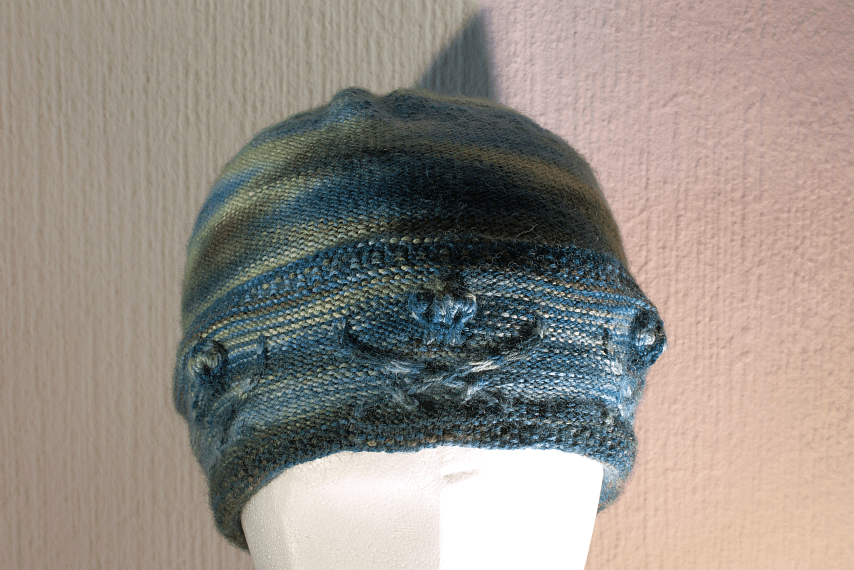
While knitted hats are usually not suffering from exposure time problems due to gold thread, small cables also have a tendency to look really obvious in real life, just to suddenly and quietly disappear into invisibility on a photograph. Human eyes and human brains are just really, really good at seeing 3D and making the most even of small differences of light and shade.

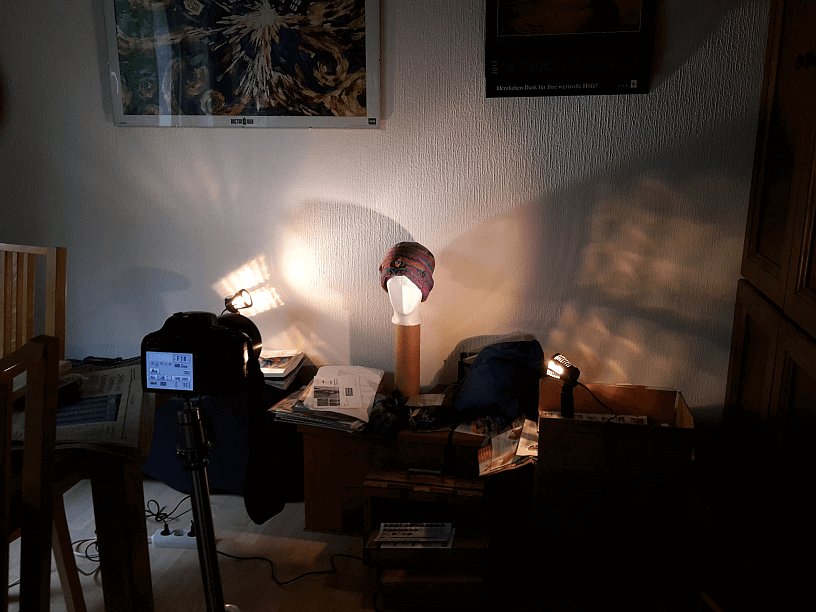
So I was very happy about having two nice little photo lights, and a good tripod, and some time for fiddling. And some more time for fiddling. Then some more. There were also some, um, alternative supports for the two photo lights so that I could adjust them juuust so - a few millimetres, or a few degrees of the head angle, already made a huge difference in the outcome.

[caption id="attachment_3367" align="alignnone" width="816"]pirate_roberts_pics Lamps, a styrofoam head with the hat, a camera on a tripod. And some motivational coffee (not shown).


In the end, though, I did get a few decent pictures - so I'd say the fiddling was well worth it!

pirate_roberts_detail
0
SEP.
11
2

Spindle-whorl making thoughts.

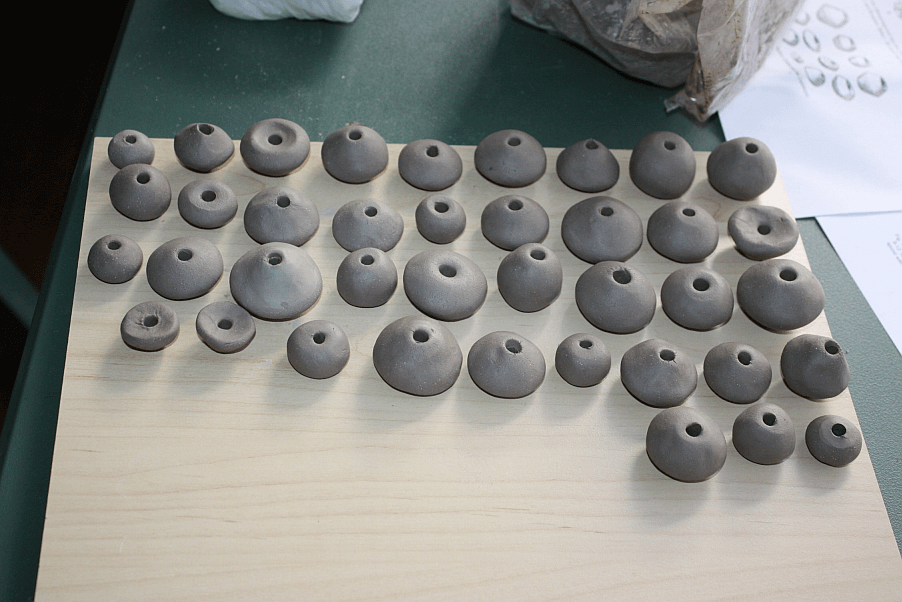
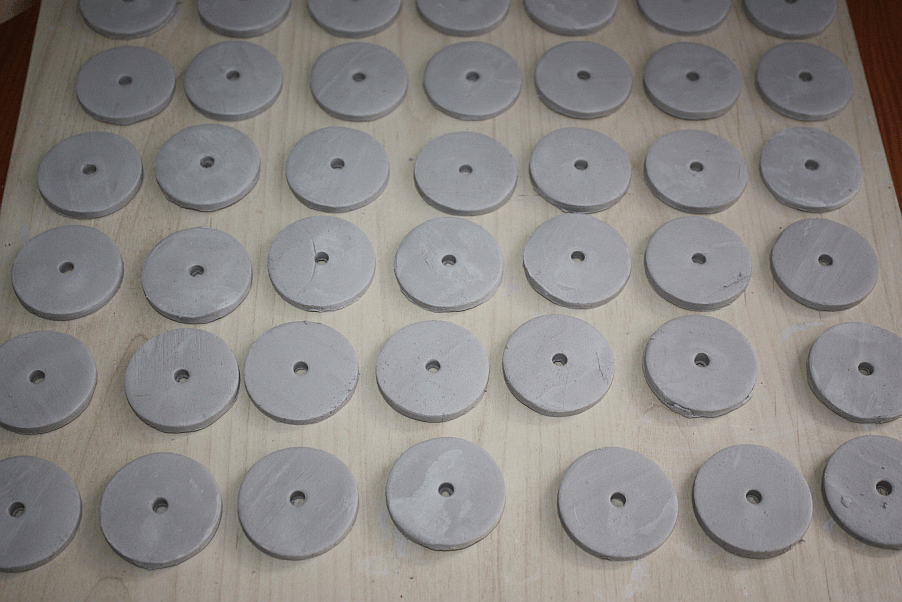
I still have a fairly large selection of spindle whorls hanging out here, but some weight classes are running low, and especially the disc-shaped whorls are almost gone again. Which means it's time to go into the basement, fetch the clay and assorted whorl-making tools, and a while later, more spindle whorls have been made, and are now quietly and happily drying out.

[caption id="attachment_3357" align="alignnone" width="507"]Re-stocking in progress, with both biconical/roundish whorls... Re-stocking in progress, with both biconical/roundish whorls...


[caption id="attachment_3356" align="alignnone" width="514"]...and the flat ones. ...and the flat ones.


Even though I have a form to make the flat whorls, they never come out exactly alike - there's always small differences in the thickness, even if I try very hard indeed to roll the clay out exactly to the right thickness, and exactly plane. Last batch was a bit too thin altogether, and I hope this won't be too thick because of overcompensation.

The other whorls are different in difficulty, because they don't need to be exactly a weight or thickness; I try to make a range of sizes and shapes every time, but sometimes I tend more towards lighter ones and sometimes more toward heavier ones. Which is sort of an issue when I should be re-stocking a certain weight range as a priority, and I end up making whorls that are, erm, not inside that range.

My theory why the biconical whorls are quite common, by the way, is that it is very easy to form a biconical shape when rolling a ball of clay in your hands - way easier than getting a perfect sphere, for instance. My main problem then is that the tips of the cones are usually a little outside the centre, which makes getting the hole into the whorl in a way that will not cause it to wobble slightly more interesting. Also, whorl-making is actually a pretty boring process (a feeling that is, by the way, shared by the lovely guy who makes the wheel-thrown whorls for me, as he told me when I ordered the most recent batch). I try to overcome the boringness by listening to EscapePod, which usually sort of works, but somehow I still feel it's more mind-numbing than spinning.

Which is actually weird, because it is no real mindless job. Getting the whorls an approximate size and a suitable shape is not really hard, but it does take a bit of concentration; getting the bore hole into the middle so that the whorl does not wobble too much also needs some attention. I give each whorl a whirl on the stick I use to make the hole, and while a bit of imbalance is practically un-avoidable at least for the larger whorls, if it feels too much out of centre, I get to knead it up again and try once more.

The larger and flatter the whorl is, the harder I find it to get it right, as a little off-centeredness in shape and in hole position will have a large impact. There's also some times that I get them all almost perfect just like that, and then, a while later, it feels as if I can't get even the easiest and smallest whorl done in an acceptable way.

So, to sum it up: spindle-whorl making, in my very personal opinion, is harder than it looks, and while I love those nice little tools, making them is a singularly obnoxious task. And even though I have wonderful drawings with cross-sections of actual prehistoric and historic spindle whorls that definitely show they were not perfectly symmetrical, or perfectly centred at all, having mine a bit wobbly always makes me fret, and feel a bit unsure whether the ones I produce are good enough for the spinners that buy and use them (even though I haven't gotten complaints yet). Which also plays a part in making this task feel a bit harder. Weird, huh?

What I totally love about the whorl-making process, though, is picking the still warm, very dirty freshly fired whorls out of the ashes and seeing the many different shapes in  black, light grey and various marbled mixes of them - that is always like unpacking a present!
0
SEP.
08
0

More Stuff from the Net.

Some more stuff, while I am prepping for Bielefeld in the background and still trying to get on top of the heap...

Here's a free Dragon Lace pattern - for you knitters among us. The really fun thing about it is that its creator, Naomi Parkhurst, uses a special method to encode a word into a knitting pattern - and in this case, it really looks like dragon heads...

If you prefer to be creative in a totally different way, there's a competition thingie run by the EU parliament. Your goal is to de-bunk one of the EU Myths (such as "cucumbers have to have a certain shape to be able to sell them") in a comic or caricature. The page I found is German only, and it seems it originates from Austria - but if you read German enough to understand what you can do, you should be able to join in, I think. It's the EU, after all.

If you are using Twitter and have received the note about a change in the TOS, and are now wondering about said changes - a kind soul has made a difference check that you can see here.

EscapePod, my favourite science fiction story podcast of all time, has put up a list with a few suggestions for new listeners... so in case you need a story or two, that might be a place to start.
0
SEP.
07
0

Assorted Links Once Again.

Here's a stack of things you might find amusing or interesting - or at least I hope so:

There is a woven and embroidered Game Of Thrones tapestry, modeled after the famous Bayeux original. While the base design was made on Jacquard looms, details have been added by embroidery, as this article explains. What an interesting project - and it does show that the Bayeux tapestry is still a force to be reckoned with, influencing modern day textile art and pop culture!
The tapestry is on display at the Ulster Museum, if you are in the area and want to have a look at it yourself.

More textile stuff - there's a free ebook about textile terminology available! You can download the pdf version of Textile Terminologies from the Orient to the Mediterranean and Europe, 1000 BC to 1000 AD here. It contains papers from a conference about textile terminology, which is a really interesting and a really big topic - and one that still has lots of unsolved problems.

Even more textile stuff, though much more modern: Speed hooks for rag rug hooking - a really interesting tool shown in this video.

And now for something completely different: Better lettering for comic book/graphic novel letterers. If you like to read graphic novels, or typesetting, or both, these might be interesting for you!
0
AUG.
30
0

Holiday Knitting.

All the sitting and standing in line at WorldCon, by the way, meant prime knitting time for me - and I think I haven't ever had two weeks of holidays in which I have knitted so much.

I left the mostly-finished Moyen Age sweater at home, because a knit-in-one-piece-seamlessly thing, even in a small size, is not a good thing for travel knitting. Instead, I packed up the blue silk yarn I bought back in July, together with a print-out of a simple pattern for a jacket with a bit of a very basic lace pattern, and that was my holiday knitting.

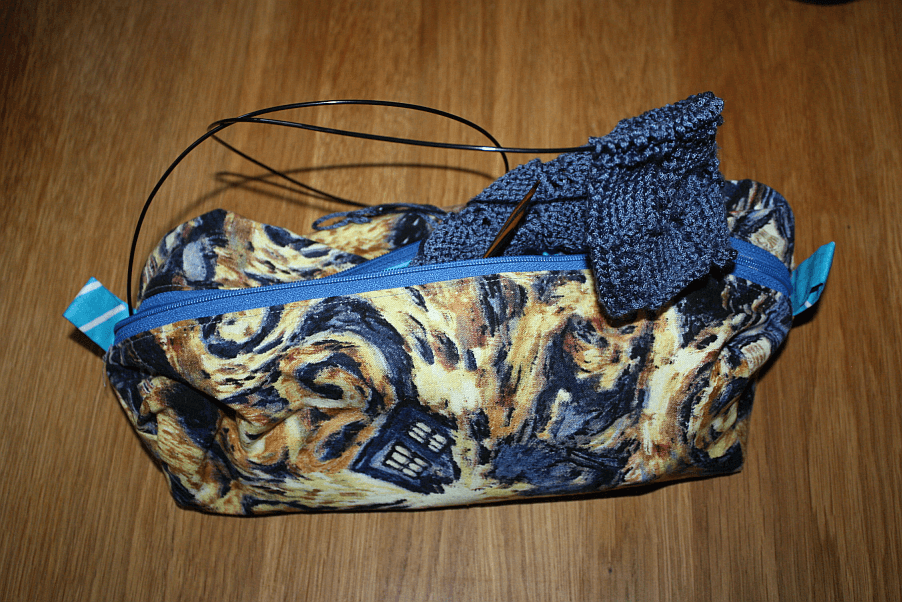
The knitting necessities for that (and just that) - the pattern, a crochet hook in case of Bad Things Happening, a darning needle, a measuring tape, stitch markers, a key to tighten the screw-on tips (because if you don't bring one, they will loosen up), my row counter ring, and of course needles and one ball of yarn went into my little Exploding Tardis knitting bag. (Usually there's also a piece of emergency chocolate in there, but I ate it before the journey. It had gotten rather old, and needed to go.)

travelknitting
So there was knitting - on the way to the airport, in our apartment in Helsinki, in cafés, and in the lines at the WorldCon as well as at the Stitch'n'Bitch they had there. And in most of the panels I went to, as they were talking people only, and if you're not tall and seated quite far in the back, you can't see the speakers anyway.

The choice of pattern proved to be a good one for knitting like that, as it is really quite simple - no waist shaping, very little armhole shaping, and the lace pattern is basic and easily remembered, not needing much attention at all. I did change the shoulder and neckline shaping a little, based on the Vignette cardi, as the original pattern just binds off straight, and that seemed a little bit too boxy to me - but these things were rather quickly done, and did not need too much attention either, or were knit when I was able to concentrate.

Which means that I left home with the pattern and six balls of yarn, and came back with the body of the jacket all knit, and parts of the first sleeve, too.

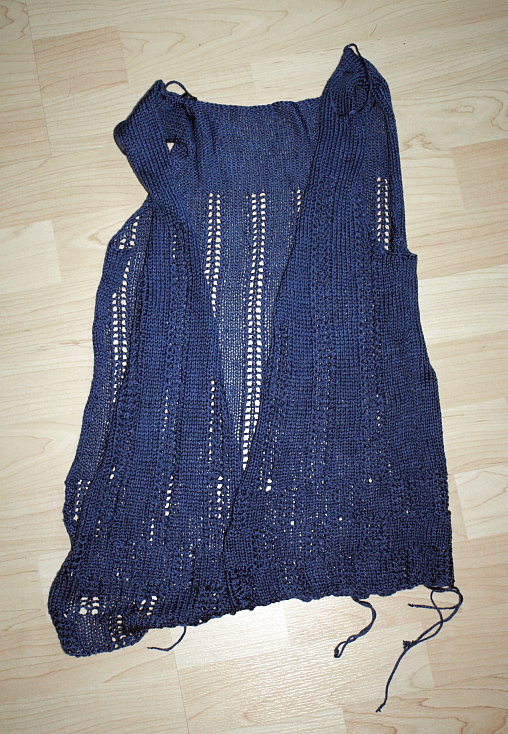
baton_rouge_body
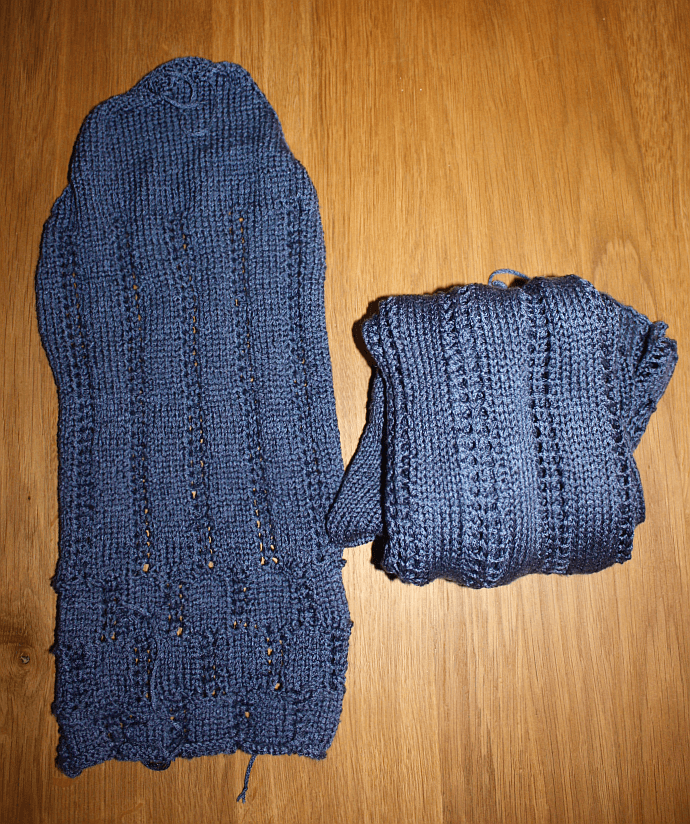
It got a bit of blocking for the body parts, and here they are, partly sewn up already - waiting for the sleeves to go in and the neckband to be knitted on. And in case you were ever wondering whether blocking is a good idea, or really changes things? Here's a picture of the unblocked sleeve beside the blocked parts (folded up):

baton_rouge_sleeve1
Even though it doesn't change the measurements of the finished piece, it does make a world of a difference appearance-wise. About one hundred more rows to go on the second sleeve, and then... more sewing together, and knitting the neckband. Yay!

The pattern, by the way, is called Baton Rouge. Which meant I had an earworm many, many times!
0
AUG.
04
0

Knitting patterns for men. Delightfully dated.

The Library Digitisation Unit of the University of Southampton has a Knitting Reference Library with Victorian knitting manuals and other old and really interesting knitting reference books and instructionals.

They also have, under the section slightly misleadingly titled "Knitting Patterns", a lot of title pages of 1950-ish and onward printed knitting patterns, all of them for men's upper body garments. Unfortunately, it really is only the title pages, so there are no actual patterns to be gotten. However, it is wildly interesting to just take a look at all of the title page pictures with the garments modeled: Some of the sweaters and cardigans look really timeless, and you wouldn't be surprised at all to see them worn today, or a pattern for them sold, or a garment like that on a hanger in a clothes store.

Some others, though? To my modern eyes, they look really, really weird. Some of them remind me of Captain Kirk, some of them loudly scream "Nineteeneighties!!", and some of them made me think "That looks like a dressing gown or pyjama part, that was worn on the street? Wow!"

Mind you, though, when I browse through modern knitting pattern magazines, I sometimes also wonder who would actually wear this. Those things are looking weird in a different, more up-do-date way, though.

So - if you enjoy looking at slightly weird older knitted garments - have a rootle in the Knitting Reference Library's 164 "knitting patterns". You might be as delighted as I was.
0
JULI
27
0

Brainbenders!

I've been tablet weaving again, a bit, trying to wrap my brain around... stuff. I've used the next Textile Forum as an excuse for this, as I want to take a look at tablet weaving, or, more concisely, on how patterning was done.

This is one of the things that keep fascinating me, and that I've wondered about for ages. We have incredibly complex weave patterns (not only in tablet weaves, but that technique is more accessible to me than loom weaving), and when we do these patterns today, trying to recreate the historical textiles, it usually results in a huge chart for the weaving pattern. Heidi Stolte once took the pattern from the maniple of St. Ulrich, and the pattern drawing on graph paper is about 7 m long and a good 70 cm wide. That is huge.

For the tenth century, we can quite safely assume that there was no similar roll of graph paper with the pattern on it. Which means that the weaver was either just all making it up as he or she went along, or had something else to work with. What, though - something like a sampler band, a sketch, or a different kind of pattern, or just a memory aid such as a rhyme - we don't know.

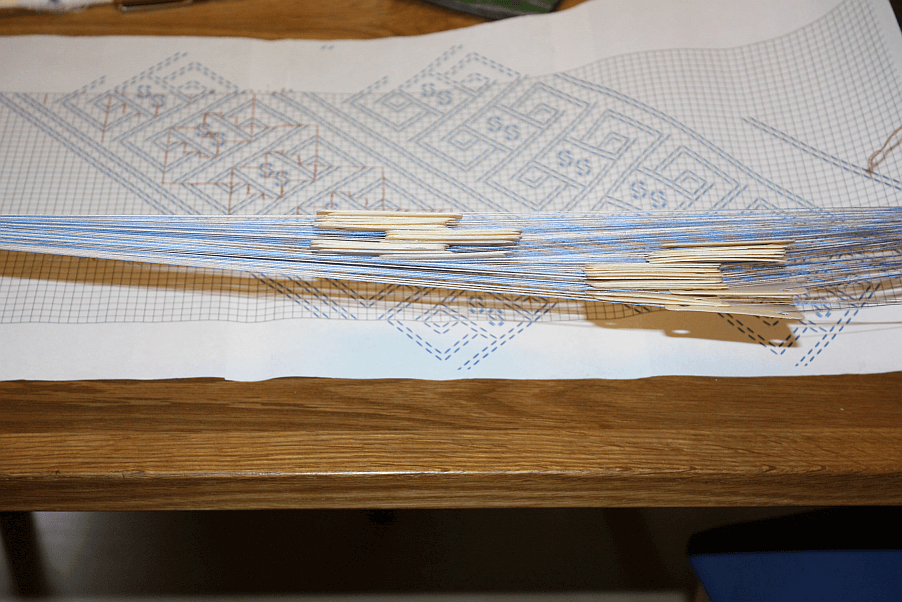
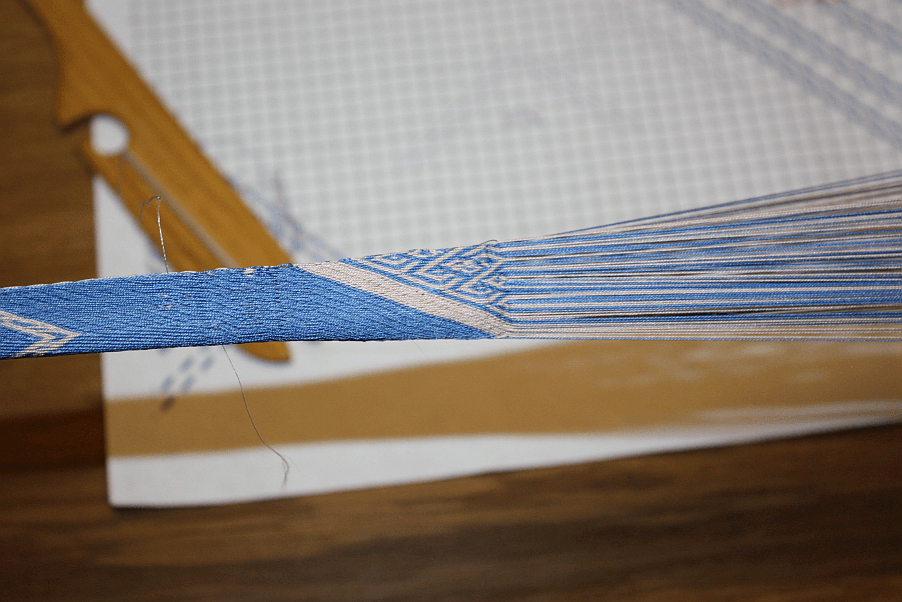
Now, whatever the aid for the patterning, it will most probably require you to be able to look at the band and see what has to come next. There might also be a kind of flow to the pattern at some point... so since the Ulrich maniple has also been fascinating me for ages, I took a part of the pattern and a silk band with 42 tablets, sat down and tried my hand.

band_2
From my previous tablet weaving experience, I found that having strict rules on how things are done and in what sequence they are done does help a lot. The tablets are separated into packs that turn in different directions, and I know which direction of turn always results in which slant in the band. In this band with its 42 tablets, I have split them into two sections that I can still turn with good control; a necessity that, unfortunately, also complicates matters a little.

band_1
I have a few ideas on how this could work, and I've had a bit of success before in getting an inkling on how and where to look, but today, unfortunately, my brain was not up to it - partly because there was a mistake to fix, and then I wanted to get a few picks correctly, and so I sort of fell into the trap of going after the charted pattern, counting tablets and marking off picks that were done instead of looking at lines and structures... which, yes, is a brainbender, but much more helpful than counting 5-3-1-change next 2- and so on. I've not given up hope, though - there will be more time spent at the band.

Probably with more coffee. And some chocolate.
0

By accepting you will be accessing a service provided by a third-party external to https://pallia.net/

Kontakt