Latest Comments

Guest - Katrin Sprang Discussion
18 September 2026
Hi Rachel, I have looked for more photos of you, but that was not very successful. I found a link on...
Guest - Beatrix Sprang Discussion
15 September 2026
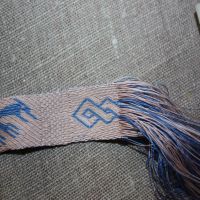
That lozenge pattern element is not a photograph, but a scan. So it should be to scale. But I pinned...
Guest - Katrin Sprang Discussion
15 September 2026
I was not referring to Rachel's reconstruction (is the reconstruction you refer to the one photograp...
Guest - Beatrix Sprang Discussion
14 September 2026
There is something Rachel did not mention. She told me: "Well, I worked with the measurements we too...
Guest - Katrin Sprang Discussion
14 September 2026
Well, this is certainly developing into an interesting discussion. Firstly, going from that lovely l...
JUN
09
0

Calculations.

Well, after a very nice day off yesterday, today was eaten up by doing this small thing and that one and another one, all good and necessary, but somehow it led to me not getting done what I wanted to do today. Mind you, my brain was quite scattery anyways, so the flitting from one small task to another suited the day's mood, but still - the main task for today did not get dealt with. (Yet. I am planning to squeeze in a little bit more time to at least get it pre-organised.)

Part of today's planned and not-yet-done task involved calculations on the costs of fabric reconstructions. Only approximate ones at the moment, but they are still complex to do, and need some brain power and checking of lists (of previous similar, or sometimes not-so-similar tasks), and checking of material availability and costs.

On a similar vein -  I've been asked if the membrane thread will eventually make its way into the online shop. Ah. Well. Theoretically... it could. But practically... I'm not convinced it will be a well-selling item. It will, however, definitely be a very, very pricey item.

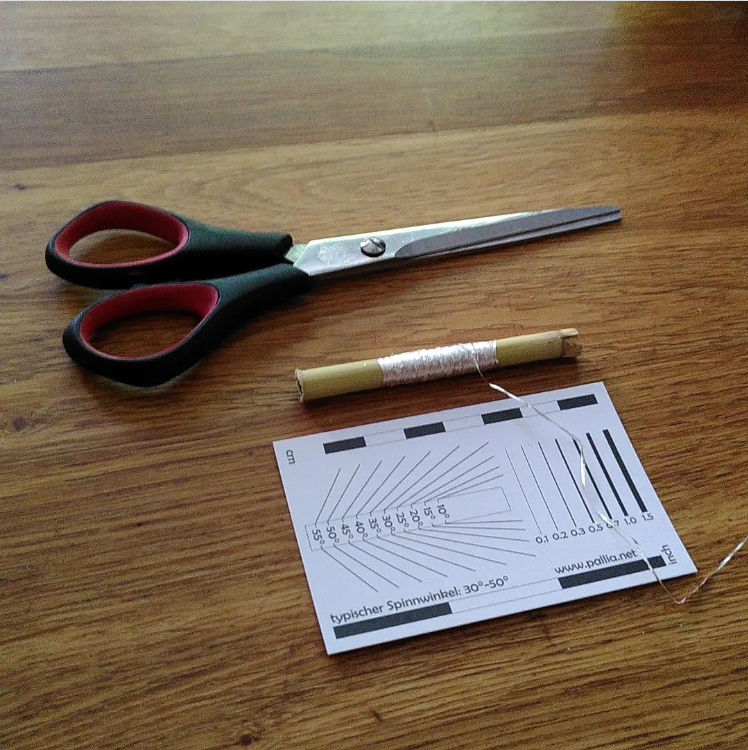
Membrane strip, wound up, my current favourite tool for cutting it, and a little helper card - this time not for yarn thickness or twist angle check, but for strip width check!
The easy part for calculating the price of membrane silver thread like this is adding up the material costs. There's the goldbeater's skin as the basis, the parchment glue (which has to be prepared, too), the leaf silver, and the core thread. The core thread I currently use is vintage linen yarn, and I can't really remember where I bought it, but it's possible to find comparable yarn and see how much that costs. For the rest, I have the numbers... and adding them up, they are not pretty. But that, of course, is only the first part of the calculation process.

Now that I've more or less gotten the hang of cutting the strip and winding it around the core, I can do some time measurements for how long things take, and add those up. For the gilding process, though, I will have to estimate - I have not done that often enough yet to have a good established process, and the last approaches at stretching the skin in a frame for the glueing and gilding did work, but took a disproportionate amount of time. 


Those bits in the calculation process are the hardest for me. I don't want to shortchange my customers, but nor do I want to end up with a much lower wage than intended because I underestimated the time necessary by a lot. And unfortunately, when you do those estimations for work time, that is very easy to do. 

So... I've made a rough guess on where I will end up, per metre, if I calculate properly. I can tell you that the material costs for about 30 metres of thread are at around 40 €. Added to that is the work time necessary to do all the steps from naked membrane to finished thread: Framing the membrane, treating it with glue, gilding it, glueing it into a cylinder, cutting the strip, preparing the core thread (which means winding two single yarns onto a spindle), and finally wrapping the core thread with the cut strip.

Want to guess along with me? Then let me know in the comments where you'd see the price for a metre of the membrane thread end up!
0
SEP
01
0

Whoops, where did that day go?

A chunk of it was eaten by some more research into the photo database problem; then there was a bit of writing; there was a bit of textile work; some organising; there was lunch at some point inbetween, and woosh, the day was gone.

Speaking of time, just a few days ago I was chatting with a friend about wages, and pay, and freelance employment. A few years ago, I had found an online calculating tool that helped in calculating a sensible rate for freelance work, with a list covering expenses and taxes and all these things, but that has long since gone the way of the Dodo Website.

A quick search, though, found a page called, very fittingly: The Freelance Rate Calculator.  Clicking the link there sends you to a google spreadsheet that you can download and fill in, to find out what you will need per hour to earn the money you need. It does, very handily, remind you that you might want to have some savings too... so a very smart thing.

In case you consider going freelance: Check out this sheet, or something similar. You definitely want to find out if you can turn whatever you are planning to make your main job into a business that will sustain you... before you take the plunge.

0
JUL
31
1

Need some wool?

There's not many traditional sheep flocks left in Germany, wandering around to graze here and there. Rules, regulations (sometimes really stupid ones, especially concerning herd protection dogs), the intensive agriculture in Germany, the many streets and roadways, and last but not at all least the very low price for wool are all making it hard for this way of keeping sheep to be economically viable. Yet sheep grazing is the thing that keeps some of the iconic landscapes of Germany what they are, and wandering flocks like that are the only way to preserve them.

One of the last flocks that remain is now trying to change the "no money for the wool" dilemma, to make things better. The shepherd (who is also active on twitter) started a Startnext campaign to sell their wool directly. It has been funded already, then met its second funding goal, but there are a few more days left to support it, and there's also (most importantly) some knitting yarn, carded wool, and other wooly product stuff left to get.

I think it's a wonderful project. Supporting the project means a reasonable price for wool, making sure traditionally-kept wandering flocks like Sven's flock can keep going, and helps to protect the very special environment in German regions that have been grazed on, and formed by this, for many years. Plus you get knitting or spinning fodder!

You can check out the project under "Paulas Wolle" at startnext, and support it there. Text is German only, but they do send their wool outside of Germany within the EU (sorry Great-Britain, you're out).
0
FEB
27
4

Hobby vs. Job.

One of the topics that come up from time to time is turning a hobby into a job, or a part-time job - people selling the things they are making.

One of the things that I always mention when this happens is the importance of calculating correctly. This means that if you would be working full-time in this new job, you should be able to make enough money to live off it. So you should calculate the price of your items accordingly - and that will give you a benchmark for what to ask, and should also give you an idea of whether turning your pastime into a job could work. Especially if you are thinking of quitting your current day job, you might want to check if you will be able to keep the standard of living that you are accustomed to, or if (and how much) you are willing to save in order to change to your new venture. Which means it's probably a good idea to list how much money you are spending each month, and how much of that is fixed (which includes, for instance, rents and insurances) and how much is fluid. I had a conversation about this fairly recently, and it only took about three minutes of mentioning what all has to be paid by the income of what is made (such as health insurance, website costs, savings for old age, light and heating for the workspaces, and a gazillion other things) to get my conversation partner think really hard about whether this would be a good idea or not.

In case your numbers come out favourably, and you are planning to go full blast into your new venture, it's also a good thing to keep in mind that your company will take some time to start up and to get known well enough to actually make money. Usually, it takes about two to three years for this - which means you should have some savings to keep you afloat during those lean times. Or start part-time, build up from there, and see if you can (and want) to go full-time after you are better established.

It may well be that, after looking at all these figures and doing the maths and thinking about it, you will prefer to leave things as they are - your day job as your day job, providing work and bread, and you hobby as just your pastime, providing fun and satisfaction (hopefully in addition to the satisfaction you get from your day job). And that is an absolutely valid decision. In fact, it may be the smartest decision in a lot of these cases.

One last thing that is sometimes forgotten, or not mentioned: If you turn your hobby into your work, you will lose the hobby. The way you look at things related to the hobby will change, and your whole attitude to this will change. It may stay fun work, but it will be work, and there will be days when you don't enjoy it that much.

When I went ahead and turned Living History stuff into part of my job, it changed a lot for me. I knew that would happen, so I wasn't surprised by it. However, the extent of the change actually did surprise me; I had not expected that much, and that deep of a change on how I look at things. It's hard to pinpoint all the little and large aspects, and even harder to explain. It also does not mean that I don't enjoy dressing in medieval garments and cooking food over an open fire and chat with people who do the same - but I'm still at my workplace, and I still have my professional hat on in some way, so it does feel very different from what it was before. So be aware that while trying to make money by doing something you love will not necessarily reduce that love, but it will most probably change things around it very much indeed.

There's nothing wrong with having a hobby you enjoy and not making anything out of it except your own, personal enjoyment. That is what pastimes, hobbies, and holidays are for, after all: Personal enjoyment. Plus, while a part of your enjoyment may lie in getting better at what you are doing, part of what makes a hobby so enjoyable is that there is little pressure to achieve something within a certain time, or someone else expecting you to perform to a given standard. (Obviously, if your hobby is competing in some way, this may not be true - but it should still give you personal enjoyment, and that's the point.)

Finally, there's a very nice article about just that topic - letting a hobby stay a hobby - here. Enjoy - and let me know what you think!
0
MAR
31
0

You Should Not Work For Free.

If you've been reading this blog for a while, you will know that I have strong opinions about fair payment for work (see the Fair Prices for Crafting posts). If you are working a full-time job, no matter what the job is, you should be able to live off your job. That means if you are a professional knitter, your knitting should pay for your life needs. It does not matter whether you are a writer, or an artist, or a cashier, or a carpenter, or a nurse - your job should support you.

I can totally understand if somebody asks me about pricing for, say, a dress; I tell them what to expect, and the answer to this is "well, thanks but no thanks". I do know that having a dress or some other garment made to measure, sewn by hand, possibly using special materials will be beyond what a lot of people (and incidentally also quite a few institutions such as museums) are willing or able to spend. I am fine with that. I'm also fine with getting together with the prospective client to explore possibilities and alternatives that will result in finding a different plan of action, and both of us being happy with the price point for that. If that is not an option, I don't care whether the "no thanks" is due to not being willing, or not being able. There's a reason that I have arrived at the pricing I've given, and doing the same work for less will not work out in my favour.

The calculations I make for my offers, whether it's a service (such as making a garment), teaching, or the goods I offer in the online shop and at my stall at markets, are solid. The prices I charge do allow me to support myself. I'm not calculating overly generously for my benefit, though - if there's a slow period with few sales and few or no projects, I can definitely feel it, and my one-woman company still falls into the "small microbusiness" category.There are occasions when it is necessary to put in some work to make a proper offer for something, so I'll do research and planning and calculations, and I don't get money for this unless the offer is accepted - but that is normal, and that is acceptable, and something that is calculated for. But something I will not do at all? Definitely not? Work for free. Or for "exposure", which basically means "go work for free for us, and we will tell a lot of people so you might have trouble explaining later why you won't go on working for free for others, too".
I also get cranky if I get asked, by some institution or company that does turn a profit, to work under my price point. This does happen rarely these days, by the way - but it does still happen occasionally. Professional work should be paid.If you're wondering what brought on this ramble, it's the "offer" of the World Fantasy Convention to submit a new award design. Key phrase here is "there will be no monetary remuneration." Yes. For an award design that will be used for nobody knows how long. That they want to have all copyright for.Much to my happiness, this "offer" has already led to several people stating very, very clearly that it is a bad offer, and a bad idea to submit artwork for it. Jim Hines writes about working for exposure only (though not directly linking to the Award Kerfuffle). Mary Robinette Kowal has strong feelings about the award specs and whole thing. John Picacio already posted about the issue in November 2015. I'm really curious to see how all this will turn out - and whether the critical voices will lead to a change in the submission guidelines or not.

0
FEB
11
0

Textile Economics.

One of the things that come up frequently when I do presentations or demonstrations of textile techniques is the value of textiles. We're so used today to going into a clothes shop that sells things for ridiculously low prices that our estimation of textiles and their worth tends to be very low.

The ridiculously low prices are not without their own price, though - only it's usually not us here who are paying it, but cotton farmers, clothing factory workers in Bangladesh, or everyone in the area where cotton is grown when water supplies are used up and the groundwater level plummets (no wonder if up to 20 000 litres of water are used to produce one kilo of cotton), or is poisoned by herbicides and pesticides.

It's not fair, it's not sustainable, and a lot of people have been talking about this "fast fashion" and its problems in the last years. (Just plug "fast fashion problems" into your favourite search engine. You'll be surprised.) There's things we all can do, though - one of them is becoming more aware of what we buy, and how often. Another thing is to try and avoid conventionally grown cotton (organic is much kinder to both producers and the environment) and look for clothes that were not produced in Bangladesh, but more locally. Buy used clothing, mend things that can be mended, and give things you do not wear anymore away instead of tossing them into the bin.

The fact that textiles are such a cheap commodity today has coloured our perception of textile crafts, and our internal valuing of fabrics. This makes it hard for many people to understand why fabrics were so precious in the Middle Ages (and also way past that time, until rather recently). Clothes used to be a very valuable thing, in our past, and I do wonder if they will, one day, be again.
0
JAN
10
0

Random thoughts.

I've barely started on the current big project, and first complications have already arisen, hooray - there is an issue with the fabrics I had planned to order. If I am lucky, I can get very similar replacements for them. If not... well. We shall see. At least it starts out quite, quite interesting.

There are bits and pieces I can get started on, though, and I am firmly planning to do so today, with just one single other point on my agenda.

(Sorry for the vagueness - if things work out, I'm planning to de-vague it soon, and you will be along for the ride.)

So while I'm feeling a little torn about how things will work, here are some scattered random links for you.

The Yarn Harlot writes about a baby sweater, and how only love could buy it. Yes. This. (Fits right in with the Fair Prices stuff that I blatantly plugged again yesterday.)

If you read German, Archaeologik posts about an excavation of a modern ceramic firing pit (pit was courtesy of a school project). If you don't read German, there's piccies.

Random fact of the day: I'm still doing yoga. My standard go-to site is doyogawithme.com, which I still highly recommend. There are pay-for sites that are by far not as nice as that one. And online yoga is a business with quite a bit of money to be made, as noticed by a company called YogaGlo... who have, apparently, patented a certain layout of the room for video classes.
This has led to hubbub and kerfluffle with the other yoga class sites, among them Yoga International. How is that interesting for you, you ask? Go read their open letter - and then you might want to enjoy their offer of all their classes for free (offer stands with undisclosed end time, but probably not forever).
0

By accepting you will be accessing a service provided by a third-party external to https://pallia.net/

Contact