
Latest Comments

Guest - Katrin Sprang Discussion
18 September 2026
Hi Rachel, I have looked for more photos of you, but that was not very successful. I found a link on...
Guest - Beatrix Sprang Discussion
15 September 2026
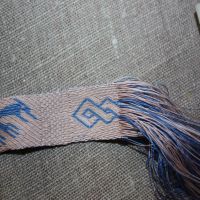
That lozenge pattern element is not a photograph, but a scan. So it should be to scale. But I pinned...
Guest - Katrin Sprang Discussion
15 September 2026
I was not referring to Rachel's reconstruction (is the reconstruction you refer to the one photograp...
Guest - Beatrix Sprang Discussion
14 September 2026
There is something Rachel did not mention. She told me: "Well, I worked with the measurements we too...
Guest - Katrin Sprang Discussion
14 September 2026
Well, this is certainly developing into an interesting discussion. Firstly, going from that lovely l...
AUG
13
0

The PPWR Mess.

Well, mess is a rather tame word for this, to be honest, but... we'll leave it at that for now.

I have promised you more about the shipping issues that many small vendors currently face, so here you go.

First of all, because most German social media posts about these problems currently are full of comments bashing the EU. (Notice that I write comments - it's not the posts themselves.) Personally, I do stand very firmly behind the idea of the EU. We are stronger together, and many, many of the things the EU does are really wonderful. I am also old enough to still remember the hassle of border controls, and the constant maths in your head of trying to do currency exchange calculations while shopping for coffee or food or souvenirs, and the problems of ordering something from a small shop outside your own country, with different currency and all. Joining up under an umbrella that helps us to negotiate better with other large nations like China and the US, and making things within the EU simpler and more harmonised - that's a great idea. Unfortunately all great ideas struggle with small-mindedness, and may also struggle with egoism, and that is surely part of why some things, intended for the very best, go horribly pear-shaped and suddenly find themselves rather brown in colour and on a rapid trajectory towards the next fan.

I am also all, all for the reduction of waste and environmental impact. If you've been hanging out on this blog for a while, you will know that sustainability and reducing unneccessary waste are quite high up on my personal list. We have numbers for the EU (well, for the whole world, but anyways), and packaging waste (especially single-use plastics) are a huge portion of general waste, so it is important to act in this respect. Whcich means... in general, the EU idea of unifying waste and packaging material treatments across all countries, and sequentially introducing more rules for better sustainability - it's great, and very, very necessary.

So where did things go wrong? Previously, we had different rules for each of the EU countries, with different thresholds for import, different costs for package waste licensing, different minimum amounts for that. Quite a few countries had a de minimis threshold, so you'd not need to bother registering for a handful of packages each year. We are talking literal handfuls here; like many other small sole traders, I am not sending more than at super-duper-most five packages per year to any one single other EU country*.

All these countries had established their own systems, and they are vastly different from nation to nation. Obviously, all countries were somehow convinced that their system is the bees' knees, and did not want to change it or adopt anyone else's instead. So, consequently, there was no agreement on new, EU-wide regulations. The only thing that happened was that there are the same labels in all of the EU now, and each country now works on the same baseline: They still have their national waste licensing system, and you are still required to enter it if you ship to that country, but there are no more thresholds with the intention to offer the same terms everywhere and to everyone. That, unfortunately, means that you have to register via a licensed, notary-confirmed authorised representative in each single of the 26 countries if you intend to offer selling into that country, and this starts at the very first package. And with this harmonised, they have not even agreed on the same fee structure or waste amount tiers, which means that one country you might have to register and it's a minimum amount of 100 kg of paper you pay for, and in another one it might be 30 kg.

If I could be sure to have a shipping volume of around 250 packages per year into any single country, I could add around 3 Euro to the cost in every shipping tier, and it would work out approximately (if the licensing fees are not too high in that country, that is). With less shipping volume, it's not even worth doing the maths for that country. 

The EU has planned some exemptions for small vendors, but their definition of a "small company" is one with less than ten employees and less than two million Euro turnover per year. They have been told, time and again and not just within the last few days, that these rules are way, way too much bureaucracy and way too much expenses for small traders. However, nothing has happened. Which means that the really small vendors, the solo entrepreneurs and similar tiny ones (in German you'd say we are a fly's shit), we're getting grouped in with companies just below two million turnover per year. This, dear reader, cannot work well, as anyone knowing and doing a little bit of simple maths will be easily able to understand.

Unfortunately, and this is where I do get a bit grudgy now, the EU representatives were not even able to agree among them all on a really ridiculously low de minimis threshold.  There's always be going to be malcontent people where they are just above a minimum line, but really, if we're talking about amounts that an ambitious granny could post to her family each year - even if it's only ten parcels free to other countries each year, that would already help the really small ones.

Because, and here's the next bit of irony: Many of the small traders whose statements I've read do say that they are happy and support the general idea of waste control and waste management. They are also trying to comply with the rules as best they can** - so consequently they are stopping shipping. Some are already very frustrated about all the rules and regs that, for instance, make it harder to re-use packaging materials on top of all the other stuff that you have to keep up-to-date with. Quite a few of them are holding a grudge, but I have not seen any of them state we need to leave the EU. That is done in the comments by some readers, mostly of the right-leaning-maybe-already-brownish tinged fraction that really have no understanding of how shitty that would be overall, and have obviously also not paid attention to what Brexit has turned out to be. (Spoiler alert: It has turned out to not have been a good idea.)

So where am I going with this text, apart from getting it all off my chest? One, hopefully you can understand a little better now why so many shops have stopped EU shipping. We fly-shit traders really want to have nice, fair rules that we can adhere to, and can't use more insecurities because of grey zones. Two, if you are unhappy about the situation (which I very much hope you will be), you have some options: Write to your EU representative(s), or call them up if you like phone calls better. Write to the EU commissioner Jessika Roswall. Leave a statement in the official feedback page (it has opened August 6 and will be open until September 10). Sign the (new) petition about this mishap. Tell your friends. And then... please do something that makes you happy, to balance out all this shit.

I can tell you that I have spent much, much more of my time and energy on this whole kerfuffle than was good for me. I have hoped against hope that I'd get heard along with all the other tiny shops. I have read the texts of the regulations, in English and in German, trying to find the exemption for the small ones. I have cried with frustration of having so, so many things that it is really hard to conform to, and you know that you are in a grey zone here, and there, and there, and there, and at some point it adds up and you lose the energy to keep up when the next one comes up where there's just no way around. There's also the little issue that many of the people I work with, and am getting goods from - both for the shop stock and for my museum work - are in some other EU country, and most probably they, now, are also stopping shipment within the EU. Something like the Alpirsbach hose project? The fabric came from Sweden - so nope (or add another c 500 € to the cost of the fabric). My dyeing expert? Lives in France. Some of my spindle whorls? From Belgium. If I have a regional source, I'll go for that, but many things are so niche that I'm over the moon if I can find anyone at all willing to do these things, and chances that they're outside Germany are very, very high. 

I am not sure what is to blame for this all going so utterly and senselessly wrong, but I am sure that it's something profoundly human (but maybe not very good-human) that is part of all this.

Having to stop shipping to UK because of Brexit, and to the US because of taxes and tariffs was frustrating already. Having to stop on what I had considered, more or less, the home turf hits much harder, and differently. So for now, I will let this thing rest, and hope that it will resolve itself in some way. If it doesn't do it quickly and you need something shipped from me, or from any other small vendor in a different country, your best bet will probably be to find a friend who lives in that country, and do the ordering and shipping via them.

Good luck, to all of us.


* At this volume, shipping abroad is basically customer service, and if calculated properly, I guess the work time invested overall in keeping up to date with shipping cost changes and shipping rule changes, plus the extra filling out of import forms probably more than eats up the revenue gained with these shipments - but I enjoy having my stuff travel the world, and I know the pain of not being able to get something just because you're too far away, so I have never done the maths on that correctly, on purpose. 

** It is, in fact, no small feat to even just keep up with the developments so you know what you have to change, or check, or amend, or look out for. There is no official channel that will give the stuff to you in somewhat digestible form - so you can either spend a lot of time trawling the EU and national rules pages, or hope that you're lucky and will hear about it in time, or sign up to some "vendor help" newsletters that will give you most of the news at some point, but always in a way to make you feel like buying some programme or service from them is your only sensible way to deal with the new shit. If you're a 200 employees company, you'll have someone dealing with all the law stuff and compliance shenanigans. If you're just one person... every hour that this research and the consequent adaptations for compliance eat up is time that you can't spend on your core business. And believe me, it's not done with one hour per change usually.

0
MAY
21
0

More Tablets!

With the last Textile Forum focusing on tablet weaving, I was preparing for running empty (or almost empty) of tablets due to that... which didn't happen, because most participants brought their own.

But still, stocks were running low, so I started on the quest of getting more. For this, you need a) something to punch them, b) someone to do the punching, and c) something to use the punching tool on. The first two were comparatively simple, but finding a good source for the right material... wasn't.

The old ones I had were made of some special kind of cardboard with a very good stability in both directions, and quite firm if you press on the sides, and a not-horrible colour (brownish).  It took a bit of looking around before I found out that it's indeed a special kind of cardboard, and then it took a while longer to realise that bookbinding and other paper-workery stuff are only a side use of the material, and that it's mainly used for isolation in electronics. 

Then it took a while to sort out the possibilities of sourcing it there. And finally, I could get the stuff for not as horrendously a price as it would have been through bookbinding suppliers. 

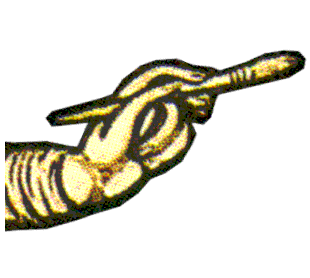
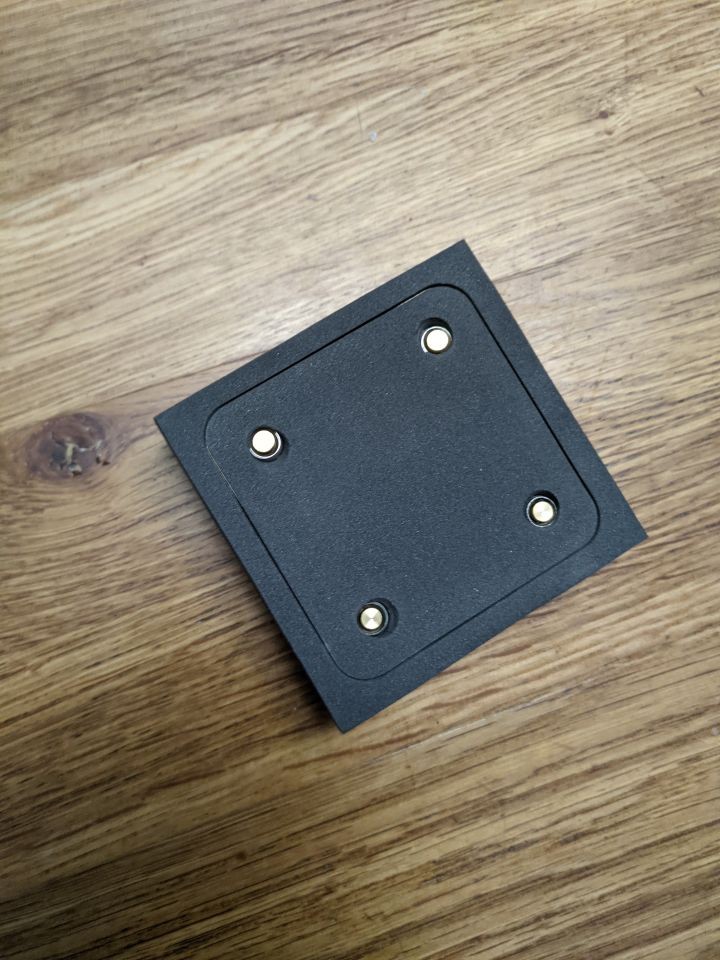
The punching tool, by the way, looks like this:

I also learned that there's a specific lingo to all the punching stuff, too, which was fun - as was the tour of the local printing press who ended up doing the punching step, and who were really lovely and nice all along.

The tablets are looking just like the old ones - so that was a success, I'd say. And now I have stock again for a good, long while!

0
JAN
26
1

Pin-making.

It's been a good while now since I've run out of the brass pins in the shop, but somehow there was this and that and things didn't line up, and I never got around to sitting down and making new ones. 

Today, though, I really felt like doing something practical again for a bit, after all the website and writing things, and I got out the metal-working supplies and started a bit of pin-making.

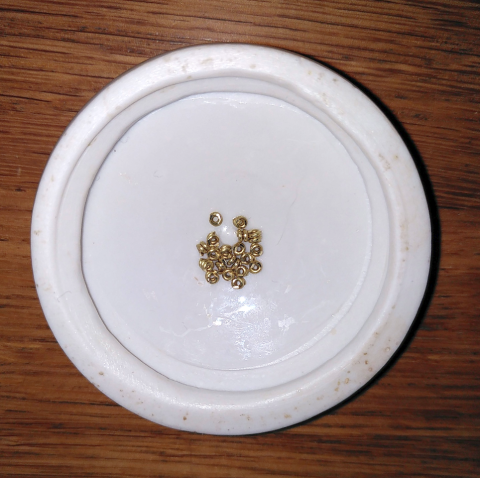
It begins with preparing the heads, which are made from wrapped wire, then cut into bits: 

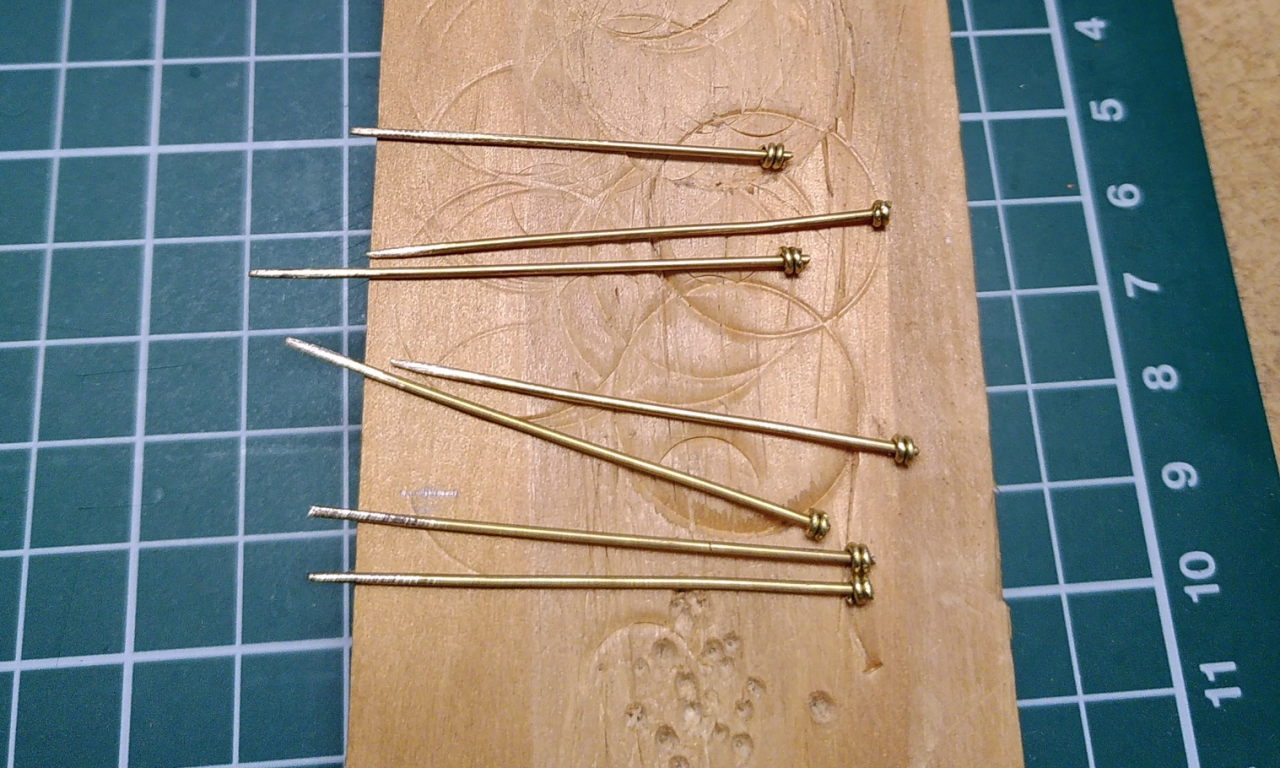
Then shanks are cut and hammered into the little head coils, and then I do some more hammering to make sure the heads are decently stuck on the shanks, and then the annoying bit starts: sharpening the tips.

The photo shows half-finished tips on some pins. I'm still not completely happy with the workflow in that part of the process, but at least I'm getting pins already. Some more grinding, and some more testing of possible methods to come... and soon, pins to come back to the shop. Yay!

0
SEP
22
0

Cascading Stuff, Keywords, and Controlled Vocabulary.

You probably know this phenomenon - you have to do something to some stuff somewhere, and then you start doing it, and then you realise that it would be smart to do something else to something connected somewhere else first. And then... it might just cascade on from there.

Sometimes, that is all well and good, and it's sensible to start at the roots and do things from there up. Sometimes, though, the cascading can be just too much, and it would have been (or would be) better to do the incomplete thing and have it dealt with, instead of having it spiral out of control, attracting more and more work on its merry way.

The true art is probably to know where to stop, as so often in life.

You can probably guess that I'm not writing this out of the blue, too... the current cascading effect that I have to (potentially) deal with is, of course, connected to the photo database migration. (Which is progressing, hooray!) The old programme had flat, non-hierarchical keywords, and the new programme can do hierarchical ones, which is very nice and very welcome. The keywords themselves, though...

I've been adding keywords whenever it seemed necessary, and I tried to process and tag every image as it came into the database. Of course that did not work completely, and there are plenty of un-tagged images around. For the ones that do have keywords (which is most of them), they are not always consistent. That is, obviously, not helpful. So the plan is to clean up keyword issues as I'm sorting them into the new hierarchical structures.

In some cases, that's easy. Birds are animals, just as the tags "horse", "flamingo", or "dog" will go under animals. It's getting more difficult with objects. Fortunately, there's lists of hierarchies for object description and tagging available, developed by museum people and geared towards different focus areas of interest. The Getty Research Institute, for instance, offers a number of vocabularies. (Look for the "Browse ..." line when you are offered a search mask, that gets you to the full set.) For German cataloguing, there is, for instance, the "Objektbezeichnungsdatei" offered by the Digicult-Verbund. Because choosing what to catalogue, and what not, and how to do it, is not at all trivial, there's also literature about that, such as the "Cataloguing Cultural Objects" guideline, a slim and slender 407 pages small, free to download for everybody interested or in need.

One of my main questions for now is how to handle male and female clothing. For my old database, I had a sort-of-makeshift solution, stating "TunicMale" or "TunicFemale". That was not perfect, but it did work. Now I'm not sure what to do for marking things - do I split my clothing term hierarchy into "male garments" and "female garments"? That means that when searching for something unisex, I'll have to search for two terms. On the other hand, I wouldn't have the problem that when looking for, say, only women wearing hoods that also men come up in the search.

Another option would be to mark unisex garments with an (m) or (f) behind the tag proper, giving me the option of having that as a lower hierarchy tier and having the complete term above this. That's probably the better solution, even though it adds layers to the hierarchical tree - which is also something that should not be done too excessively. Ah well. Difficult decisions, but fortunately not ones that need to be taken right away, I can think about it for a bit longer!


0
MAY
10
0

Finally Fully Degummed.

A while ago I wrote about dyeing silk and different outcomes, depending on whether it had been degummed or not. My degumming try that I referenced back in that post ended up being not completely successful, as some of the gum had still stayed in. 

I finally got around to doing it again, with a fresh sample, and this time I made sure to steep it to death, or something very close - it stayed in the hot soapy bath for a full hour, and I used de-ionised water to avoid any hindrance by our rather hard tap water. 

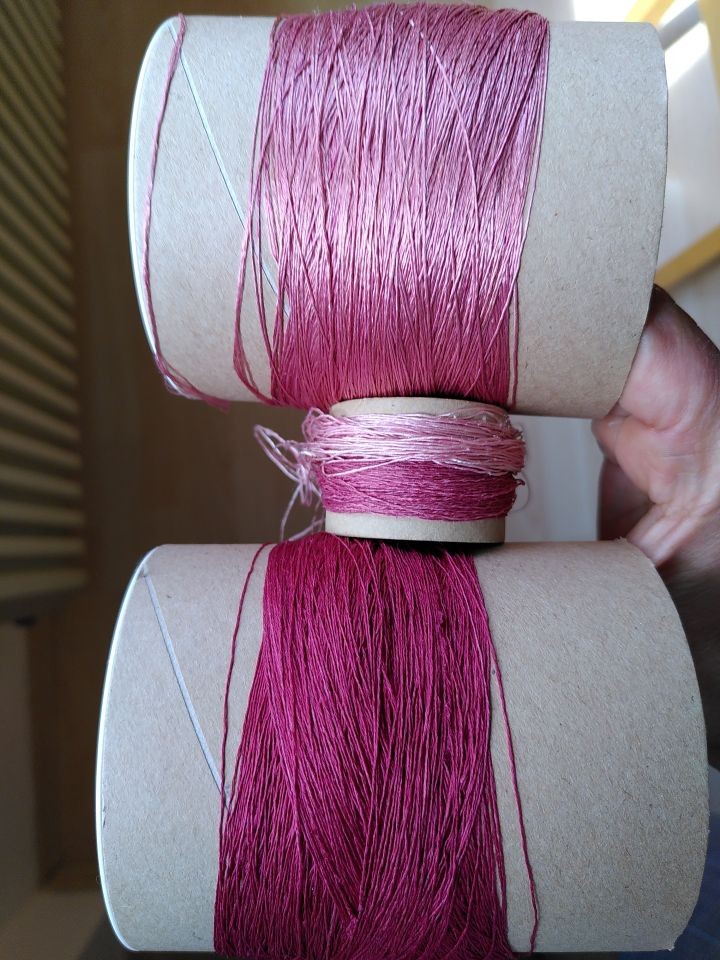
And here's the result:

As you can see, there's four samples now. The one on the bottom is the silk dyed in the gum, the one on top is untwisted degummed embroidery silk dyed together with the gummy silk. On the small roll in the middle, the bottom one is the outcome of my last trial, partly degummed, and on top is the completely degummed silk. 

It's become very light in colour, even lighter than the silk that was degummed before dyeing. I had expected something like that - either a bit lighter, or somewhere around the colour of the embroidery silk. 

There is definitely more shine now, but it is also much more delicate; I've had several snaggy bits even though it's a twisted silk. 

So my current conclusions are:

If you want to work with silk that has next to no twist at all, leaving it gummy or partly gummy might be a good idea to up the stability. The sericin also seems to take natural dyes much better, so if you want to have really deep, vivid colours... leaving it gummy or partly gummy is, again, your friend. In case you want it to be utterly shiny, though, degumming is the way to go.

Though I had the impression that the thin strands of gummy silk, with about 20 den, are also looking quite shiny. More exploration might be necessary...

0
APR
21
0

Fair Food.

No, this time I'm not talking about food that is paid for fairly - but fair food as in the things I eat when on a fair. 

There is, obviously, a huge difference between going on a fair as a visitor and going on a fair as a vendor, though in both cases, I tend to bring my own food. Most of the time, the things offered at the food stalls are not, um, top-quality stuff in regards to ingredients and taste, and they are usually also quite high-priced. 

When I go to visit the Spiel game fair at Essen, the usual stuff we're taking along is sandwiches, some fruit, and a bit of chocolate or other sweet stuff. There's a nice breakfast in the morning and the group goes to have dinner at an Italian or other place in the evening. Packing and food prep for that is easy, as it's only the sweet stuff and maybe some extra fruit to pack and bring along, the sandwich ingredients are provided at breakfast time, as is more fruit. So nothing to think of or prep in the days before.

When I'm on a fair as a vendor, it's a wholly different picture. Sometimes breakfast is provided, but that's the exception; usually it's pack your own for all the event. Which means packing food that is ready to eat, does not need to be refrigerated, is more or less sensible, easy to eat a bit of and put away again (in case customers come along while you're munching), and preferably also tasty.

Bread and smoked sausages as well as boiled eggs are among the typical things that fit these requirements. Chocolate, of course - my rule is to take one bar of chocolate per day, just in case things happen and there's no time to eat properly. Carrots, radishes, and cucumbers are good choices for getting some fresh stuff that does not wilt when you look at it oddly. But something that is not bread is also very nice to have.

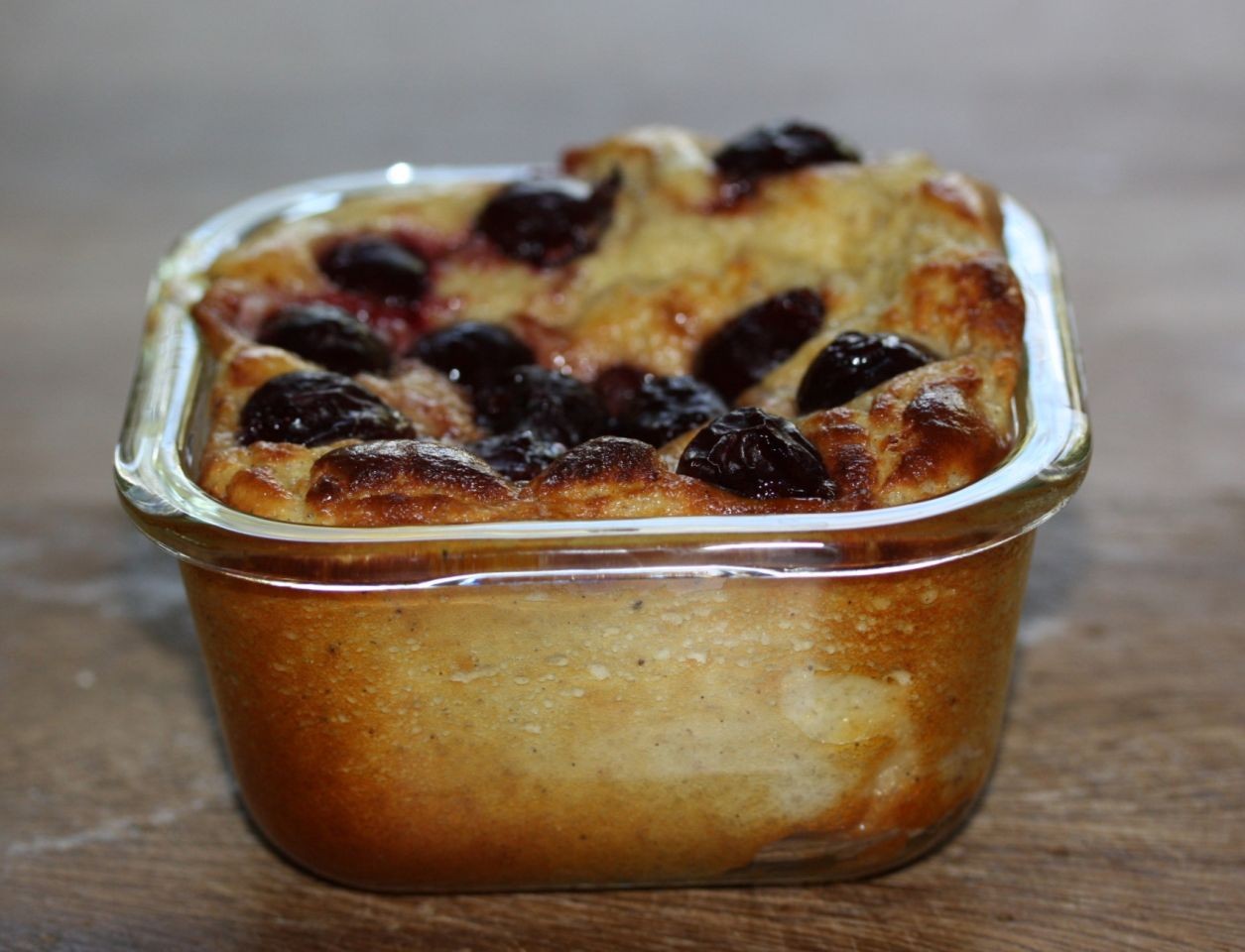
One of my not-bread-meal staples for these occasions is Quarkauflauf - which is, more or less, a crust-free cheesecake with fruit in it. And today's the first time since ages that I'm prepping this. With Zwetschgen as the fruit, that lovely variety of plums that I like so much, and that I find is unrivalled in Quarkauflauf. I don't really know why I haven't made this since the last fair, but I can tell you that I am very much looking forward to this fair food, to be consumed this weekend in Hohenlohe!

In case you're in the region, come see me at my stall, the fair runs Saturday and Sunday in Blaufelden. And if you have suggestions, or a favourite food to take along on travels or events, let me know in the comments - it's always interesting to hear what other people have to keep them going on events!

0
APR
01
0

Riding Slits, Part 2.

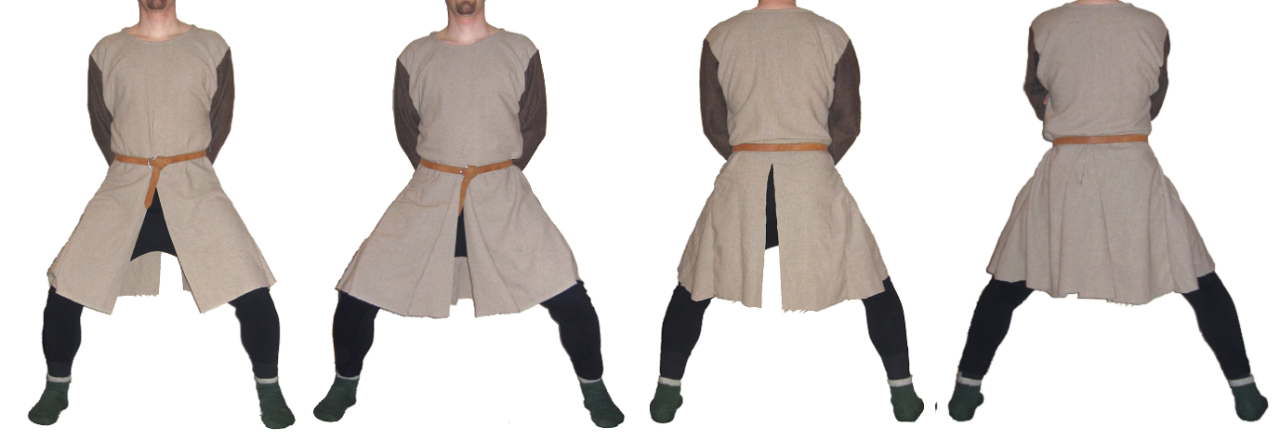
Here's a comparison of a mockup tunic with slits cut in, with and without middle gores around those slits: 

Simple tunic with riding slit cut in, from left to right: front view without middle gore, with middle gore, back view without middle gore, with middle gore.

Well, the horse is missing from those images (due to lack of handy horses around here), but you can see that the slit functions, of course, in both instances - with and without a middle gore. However, the version with gores remains much more "closed" even in the riding position. Especially noticeable in the view on the back, where the slit is not visible even in this leg position.

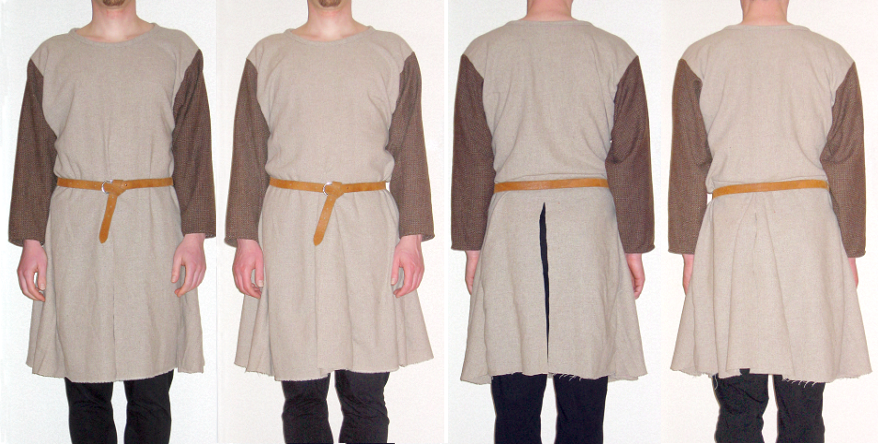
The whole issue gets properly interesting, though, when you are standing normally:

From left to right: front view without gore, with gore, back view without gore, with gore.

As you can see, the tunic does not close properly at the back if there's no middle gore inserted. This is standing position; the slit issue gets worse, and more noticeable, once the wearer starts to move - when walking or running, the slit will gap open, unless you insert the middle gore.

So that's something you'd definitely want to do for your coverage. Not only to avoid flashing your undies, but also because the slit, staying open, will make things rather drafty in cooler weather!

What you can also see in those standing position pictures is that the fall of the tunic changes with the insertion of the gores. This is significant because riding slits are closely related to riding, which means horses, which is an expensive and status-y thing to have not just today, but also in the Middle Ages. Owning a horse that is used for riding is not something everyone can afford.

Consequently, if you're wearing a tunic with riding slits, that indicates that you have a certain amount of wealth, being a horse-rider. If that changes the fall of your tunic... it's not a big thing to insert a middle gore, with or without slit, leading to the same fall of the tunic regardless of being a horse-rider or not. So that could be an explanation for the middle gore to be found in men's tunics, whether slitted or not, but not in women's dresses. 

From the archaeological record, I know of no garment that is certainly associated with a woman with middle gores set in. There's piecings for panels in some of the later dresses (like the Golden Gown of Queen Margaret) that sit in the center front, but they do not change the fall and drape of the garment away from the straighter, more slender silhouette in the front. The fall-changing middle gore is never present. There's also no example of a slit tunic without a middle gore. 

To me, this makes perfect sense - you do not need a riding slit in a woman's dress (the bunch-up problem is solved differently, if the woman does ride a horse), but you want the slender look that is easier to achieve with a straight front and back panel in your dress. In men's garments, if you cut in a slit, you definitely need the gore to cover up the unmentionables; that changes the tunic to give it a different fall and drape. That, in turn, may have been associated with a "manly" look, or with higher status, or both, and said associations probably led to the universal adoption of the middle gore in men's garments.

2

By accepting you will be accessing a service provided by a third-party external to https://pallia.net/

Contact