
Latest Comments

Guest - Katrin Sprang Discussion
18 September 2026
Hi Rachel, I have looked for more photos of you, but that was not very successful. I found a link on...
Guest - Beatrix Sprang Discussion
15 September 2026
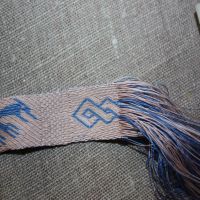
That lozenge pattern element is not a photograph, but a scan. So it should be to scale. But I pinned...
Guest - Katrin Sprang Discussion
15 September 2026
I was not referring to Rachel's reconstruction (is the reconstruction you refer to the one photograp...
Guest - Beatrix Sprang Discussion
14 September 2026
There is something Rachel did not mention. She told me: "Well, I worked with the measurements we too...
Guest - Katrin Sprang Discussion
14 September 2026
Well, this is certainly developing into an interesting discussion. Firstly, going from that lovely l...
APR
23
3

Sashiko, Boro, and Medieval Mending.


In Tuesday's Ask me Anything post, I got this question from Michaela:
I'm getting started on mending and darning all the little things that are usually done by my mom (as she's currently obviously not visiting). Coincidentally I came across the japanese tradition of sashiko and boro (visible mending on garments sometimes used over several generations) and wonder if there ever was a similar tradition in Europe?

I had to look up both sashiko and boro first - and I hope that I've gained enough of an understanding of my quick look at the wikipedia articles to properly answer the question. For those of you also not familiar with these Japanese textile traditions, sashiko is using running stitches to make embroidery motifs; this can be used as a kind of quilting to reinforce worn textiles, or to firmly attach a patch to a worn or damaged textile. Boro is a technique where patches of fabrics were sewn together to provide more warmth in a very poor and very cold area of Japan - here is a Japanese museum site with explanations and images.


Both these techniques, as far as I can gather, were born out of necessity and poverty. Mending clothes was something done everywhere and in every time period when the cost of the textile, or the garment, was high enough to make mending feel worthwhile. In some cases, mending was done to be as inconspicuous as possible, while in other cases, the higher priority was to fix it in some way so that it would be okay to use again, with optics playing a secondary or no part. Which kind of mending was done probably depended on many different factors, including the personality of the mender and the owner of the garment.

Mending things usually is associated with poverty - if you are rich, you can afford to have new, unworn and undamaged things, and thus no mending. While having mended stuff would probably have been the norm for most people during most of human history, this association did its part to lead to our modern culture of throw-away clothing, bought very cheaply and in poor quality, worn a few times and then ending up in a landfill, or getting burned in some wast combustion plant.

Today, mending is becoming more fashionable again, in a turn against wasteful consumer culture. This also means that visible mending is turning into a kind of fashion statement - including the aforementioned techniques of sashiko and boro.

So did we have these, or similar techniques, in the Middle Ages in Europe? Whether that is answered with a "yes" or a "no" partly depends on how you see the different aspects.

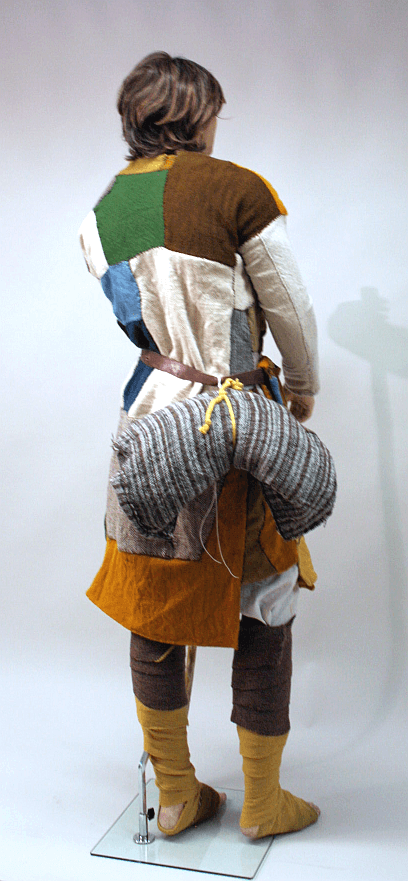
Firstly and most importantly, we did have a similar tradition in the widest sense - that garments and textiles were mended, re-used, and re-purposed; especially in poorer areas or by poorer people, who could not afford to buy shiny new things all the time. For the boro tradition, what comes to my mind first is the textile equipment of the Man from Bernuthsfeld, whose tunic was put together from many different patches of many different fabrics:

[caption id="attachment_3692" align="alignnone" width="273"] Reconstruction of the Bernuthsfeld tunic, made for the museum in Emden by Jens Klocke and myself.


However, this tunic is a special case - there's nothing else made in a similar fashion from the Middle Ages, as far as we know, and there is a lot of different speculations on why the man wore something like this.

There is a tradition in the European Middle Ages, though, that could be seen as a parallel to Japanese boro: Re-using the fabric of a garment to make something new out of it. This was done with garments that had a high value, either a tangible one (a very costly fabric) or an intangible one (something worn by a saint). Examples of these re-purposings are two Swedish altar frontals made from expensive garments that were donated to the church, or the Sixtus chasuble in Germany which was pieced together from another fabric, or St Birgitta's mantle in Sweden, which was made from what was a tunic or dress before.

There's also plenty of evidence for patches being sewn onto garments, sometimes in several layers, like in the underpants from Lengberg. Mending was not restricted to lower-class garments or less expensive fabrics either; for instance, the golden gown of Queen Margareta also has mends and patches. Off the top of my head, though, I don't know of patches reinforced with running stitches, or these stitchings being used as decoration.

So - I'd say that we had some aspects to mending traditions in Europe that could be considered similar to boro in Japan, but nothing that exactly or closely parallels the two Japanese techniques.


Read more about:

The Sixtus chasuble:
Worch, Maria Theresia. "Dokumentation zur Konservierung der Sixtuskasel." In Die Sixtuskasel in Vreden. Untersuchung und Restaurierung einer mittelalterlichen Gewandreliquie. Denkmalpflege und Forschung in Westfalen Bd. 35., edited by Elisabeth et al Jägers, S. 20-40. Bonn: Dr. Rudolf Habelt Verlag, 1997.

The altar frontals:
Nockert, Margareta. "Precious coats from the fifteenth century." In Opera Textilia Variorum Temporum. To honour Agnes Geijer on her ninetieth birthday 26th October 1988, edited by Margareta Nockert and Inger Estham, 111-20. Stockholm: Statens Historiska Museum, 1988.

The Bernuthsfeld man:
Farke, Heidemarie. "Der Männerkittel aus Bernuthsfeld. Beobachtungen während einer Restaurierung." In Textiles in European Archaeology. Report from the 6th NESAT Symposium, 7-11th May 1996 in Borås, edited by Lise Bender Jørgensen and Christina Rinaldo, 99-106. Göteborg, 1998.

St Birgitta's mantle:
Andersson, Aron, and Anne Marie Franzén. Birgittareliker inlånade till Historiska museets utställning "Birgitta och det Heliga landet" 30 november 1973-17 februari 1974. Vol. 59, Antikvariskt arkiv. Stockholm: Almqvist & Wiksell, 1975.

Margareta's Golden Gown:
Geijer, Agnes, Anne Marie Franzén, and Margareta Nockert. Drottning Margaretas gyllene kjortel i Uppsala domkyrka. Stockholm: Kungl. Vitterhets Historie och Antikvitets Akademien, 1994.
0
MAR
12
0

Choose Wisely!

After being happy about figuring out the setup and sequence for my twill tablet weaving demo for NESAT, using up the last of my playband, I set out to warp a new band. Logically, that band also needs two colours, ones that play well together as in "give good contrast".

Well. Let's say my brain was probably not fully online when I was making the new warp... I looked at the colours, thought "they look nice together", found that the two colours were rather different from each other, then thought for a split second "but they are both rather light..." and then proceeded to warp anyways.

Which was, in retrospective, not a good choice. That quickly became clear when weaving the first few picks.


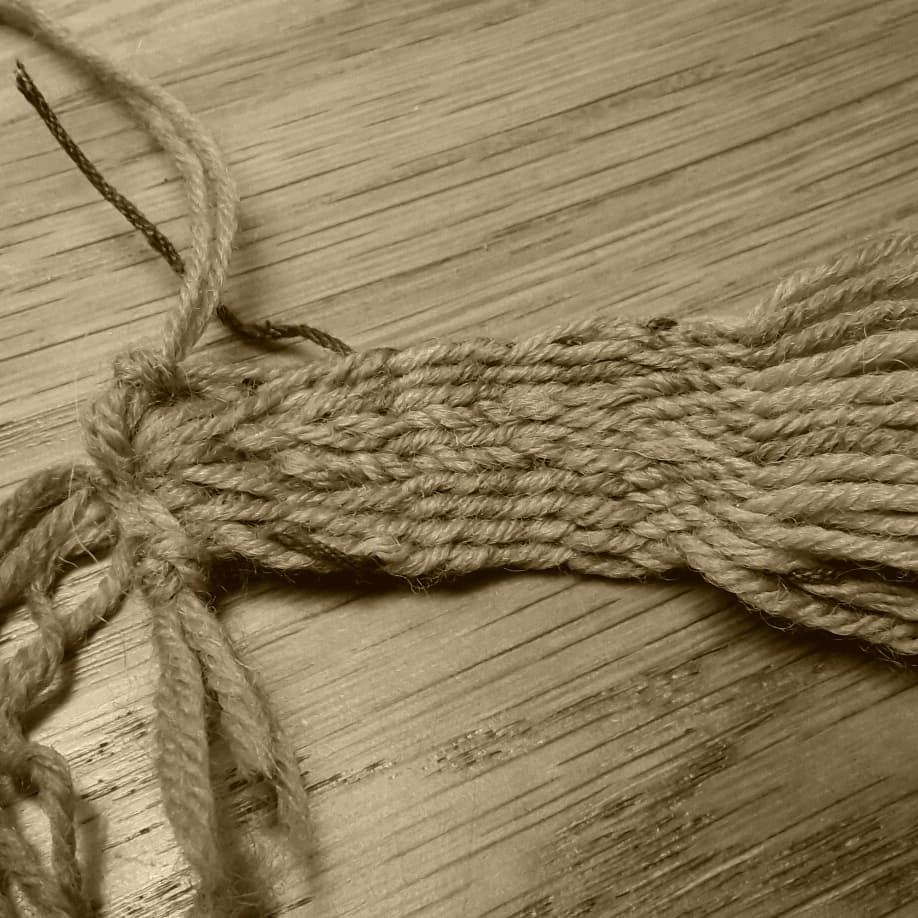
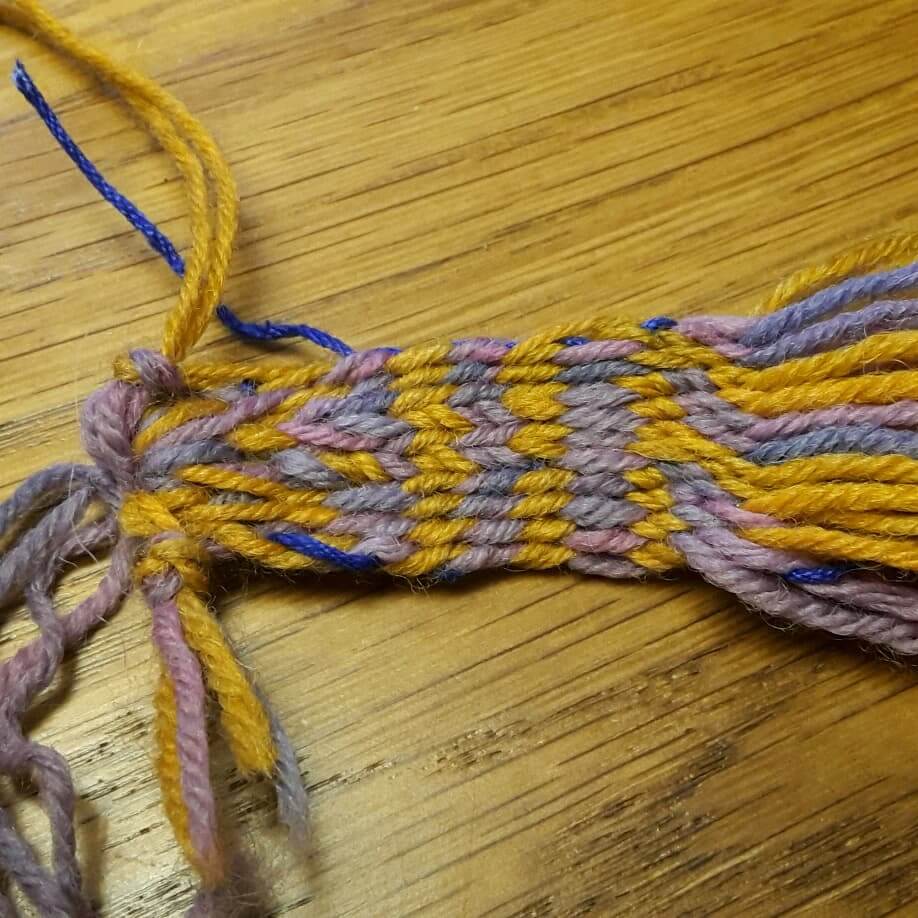
Yes, the two colours do look nice together. Yes, you can see the lines. However, contrast is not very high after all, and high contrast in every imaginable lighting (including not-so-good lighting) would be a very smart thing to have for a demo band.

The reason for the not-so-good contrast is the difference, or better the lack of difference, in the grey value of the colours... which becomes very obvious if you use one of the convenient quick filters that will turn your image into grey-scale or, in this case, because I like it, sepia:


Nice, isn't it? You can see the structure of the band, and you might be able to guess where one or the other colours are, because of teeny tiny differences in darkness - but then that might just be an effect of the slight irregularity of the colours.

So this warp is not what I need for my demo. But. The effect of "everything the same colour" is just what you get in so, so many cases of archaeological textile finds - which, of course, includes tablet weaves. In these bands, there's sometimes a hint of pattern weaving because of changes in twist direction in the band.

I've had this idea of trying out how a band with a few different pattern types would look if everything turned the same colour for a while now, and this oopsie warp now means I have something to do exactly that. It's just 10 tablets, and not very long, so it will not result in spectacular stuff, but I'm planning to do some "threaded-in patterns" using tablet threading direction and alignment, a bit of "4 forward, 4 back" patterning, and then some Egyptian Diagonals and twilly stuff to round things off. Make photos of the band in colour, turn them into sepia, and see.

I think this sounds like fun - it just remains to see when I'll find the time for said fun, as there is still the "real" NESAT demo prep work to do. (Also there's a queue of fun stuff waiting for their turn... which, yes, is a luxury problem.)
0
FEB
19
7

Warp Weighted Loom Thoughts.

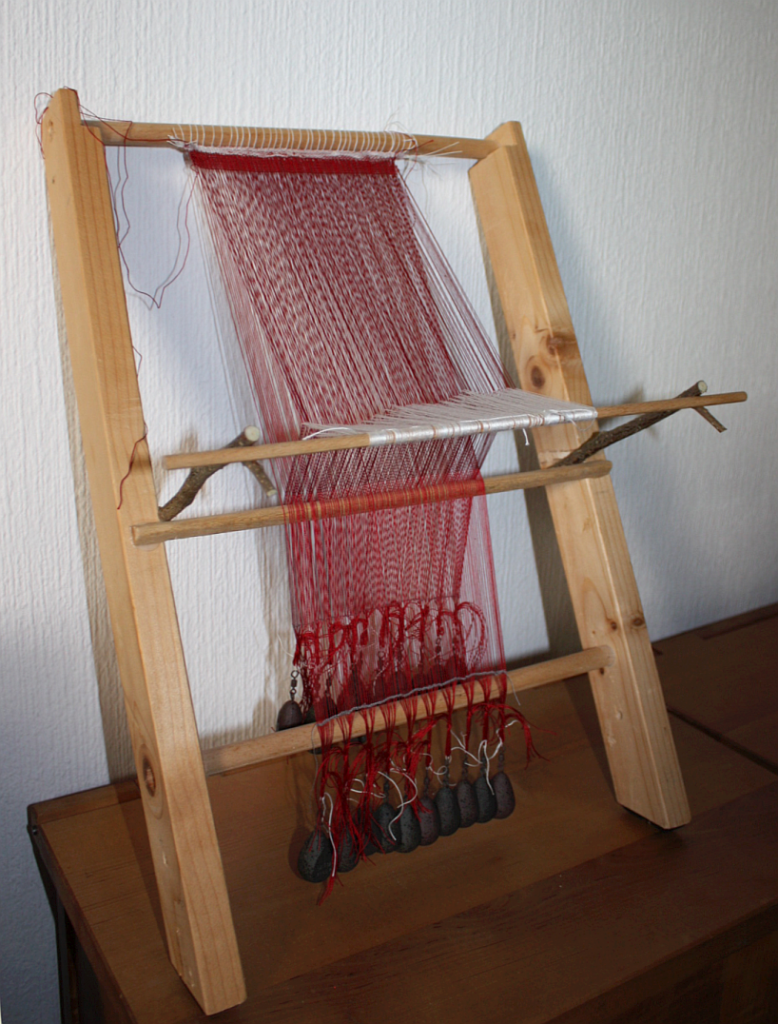
A long, long time ago, I made this little model of a warp-weighted loom, and after a few more years, I set it up again properly, trying to scale things down as well as possible.


The model has come in handy for a lot of occasions now - it's the perfect way to very quickly explain how a warp-weighted loom works, and much easier to transport than a full-size one. For weaving purposes, though... it is obviously not the most suitable thing.

For actual weaving on a warp-weighted loom, you need a full sized version. And due to some people putting a flea into my ear, I've been pondering the question of how to organise a loom-weaving workshop, in logistical terms. Because you'd obviously need a loom for every weaver...

Now, in my personal opinion, the weaving itself is not the crux in learning how to work with a warp-weighted loom. Yes, you can of course muck up things wielding the shuttle and beater - but according to my experience, the stage where the main decision happens on whether you will end up with thread salad or a proper fabric is the setting up of the loom. Which also happens to have a lot more steps, and a lot more varied tasks, than the actual weaving itself (which is, basically, change shed, beat, insert weft, repeat). So to learn the how-to, I would actually aim to teach setting up... followed by a bit of weaving.

Whether the one or the other, though, you still need a loom for every weaver. Preferably one that is a good, efficient tool which would be suitable for production weaving. Also relatively cheap and easy to make (even without a woodworking workshop and lots of tools), suitable for normal-sized women (a plus would be easy adaptability for body size), and with the option of making it free-standing (in case the workshop area does not have enough wall space). It should be possible to take it completely apart for storage or transport, preferably with no single piece longer than 2.2 m.

The most important measurement for me, at the moment, is a suitable and sensible depth of the natural and artificial shed. How deep does the shed have to be, in order to weave comfortably? At one point, it will be too shallow to pass the shuttle (or weft ball, or whatever) through. (Obviously, the wider the fabric, the more fiddly this might get.) Making the shed deeper than necessary, though, means that you have to pull your heddle stick out further than necessary each time, and that is not very efficient.

Mathematics say that the depth of shed and height of loom will dictate the angle of the loom, and thus how far its bottom will stick out from the wall, and thus how far forward you will have to lean to pull the heddle stick, and how long the rests will have to be for the artificial shed - so, basically, everything.

Which means that construction-wise, deciding on a smart depth of shed is the most important thing... which also means that if any weavers with experience on a warp-weighted loom are among you, please let me know about your thoughts - and your experiences with shed depths!
0
JAN
30
2

No end to the linen yarn.

I've finally managed to get the remaining two kinds of linen yarn into the shop system - a white one and a thicker beige one, both from organic Belgian linen. They've been wound and ready to go in for a while now, but I had not gotten around to writing the description and making the photos.

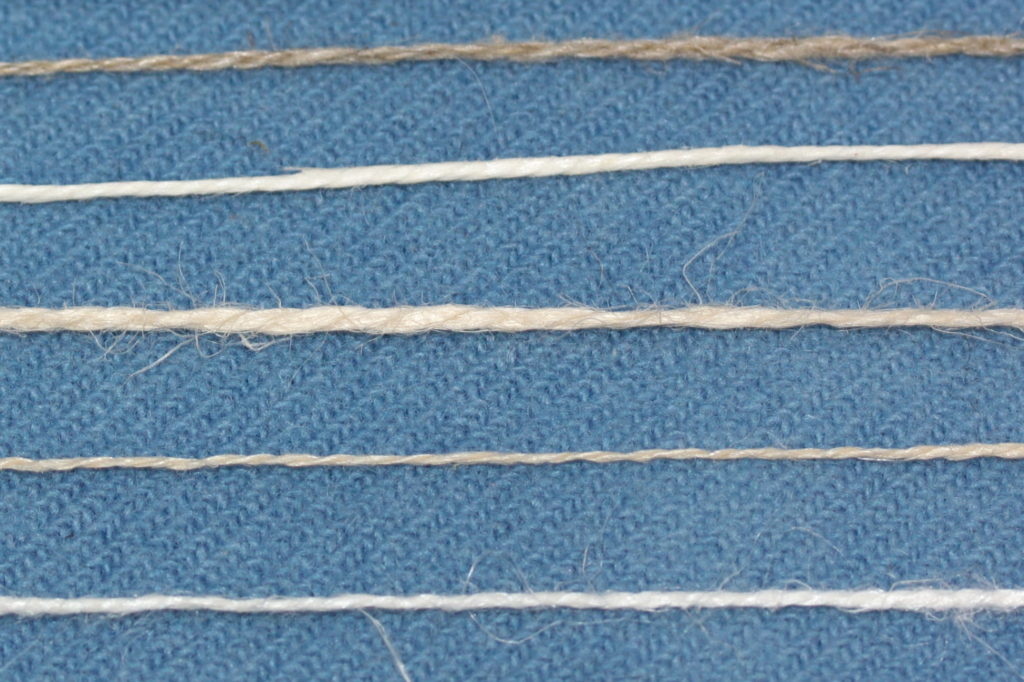
Which has both happened now - and I've taken the opportunity to do a comparison pic of all the thicker linen yarns in the shop, which looks like this:


From top to bottom, these are the thick linen yarn in unbleached and in white, the thick half-bleached organic yarn, the goldbeige yarn, and the white organic yarn. They are all Z-/ss yarns (which means they consist of two individual plies, both s-spun, plied together in Z direction), they are all strong, and especially the white organic yarn has a very nice, tight ply.

You can find them all in my shop in the yarn section, in case you now find yourself in need of some linen threads...
0
JAN
29
0

Samite, woven.

On my task list for the upcoming weekend is a presentation about medieval fabrics... and on my personal task list for this thing is "explain samite". Because I believe that, if you are interested in the fabrics used in the Middle Ages, you need to have at least a very basic understanding of what complex weaves are, as they were used for high-status garments throughout the High and Late Middle Ages.

There are very few people these days who still make medieval-style complex weaves, and one of them is Sylvia Wiechmann, who runs a weaving workshop in Munich. She made a reconstruction of a type of samite called "Kölner Borten" a while ago, and has a video on Youtube showing how they are made, and explaining the process. In German - but maybe watching it is still interesting for you even if you don't understand the text:


0
JAN
27
0

Fixed it.

Tax things and bookkeeping things are some of the details that I had never thought about before I suddenly became my own company, and then, when I had to deal with them, they were quite the scary thing for me. It became much better after a while, and with the discovery of a relatively easy-to-use, but still very professional, bookkeeping programme that does not cost an arm and a leg each year.

Meanwhile it has become more or less routine to do the bureaucracy stuff regularly. And then, every quarter year, I have to take care of tax stuff - one of the inevitable things when you have your own company (even if it's a tiny one). Which means I have to sit down and take care of the bookkeeping that has not yet been taken care of, make sure all the numbers tally up, and then file the report and send the money owed to the state.

Which, you guessed is, was part of the things I did today - and this time around, it included checking a stack of past entries to find the elusive mistake that had snuck in somewhere. I used to think that it's not hard to type off numbers correctly, especially not if you have a habit of double-checking them, but it turns out that at some places, I had clicked a wrong button (and I had actually mis-typed at another point, so the issue had to be fixed in more than one place).

So there you are - the exciting daily (or quarterly) things in my life! Though in this case, I prefer non-excitement quite a bit above this kind of interesting.

I am, now, very happy that I finally managed to find it, and that I have now fixed it, and consequently things feel much, much better. Since I discovered that the numbers must be amiss a few days ago, this has sort of irked me continuously - after all, mistakes in book-keeping are a Bad Thing (TM). Now my tax stuff can be finished and filed and sent off as it needs to, and I'll be a happy woman with nicely corresponding numbers again!
0
JAN
23
0

Lots of little dots today...

I'll be giving a workshop about brocading in tablet weaving next weekend, so today saw me drawing lots and lots of little dots - thankfully, using the computer and appropriate drawing software made this a lot easier. (The whole thing was also helped by the fact that we'll only be using 15 tablets. There's a lot less dots in 15 rows than in 55 or more!)

So we'll have a selection of nice simple patterns to use in the workshop, all nicked from actual historical bands - though I suspect that we'll not get down to the actual original size of many of these bands, which was in most cases (for around 13-17 tablets) at somewhere between 4 and 10 mm in width... rather tiny.

But then, the tinyness does help with the bands looking quite spectacular. There's a small band with a dragon-like motif in the Irish National Museum Dublin, for instance, that looks just like solid gold. It's tiny and has really thin threads, and I'd love to show you a photo of it, but alas, it's copyrighted... so I'll have to keep the blurry photograph that I have of it to myself. Sorry.
0

By accepting you will be accessing a service provided by a third-party external to https://pallia.net/

Contact