
Latest Comments

Guest - Katrin Sprang Discussion
18 September 2026
Hi Rachel, I have looked for more photos of you, but that was not very successful. I found a link on...
Guest - Beatrix Sprang Discussion
15 September 2026
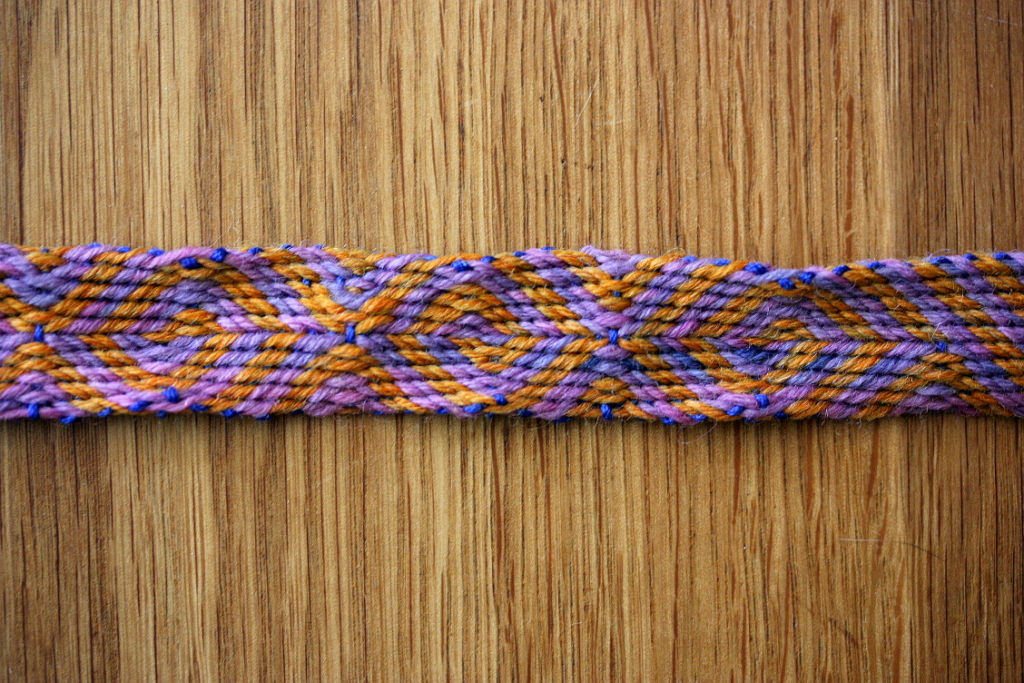
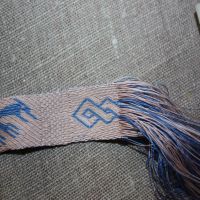
That lozenge pattern element is not a photograph, but a scan. So it should be to scale. But I pinned...
Guest - Katrin Sprang Discussion
15 September 2026
I was not referring to Rachel's reconstruction (is the reconstruction you refer to the one photograp...
Guest - Beatrix Sprang Discussion
14 September 2026
There is something Rachel did not mention. She told me: "Well, I worked with the measurements we too...
Guest - Katrin Sprang Discussion
14 September 2026
Well, this is certainly developing into an interesting discussion. Firstly, going from that lovely l...
JUL
01
0

Phew. Back online.

The shop is back online, after a short break overnight to implement the change in VAT rate that is in effect here in Germany starting today.

I think the change was one of these ideas that are well-meant and sound really good at first, but are not as brilliant on a second, closer look. For me, it was rather easy to implement, with a smallish shop and a decision on how to handle it that makes things much easier for me. Changing the tax rate was, in my case, quick and easy to do. The prices, though, will remain the same, as the shop fixes the brutto price (including the tax). As I have both things with reduced tax rate in the shop as well as normal rate things, and the printed matter is partly bound to the price (there's a German book price law, which means a new book will cost the same no matter where you buy it, and the price is fixed by the publishing house), I can't just slap a general discount on.

My solution is to offer a discount code - you can enter this in the appropriate field shown on the shopping basket page - and you'll get the price reduction on all the eligible items. (Or you can just pay the full price, if you want me to have a bit more revenue from your purchases, which will also be welcome.)

Other vendors have not had it this easy, though. Especially if you have an automatic cashier desk or similar things, I've heard that things could be very complicated, and nerve-wracking. In quite a few branches of trade, there's a lot of confusion on how to handle this, and whether it's better to pass on the reduction to the customer, or to keep the little extra revenue. It should be clear in gastronomics (which was, I think, the primary reason for the VAT rate reduction), but in other businesses, I wonder if the extra amount of work and hassle will really be worth it. It's extra-complicated in the book trade, due to the fixed-price law!

Just like in so many other circumstances, only time will tell whether this stunt will actually do something for German economy. In the meantime, you can enjoy the discount and with it the accompanying "krumme Preise", as we say in German - non-round, slightly weird numbers for the prices.

And that's it for the current behind-the-scenes report...
0
JUN
25
1

More About the Dublin Knife.

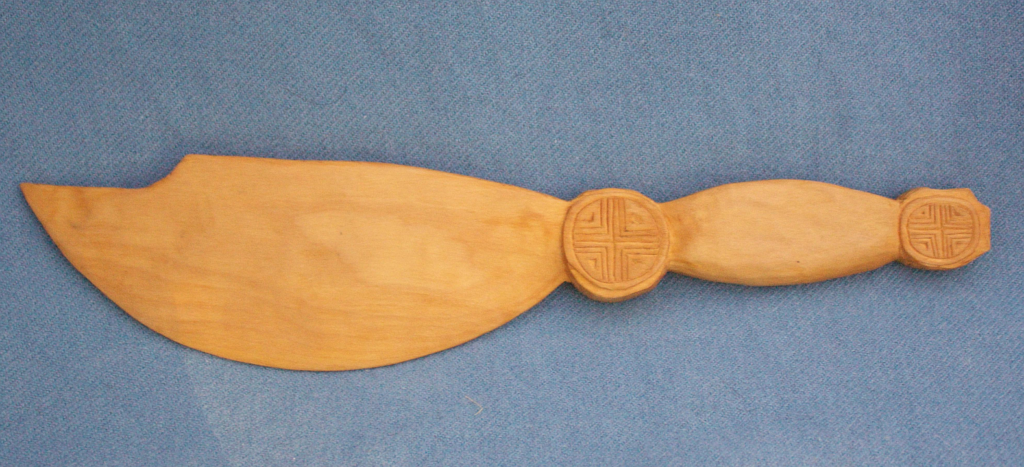
Since the question came up - here's some more about the weaving knife from Dublin.

The information I have about is is from a single book:
James T. Lang et al: Viking Age Decorated Wood: A Study of Its Ornament and Style (Medieval Dublin Excavations, 1962-81: Series B, Band 1). 
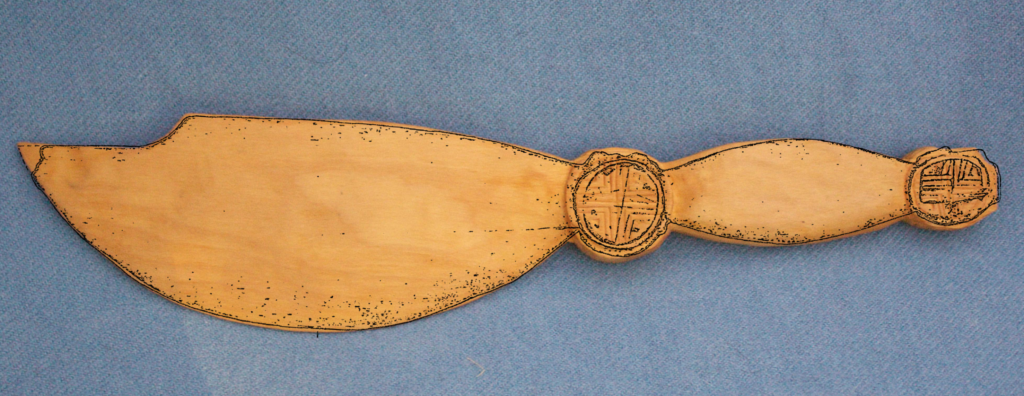
The knife has the catalogue number DW80 and the additional number (1887:143). It was found near Christ Church Cathedral in unknown context. Length ist 26.7 cm, depth 5.8 cm, thickness 1.3 cm. The original has lost its blade tip (it's broken off), so how exactly the blade ended is conjecture. There is no information about the kind of wood used for the knife.

Here's the knife I have, which was replicated by a friend, complete with the carvings:


And here's the same photo, with the archaeological drawing from Viking Age Decorated Wood, p. 77, as an overlay:


As you can see, it's definitely a very good match (and you can also see the conjectured blade tip).

I haven't been able to find out more about the knife. Apparently, the excavation took place in 1972-1976, and it has not been published completely yet. Finds from the excavation date from the tenth to the early fourteenth century, with most of the evidence from the mid-tenth to the twelfth century. You can find out a little more about the excavation on this website from the Irish Heritage Council.

There is a second smaller knife that was found at Fishamble street, which has a similar overall form, including the cutout on the blade back at the tip. It was on display in the National Museum in Dublin, at least a few years ago; unfortunately, the museum has no online catalogue.

Though it is listed as "weaving knife" in the book, there has been quite a bit of discussion on whether it is one or not, and if yes, for what kind of weaving it was used. The shape especially seems to have caused doubts about its usefulness.

From my own experience working with it, I can only say: I love it. It's very useful for both pressing in the weft (with lots of fine control due to the curved blade), and the tip is handy for clearing the shed, picking out individual threads for checking, it can be used to create a brocading shed, and I also find it very useful when weaving back to undo mistakes. You can read more about my personal experience using it in this post here.
0
JUN
17
0

Looking the Dog in the Eye.

The eye, the nose, the neck. Ah well.


First, let me tell you about the main difference, for me, in weaving ass-first versus nose-first: When starting with the nose, I will very easily end up with a baboon ass on the dog because of getting the timing of leg slope start and back slope start not quite right. When starting with the tail, I have a high probability of ending up with a too-thick neck because of somehow fuddling things up in the middle, and then getting the timing for the neck not quite right. I suspect that if woven cleanly, the thick-neck-problem might evaporate. (It's on my list to manage that the next time.)

The nose area, however, is a different beast.

[caption id="attachment_5364" align="alignnone" width="328"] Photo from UNIMUS.no


[caption id="attachment_5365" align="alignnone" width="441"] Photo from UNIMUS.no


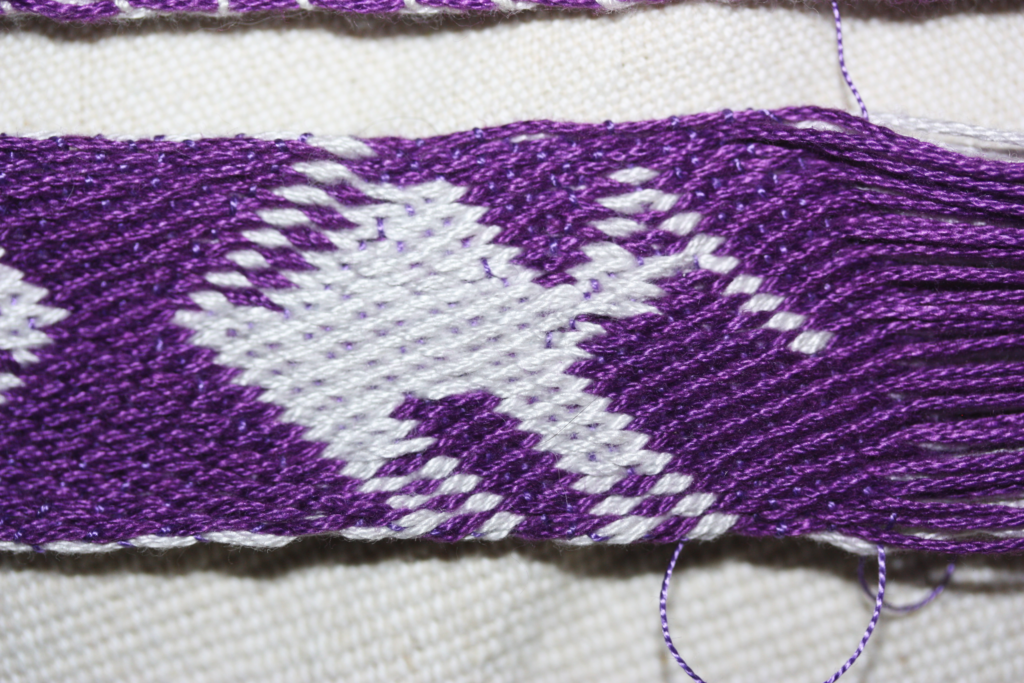
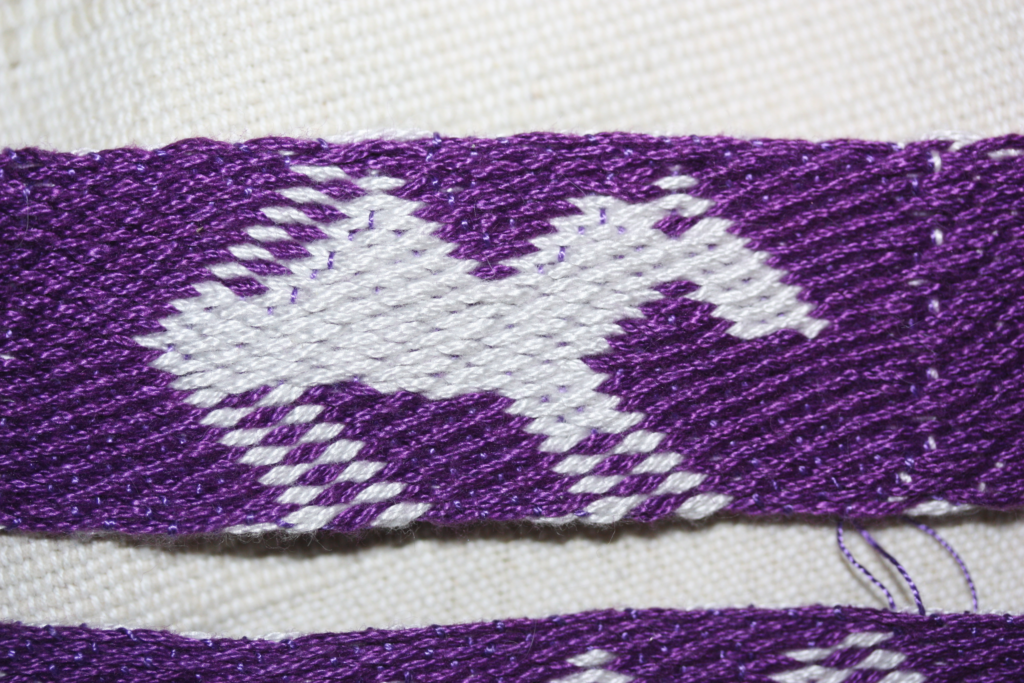
If you compare the look of the back of the band in the tail and leg region, you can see that there is a characteristic look of broken narrow lines - that's the back of the regular diagonals structure, which is exactly what we have on the front for a while: white, purple, white, purple.


The noses on my dogs are all one of these regular stripes as well - white, purple, white; a single (two-thread) line on top of the band, and the regular broken line on the back. Except in the very first dog, where I did a wide nose.


Now, the rules of normal twill dictate that a line you "draw" on the background is either one line (two thread's worth) wide, or three lines (in order to go out with a nice clean line again). Three lines because you have, in the diagonal base setup, a white line coming out of the twill, then your pattern dark line, a light line, a dark line, and then a white line going back into twill again. For a wider line, you cover up the light between the two dark lines by change of tablet turn direction, but you still have to weave into the regular dark line to get a clean shape. So. Two or six is the choice you have.

The original animal's nose is wider than a single line (of two threads) and much more narrow than a regular wide line, though, and that is technically not possible without doing Strange Things (TM).

I suspect the sneaky and ingenious use of some double-turns here, to get the effect. I'm not sure yet how and where they need to get started, though. This is one of the cases where I'll actually sit down with pen and paper and start drafting this to see where lines meet normally, and where lines have to start, or change, to get the desired effect.

And then I can see another dog-weaving stint in my future...

(By the way, in case it interests you: If I don't make silly mistakes and have to weave back, weaving a doggie takes me about one and a half hours. Do try this at home, but not late in the evening when tired, especially not late in the evening when tired plus distracted by other stuff going on in the room that you feel the need to participate in while making silly mistakes in your weaving.)
0
JUN
16
2

The Return of the Evebø Dog.

The Evebø band... oh, source of joy and questions. For me, at least.

The Evebø band is a find from Norway and dated to the 6th century; it's a tablet-woven band with twill technique patterning, and very good, very detailed pictures of the band can be found at the Fotoportalen Unimus. Including, to my great joy and delight, photos of the back of the band... because, as simple as the band might look at first glance, there are some strange things happening with the animal that might be a dog (though the Most Patient Husband of Them All says it looks more like an ant-eater to him, and I sort of agree).

[caption id="attachment_5364" align="alignnone" width="368"] Photo from UNIMUS.no


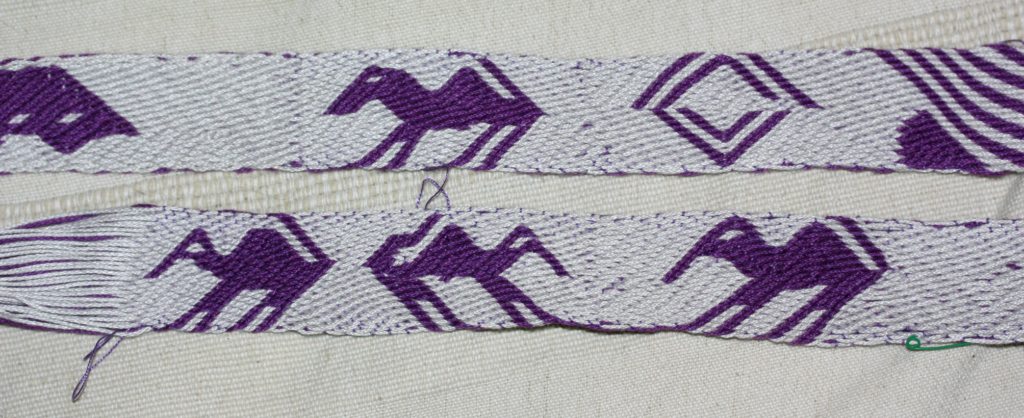
The original band happens to have a 20 tablet pattern zone, which coincidentally is the width of one of my playbands... so of course, at some point, I had to weave the Evebø ant-eater doggie. And as we all know, dogs are pack animals.

So. Let me introduce you to my Evebø dog collection:


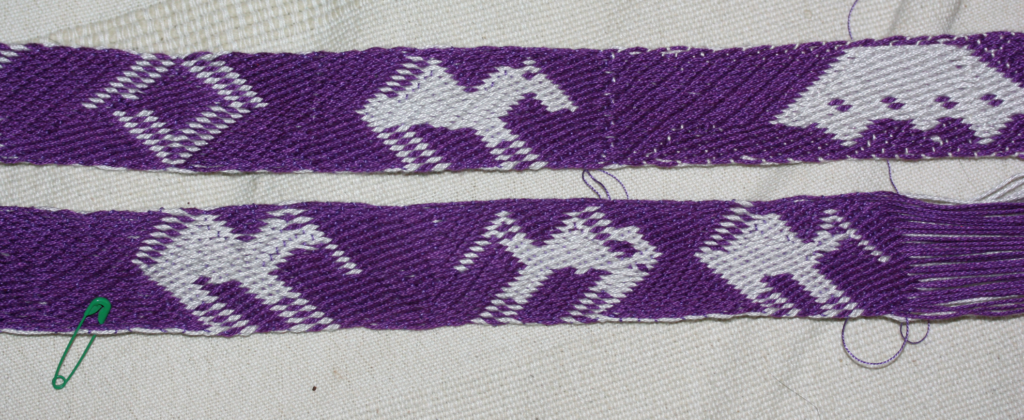
The first one, in the upper band part on the image, was woven starting from the nose, after just a sketch of the original animal. Though I was sort of aiming to reproduce it, I wasn't going for the "have to match it exactly" approach, but more for the general direction. As you can see, it has a wider nose than the original, a much thicker neck, and a baboon butt.

The rest followed a considerable amount of time later - they grow younger from right to left. First (rightmost) was woven from the tail onwards; then, because the first one had been so long ago and that made it hard to compare what the differences were, I did another one starting from the nose (you can easily tell that by the baboon butt). Finally, I did a third one, trying to a) weave less mistakes than in the first ass-starter, and b) matching it as closely as possible to the original. Which was... well... not completely successful in both cases. As you can see mostly in the chin and nose area. Sigh.

If you compare my versions with the original, you can find quite a few differences (even disregarding the baboon butt versions, and just looking at the ass-first doggies). A small thing is the forelegs not having the split further down than the hind legs in one case - though that is just a question of me not paying enough attention to where the split was supposed to come, and not a technical issue.

The really interesting differences, though, are in the neck, eye, and nose area... can you spot them?
0
JUN
02
5

Disappearing Patterns.

Addition to clarify things, June 4 2020:

Silvia very correctly points out in the comments that she knows of no tablet-woven bands that appear in just one colour, but have a twist direction turn pattern that points to an original patterning. This is true - I don't know of any either (though my overview is not as good, or current, as Silvia's).
Knowing a little bit about how many textile finds are not published, and how decisions are made on what to publish with the very limited time and resources available... my suspicion is that at least a few bands exist that lie somewhere in an archive or a freezer, which would carry a hint of original patterning in form of twist direction changes. Or none at all, if the pattern was formed while only turning the tablets in one direction. They are, however, too unspectacular to be looked at in detail, or published. The same is probably true for bands that still do have a visible (maybe just faintly visible) simple pattern. Since tablet-woven patterns come out best when contrast is high, the chance of the pattern staying visible even in discoloured bands is relatively high.
So - I am not trying to say that there are lots of simple bands published who originally had a colour pattern, which has disappeared now. I'm trying to point out that there is a possibility of simple patterned bands discolouring in a way that would make it harder or impossible to see what the original pattern was. How likely that is, exactly, and how many of these might be in archives or storage boxes, is another very interesting question, but unfortunately not one I'm able to answer. I just think it's something worth to be aware of.

End of addition.

 
A while ago, I botched when setting up a warp for a tablet weaving demo band - I took two colours I liked, held the balls of yarn next to each other, went "yeah, that looks good", and warped the band in a setup for diagonals or twill.

Just to find, a few wefts in, that the contrast wasn't as good as I had thought it to be. A quick check, and yes - the grey value of the two colours is identical. So while the pattern is visible in normal lighting, the contrast isn't high enough to use this as a demo band for showing how to weave twill.

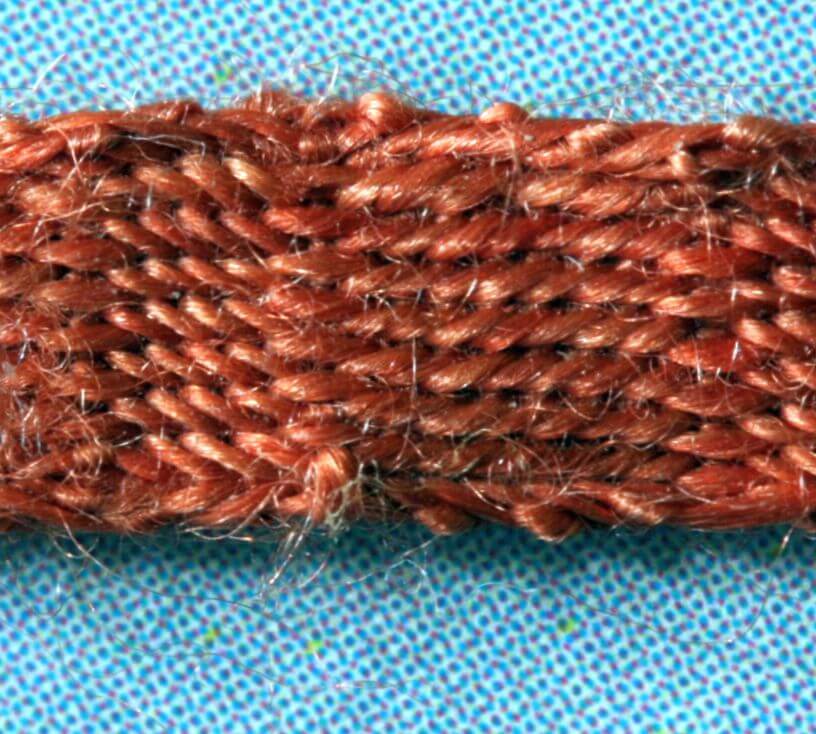
It is, however, perfect to show something else: What can happen to a tablet-woven band when it's buried in the soil for a few hundred years and turns all brown all over. Because then, all you might be able to see is that there must have been a pattern of some kind.

Case in point?
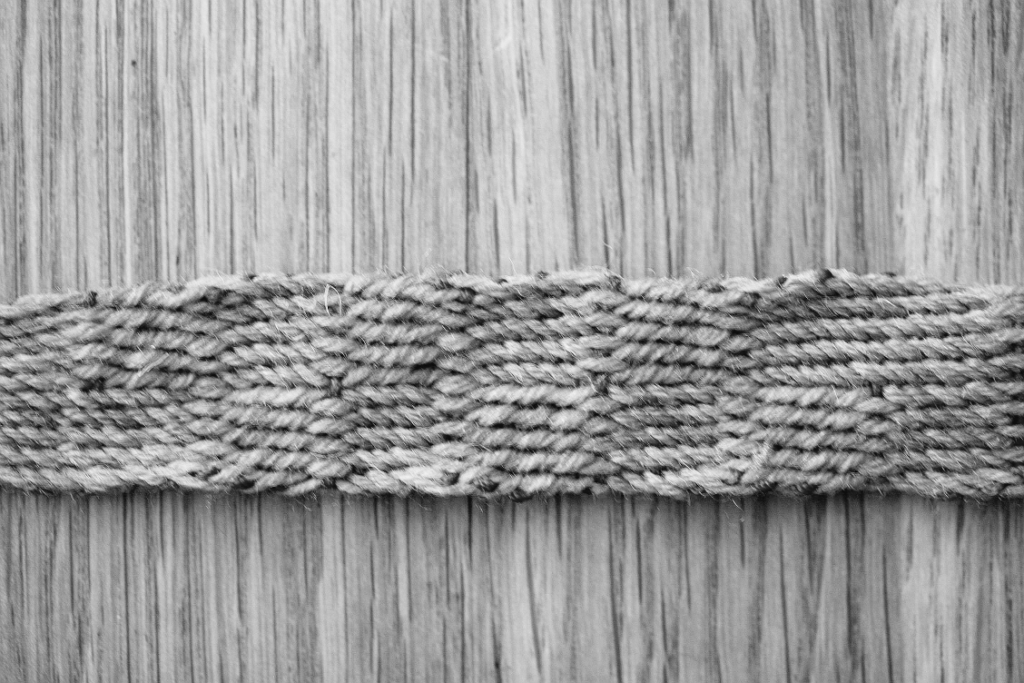
Let's take one of the most simple patterns you can weave with a diagonals setup: diamonds. It looks like this on my band:


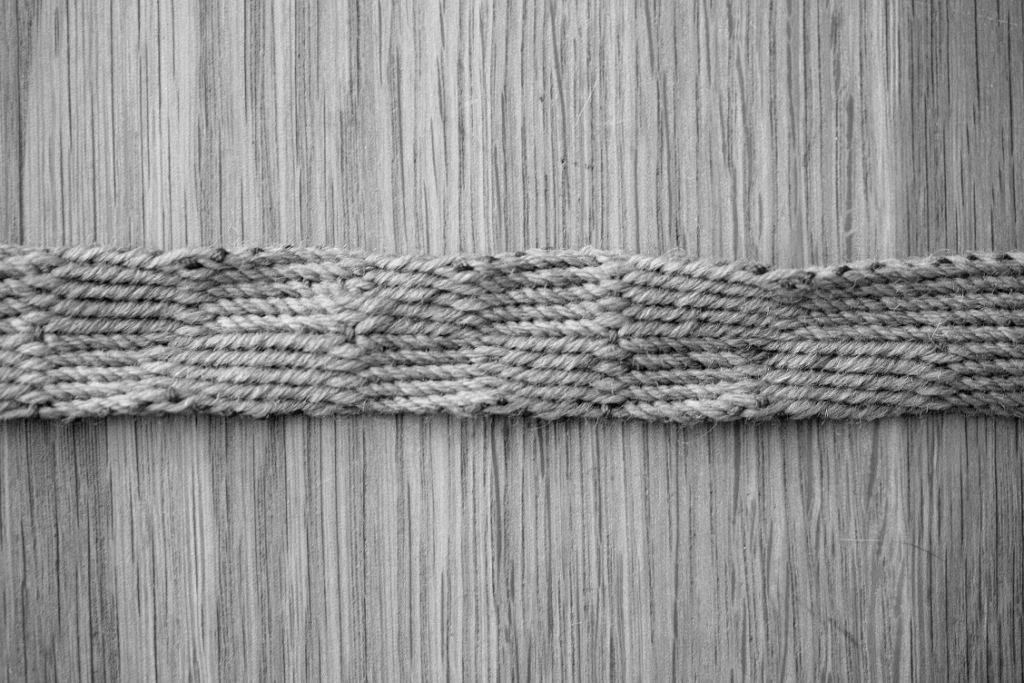
Now let's put it into virtual soil to turn all brown - or, in this case, convert the picture to greyscale.


You can see the turning points across the whole band, coming in at more or less regular intervals - so you can assume that some pattern must have been happening here. You won't be able to tell which one, though.

Let's spice it up a bit. Imagine you're the archaeologist and find this:

[caption id="attachment_5317" align="alignnone" width="640"] Click on this link to find out.


Are you able to guess what it looks like in colour? Click on the link to find out.

So there we are. A band like this would probably not get published prominently - and I think that we might have found many more simple patterned bands in the Middle Ages than our finds show today. No metal (as in the brocaded bands) will mean worse chances at surviving in the soil, and small bits and pieces of uniformly coloured bands will give scant hints at the patterns that might once have been visible...
0
MAY
06
0

Twist matters.

Things I learned in the past days:
  1. Filming a video presentation of something makes me extra-super-duper nervous. Part of this is the thought in the back of my mind that every "erm..." and every silly facial expression and every little imperfection in speech will be recorded and thus preserved FOREVER, and thus I should be absolutely perfect, and that is hard to do.
  2. Writing subtitles in English underneath a German spoken text is hard, not only because I can (duh) talk much faster than I can type. There's also the temptation to deviate (too) much from the things I actually say, to make it more clearer to the reader, or to cram more info into the text... which I as a viewer would find confusing, and not ideal.
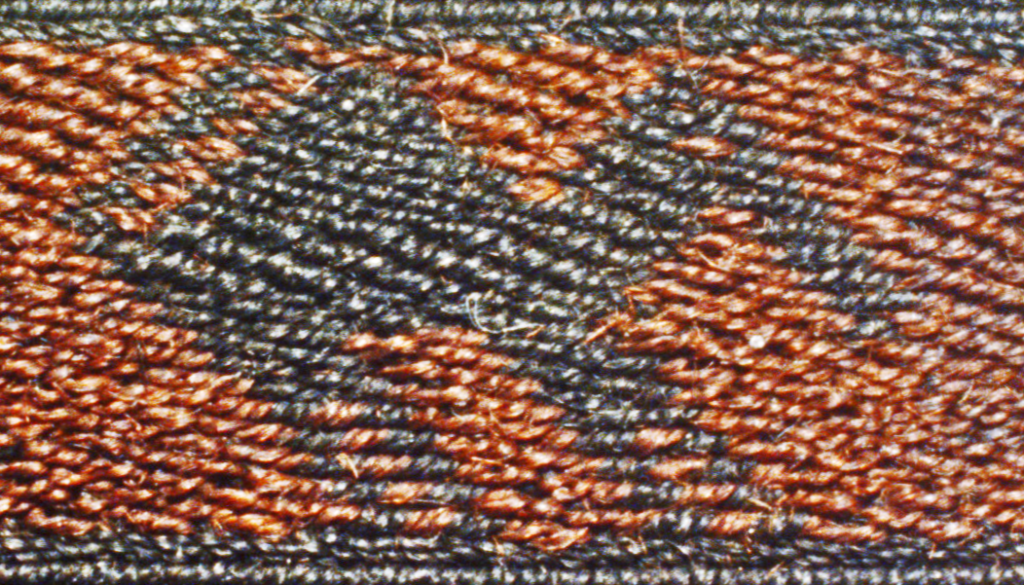
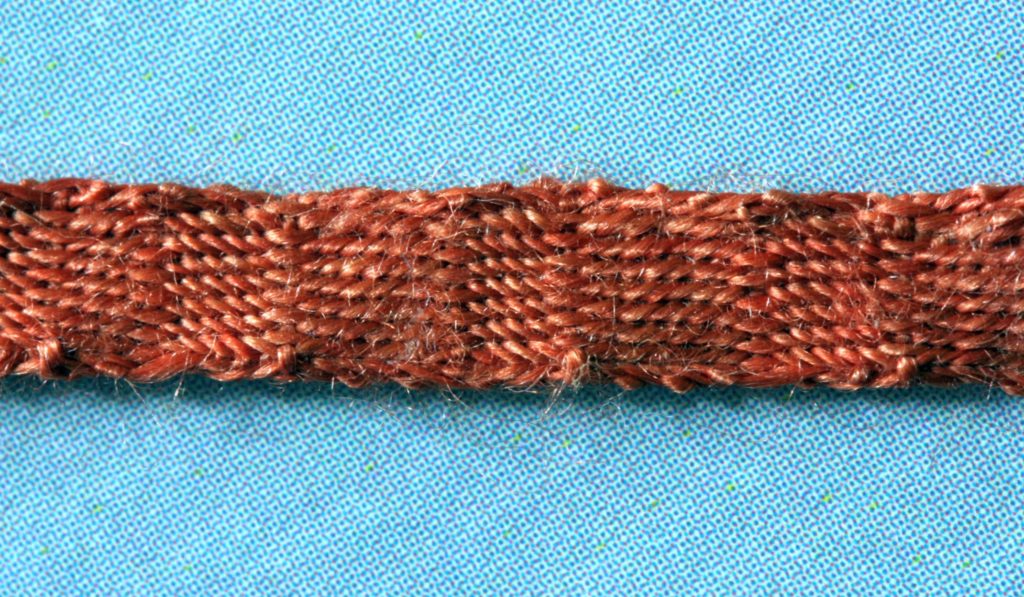
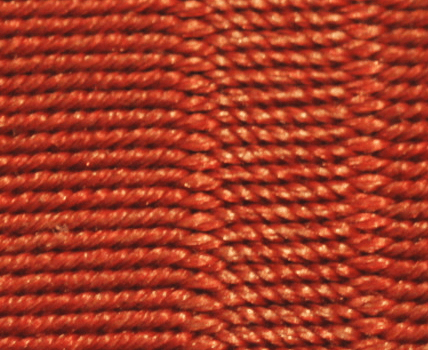
  3. There was very, very, very little twist in the threads used to weave the Albecunde belt. My tests done with my (only very slightly twisted) embroidery silk look like this:


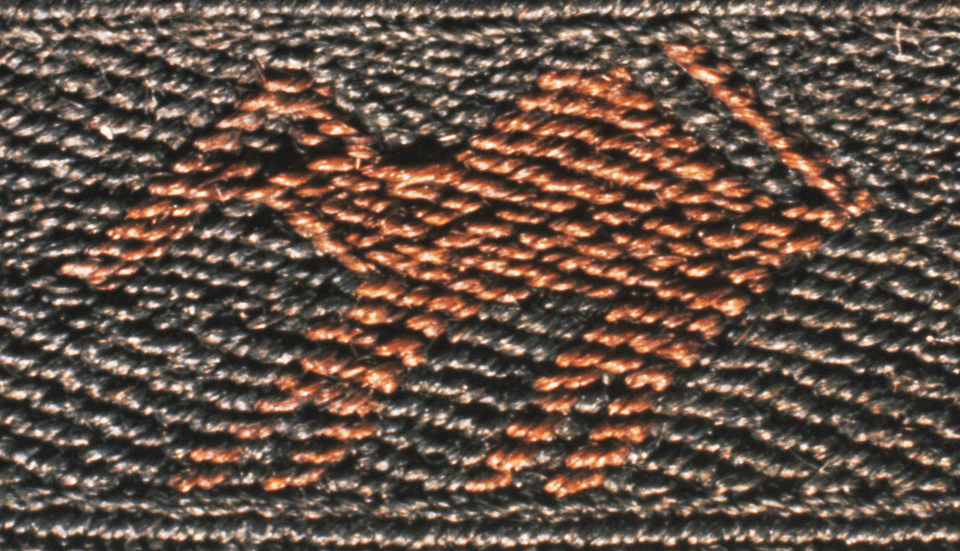
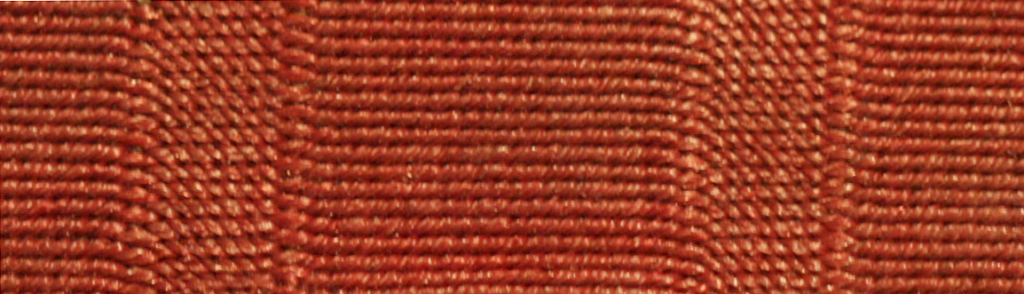
While the original belt looks like this:


You cannot see the pattern as clearly on my test piece as you can on the original - it looks very pronouncedly diagonally structured in one twist direction, but more like a mushy solid surface in the other. On the original, there's a diagonal structure visible in both directions, and it's only a very little more pronounced in one compared to the other.

Here's closeups to make things even more clear:


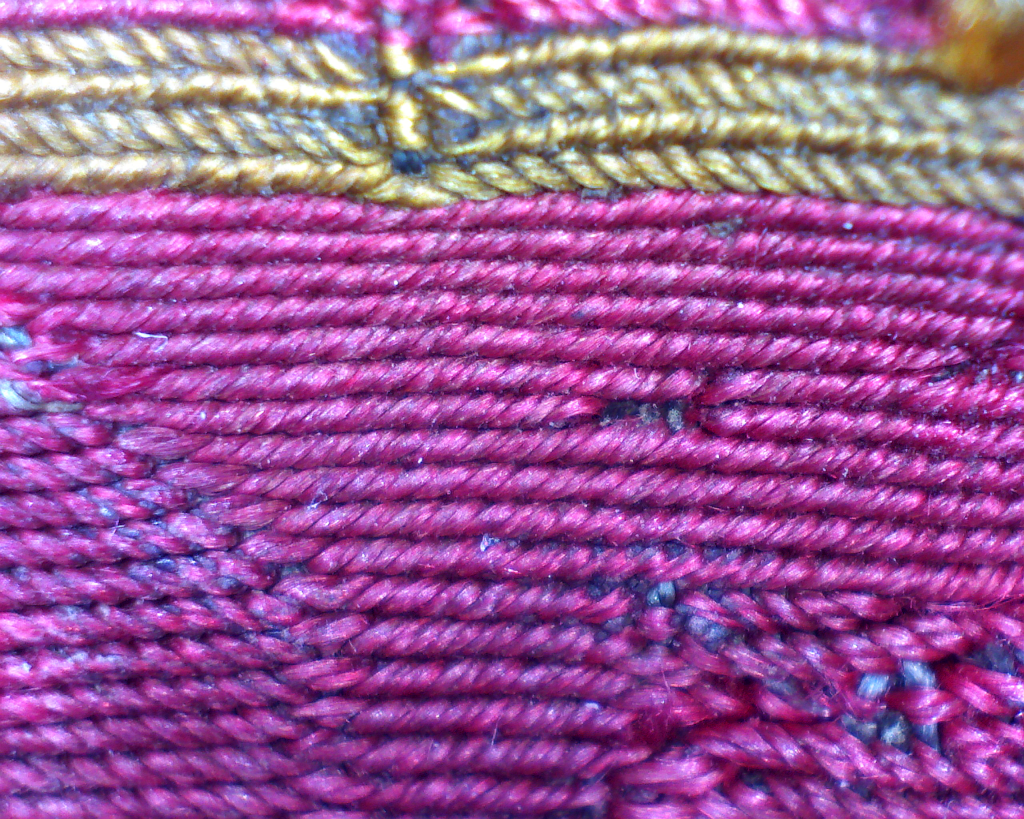
You can see that the diagonals with an S-slant are much more defined than those with a Z-slant. That's because my thread is slightly s-twisted. It's not much, but enough to make quite a visible difference in the outcome; enough of the z-twist the tablets introduce is levelled out by the yarn twist to show. The twist is visible, if you look closely, in the areas where I changed tablet twist direction.


This is a detail, closeup, of the original. Here, too, you can observe the individual thread twist in the places where tablet turn direction changes - but it is so slight that it's almost impossible to detect. The best indication of it being a hint of an s-twist is that the S-cords in the tablet weave are a little bit more defined than the Z-cords.

Here's a microscope picture, going even closer to the threads:


This shows how important even a little bit more or less of twist can be when you are weaving a pattern that relies, for its effect, exclusively on the shine and the light refraction of the silk used - and how much knowledge and skill went into this band.

You can hear more about the Albecunde band on Sunday in the presentation at Virtual Lauresham (and see my video thingie...)!

Thank you to the Diözesanmuseum Augsburg for letting us study the belt in detail for our reconstruction project!
0
MAY
04
4

Oillight Stuff.

I've recently started to bake bread again (I blame one of our friends, who reminded me of the joys of sourdough), and if you bake traditional sourdough bread, the dough needs to hang out in a warm enough place for quite some time.

The typical hack for this is to put the dough in its covered bowl into the oven and turn on the oven light - just the lamp; this puts out enough heat to warm the inside of the oven to about 30° C if you leave the door open a bit. However, our oven is a shiny new-fangled thing with a light that goes out after about 15 seconds... so I needed another way to gently heat it up.

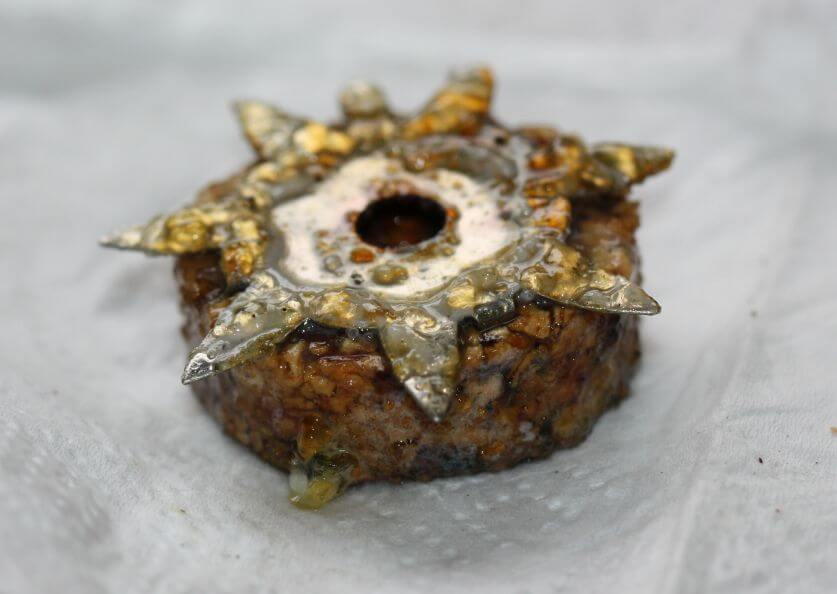
The solution? A candle or, in my case, an oil light. There was a bit of trouble at first, though, as the light went out after a short while - and it took me a little time to discover the reason. Which was... old oil on the swimmer.


When I sell these, I usually tell my customers that if they are not using the light for a while, it's a good idea to take the swimmer out and give it a good rinse to clean it, then dry it.

Very obviously I'm not always taking my own advice... this swimmer has been in use for a rather long time, with breaks inbetween uses where I sometimes took it out and rinsed it  and sometimes not. Over all this time, a good layer of gummified oil has accumulated both on the metal bit and on the cork.

That is, unfortunately, not just an optical issue - the gummified oil warms up when the light is burning, and then seems to get just liquid enough to get into the wick, blocking it up. Which means that the wick cannot get enough oil through anymore, and the flame goes out.

So - should you have an oil light that does not work properly anymore, check it for gummified oil; clean it if necessary (hot water and soda, and a good long soak in there, will help), or get a replacement swimmer.
0

By accepting you will be accessing a service provided by a third-party external to https://pallia.net/

Contact