

Latest Comments

Guest - Katrin Sprang Discussion
18 September 2026
Hi Rachel, I have looked for more photos of you, but that was not very successful. I found a link on...
Guest - Beatrix Sprang Discussion
15 September 2026
That lozenge pattern element is not a photograph, but a scan. So it should be to scale. But I pinned...
Guest - Katrin Sprang Discussion
15 September 2026
I was not referring to Rachel's reconstruction (is the reconstruction you refer to the one photograp...
Guest - Beatrix Sprang Discussion
14 September 2026
There is something Rachel did not mention. She told me: "Well, I worked with the measurements we too...
Guest - Katrin Sprang Discussion
14 September 2026
Well, this is certainly developing into an interesting discussion. Firstly, going from that lovely l...
SEP
15
0

Layered Clothes.

Layered clothing is a thing in the late Middle Ages. There's been layers before, obviously, and there are passages in the Nibelungenlied that point towards some of the additional layer garments (like a cloak) being not strictly optional bad-weather garments for someone like a queen, or very high-ranking woman. 

But this is the first image that I have seen which very clearly shows two doublet-type garments worn on top of each other: 
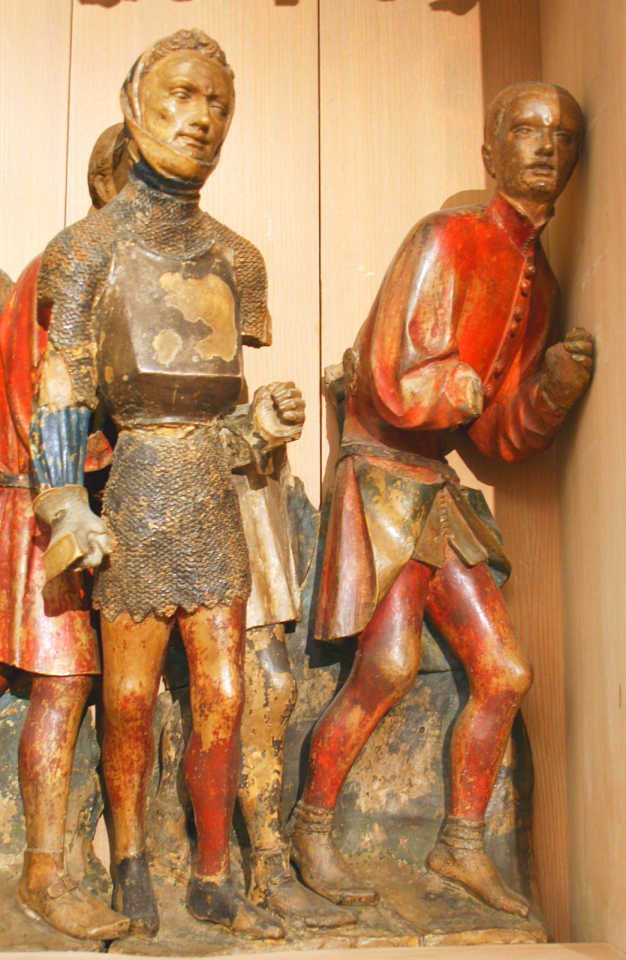
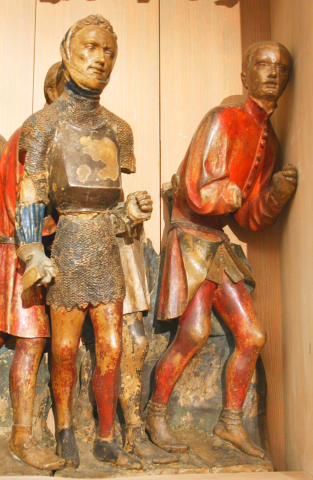
Lorcher Kreuztragung from St. Martin, Lorch am Rhein. Mittelrhein, probably Mainz, um 1425. Fired clay, old colouring. Bode-Museum Berlin, Skulpturensammlung Inv.Nr. 8499. Photo Katrin Kania.

This is a detail from a "Carrying the Cross" scene in the Bode Museum, Berlin, dated to c 1425. You can find the full piece and the corresponding database information here in the Berlin Museums Database.

The man on the far right is clearly wearing long hose or joined hose, and he is also wearing a doublet-like garment with button closure in the front that goes down to very shortly above his knees. Interestingly, the front is unbuttoned up to his belt, and the corners of the garment tucked into the belt. This reveals a shorter doublet-like garment, laced close. The guy to his proper right is wearing comparatively boring ringmail and a breastplate, and something under the ringmail which might have a sleeve that forms soft vertical folds, or the vertical lines might indicate some kind of padding and quilting (the garment from Chartres also has vertical quilting lines down the sleeves).

This is certainly... interesting. Very interesting. If these garment types were layered here, is that a common occurrence? Would something like the Chartres garment have been worn over a second doublet-style garment, then a ringmail? There are rust spots on the lining of the Chartres doublet which point to something metallic having been in contact with it. 

Only a shirt underneath the ringmail is theoretically possible, but might not be the most comfortable arrangement. We do have some few examples of laced-closed doublets that were definitely worn under armour (see for instance this article, and sorry for the paywall). So - how many of the pieces we see on late medieval paintings were worn solo? How many were worn over a second layer of armour, be it textile, metal, or both? 

It also adds some more interesting aspects to the Oswald reconstruction. Though due to time and budget restraints, I don't see a full ensemble of two doublets and the ringmail come about... 

If you should have seen anything similar somewhere, please do let me know! I am still all excited about this discovery and would love to know if there's more...

0
SEP
14
0

More Sprang Cap Questions...

All the discussions about size, fit, and how to wear a sprang cap aside - one of the interesting side track things that I have realised is that there seems to be a rather narrow selection of who is shown wearing these caps, and in what context.

In their article "Enigmatic Beauty", the authors have a list of fourteen examples of headwear with sprang or net inserts. Some of these are shown as re-drawings in the article, some are only listed (for instance there are several occurrences in the Schatzbehalter from Heidelberg University). Interestingly, there seem to be almost only midwives, executioners, and to a smaller extent servants who are wearing these caps.

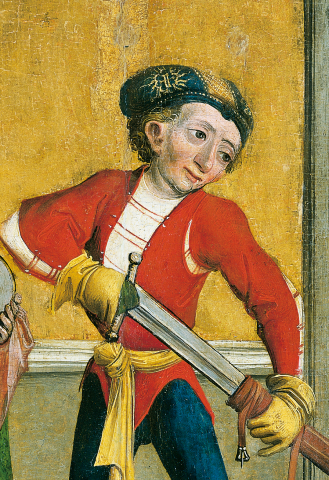
Detail from the Decaptitation of John the Baptist, by the Master of the Eggenburg Altar, 1450. Städel Museum Frankfurt am Main, Inv.Nr. 1621. Full image and detailed information available here: https://www.staedelmuseum.de/go/ds/1621

That is one of the additional instances I could find - and, again, we see an executioner.

So the logically following question is... why do we have the caps in these rather selected circumstances, and, at least as far as I can tell, rarely anywhere else?

Executioners are a sort of special person, as they are doing work that is considered dishonest. Yet they are still needed - and as a lot of saints get to be executed in some way, they are frequently depicted. Usually, they are wearing up-to-date fashionable garments, but they are also not the most positive characters. So are they wearing the caps in the images because they did so in real life? Or was it some kind of slander? Unfortunately, I regret sometimes these days that I didn't catch more background knowledge about art history, which would be helpful in things like that - but the executioners and sometimes some (male) servant wearing a cap like this does not point towards a high status, at least not as a piece of menswear.

If we look at the women, the scene where there's most of the depictions is the Birth of Mary. Here, we have a clearly domestic scene. Mary is on the bed, there's usually someone in the background doing something in the kitchen, and there are one or several other woman assisting with the birth and the newborn child. Notably someone usually identified as midwife - and that woman, sometimes wearing an apron, sometimes not, has this cap on her head - while Anna, the new mother, and the other assisting women usually wear a headcloth, or sometimes nothing (maybe signifying an unmarried status). Sometimes, the midwife has her sleeves drawn up, or wears a sleeveless dress (sleeves removed?) and her shirtsleeves are visible. 

To me, this gives the impression of someone partly undressing to do the work necessary, which would have been including different kinds of fluids that you'd not want on clothes more than cannot be avoided. She's not wearing the complete "outside" dress usually including several layers, and she's not wearing the full headcloth that is also usually seen. That full headcloth that, coincidentally, might or might not have been fastened to something worn underneath - because some constellations of that headcloth would require glue, magic, or, well, something to pin them to in order to stay where they are. 

I would be inclined to see the cap as an under-cap, thus, designed to sit on the head firmly enough (while hopefully still comfortable) to pin the rest of the headdress to, or if no pins were needed to provide some more friction between fabrics than between fabric on hair. That would also explain why we don't see it worn out and about by women, though they do sport many different kinds of headcloths otherwise. 

(I will be keeping my eyes open for more examples of this kind of headwear - so if you happen to know more images apart from those already mentioned, these are very welcome!)

0
SEP
11
7

Sprang Discussion

Beatrix' comment to yesterday's blog post merits an answer. I was originally planning to do that in the comment section, but it is a little too long for that, and I ended up wanting images, so here's my reply.

In one of the articles published about the piece, a 57 cm head circumference is mentioned as the reconstructed head size for the cap to fit, which corresponds to an not overly large modern woman's head (I think the article is the one in the Collingwood memorial volume, "Crafting Textiles"). If one looks at the re-drawings of caps worn by women in the article "Enigmatic Beauty", the ones showing the back are all going down into the nape of the neck and are fully covered by the ties, with the sprang panel sometimes jutting out a bit (presumably to accommodate a hairbun). A very nice example is online in the collection of the GNM. In no case I have been able to find, either on the images referred to in "Enigmatic Beauty" nor on other images, the lower end of the sprang panel being visible; the ties always sit low, always cut across the sprang at its full width, and with the sprang panel pattern visible right above the ties.


Both the reconstruction and the original on the images in the "Crafting Textiles" book sit fairly high up on the dummy head, and the reconstruction is also shown from the back. There, it is possible to see the double-thread sprang passage just on top of the crossed ties, which is about mid-way up the back of the head. That is not what I would consider a "good fit" compared to the contemporary images. Coincidentally, if wearing the hair in a bun, this is the typical place where most of the hair mass would sit. Placing the ties just there makes the whole arrangement either quite uncomfortable or insecure, in my personal test results.

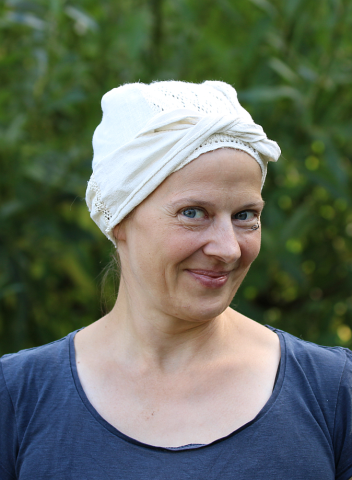
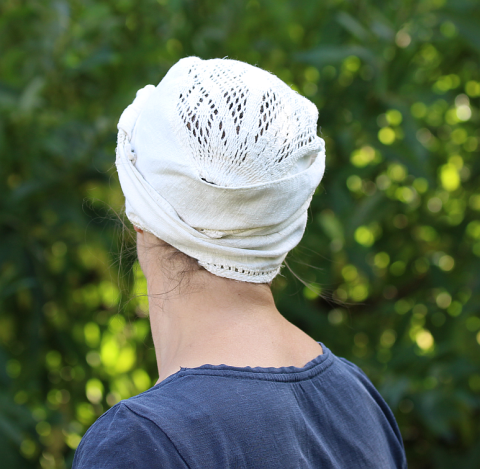
This is the cap done, as best as possible, to the measurements given in the articles about the piece. The sprang section is 27 cm long allover. As you can see on the left, the cap sits right at my hairline, not especially deep in the forehead. On the right, you can see how it looked after careful arranging of the ties so that they more or less covered the lower edge of the panel. It took some fiddling, and you can still see a little gap. The ties are definitely not crossing low on the nape of the neck here. 

For the sake of full disclosure on my head size: My head measures 57 cm around on ear level if I measure over all my hair put up in a bun. It is 52.5 cm measured at the same place without hair. The circumference going from below the hairline in front of the forehead to the nape of my neck and back is exactly 52 cm. Measurement from front of hairline in the middle of the forehead to the nape of the neck, across the middle of my head and down to the nape, going over the bun lets me come out at about 37 cm.

(And now you know more about my head measurements than you ever wanted to know.)

Now, this specific cap might have been worn differently, or on a much smaller head, resulting in a different fit, which might well have been the case, and so a 27 cm sprang panel might have been the correct full length. It might have been worn by a small child, for all we know.

But then the maths still does not add up. We have a full length of 27 cm of the complete sprang panel stated, measured from top to bottom. I assume this does include the double-thread passage at the end, as there is nothing mentioned anywhere to hint at this being only the patterned section. 

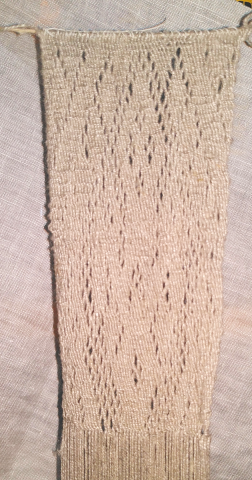
On one of the images published in the article "Linen sprang from Lengberg Castle", it is possible to measure the length of one of the lozenges in the pattern. I get about 1.8 to 2 cm, so let's stick with 1.8 as the smaller measure.

That pattern element consists of 10 rows, which gives each row an approximate height of 1.8 mm. The complete pattern has 186 numbered rows, as published after Carol Jones' reconstruction in the article "Enigmatic Beauty". There is one un-numbered row above row 1, which is a plain 1-1 row. (There are some numbering hiccups in the pattern, looking at the numbers on the side, but they even out.) In addition to these main pattern rows, there is the slightly wider row formed around the starting thread, and because the pattern holes in the image mentioned above only start at a little distance from that starting thread, there have to be two more plain rows before the pattern start (of which one would be the un-numbered 1-1 row in the pattern). Then there's an additional seven rows done with double threads at the very end, narrowing down the panel.

So we have 188 sprang rows, plus the slightly thicker starting row around the anchor thread, plus the seven double-thread rows. Even if we say all of these are no larger than the 1.8 mm found above, a total of 196 rows times 1.8 mm results in 352.8 mm - so 35 cm and a bit. Consequently, one thing must be incorrect: either the 27 cm total panel length, or the pattern description as given, with the 1.5 repetitions of the motif.

Which means either the sprang pattern length would need to be revisited, or one of the measurements somewhere has a typo or was erroneous (which we all know can happen, or, as the German physicists taught me, "Wer mißt, mißt Mist" because something can always go more or less wrong), or there is something else somewhere that would explain the discrepancies. I cannot say which is the case - only what I have found from trying to work the reconstruction as described in the articles.


Literature referred to:

Nutz, Beatrix, Case, Rachel and James, Carol 2021. A unique survival: A woman's fifteenth-century headdress from Lengberg Castle, East Tyrol. In: PRITCHARD, F. (ed.) Crafting Textiles: Tablet Weaving, Sprang, Lace and Other Techniques from the Bronze Age to the Early 17th Century. Oxford: Oxbow Books.

Case, Rachel, Nutz, Beatrix and James, Carol. 2019. Enigmatic Beauty. The Decorative Headwear of Lengberg Castle.


0
SEP
10
1

Sprang Update.

You remember the Lengberg Sprang cap project? Something about the sprang panel has somehow kept nagging, especially the difference between the length I had at the end with my piece and the original length as stated in the article. So... I have started it once more, and it does look like I'm at the same density now. 

There's also a difference between the pattern given in the article "Enigmatic Beauty" and the pattern shown on the photograph; there is a hole missing in the pattern to form one more lozenge instead of a solid diagonal. I only noticed because I had measured said lozenge on the photograph to find out how long it was in the original (20 mm) and then I had progressed beyond that area in my piece and went to measure the lozenge and... it wasn't there. 

Cue an unsuccessful try to spot-fix, a complete unraveling, and a startover, this time with the amended pattern. And yes, my specimen measures 20 mm to the end of the lozenge. So... whew.

This is somewhere around row 60-something now, so still about 120 rows to go.

However... however, this also means that a pattern with one and a half repeats of the tree of life, with its 120 or so rows, cannot be done in 27 cm of length. If I do the maths on that, I end up with something around 40 cm of length. Which would, actually, be a much better fit for the head of a fully grown woman, as the cap I made stopping at the 27 cm length ends up with the lower edge of the sprang panel on the middle of my back of head. In contrast, the images showing these caps are always reaching down to the nape of the neck, where the end of the inset is covered with the bands crossing over. I can do the covering with crossing, but it's way further up, and takes some fiddling, and even then it's not a really nice fit and really nice coverage.

So something about the numbers seens to be amiss in that article, especially as the numbers listed in the text and the schematic drawings also do not match everywhere. The sprang was fragmented, but it must have been complete enough to read out the 1.5 pattern repeats of the motif, so it cannot have been totally fragmented, which makes me wonder what happened to give these measurements that do not seem to fit together.

For now, I will assume that the 1.5 pattern repeats are correct, and I will follow through until I have the full length of the panel as stated in the text - and then I will have a look at how the linen pieces will have to look to fit it, and how that compares with the original cap.

0
AUG
25
2

Weird ways to put your hood on.

Inspired by yesterday's comment, here's a little elaboration on why I think the red thing Oswald is wearing is a hood.

Around the 1400s and into the earlier part of the 15th century, there's a plethora of hoods being worn, in all kinds of shapes and sizes. There's hoods with no liripipe or a very short one, there's buttoned hoods (sometimes worn open), and there's a number of hoods with a long, wide liripipe, sometimes as long as the wearer.

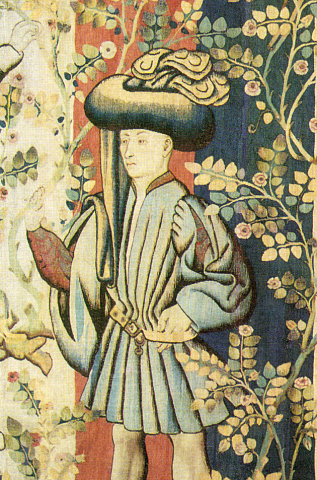
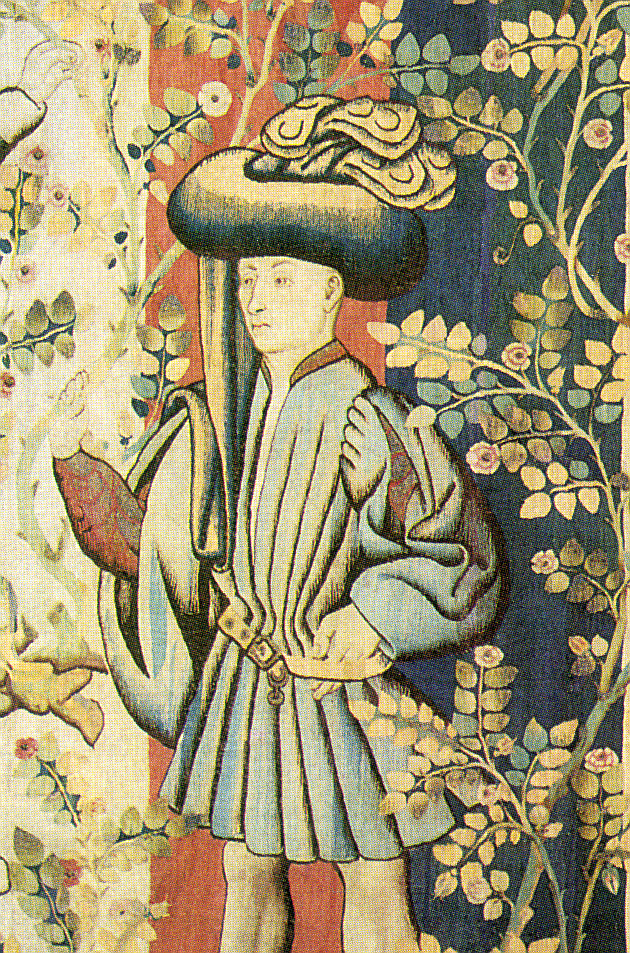
These are, obviously, not the superpractical functional garments anymore. Instead, they are worn in some rather inventive ways, with the liripipe draped fetchingly across the upper body, the shoulders, the arms. Sometimes the face opening of the hood is stuffed to form a nice shaped ring, like a fabric donut in superlarge, but narrow. Sometimes they also overdo it a bit with the stuffing, like here:

Southern Netherlands, c 1450-1455. Detail from a tapisserie worked in wool, silk and metal threads, 2,89 x 3,25 m. New York, The Metropolitan Museum of Art. Image from Camille, Michael 2000. Die Kunst der Liebe im Mittelalter, Köln, Könemann.

You can see the long liripipe (not dagged in this case) draped across the right shoulder, hanging down in front in a loop and then going to the back. There's the super-overstuffed ring that would once have been the face opening, and it sits on the head, with what would once have been the cape part sticking out on the top with a bit of decorative dagging. 

This is one of the more extreme examples where it's clear that this is not going to function like a normal hood anymore. There's quite a lot more where the modifications have not gone as far, but they do have heavy dagging on the cape, and often a very long and also dagged liripipe.

This long thing can be draped across the shoulder and arm, or sometimes it is wrapped around the head turban-style. There are a few images where it's pulled through one sleeve, coming out near the hand like a decorative fabric waterfall. Unfortunately these are, indeed, rare - but the playing cards from Stuttgart provide several examples, both men and women. You can find the whole series here on the museum digital pages

As the colour and style (patterning) of the thing coming out at the sleeve always matches the hood worn, I am convinced that this is the liripipe being drawn through the sleeve. It works very well; I have a few reconstruction hoods with a similarly ridiculously long dagged tail, and it's quite easily possible to wear them this way, unless your sleeve is super fitted. I have done tests with modern sweaters, and it works just fine. 

On the other hand, while we do have images of extra sleeves being worn by women, these are not, to my knowledge, documented for men; and usually they are also not extra long and spilling out (I only have one layered outfit in mind where it might be the case, that's all). 

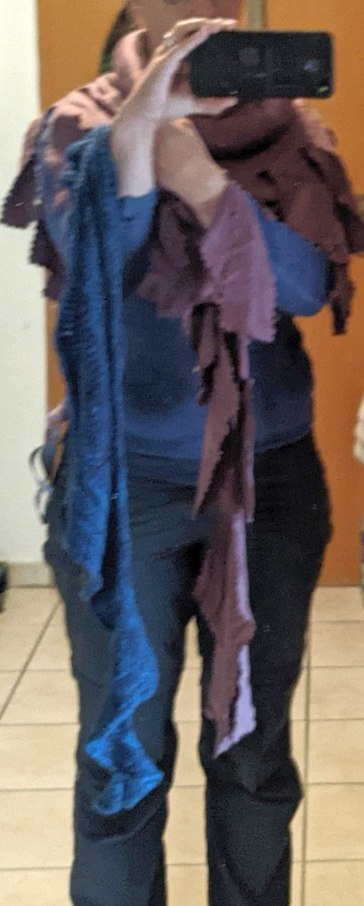
My big issue with good old Oswald is thus only the two spilling tails - as a double-tailed hood is not something I have ever come across. However, the Most Patient Husband of Them All suggested yesterday it might be only one, but draped a little weirdly. So can this be?

Obviously, this has to be tried out. Unfortunately my hoods do not have the right type of liripipe, so I had to simulate long dagges with a second piece of fabric - but yes, it seems to work. Both the blue scarf and the purple liripipe are coming out of my left sleeve, and one just happens to drape over my right arm. Tree hugging was suspended in favour of holding the phone to make this rather blurry picture, but I hope you can see all the relevant details well enough to be as happy as I am with this possibility!

0
AUG
24
1

Oswald's Garments.

You might or might not be familiar with St Oswald, also King of Northumbria - I am currently definitely getting to know him a little better.

I have the pleasure to work on a 3D reconstruction of Oswald as he's portrayed in a Garden of Paradise dating to the early 15th century, and like these projects often are, there's a lot to discover and at least as many questions.

The digitised version of the painting can be found at the Städel Museum website, and the guy in question is the one to the right, hugging the tree. There's quite a lot of things going on in the image, but if I only sort of concentrate on Oswald, the primary problems are: What kind of fabrics were used? Especially the red-gold hood is rather unusual; this time saw quite a fancy for hoods with a long, dagged liripipe, and there's a number of illustrations where the liripipe is drawn through a sleeve, but Oswald... has two. That's a new one to me, definitely. (Should you have seen anything like it, please do let me know!)

The cloak could be silk or wool, but I'd lean towards some nice, fulled wool as a practical coat. Then the hose, which I would assume to be joined already, have some gold decor at the shins; the fabric could be either silk or wool. Gold ornaments re more something that makes me think silk, however, wool would be the easier and more budget-friendly choice. In addition, modern silks tend to be quite different from medieval silk fabrics, so I am not sure where I'd be closer to the mark regarding the fabric. (Modern wool is also different from historical wool fabrics. We're basically going for the looks here, trying to get as closely as possible without going for a full fabric reconstruction, as that would not be in the budget in any way, so it's compromises in each case.)

For the whatever he's wearing on his upper body, I'm planning to use some relatively heavy modern silk. Unfortunately, there's not much visible apart from the right sleeve, which looks rather baggy. As there's a teeny tiny bit of mail armour visible on the top of his leg, it can also be supposed that the garment was rather short.

So here we are. Timeframe is in the 1410-20s, so the dagged hood is definitely very nicely fashionable. There's no surviving man's garment from that time exactly, though we have two complete (with a little damage) from mid-14th century (Charles de Blois and Chartres); there's also the garment of the Black Prince, so at least there's some basis to put conjectures on. 

Still, this leaves quite a bit of guesswork, or of interpretative decisions. Which, by the way, is something that is going on so much and all the time with these reconstruction projects. (One of them is also what to start with - the upper garment? The hose? The hood? Hmm...)

0
AUG
14
0

And... down another rabbit hole.

Sometimes, well, things sort of line up. This time, they lined up to lure me down the hole into that extensive rabbit warren that is late medieval to early modern legwear (men's legwear, that is). 

The things that lined up were a) the Alpirsbach project, b) the currently ongoing clothes-like-in-a-picture project,  and c) the almost-eternal updating and translating of the thesis project. 

The latter would greatly benefit from some more details in regard to the legwear reconstruction and development, both in the theoretical part and in the (very short, I know) practical results part. The first is skimpy as there was next to nothing known (now I know of a little bit more), and the latter is superdupershort because, well, it is toward the very end of the book and I was running out of time, and even more running out of steam.

There's this classical thesis writing timeline, you see. You start out and you're told that you should do it within three years, and at the beginning, that sounds like forever and a day, and you start, and suddenly the first year is over but well, you made progress and starting out is always a little slower, and then suddenly you are nearing the three-year mark but there is still so much to look into and tweak and to study and to read and to try and then you are close to year four (four! When did this happen!) and in some instant of painful insight you realise that really the only thing you want now IS TO FREAKING FINALLY GET FINISHED WITH THIS THING THAT IS EATING YOUR LIFE AND WILL NEVER STOP DOING SO UNLESS YOU MAKE IT STOP BY HANDING IT IN AND NO I WILL NOT LOOK INTO THAT BOOK AGAIN I WILL JUST DELETE THIS REMINDER RIGHT NOW HERE YOU GO CHAPTER DONE. Phew. 

This may be a little dramatic, but at times, that really was how it felt. I was told about this timeline before (as probably everybody starting out on a PhD is). And I did what everyone in that situation does, just like every author has to be convinced that their new book is the hottest shit ever and will sell like nothing else, and every editor has to listen to this and nod quietly and think to themselves "yeah, yeah", I was told about this timeline and I nodded quietly and I thought "yeah, yeah" and then, suddenly, well, see above. 

The legwear, at that point, was still sort of basic ideas and outlines only, and it did get elaborated on enough to pass, but, well, see above. By now, I have realised that there is enough material and open questions about just the development of male legwear throughout the centuries that it would easily merit its own PhD, so I won't be able to cover it all, but I'd like to have a little bit of extension to the short chapter in the updated version.

There's several stages in the development - at first, the hose are just getting longer but with no cut-out necessary for the crotch yet; then they have to get even longer and need some kind of crotch solution; then they cover the front as well, needing something to cover up the gap between the two leg parts. At some point, the two hose get joined by sewing them together, and that is probably only the butt first, and then there's the codpiece at some point getting added to both cover up the front (where previously breeches and shirt may have been seen) and also offering possibilities to have the construction a little easier in the lower butt and lower crotch area.

However... this hose development goes hand in hand with the shortening tunics in male fashion, and plenty of men in the not-so-fashionable strata of society just go on wearing the mid-thigh to knee tunic, and the old-fashioned legwear going with it. The other guys, well, we don't have a lot of finds, and we do have a good bit of images but they have this maddening tendency of only almost showing the bits with the crucial information. Argh.

So now I find myself pondering pattern developments (at least I have one new idea! Yay!), folding up little bits of paper, drawing on any sheet that is in reach while some question comes up, and even thinking of making small fabric mock-ups. Plus spending quite a bit of time staring at men's butts and legs in medieval art. Which is, admittedly, also kind of... fun.

0

By accepting you will be accessing a service provided by a third-party external to https://pallia.net/

Contact