



Search the Blog

Latest Comments
Weird ways to put your hood on.
Inspired by yesterday's comment, here's a little elaboration on why I think the red thing Oswald is wearing is a hood.
Around the 1400s and into the earlier part of the 15th century, there's a plethora of hoods being worn, in all kinds of shapes and sizes. There's hoods with no liripipe or a very short one, there's buttoned hoods (sometimes worn open), and there's a number of hoods with a long, wide liripipe, sometimes as long as the wearer.
These are, obviously, not the superpractical functional garments anymore. Instead, they are worn in some rather inventive ways, with the liripipe draped fetchingly across the upper body, the shoulders, the arms. Sometimes the face opening of the hood is stuffed to form a nice shaped ring, like a fabric donut in superlarge, but narrow. Sometimes they also overdo it a bit with the stuffing, like here:
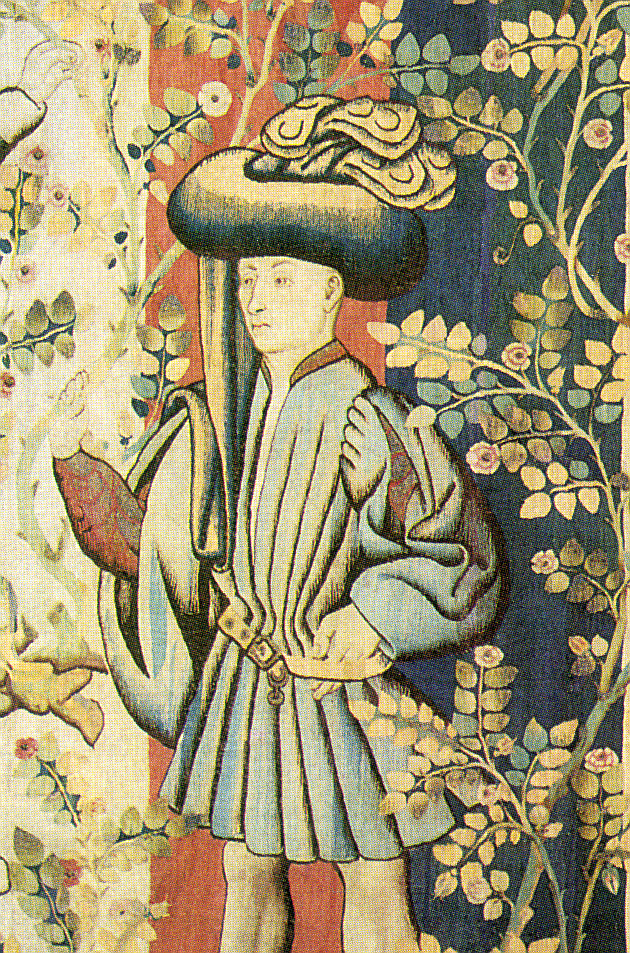
You can see the long liripipe (not dagged in this case) draped across the right shoulder, hanging down in front in a loop and then going to the back. There's the super-overstuffed ring that would once have been the face opening, and it sits on the head, with what would once have been the cape part sticking out on the top with a bit of decorative dagging.
This is one of the more extreme examples where it's clear that this is not going to function like a normal hood anymore. There's quite a lot more where the modifications have not gone as far, but they do have heavy dagging on the cape, and often a very long and also dagged liripipe.
This long thing can be draped across the shoulder and arm, or sometimes it is wrapped around the head turban-style. There are a few images where it's pulled through one sleeve, coming out near the hand like a decorative fabric waterfall. Unfortunately these are, indeed, rare - but the playing cards from Stuttgart provide several examples, both men and women. You can find the whole series here on the museum digital pages.
As the colour and style (patterning) of the thing coming out at the sleeve always matches the hood worn, I am convinced that this is the liripipe being drawn through the sleeve. It works very well; I have a few reconstruction hoods with a similarly ridiculously long dagged tail, and it's quite easily possible to wear them this way, unless your sleeve is super fitted. I have done tests with modern sweaters, and it works just fine.
On the other hand, while we do have images of extra sleeves being worn by women, these are not, to my knowledge, documented for men; and usually they are also not extra long and spilling out (I only have one layered outfit in mind where it might be the case, that's all).
My big issue with good old Oswald is thus only the two spilling tails - as a double-tailed hood is not something I have ever come across. However, the Most Patient Husband of Them All suggested yesterday it might be only one, but draped a little weirdly. So can this be?
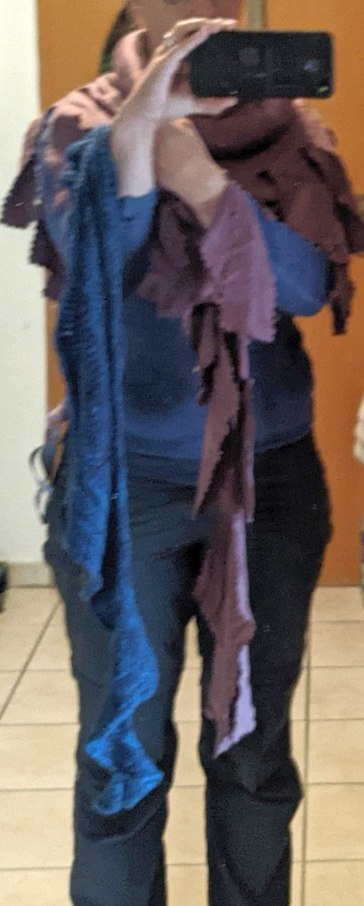
Obviously, this has to be tried out. Unfortunately my hoods do not have the right type of liripipe, so I had to simulate long dagges with a second piece of fabric - but yes, it seems to work. Both the blue scarf and the purple liripipe are coming out of my left sleeve, and one just happens to drape over my right arm. Tree hugging was suspended in favour of holding the phone to make this rather blurry picture, but I hope you can see all the relevant details well enough to be as happy as I am with this possibility!
Comments 2

Huh, I hadn't thought about the possibility of stuffing the liripipe *down* the sleeve to let it be a waterfall of fabric out of the cuff. I agree that that is a possibility - and with stronger evidence behind it, given the other examples you show, particularly the playing cards. Guess that's what comes of stepping out of my mid-14th C UK comfort zone - I'm not anywhere near as familiar with either the 15th C or the Germanic evidence.
And yay for the husband's suggestion and for practically trying things out. That is, absolutely, the best way to investigate things!
Eh, I am slowly coming to the point where I doubt that there is a comfort zone at all - the closer I look at what feels like anything, the more questions I have.
But yes, the further one is away from the main turf, the more obvious it is! That said, I have not found a lot of images showing this particular inventive way of taming the liripipe, and the large dagged liripipes seem to be a thing only for a shorter period of time - late 14th and early 15th century. I'm still collecting images and keeping eyes open, but it seems to be a short-lived quite special thing.
Having tried wearing these long-piped monsters, I can attest that it takes some getting used to and it's certainly more on the extravagant than on the practical attire side...
By accepting you will be accessing a service provided by a third-party external to https://pallia.net/