
Latest Comments

Guest - Katrin Sprang Discussion
18 September 2026
Hi Rachel, I have looked for more photos of you, but that was not very successful. I found a link on...
Guest - Beatrix Sprang Discussion
15 September 2026
That lozenge pattern element is not a photograph, but a scan. So it should be to scale. But I pinned...
Guest - Katrin Sprang Discussion
15 September 2026
I was not referring to Rachel's reconstruction (is the reconstruction you refer to the one photograp...
Guest - Beatrix Sprang Discussion
14 September 2026
There is something Rachel did not mention. She told me: "Well, I worked with the measurements we too...
Guest - Katrin Sprang Discussion
14 September 2026
Well, this is certainly developing into an interesting discussion. Firstly, going from that lovely l...
OCT
13
2

Density Differences.

Let's get back to some more textile-related things, shall we?

Test spinning has finished, and now... more testing is about to happen: I'll set up the warp for an Egtved corded skirt, and I'm all excited about that!

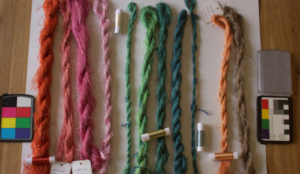
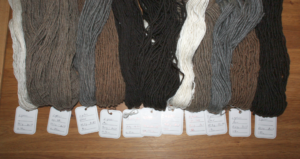
Before I get to warping, though, you're getting a shot of the test yarns, all nicely set up in a row:


I did some labeling, and weighing, and measuring, of course. Just like I expected, even though I tried to spin all of them about the same thickness and the same amount of twist, there are considerable differences between the individual fibres. The Nm, for instance, varies between 0.8 and 1.9.

If you're not familiar with Nm, that is a gauge measurement for yarn thicknesses, and it tells you how many metres per gram a yarn has. So Nm 1 would be a single yarn with one metre per gram; Nm 5 would be a single with 5 metres per gram. If you have two numbers, like in Nm 10/2, the second one gives the amount of yarns in the ply, and the first the overall count - so the Nm 10/2 would be a two-ply yarn with ten metres per gram, made up from two singles. (In most yarns, you can assume that the single yarns in the plied yarn will be similar, so that would mean they both are an Nm 10, and the plied yarn thus ends up being Nm 5.)

In my test spins, the Gotland yarn has the lowest Nm, with 0.8; it's also the fibre that is densest when I portion tops for sale, and thus makes the smallest 100-g ball. The others were more or less similar, ranging from Nm 1,3 to 1,9 - with the irregularities of hand-spinning, and the squish factor when skeining (the tension, and half a round more or less), and the relatively small sample size, that, to me, does not look like such a significant difference than between Gotland and the others. More spinning will come, though, and maybe then something more reliable will show up.

First, though... off to warp!

(edit to fix typo!)
0
JUL
23
0

At least this happened.

There's been some more behind-the-scenes website wrangling, though that was not quite successful. (If you've run across broken image links in the blog - I'm working on it, they will be fixed soon. This is a side effect of me getting rid of the many, many extra images that Wordpress generates when media is uploaded... which cluttered up my webspace.)

I hope the other issue, which regards the new site and especially its template (sigh...) will get better with some support... and now I'm really looking forward to the weekend.

Which promises to be quite sunny, and nice, and warm.

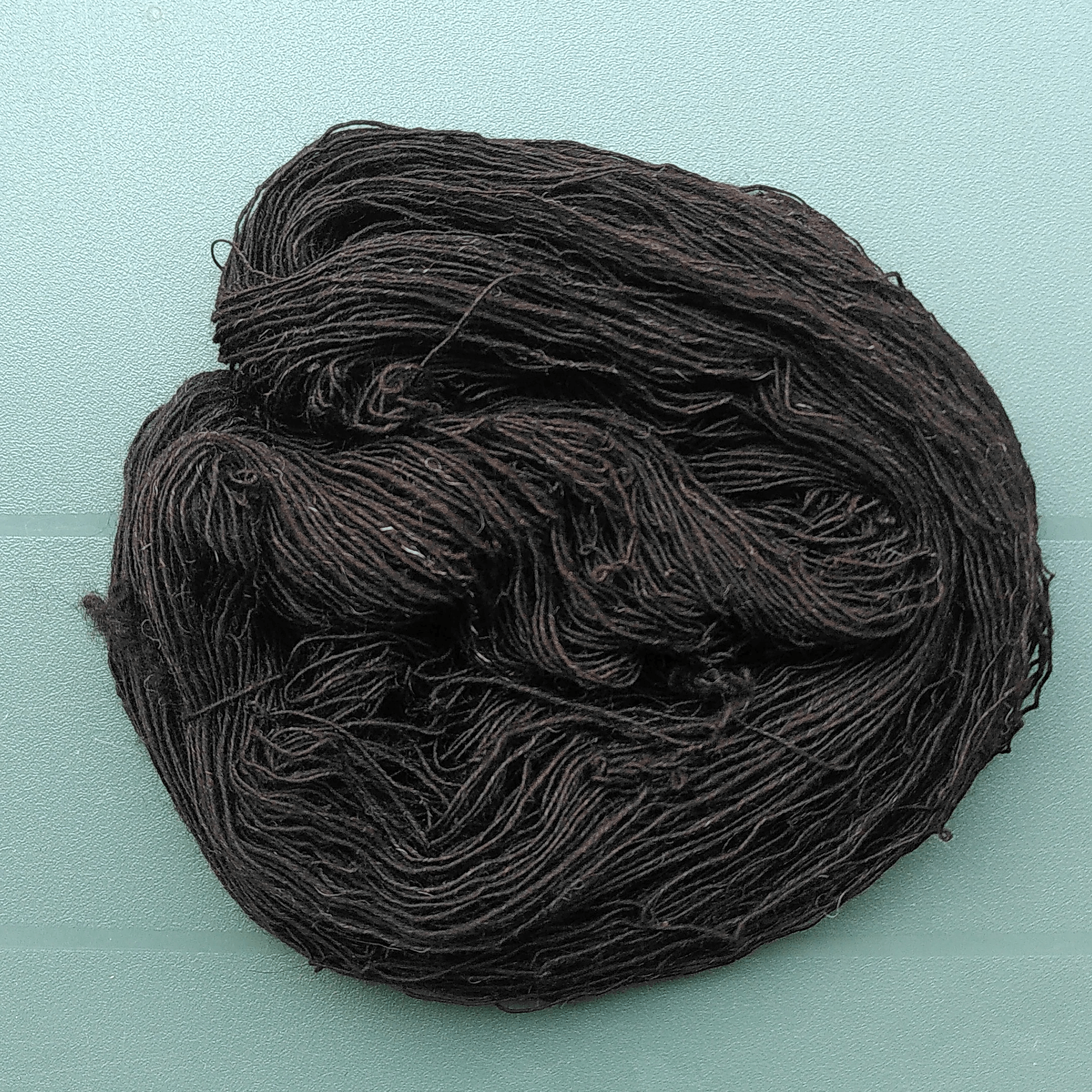
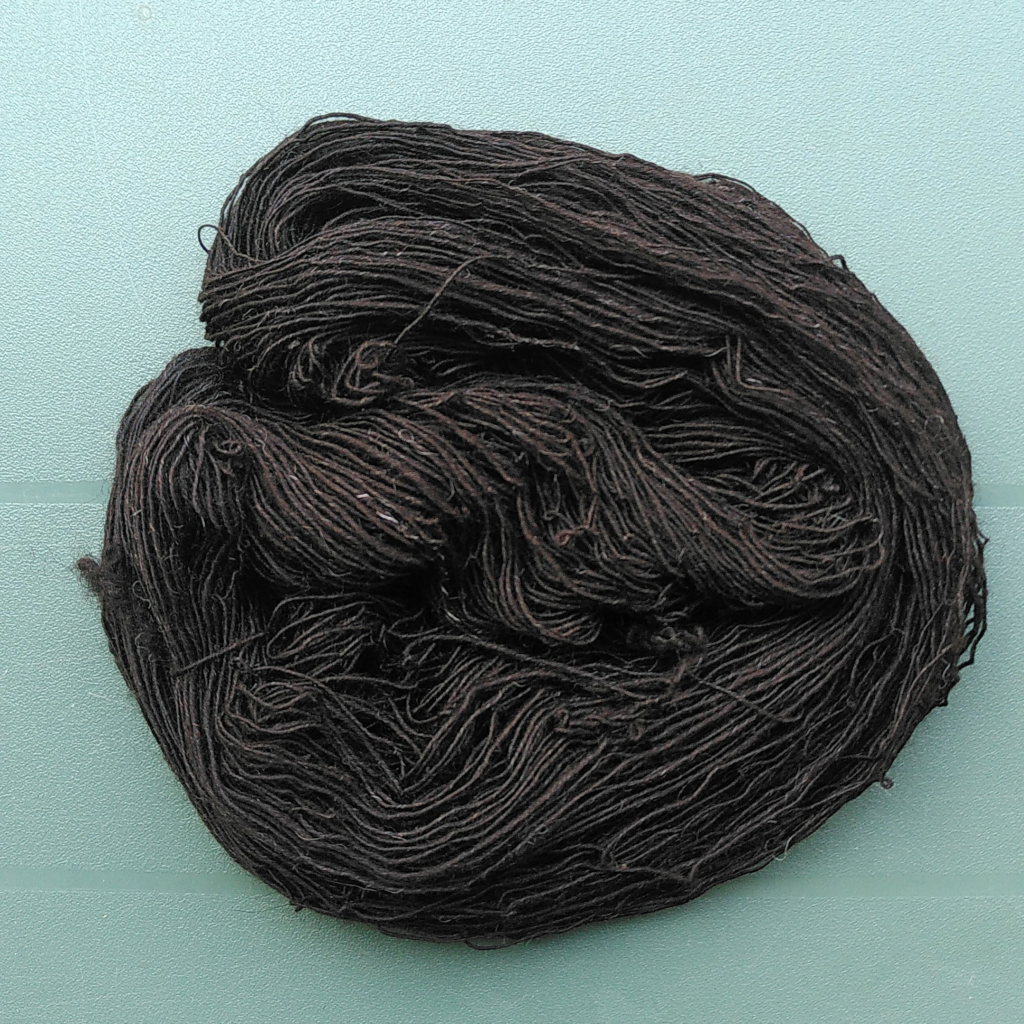
There also was some spinning! Here's the results:


One very nice skein of dark, rather shiny yarn, which was a joy to spin up. As opposed to the "fun" spinning I'm currently doing with some mystery fibre (well, I know it's wool, but I forgot exactly which kind) which has a lot of crimp, and somehow does not please me at all to work with. I'll stick with it some more, though, so that we can have some yarn for the Textile Forum to play with.
0
JUL
01
0

Viking Bling.

Reconstructions of textile finds are always including a bit of interpretation - the more fragmented the finds, the more interpretation is necessary. That is just normal, but something that is not always mentioned straight out in exhibitions.

So I'm always quite delighted when this is made clear - as is the case in this article about "Fashioning the Viking Age", which shows dress reconstructions based on two spectacular finds. There's also an instagram account with a lot more pretty pictures. Absolutely worth a look!
0
JUN
29
0

A Closer Look at Fibres.

I'm back with my Bronze Age Fibre problem. Well, it's not just my problem... it's a pretty common one if you look at reproducing fabrics from that time. Let's take a look...

Modern Merino wool, which is seen as rather fine stuff, has - if of the fine kind - fibre thicknesses of around 20 micron. Sometimes you get extrafine, which is at about 17 micron.

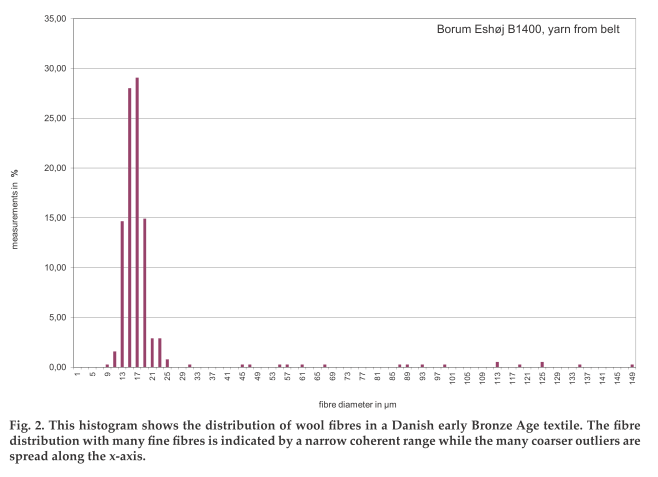
Bronze age fibres were, mostly, around 17 micron. There's fluctuations, of course, but that's the main component of the textiles - really, really fine fibres. Then there's some few extra coarse ones thrown in, with 45-150 micron thickness. A diagram of fibre thicknesses counted was published in Skals, I., & Mannering, U. (2014). Investigating Wool Fibres from Danish Prehistoric Textiles. Archaeological Textiles Review56, 24-34, and thanks to the generousness of ATR, you can download the whole issue with the article included here. To save you the search, the histogram is on p 26, and it looks like this:


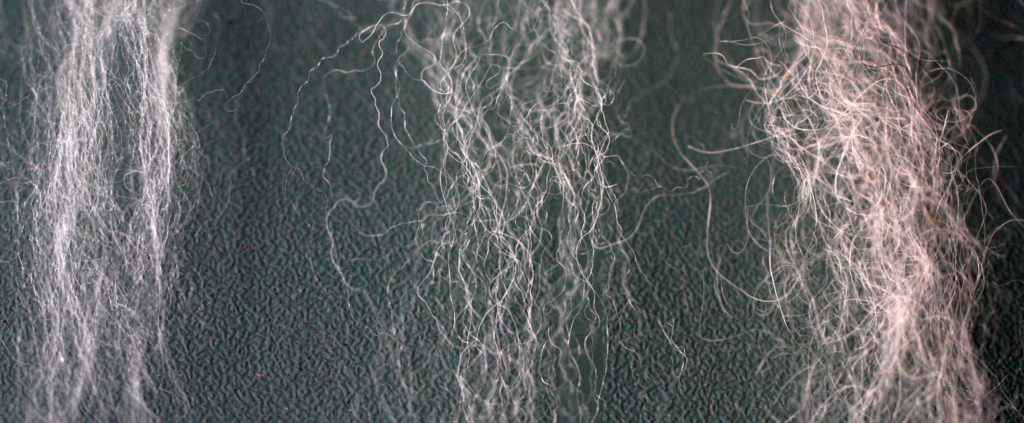
Getting this mix of fibres is difficult these days. I have gotten some superduperfine special wool now, with (according to my supplier) around 15 micron of fibre thickness. You can see it to the very left in this picture; next to it is a sample of my beloved Eider wool, and on the right Valais Blacknose wool.


Even though it's just a macro photograph, I think the difference is quite clear. The difference when you touch it is very clear as well - the superduperfine wool feels like silk, and it's supershiny (which is partly due to some post-shearing treatment), while the Eider and Valais are just normal shiny.

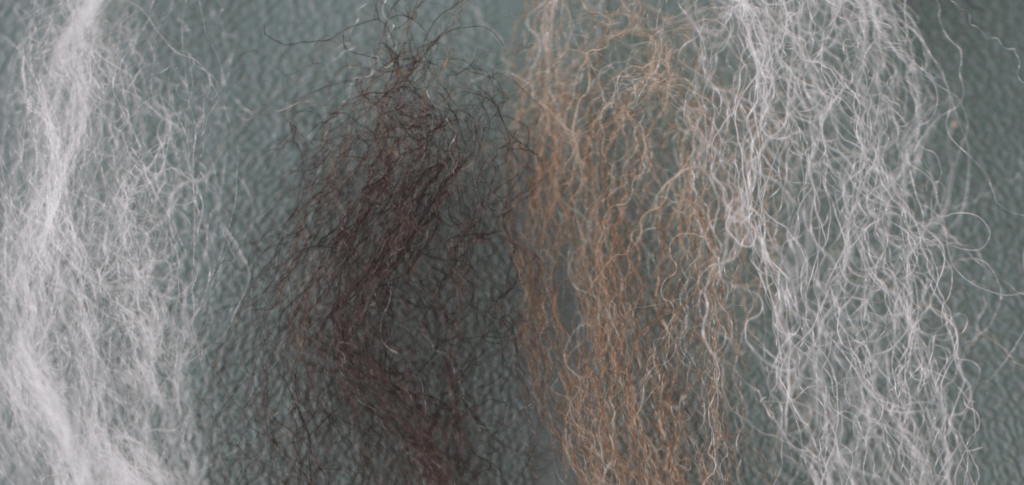
I've also compared it to the Manx Louaghtan, which is an old breed, and to another wool sample that I got for these comparison reasons:


Again the superfine is on the left, followed by my South American test candidate, then the Manx (which appears more saturated brown than in real life) and, for comparison, the Eider wool again. Both candidates are definitely finer than the Eider wool (which should have around 30-33 micron), but considerably coarser than the superduper benchmark.

And here you are. The Bronze Age Fibre Problem, in pictures. The superduperfine wool lacks the coarse fibres strewn in, and has been seriously processed to make it silky, smooth, and shiny. It also is very, very white, and BA fibres are mostly quite heavily pigmented. The two coloured wools have a mix of coarse and fine, but way too many coarse fibres strewn in to match the BA originals. They are, however, nicely pigmented.

So, like with many reconstruction projects, there's the choice between compromises. Use the very fine fibre although it has been heavily processed, dye it, and accept the fact that it lacks the coarse hairs? Try to blend some extra coarse fibres in (it would still need to be dyed)? Or use a wool that is naturally pigmented and not supertreated, but has too coarse fibres, or too many coarse fibres for the amount of fine ones?

Or... would someone please invent a time machine and fetch a handful of Bronze Age sheep? Pretty please?
0
JUN
08
1

Tutankhamun's Collar.

One of the lovely things about doing the Textile Forum organisation is that I'm always learning new things, and getting to know more from other, quite far-away bits of the textile world. Case in point? This article about Tutankhamun's Collar.

I wasn't aware of the fact that a lot of textiles were found in Tutankhamun's grave - though I will mention right now that Ancient Egypt is quite a bit away from the European Middle Ages, which are my main field. The article about the reconstruction shows very, very nicely some of the many different methods that can be used to re-create or re-construct something, for different purposes. It also shows that it is well worth to repeat a process, after comparing the outcome of the work with the original and maybe looking at some additional sources again.

Also: What an ingenious piece of weaving! I'm already looking forward to seeing more of this at the Textile Forum!
0
SEP
15
0

Cuthbert Maniple Interview!

Another thing that happened while I was away: The interview that Alex Makin did with me and Margit from Alte Künste went live!

In that post, we talk about the process of finding and dyeing the threads for the Cuthbert maniple project that Alex works on, including some details on the problems and decisions made. It was a lovely, exciting, wonderful sub-project for the Maniple Project, and I'm very proud and very happy to have been part of it.

[caption id="attachment_4346" align="alignnone" width="300"] Some of the silks dyed for the project, still in skeins.


You can read the full interview (and see the pictures) here on Alex' blog Early Medieval (Mostly) Textiles. Enjoy!
0
MAY
06
0

Twist matters.

Things I learned in the past days:
  1. Filming a video presentation of something makes me extra-super-duper nervous. Part of this is the thought in the back of my mind that every "erm..." and every silly facial expression and every little imperfection in speech will be recorded and thus preserved FOREVER, and thus I should be absolutely perfect, and that is hard to do.
  2. Writing subtitles in English underneath a German spoken text is hard, not only because I can (duh) talk much faster than I can type. There's also the temptation to deviate (too) much from the things I actually say, to make it more clearer to the reader, or to cram more info into the text... which I as a viewer would find confusing, and not ideal.
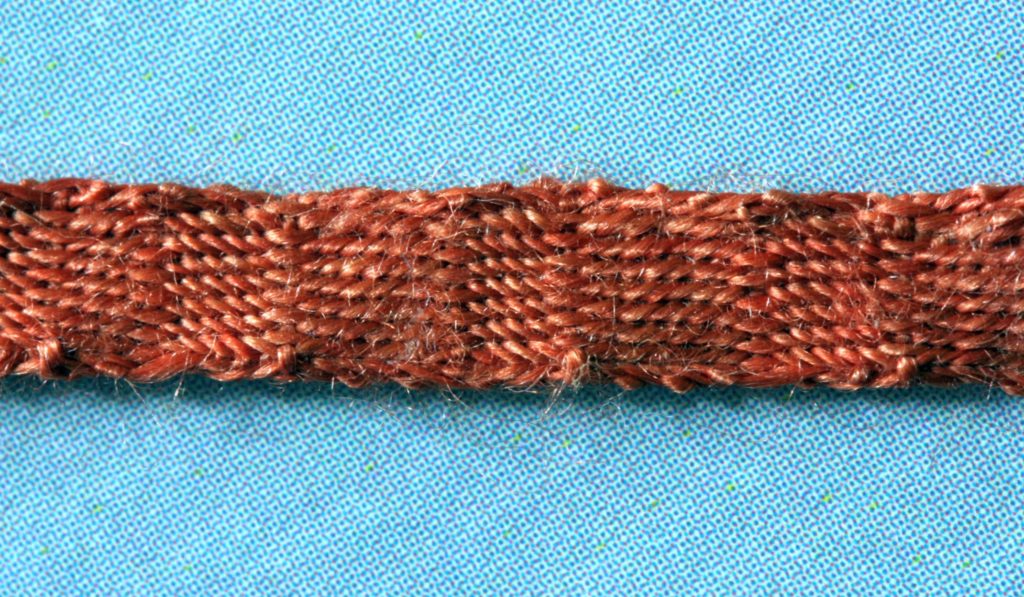
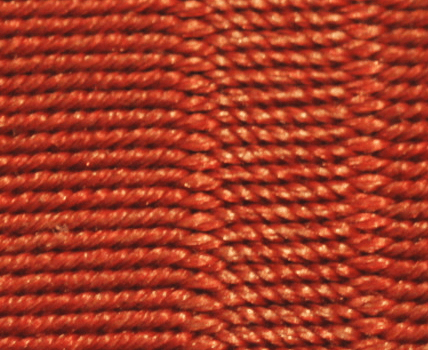
  3. There was very, very, very little twist in the threads used to weave the Albecunde belt. My tests done with my (only very slightly twisted) embroidery silk look like this:


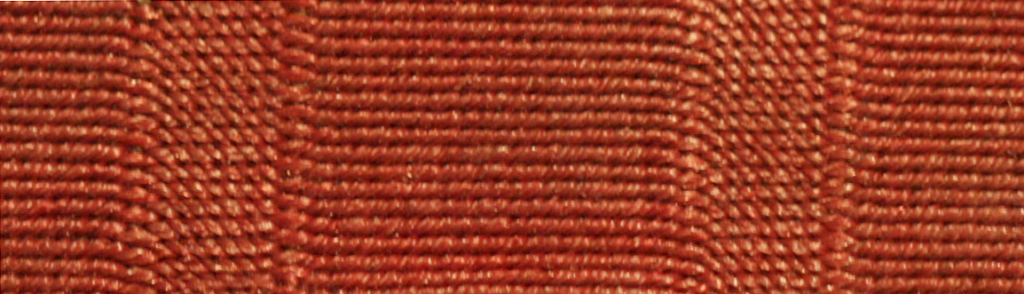
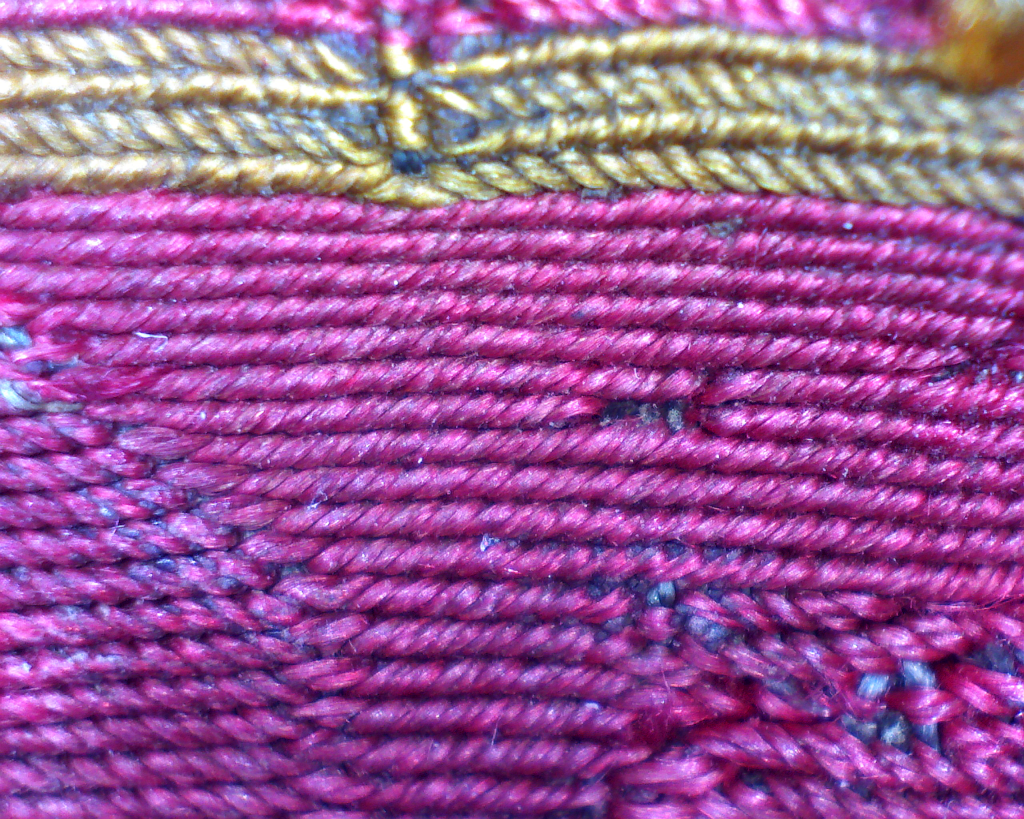
While the original belt looks like this:


You cannot see the pattern as clearly on my test piece as you can on the original - it looks very pronouncedly diagonally structured in one twist direction, but more like a mushy solid surface in the other. On the original, there's a diagonal structure visible in both directions, and it's only a very little more pronounced in one compared to the other.

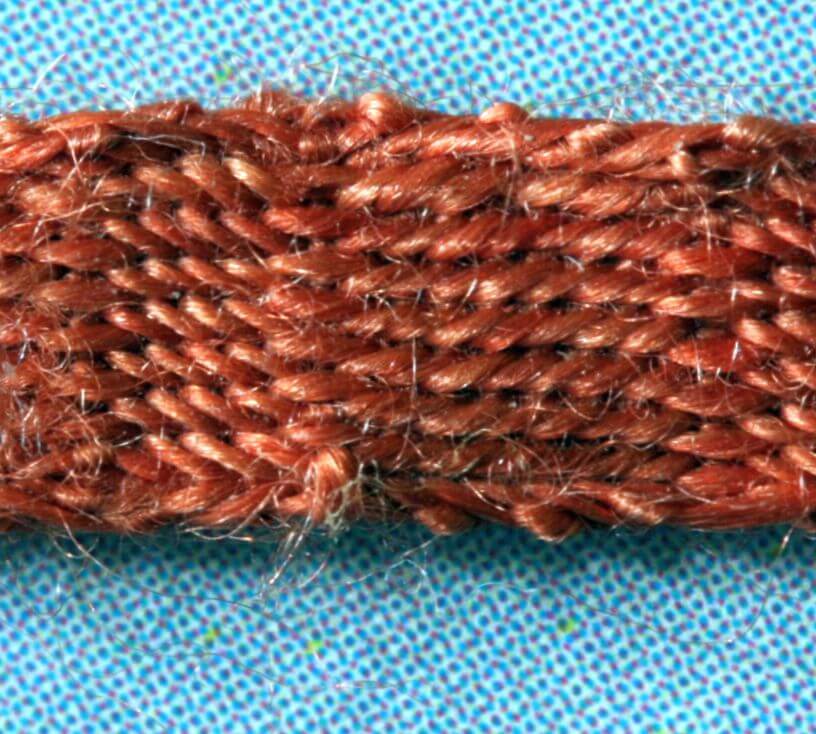
Here's closeups to make things even more clear:


You can see that the diagonals with an S-slant are much more defined than those with a Z-slant. That's because my thread is slightly s-twisted. It's not much, but enough to make quite a visible difference in the outcome; enough of the z-twist the tablets introduce is levelled out by the yarn twist to show. The twist is visible, if you look closely, in the areas where I changed tablet twist direction.


This is a detail, closeup, of the original. Here, too, you can observe the individual thread twist in the places where tablet turn direction changes - but it is so slight that it's almost impossible to detect. The best indication of it being a hint of an s-twist is that the S-cords in the tablet weave are a little bit more defined than the Z-cords.

Here's a microscope picture, going even closer to the threads:


This shows how important even a little bit more or less of twist can be when you are weaving a pattern that relies, for its effect, exclusively on the shine and the light refraction of the silk used - and how much knowledge and skill went into this band.

You can hear more about the Albecunde band on Sunday in the presentation at Virtual Lauresham (and see my video thingie...)!

Thank you to the Diözesanmuseum Augsburg for letting us study the belt in detail for our reconstruction project!
0

By accepting you will be accessing a service provided by a third-party external to https://pallia.net/

Contact