Latest Comments

Guest - Katrin Sprang Discussion
18 September 2026
Hi Rachel, I have looked for more photos of you, but that was not very successful. I found a link on...
Guest - Beatrix Sprang Discussion
15 September 2026
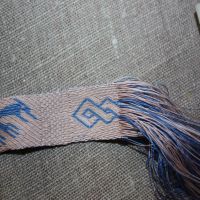
That lozenge pattern element is not a photograph, but a scan. So it should be to scale. But I pinned...
Guest - Katrin Sprang Discussion
15 September 2026
I was not referring to Rachel's reconstruction (is the reconstruction you refer to the one photograp...
Guest - Beatrix Sprang Discussion
14 September 2026
There is something Rachel did not mention. She told me: "Well, I worked with the measurements we too...
Guest - Katrin Sprang Discussion
14 September 2026
Well, this is certainly developing into an interesting discussion. Firstly, going from that lovely l...
JUN
12
0

Medieval Cooking!

If you're interested in medieval cooking, here's something new and exciting for you: Prospect Books is publishing "Zinziber: Sauces from Poitou. Twelfth century culinary recipes from Sidney Sussex College, Cambridge, MS 51".

The book is featuring recipes found on a single sheet contained within a manuscript with medical recipes, and it dates to the middle of the 12th century. This makes is a very, very early document about medieval food and cooking.

The book contains a transcript and translation of the recipes plus an attempt to recreate the dishes, a discussion of culinary traditions and flavourings, and modern recipes to try yourself... and it definitely sounds very, very interesting.
0
JUN
11
0

It's hot.

It's hot around here - incredibly hot, with the months' temperatures more like those we're supposed to have in July, and a warm one to boot. I've used up the water in the rainwater tank for washing wool, so I don't even have the opportunity to go bathe my arms in cold (if sheepy and slightly dirty water) several times a day...

I won't complain, though. Just hang in here and drink lots of water and iced coffee and tea (hot tea, mind you, somehow hot English tea is something I love both when it's cold and hot outside).

Speaking of tea - if you read German, you might be interested in Christa's article about tea in the Middle Ages. (Spoiler: It was not consumed as a normal beverage like it is today.) I always think it's rather funny how many people hanging out in the Living History scene have a very deep fondness for coffee and chocolate... even though both are obviously very much out of place for medieval kitchens!
0
MAY
15
2

Rhubarb Cake.

At the Nadelwelt, there were also opportunities to get some journals - about textile crafts, obviously, but also some lifestyle and food and drink journals, to round it all off. I happened to get one about food and drink into my hands, and of course I had to leaf through it.

That issue of the journal claimed to have the recipe for the world's best rhubarb cake. That cake featured a weird mix of shortcrust dough and yeast dough. That you were supposed to mix together until they sort of marble. Um... very, very weird.

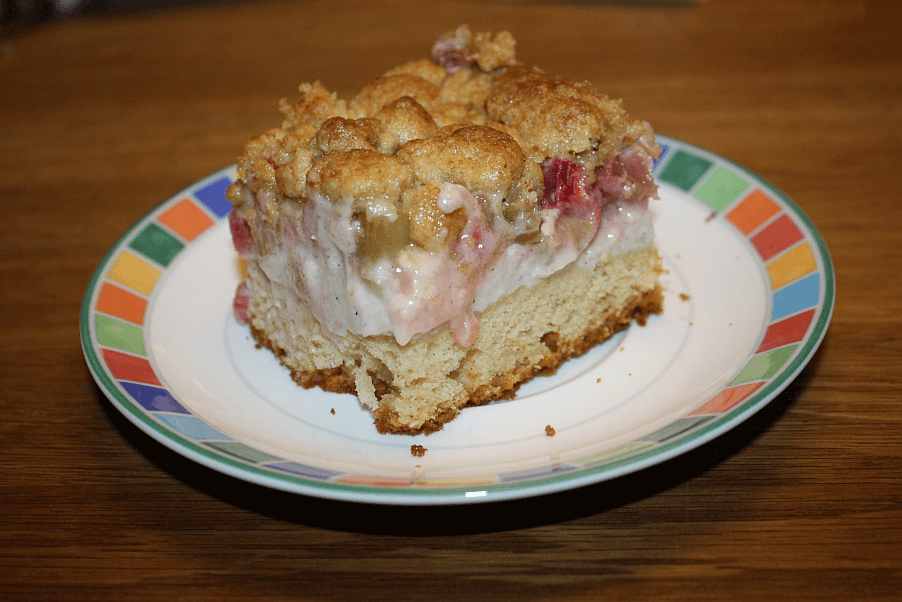
Well. That extra weirdness aside... I happen to know the world's best rhubarb cake. Intimately. It looks like this:
cake_piece

There is a nice layer of fluffy, moist dough, covered with a vanilla custard layer that smoothly transitions into a lot of wonderful rhubarby rhubarb, and all that is covered with a generous layer of streusel. That, dear readers of this blog, is the world's best rhubarb cake.

And here's the recipe for you:

For the dough:
200 g butter
160 g sugar
2 packets vanilla sugar (about 16 g)
4 eggs
150 g sour cream (around 24% fat content)
360 g flour (I use spelt flour)
2 heaped teaspoons baking powder

For the custard:
750 ml milk
60 g sugar
25 g vanilla sugar (1 part ground vanilla beans, 9 parts white sugar)
60 g starch
250 g sour cream

For the streusel:
400 g flour
200 g sugar
about 16 g vanilla sugar
300 g butter (cool to cold)

and, of course, rhubarb - 2 kg of rhubarb. Yes, that is a lot. This is not a puny little cake that has a hint of rhubarb. This is Rhubarb Central with Streusel on Top.

Peel the rhubarb and cut into cubes of about 1 cm side length; sprinkle lightly with sugar to draw some of the juice (and acid) out. (You could also blanch it, but I go with the sugar version on this one.) Let sit for about half an hour (or longer, that is no problem).

Put most of the milk for the custard into a pot, mix in the vanilla sugar, and bring to a boil. Use the remaining milk to stir in the starch and the sugar. Once the milk is boiling, take it off the heat, stir in the custard mix, place back on the heat and stir until it thickens and bubbles lightly. Remove from heat and let it cool off a bit, stirring occasionally.

Beat butter and sugar for the dough to a creamy mixture, add eggs, vanilla sugar, sour cream and the flour mixed with the baking powder. Spread on a baking tray (a large one, 30 x 40 cm), and pre-bake in the pre-heated oven for about 12 minutes at 180°C with the convection fan on. I recommend using a baking frame around the tray, as the cake will get rather high in the end, when it is all assembled.

Cut the butter for the streusel into small pieces and knead together with the rest of the ingredients until just combined; it should form smallish streusel all on its own.

Stir the sour cream into the custard and spread on the pre-baked dough layer. Dough visibility after you do this: zero.
Now spread the drained rhubarb cubes on the custard layer. There will be a lot of rhubarb. That is meant to be this way (and also why the cubes are so small - they pack more densely this way). Custard visibility after adding rhubarb: close to zero or zero.
As the final layer, you spread your streusel on top of the rhubarb. Rhubarb visibility after adding this final layer should be close to zero or zero.

Bake at 180°C for about 30-35 minutes; the streusel should be golden brown.

There you go. The custard and sour cream mix wonderfully with the tartness and taste of the rhubarb; the dough basis makes it a cake, and the streusel add texture and sweetness and buttery richness. It's not very sweet overall, so if you prefer your cakes very sweet, you might want to add more sugar to both the dough and the custard - I love it best this way.

If you're making it (it's the season, after all), do let me know if you agree or if you have another opinion on what is the world's best rhubarb cake!
0
MAR
23
1

Friday Linkapalooza!

It's time to throw some unsorted links at you again. Most of the stuff is in German - sorry for those of you who don't read it, but they are just too interesting to pass them up.

Anke Domaske is making fibres from milk that is leftover and spoiled - a brilliant example of upcycling, to put it that way. The fibres are versatile, and are getting used in a variety of ways already. (Article in German.)

Archäologentage 2018 are taking place April 12-15, and the topic is Migration. More information can be found here (info material in German and French).

Christa Schwab has tried to find out a good mixture for making a vegetarian sausage after a medieval recipe. You can read more about what she did, and how it worked, over at her blog (in German, but with pictures).

More food-related stuff - remains of Iron-Age feasting, or at least eating, have been found at the Cairns broch, Orkney, Scotland.

Not recent, but still interesting: an article about traditional Icelandic embroidery, via Medievalists.net.

It looks like there might be a cure for the Varroa mite problem that is threatening the European Honey Bees - I do hope that this will be a full success. (Article is in German.)

Sometimes, your colleagues have surprising hobbies - one of my archaeology colleagues, for instance, writes music and sings. In this case, an eulogy on a house from 1534 that was recently demolished. It's in English, too.

Also in English: Some new research on one of the tablet-woven bands from Hallstatt (Halltex 152) by Maikki Karisto, together with Mervi Pasanen and Karina Grömer. Mervi's blogpost includes the new pattern draft.

Textilis has a study of knitting sheaths from North Yorkshire.

And that's it for today - finally a few less tabs open in the brower!
0
FEB
06
3

Fun with Chocolate Cake.

I've finally gotten around to testing the 3D cake mould that we got presented with years and years ago... which bakes a little moose.

My mum has a rabbit mould (well, actually an easter bunny mould) and we used to make a bunny at easter, usually as a marble cake. These 3D forms are, though, usually rather small and I'm normally baking cakes that are... large. However, circumstances have aligned and it was time to try out a new chocolate cake recipe, and that in turn was sort of the instigator to also try out the mould.

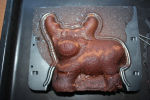
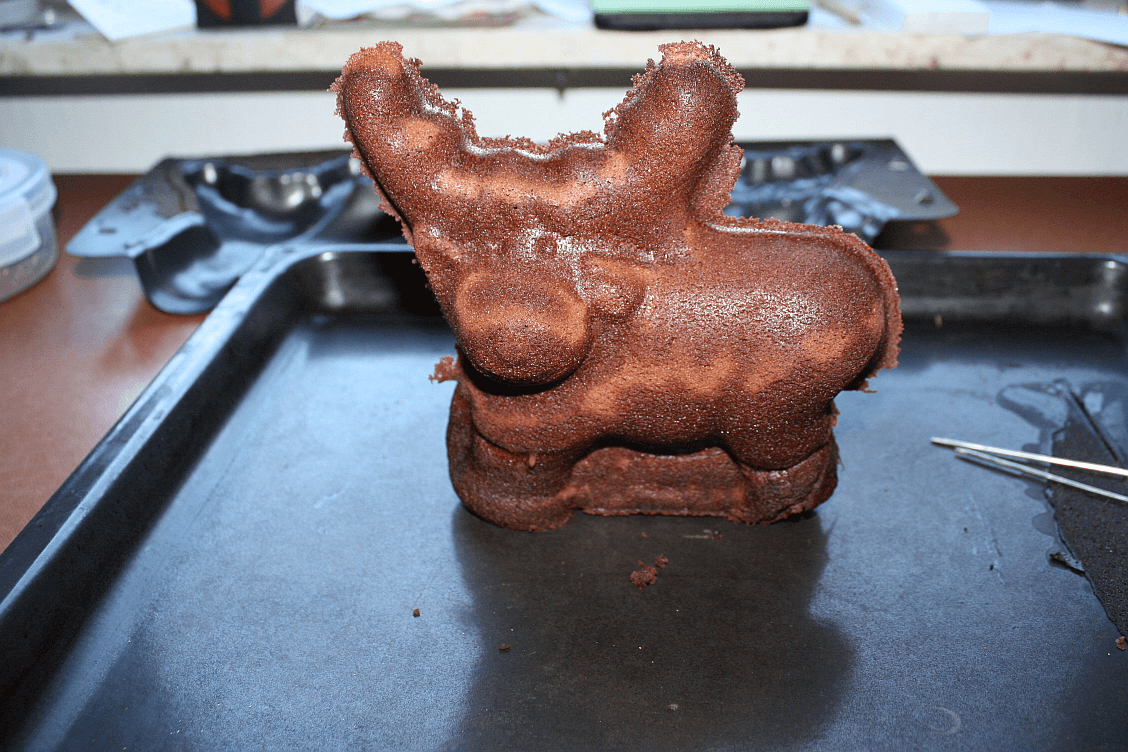
As the instructions demand, I did butter it carefully, and it came out nicely when it had cooled:

[caption id="attachment_3603" align="alignnone" width="428"]coming_out Still in the second half of the mould...


[caption id="attachment_3602" align="alignnone" width="482"]It's out! It's out!


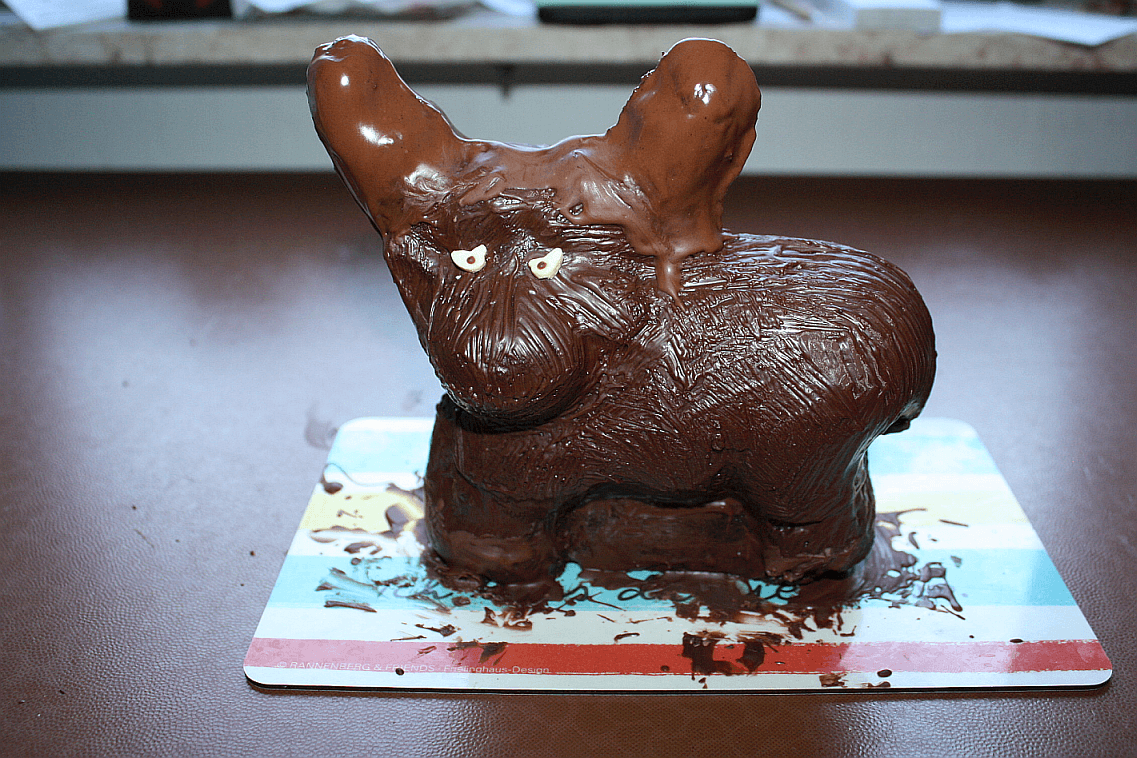
And because everything chocolatey is better with even more chocolate, I decided to coat it with choc. When finished, it looked like this:

chocolatey_elk

The eyes are slices of cashew nuts, and the antlers have a lighter colour because I mixed a spoonful of peanut butter into the hot chocolate. Which is, by the way, utterly delicious.

Now we'll see how it tastes, and then I will decide if that recipe stays or goes...
0
DEC
18
0

The Tasting Thing.

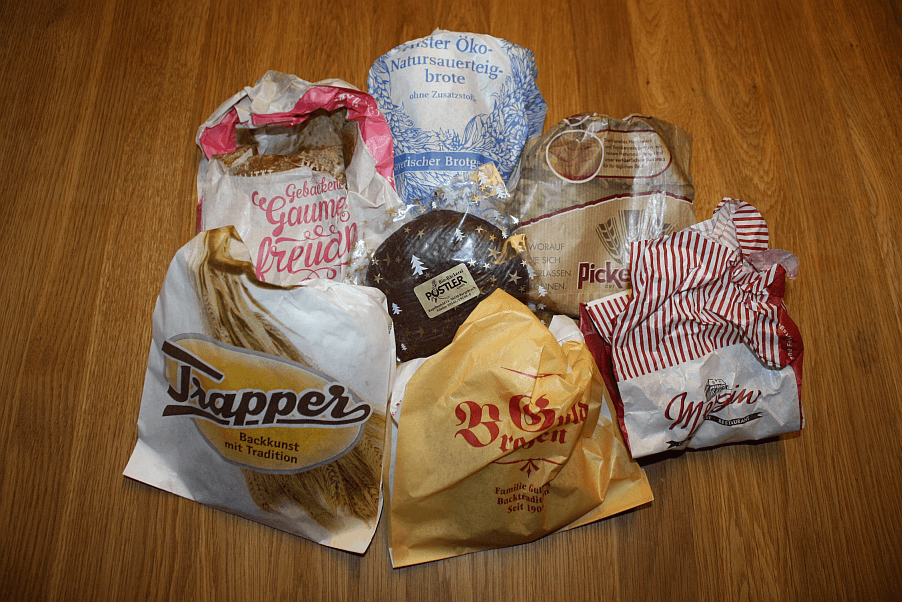
The region I live in is the Promised Land if you like bread, pork-based meat dishes, sausages, beer, and baked goods in general. Germany is famous for its wonderful bread varieties, and Franconia has the best breads in Germany. But I'm actually not concerned with bread at all at the moment - my mind is much more seasonally and regionally occupied: with Lebkuchen.

Lebkuchen (which may or may not contain ginger in the spice mix, and thus may or may not be translatable as gingerbread) is especially famous if coming from Nuremberg (or the area), and the best kind are Elisen-Lebkuchen, which contain little or no flour. I have my own recipe for them, and I like the result a lot, but this year, we'll get our supply again from our favourite Lebküchnerei (which is a bakery, but making only - or almost only - Lebkuchen. Welcome to Nuremberg.)

We (and quite a few of our friends) are quite sure that those are the world's best ones. But of course, tastes differ, and there's always the (albeit small) chance that there might be something even better around. So what do you do, obviously?

You team up with like-minded Lebkuchen-loving curious people and get a variety of individual ones from individual small bakeries. All hand-made. All of the "Elisen" variety. All covered with dark chocolate (because, really, there IS only that kind, if you ask me). Several of them claiming of being the best ones in town.

lebkuchen

And then you get together and cut them all into parts and taste them all to see which ones are best. Like a wine-tasting, only with tea instead of water to accompany the wine, and Lebkuchen instead of wine. (Friends of ours, by the way, did something similar with Bratwurst - there are so many good ones that it's really hard to find out which ones are best. They had a barbecue event and tried sausages from about a dozen different places. That's dedication!)

I'm really, really looking forward to finding out which one will be the best of the lot - and how they compare to our benchmark Lebkuchen.
0
DEC
06
0

Linzer Plätzchen.

There's a few recipes left that are among my usual candidates for the seasonal baking that I haven't shared with you yet - so this year, you are getting the Linzer Plätzchen. These have only been part of the selection for a few years now, but have become one of my firm favourites.

They are egg-free, slightly nutty, slightly spiced and I like them best with raspberry jam filling that still has the little kernels in, as it somehow feels more like proper raspberry for me then (even though it means that a kernel might get stuck between teeth now and then).

So here you go:

250 g butter
100 g powdered sugar
300 g flour
200 g hazelnuts, ground (I use medium-coarse ones)
2 teaspoons cinnamon, ground
about half a teaspoon each of powdered cardamom and cloves (the German measurement is "je 2 Messerspitzen", which is twice a small heap of powder on the tip of a knife)
2 tablespoons cocoa

raspberry jam for the filling

Soften the butter and stir in the powdered sugar until creamy, then knead the remaining ingredients into the mix. Set into a cool place for a while to rest.
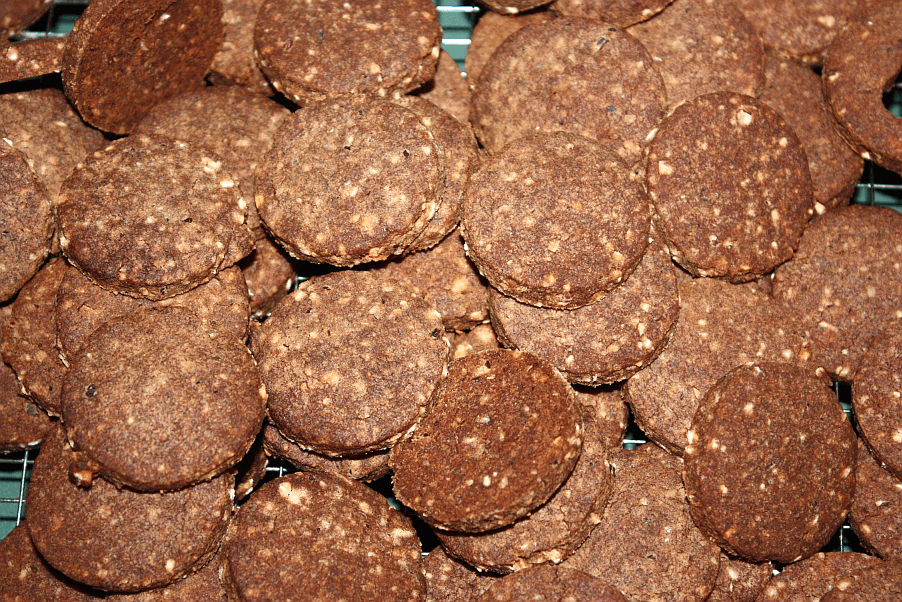
Knead the cold dough until malleable again. Roll out between sheets of foil (I use silicone baking mats for this, as they are re-usable and cause no extra plastic waste) to about 3-4 mm thickness, then cut out cookies. Bake at about 170-180° C for about 8 minutes, taking care that they don't turn too dark.

linzer_halb

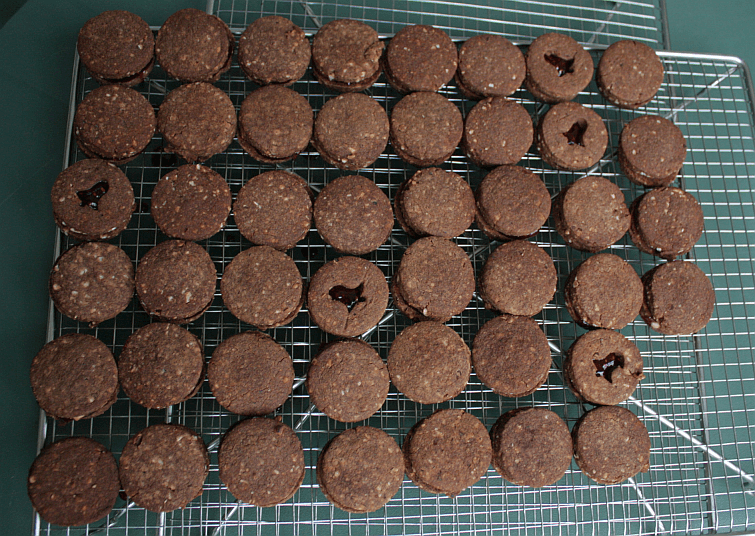
After they have cooled off, glue them together with a generous dollop of raspberry jam. Makes about 45 cookies.

linzer_fertig

Happy baking!

The other seasonal recipes that I blogged in the past are:
0

By accepting you will be accessing a service provided by a third-party external to https://pallia.net/

Contact