




Latest Comments

Guest - Katrin Sprang Discussion
18 September 2026
Hi Rachel, I have looked for more photos of you, but that was not very successful. I found a link on...
Guest - Beatrix Sprang Discussion
15 September 2026
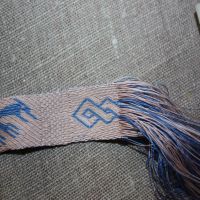
That lozenge pattern element is not a photograph, but a scan. So it should be to scale. But I pinned...
Guest - Katrin Sprang Discussion
15 September 2026
I was not referring to Rachel's reconstruction (is the reconstruction you refer to the one photograp...
Guest - Beatrix Sprang Discussion
14 September 2026
There is something Rachel did not mention. She told me: "Well, I worked with the measurements we too...
Guest - Katrin Sprang Discussion
14 September 2026
Well, this is certainly developing into an interesting discussion. Firstly, going from that lovely l...

Really Old Indigo Dyeing.

In Peru, cotton textiles have been found that are the earliest evidence for indigo dyeing to date - about six thousand years old. Both the LA Times and the Smithsonian Magazine have an article about these finds.

It really is an amazing find - firstly because these textiles have survived at all for six thousand years, in a condition good enough to still see the blue colour, even though it's faded, with the naked eye. Secondly, it's not just a few fragments, it's thousands of them. Thousands!

The fragments have been cleaned and partly analysed; you can read an article about the dye analysis here.
0
Opus Anglicanum Exhibition coming up
First Times.
 

Comments 1

Catherine Raymond (website) on Saturday, 24 September 2016 23:11

Thanks for posting about this discovery.

I learned of the recent analysis of this find from a friend of mine, who read the article closely because she knows that tests for indigotin and indirubin, the active dye substances in the indiqo plant, are found in other plants (woad, for example) and that the tests for these substances cannot determine the specific plant from which they came. The scientific article about the dye analysis says: "The source of the indigoid dye at Huaca Prieta was most likely Indigofera spp.; however, other indigo-producing plants native to the tropics of South America are grown as dye plants today, including Justicia colorifera (cuaja tinta or tinta montes), Koanophyllon tinctorium Arruda, and Cybistax antisyphilitica Martius (yangua). These plants produce blues similar to those of Indigofera, and the dye produced by yangua, for instance, contains both indigotin and indurbin [sic] (22). Although these plants are not grown on the north coast of Peru today, their distribution 6000 to 7000 years ago is unknown."

So the news articles' claim that the Peruvian textile was an example of "indigo" dyeing might be technically incorrect depending on how one defines "indigo", but the find still is amazing and wonderful.

Thanks for posting about this discovery. I learned of the recent analysis of this find from a friend of mine, who read the article closely because she knows that tests for indigotin and indirubin, the active dye substances in the indiqo plant, are found in other plants (woad, for example) and that the tests for these substances cannot determine the specific plant from which they came. The scientific article about the dye analysis says: "The source of the indigoid dye at Huaca Prieta was most likely Indigofera spp.; however, other indigo-producing plants native to the tropics of South America are grown as dye plants today, including Justicia colorifera (cuaja tinta or tinta montes), Koanophyllon tinctorium Arruda, and Cybistax antisyphilitica Martius (yangua). These plants produce blues similar to those of Indigofera, and the dye produced by yangua, for instance, contains both indigotin and indurbin [sic] (22). Although these plants are not grown on the north coast of Peru today, their distribution 6000 to 7000 years ago is unknown." So the news articles' claim that the Peruvian textile was an example of "indigo" dyeing might be technically incorrect depending on how one defines "indigo", but the find still is amazing and wonderful.
Already Registered? Login Here
Monday, 21 September 2026

Related Posts

By accepting you will be accessing a service provided by a third-party external to https://pallia.net/

Contact