
Latest Comments

Guest - Max Mustermann The True Cost of Driving a Car.
06 November 2026
Great breakdown — the non-fuel costs are exactly the bit most people forget when they compare cars. ...
Guest - Harma Phew. Now it gets involved!
21 October 2026
Have fun at these events.
Guest - Aislinn Dyestuff Citizen Science.
09 October 2026
This is a great project. I look forward to the results. Thanks for letting us know.
Guest - Aislinn Time for...
09 October 2026
Looks delicious!
Guest - Katrin Sprang Discussion
18 September 2026
Hi Rachel, I have looked for more photos of you, but that was not very successful. I found a link on...
SEP
11
7

Sprang Discussion

Beatrix' comment to yesterday's blog post merits an answer. I was originally planning to do that in the comment section, but it is a little too long for that, and I ended up wanting images, so here's my reply.

In one of the articles published about the piece, a 57 cm head circumference is mentioned as the reconstructed head size for the cap to fit, which corresponds to an not overly large modern woman's head (I think the article is the one in the Collingwood memorial volume, "Crafting Textiles"). If one looks at the re-drawings of caps worn by women in the article "Enigmatic Beauty", the ones showing the back are all going down into the nape of the neck and are fully covered by the ties, with the sprang panel sometimes jutting out a bit (presumably to accommodate a hairbun). A very nice example is online in the collection of the GNM. In no case I have been able to find, either on the images referred to in "Enigmatic Beauty" nor on other images, the lower end of the sprang panel being visible; the ties always sit low, always cut across the sprang at its full width, and with the sprang panel pattern visible right above the ties.


Both the reconstruction and the original on the images in the "Crafting Textiles" book sit fairly high up on the dummy head, and the reconstruction is also shown from the back. There, it is possible to see the double-thread sprang passage just on top of the crossed ties, which is about mid-way up the back of the head. That is not what I would consider a "good fit" compared to the contemporary images. Coincidentally, if wearing the hair in a bun, this is the typical place where most of the hair mass would sit. Placing the ties just there makes the whole arrangement either quite uncomfortable or insecure, in my personal test results.

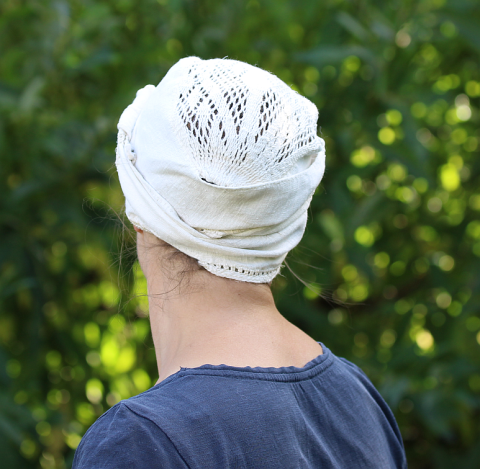
This is the cap done, as best as possible, to the measurements given in the articles about the piece. The sprang section is 27 cm long allover. As you can see on the left, the cap sits right at my hairline, not especially deep in the forehead. On the right, you can see how it looked after careful arranging of the ties so that they more or less covered the lower edge of the panel. It took some fiddling, and you can still see a little gap. The ties are definitely not crossing low on the nape of the neck here. 

For the sake of full disclosure on my head size: My head measures 57 cm around on ear level if I measure over all my hair put up in a bun. It is 52.5 cm measured at the same place without hair. The circumference going from below the hairline in front of the forehead to the nape of my neck and back is exactly 52 cm. Measurement from front of hairline in the middle of the forehead to the nape of the neck, across the middle of my head and down to the nape, going over the bun lets me come out at about 37 cm.

(And now you know more about my head measurements than you ever wanted to know.)

Now, this specific cap might have been worn differently, or on a much smaller head, resulting in a different fit, which might well have been the case, and so a 27 cm sprang panel might have been the correct full length. It might have been worn by a small child, for all we know.

But then the maths still does not add up. We have a full length of 27 cm of the complete sprang panel stated, measured from top to bottom. I assume this does include the double-thread passage at the end, as there is nothing mentioned anywhere to hint at this being only the patterned section. 

On one of the images published in the article "Linen sprang from Lengberg Castle", it is possible to measure the length of one of the lozenges in the pattern. I get about 1.8 to 2 cm, so let's stick with 1.8 as the smaller measure.

That pattern element consists of 10 rows, which gives each row an approximate height of 1.8 mm. The complete pattern has 186 numbered rows, as published after Carol Jones' reconstruction in the article "Enigmatic Beauty". There is one un-numbered row above row 1, which is a plain 1-1 row. (There are some numbering hiccups in the pattern, looking at the numbers on the side, but they even out.) In addition to these main pattern rows, there is the slightly wider row formed around the starting thread, and because the pattern holes in the image mentioned above only start at a little distance from that starting thread, there have to be two more plain rows before the pattern start (of which one would be the un-numbered 1-1 row in the pattern). Then there's an additional seven rows done with double threads at the very end, narrowing down the panel.

So we have 188 sprang rows, plus the slightly thicker starting row around the anchor thread, plus the seven double-thread rows. Even if we say all of these are no larger than the 1.8 mm found above, a total of 196 rows times 1.8 mm results in 352.8 mm - so 35 cm and a bit. Consequently, one thing must be incorrect: either the 27 cm total panel length, or the pattern description as given, with the 1.5 repetitions of the motif.

Which means either the sprang pattern length would need to be revisited, or one of the measurements somewhere has a typo or was erroneous (which we all know can happen, or, as the German physicists taught me, "Wer mißt, mißt Mist" because something can always go more or less wrong), or there is something else somewhere that would explain the discrepancies. I cannot say which is the case - only what I have found from trying to work the reconstruction as described in the articles.


Literature referred to:

Nutz, Beatrix, Case, Rachel and James, Carol 2021. A unique survival: A woman's fifteenth-century headdress from Lengberg Castle, East Tyrol. In: PRITCHARD, F. (ed.) Crafting Textiles: Tablet Weaving, Sprang, Lace and Other Techniques from the Bronze Age to the Early 17th Century. Oxford: Oxbow Books.

Case, Rachel, Nutz, Beatrix and James, Carol. 2019. Enigmatic Beauty. The Decorative Headwear of Lengberg Castle.

0
SEP
10
1

Sprang Update.

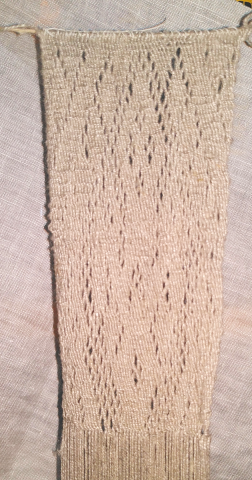
You remember the Lengberg Sprang cap project? Something about the sprang panel has somehow kept nagging, especially the difference between the length I had at the end with my piece and the original length as stated in the article. So... I have started it once more, and it does look like I'm at the same density now. 

There's also a difference between the pattern given in the article "Enigmatic Beauty" and the pattern shown on the photograph; there is a hole missing in the pattern to form one more lozenge instead of a solid diagonal. I only noticed because I had measured said lozenge on the photograph to find out how long it was in the original (20 mm) and then I had progressed beyond that area in my piece and went to measure the lozenge and... it wasn't there. 

Cue an unsuccessful try to spot-fix, a complete unraveling, and a startover, this time with the amended pattern. And yes, my specimen measures 20 mm to the end of the lozenge. So... whew.

This is somewhere around row 60-something now, so still about 120 rows to go.

However... however, this also means that a pattern with one and a half repeats of the tree of life, with its 120 or so rows, cannot be done in 27 cm of length. If I do the maths on that, I end up with something around 40 cm of length. Which would, actually, be a much better fit for the head of a fully grown woman, as the cap I made stopping at the 27 cm length ends up with the lower edge of the sprang panel on the middle of my back of head. In contrast, the images showing these caps are always reaching down to the nape of the neck, where the end of the inset is covered with the bands crossing over. I can do the covering with crossing, but it's way further up, and takes some fiddling, and even then it's not a really nice fit and really nice coverage.

So something about the numbers seens to be amiss in that article, especially as the numbers listed in the text and the schematic drawings also do not match everywhere. The sprang was fragmented, but it must have been complete enough to read out the 1.5 pattern repeats of the motif, so it cannot have been totally fragmented, which makes me wonder what happened to give these measurements that do not seem to fit together.

For now, I will assume that the 1.5 pattern repeats are correct, and I will follow through until I have the full length of the panel as stated in the text - and then I will have a look at how the linen pieces will have to look to fit it, and how that compares with the original cap.

0
SEP
09
1

Figs. And some movement in the PPWR mess.

To my very great delight, the fig bush (tree would be rather generous) in front of our garage wall is actually bearing a good number of figs this year, and they (the late batch) are currently ripening - at least some of them. Now I only have to hold out long enough for the individual ones to really, fully, properly ripen... I've managed to pluck a few already that would have benefitted from a day or three longer on the branch. But, well, figs!

Also good, though I'm still not holding my breath: Apparently there is a German request for the EU to change regulations for the PPWR, including a moratorium on the authorised representative and Europe-wide thresholds for the small players. I am hoping this will go through, and we will finally have a sensible regulation. (Maybe some of the politicians have found out that some of their own preferred stuff is not coming anymore? Who knows. And actually, I don't really care why, as long as they arrive at a sensible solution!)

0
SEP
08
0

Textile Forum Plannings.

To my great delight (and relief), the Textile Forum 2026 is now coming together very nicely. I have a few unconfirmed things in the pipeline still, but I am hopeful that they will end up on the menu, too.

So far, we will be looking at heddle variations (with knots, that being our main topic); textile finishings; making passementerie-type items (and freehand! I am so looking forward to this!); going to have a try at doing ikat dyeing, and I am hoping that things will work out in a way here that I will be able to do a little workshop on filet netting. That is a lovely technique that I like very much, but it's also notoriously awkward to teach. The good news on it is that because there is one single knot that is repeated over and over and over, you only have to learn that one knot. The bad news is that it consists of a series of movements that have to be done exactly right, or the knot will not form properly, and you have to do the full series of movements, there's no good way to break it down into baby steps. So I have kind of a love-hate-relationship for teaching this (with the love prevailing, admittedly).

If you're curious (or if you want to join in), registration is open on the website of the Forum, textileforum.org, and there's also some space left for presentations or workshops!

0
SEP
07
0

The State of Affairs.

If you have followed German news, you will know already that the AfD has gotten their highest results ever in the elections yesterday, making them the strongest party in Sachsen-Anhalt for the next years. This is going to make things... interesting, to say the least.

In the best case, the other parties will realise that it's getting really hairy now, get their shit together, team up and run the show at least in a mediocre-but-acceptable way. In the best case, some other politicians will also get their shit together and finally go for the Verbotsverfahren (to ban the whole party because it is, at least in large parts, confirmed right-wing-extremist and against the German constitution). In a not as good scenario, people will realise that they are enabling a shitshow here, and make better choices next time. In any case, even in the best ones, we'll have plenty of fallout.

The Worst Chancellor of All Times (at least according to surveys about how much he is appreciated, or not) is probably going to find some way to get the shit to the fan quicker, and the fan sped up. Well, well, well.

On a different but also not happy note, there's also discussion to make self-employed people here pay into the state pension. If you are a regular employee, you have to do that no matter what; the big difference being that as a regularly employed person, you are also getting a regular income in a known, fixed height, which is not the case for self-employed people. 

The idea behind this is, or so some of the reports tell us, to avoid solo entrepreneurs or other self-employed people running into monetary trouble in their pension age. At the moment, you have to care for your future yourself, so either you get rich enough just like so, or you pay into some private insurance. Or, as sadly happens quite a bit it seems, you ignore this and just, well, do nothing to prepare when you're old and cranky and maybe not able to work anymore.

So the basic idea is, if not noble, then at least understandable, and not superduperbad. The problem, though, is that the plan is to apply a fixed sum to pay monthly... and I am rather doubting that it will be a small sum. That comes on top of the obligatory health insurance, where you also pay a fixed sum in full each month. 

I am looking at this with more than a little doubt. It's already quite a stretch to go self-employed in Germany, this will add to the burden. At least it seems that it is to only apply to new startups, so I will probably not have to deal with this. (It would also be only of limited use, since the system means that you pay, and paying a certain amount per year gives you points, which in turn decide about how much you get as pension, with some more factors coming in. But the TL;DR is - if I'd start to pay in there now, I am a little late to the party, so I'd basically get very little back. Which means that that money would need to go on top of what I do as private insurance now. 

The thing is... I'm not sure that there'd be a different country where it would be significantly easier and so much nicer that moving there would be a really good decision. I have come to the conclusion that it's always easiest to see the shitty things and those going wrong in one's own country (well, except those that one is blind to, but that's another topic), and usually you're just not getting the nitty gritty from other places.

So. We will see. And hope. Because hope... well, it rarely hurts, right?

0
SEP
04
0

Feet first, head next, right?

So if you wanted to know what I've been working on - it was this: 

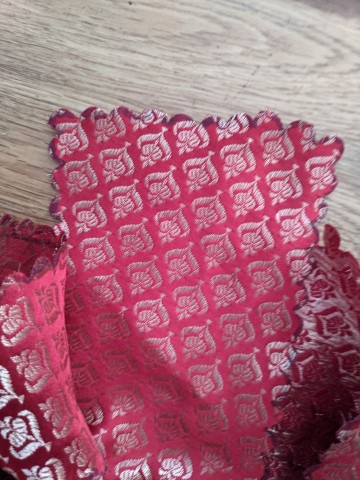
... which is part of the dagging on the hood for Oswald. I'm not entirely happy with how dark the beeswax turns out on the edges, but I also didn't want to keep it entirely unsecured. Possibly it would be less obvious with a thicker fabric, or with less hot wax, but, well, it's going to stay this way now.

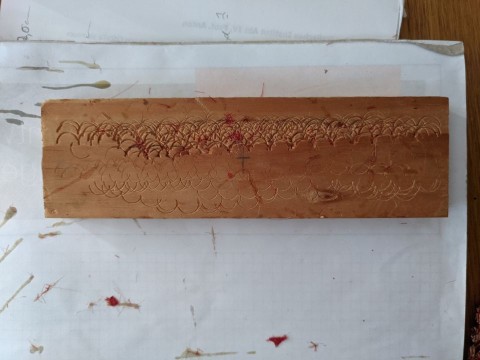
And this, by the way, is the collateral damage to my piece of support wood for making the scalloped edges:

Next step is finishing the face edge, and then putting the main piece and the liripipe together, and testing if it does look like in the image.  

0
SEP
03
2

Humans will be human.

When you study history in any context, it becomes clear rather quickly that, well, history tends to repeat itself. Mostly, if you ask me, because humans are human, both in the best and in the worst meaning of this.

If things are getting tough and scary and there's not enough to go on living as one did before, there's always a good chance that someone will get the idea that a war is the best solution for this. After all, it means you have a clear-cut enemy now who is, if in doubt, the reason for everything going wrong. Also one could just, well, take their stuff, since it's war. Easy way out. (Also a rather stupid way out in most cases, as it's not really a way out, but if you are reading this blog, I probably don't need to explain this to you.)

On the other hand, when something happens - a natural desaster, or a death in the family, or an illness, or another of the endless possibilities how one's life can be upturned - it can well be that friends and family and complete strangers suddenly stand there to help and support as best they can. There's been outpourings of help both financial and with time and labour after almost any catastrophe.

So where am I going with this article? Actually, I only wanted to write a preamble to this link to a rather, um, manly find from medieval Bryggen in Norway. Because some things, well, they just do not change, and that includes the wish to have some fun occasionally, and with help if necessary. Humans will be humans, and human ingenuity has never stopped at that, which the find is beautifully proving, in an anatomically correct and not too short way. (NSFW, just in case you haven't clicked on to this yet.)

0

By accepting you will be accessing a service provided by a third-party external to https://pallia.net/

Contact