


Search the Blog
Latest Comments
Guest - Aislinn
Dyestuff Citizen Science.
09 October 2026
This is a great project. I look forward to the results. Thanks for letting us know.
Guest - Aislinn
Time for...
09 October 2026
Looks delicious!
Guest - Katrin
Sprang Discussion
18 September 2026
Hi Rachel, I have looked for more photos of you, but that was not very successful. I found a link on...
Guest - Beatrix
Sprang Discussion
15 September 2026
That lozenge pattern element is not a photograph, but a scan. So it should be to scale. But I pinned...
Guest - Katrin
Sprang Discussion
15 September 2026
I was not referring to Rachel's reconstruction (is the reconstruction you refer to the one photograp...
All the Gory Details, parchment tablets.
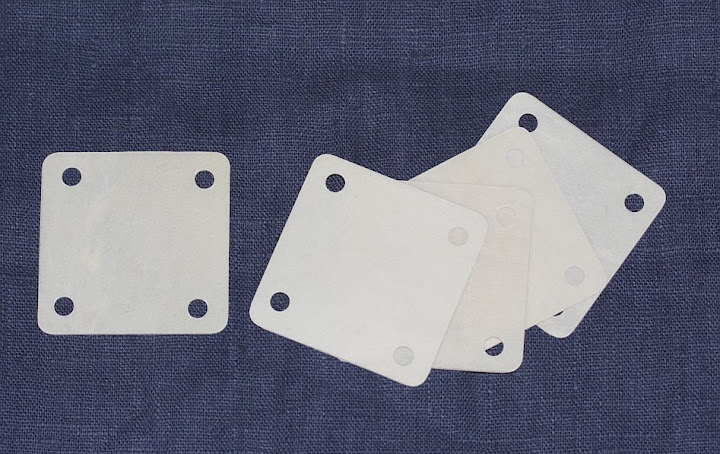
These tablets measure 6 x 6 cm, a convenient size when weaving and large enough that you can handle them well and even weave with the tablets standing on the corners, for tubular or other special weaving actions. The parchment is prepared by hand, in one of the last traditional parchment manufacturies in Germany. In this case, it is calf parchment. Rounded corners for smooth turning, large holes for ease of setting up the warp.
Parchment tablets have not been found in archaeological excavations yet (at least to my knowledge), but they are a logical material to turn to for complex bands with thin threads and lots of tablets. In some rare cases, "leather" tablets were recovered in excavations, although leather either needs to be much thicker or stiffened in some way to make it useable. A detailed analysis of these tablets would be interesting, in case they were originally parchment which underwent a kind of tanning process during burial in the soil.
In comparison to wood, horn or bone, parchment can be worked much thinner and will still be remarkably stiff and resilient. On the other hand, parchment stays flexible, so while thin wood, bone or horn might break easily, these tablets will survive bending without problem. The surface of well-prepared parchment is naturally quite smooth and will polish some more with use. With these properties, the parchment tablets are wonderful for weaving with historical material, presentations in a museum environment (please be aware that inkle looms and "tablet weave looms" are not medieval at all!), and well-suited for wide, many-tablet bands. If you are used to or happy weaving with cardboard tablets, these are a perfect historical alternative.
The parchment tablets are made completely by hand in my own workshop. The material is traditionally prepared parchment from calf hide. Being parchment, they can be marked, coloured, scribbled on - whatever is needed or desired. With a thickness of about 0,6 mm for most of them, they are slim enough so that handling a larger stack is easily possible - but stiff and wide enough to grasp them easily and that marking the edge of one tablet will clearly show.
Comments 2

doushkasmum
(website)
on Thursday, 15 October 2009 11:41
a stitch in time
(website)
on Thursday, 15 October 2009 12:10
Of course you may ask! The answer to your question is: they deal quite well. Calligraphy parchment is much thinner than the parchment I use for the tablets, and that will curl up quite pronouncedly when in high humidity. A test tablet I cut from thin parchment did this as well - one additional reason to use the 0.6 mm parchment.
The tablets will bend only slightly when in humid conditions. I have had them out in the open on very humid markets (cold and rainy or warm and damp), and they do not roll or curl up, only bend slightly. They get back into form easily by gently bending them into the opposite direction.
By accepting you will be accessing a service provided by a third-party external to https://pallia.net/