You might know the "Kuckucksuhr", that typical German clock that has a bird coming out on the full hour, making a cuckoo sound?
Well, that is not the only type of clock with a figure declaring the time of day - and there's a virtual exhibition called "Tick Tack Trick - Schwarzwalduhren mit Figuren" (Tick Tack Trick - Black Forest Clocks with Figures). While the text is all in German, there's a little video for each of the clocks that are featured, and those are all without text, but with clock sounds - and thoroughly enjoyable!
While we're at the topic of time - tomorrow is a public holiday here in Germany, so you'll get no blog post. See you on Friday!
There's so much knowledge that we have lost about medieval crafting - but some of it has been re-discovered, or has been revived. Watching these old crafts come to life again is something utterly fascinating, and I always find it amazing how much time and effort goes into something that, at first glance, seems quite simple. Such as a rafter holding up a roof.
A Swedish museum has posted this video on Youtube, and if you have twenty minutes to spare, it's amazing:
If you're a European citizen, please remember that the European Elections are coming up - and voting is a right and a privilege that we all should make use of.
If you're not sure how this all works, you can have a look at the European Elections webpage, where you can also find country-specific information and instructions by selecting your language. If you cannot get to a voting place on the election date, it might still be early enough for you to request mail voting.
If you are a German citizen and you are not sure what to vote for, I find the Wahl-O-Mat incredibly helpful. It asks about your personal opinion on a number of topics, and then you can compare your stance with that of different parties. If the party has given a reason or explanation for their answer, it is also listed in the results. (By the way, reading the explanations given by "Die PARTEI" was hilarious. Also wonderfully sarcastic in some cases.)
While the Wahl-O-Mat is a purely German thing, it's not the only voting advice application around - follow the link to find a wikipedia list of a number of them.
And whatever you choose - please go vote. Every vote counts.
Books. Aren't they always nice to have? To leaf through? Can one have too many books?
Well, the obvious answer to this is both yes and no. So in case you are currently tending more towards the no, here are two books that might be interesting for you:
If you are interested in medieval metalworking, there's a new book out, published in French, on copper and copper-alloy workplaces discovered in Saint-Julien in Douai. The book is called "Travailler le cuivre à Douai au XIIIe siècle. Histoire et archéologie d’un atelier de proximité", by Lise Saussus (dir.), together with Nicolas Thomas, Marisa Pirson and Benjamin Jagou. Douai et Louvain-la-Neuve, 2019. Here's the abstract, in French and English:
De 1983 à 1987, une fouille archéologique rue Saint-Julien à Douai révèle un atelier et ses quelques milliers de déchets témoignant d’un travail du cuivre et de ses alliages au XIIIe siècle. Cette publication examine l’unité de production à la lumière des sources archéologiques, mais aussi de sources écrites et archéométriques. Elle présente le cadre de la découverte à l’échelle de la ville jusqu’à celle de la parcelle en s’intéressant à l’intégration des métiers du cuivre dans le tissu urbain. L’étude de la stratigraphie et des structures composant cet atelier dans un vaste espace de près de 1 000 m² précède l’analyse du mobilier métallurgique, des techniques variées, en particulier celles des réparations de vaisselle, mais aussi des alliages mis en œuvre. Enrichie par l’examen du travail du fer, associé à celui du cuivre, et d’une partie de la vaisselle en céramique consommée sur le site, l’étude illustre un de ces ateliers de proximité qui ont subsisté à côté des grands centres de production tels ceux de la vallée de la Meuse. Voué à l’entretien des vaisselles, enclin à répondre à des commandes variées, ce type d’ateliers actifs aux échelles locales, celles de la ville et de ses alentours, profite de la circulation des productions de masse mises sur le marché à une échelle globale.
From 1983 to 1987, an archaeological excavation along the rue Saint-Julien in Douai revealed a workshop and its several thousand pieces of waste, testifying to the work of copper and its alloys during the 13th century. In this book, the workplace is examined in the light of archaeological sources, but also of written and archaeometric sources. It presents the framework of the discovery from the global scale of the city to the particular plot by focusing on the integration of the metalworking professions into the urban fabric. The study of the stratigraphy and structures composing this workshop in a vast space of nearly 1,000 m² precedes the analysis of the metallurgical finds, of the various techniques, in particular those of cooking and table utensil’s repairs, but also of the alloys used. Enriched by the examination of the ironwork associated with the copperwork, and part of the ceramic tableware consumed on the site, the study illustrates one of these local workshops that have survived alongside major production centres, such as those in the Meuse valley. Dedicated to the maintenance of crockery, inclined to respond to various demands, this type of workshop, active at the local level of the city and its surroundings, benefits from the circulation of mass productions placed on the market on a global scale.
The book has 277 pages and costs 30€ plus shipping costs; you can order it (and inquire about shipping costs) at either This email address is being protected from spambots. You need JavaScript enabled to view it. or This email address is being protected from spambots. You need JavaScript enabled to view it..
I'm prepping for the Nadelwelt fair - checking all the things that need to be checked, charging all the batteries, topping up the stock stuff that needs to be topped up.
Also, of course, packing the overnight things - which always include the Three Magic Wellness Things: the travel yoga mat, my current knitting project, and something to read (which usually means the e-book reader). It also always includes, of course, the washbag... which this time around put me in front of a slight problem.
As this is also what goes with me on cycling and paddling holidays, and has to fit into rather small bags for that, my washbag is supposed to stay as small as possible. Unfortunately, over the years, it has grown a bit, due to my wanting to take some additional stuff. Such as a pair of glasses for when the lenses are out. Or more skincare products. Age, here, is definitely leaving some traces!
So in the quest of keeping it small and manageable, most of the things are packed into small containers. Which means my soapbox is an old small box for peppermint candies, and it will only fit a very slim piece of soap. Which, in turn, means I occasionally transfer a piece that has shrunk enough into my travel washbag, and replace the shrunken piece with a new big one.
This time, the small piece came from the soapbox that I take with me to the bouldering gym... but the new piece of soap, bought from a soapmaking manufacture, was so large that it didn't fit that box either. A quick internet search later, and now I know how to divide a piece of soap.
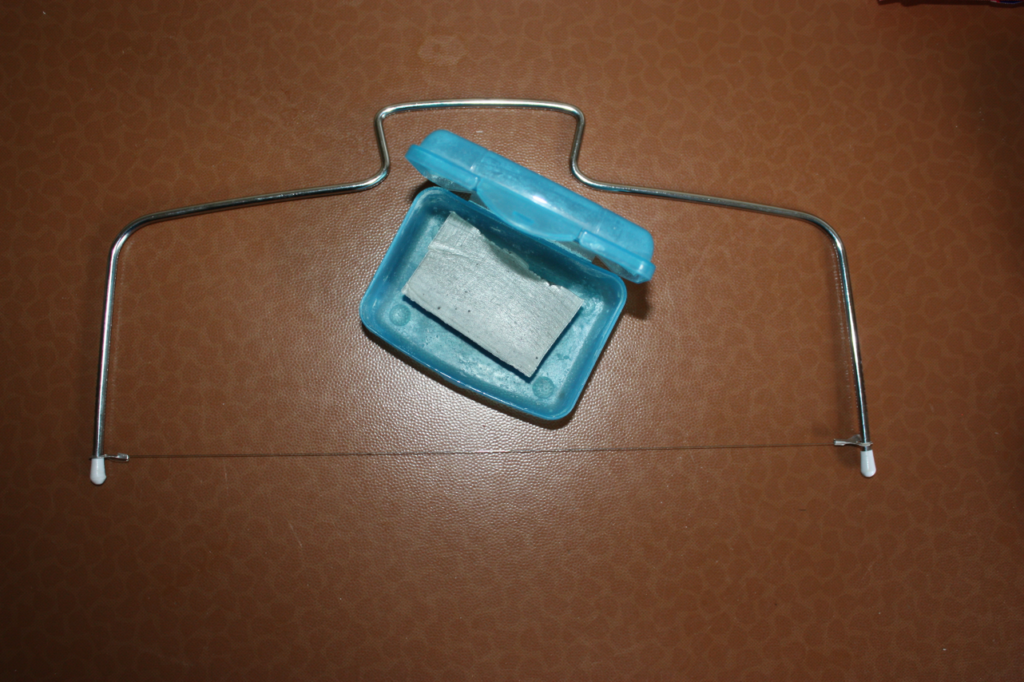
The easiest way to do this without the soap splintering is to heat it up in the oven, at about 100° C for at least half an hour; this softens the piece. Then you can either cut it by pressing through it with a very sharp knife, or try using a piece of thin, strong string, or - probably the best method - cut it with a thin wire. I used the wire from a cake cutting device that hangs out in our kitchen, and it worked very well indeed.
One quarter of the huge piece that I had to cut apart, and the cake-cutting wire device thingie. Which, by the way, also works fantastically on cake.
So now my soap round-robin is done (and I have three more pieces that will fit the box, too) - on to the rest of the packing!