Latest Comments

Guest - Max Mustermann The True Cost of Driving a Car.
06 November 2026
Great breakdown — the non-fuel costs are exactly the bit most people forget when they compare cars. ...
Guest - Harma Phew. Now it gets involved!
21 October 2026
Have fun at these events.
Guest - Aislinn Dyestuff Citizen Science.
09 October 2026
This is a great project. I look forward to the results. Thanks for letting us know.
Guest - Aislinn Time for...
09 October 2026
Looks delicious!
Guest - Katrin Sprang Discussion
18 September 2026
Hi Rachel, I have looked for more photos of you, but that was not very successful. I found a link on...
MAR
18
0

Friday Linky Stuff Round-Up.

It's Friday again, the sun is shining, and I am in dire need of some coffee (which I will make as soon as this blogpost is done). So - Friday links for you!

First of all, there's a nice post by Juliet McKenna about embroidery, and what the "richly embroidered wall-hangings" in a fantasy novel (or in a medieval source, of course) actually mean in terms of time spent (and thus in terms of wealth).

Twitter has changed its display style from chronological to an algorithm a bit similar to the Facebook one - you are now getting tweets first in line that the algo thinks you'd be more interested in. Here's a longer post about it - but if you just want to go back to how Twitter was before, go into the "settings" menu and uncheck the appropriate box.

Internet memes change our language - for instance, turning nouns into verbs (let me google that for you) has become quite common. JSTOR Daily has an article about this phenomenon here.

The British Library has an Anglo-Saxon manuscript digitisation project running, and the latest addition is the 11th-12th century MS Cotton Vespasian A XIV, which contains the letter book of Archbishop Wulfstan.

Medieval Histories has a short article about 13th-century knitted mittens from Estonia (where else?).

And that's it for this week. Have a sunny weekend!
0
MAR
14
0

Happy Pi Day!

It's Pi Day! Hooray! And now you are getting a really crude transition in addition to a late and short blog post - I had a meeting today that ran a huge lot longer than anticipated, and it shot my schedule for the day to the ittiest bittiest bits imaginable.

It is Pi Day. Pi sounds just like pie. Pie has layers. Something else that had layers? This Mortlake tapestry, dating to the 1630s - a part of the tapestry was folded back and hidden...

Also fascinating: Conservation treatment of a Sudanese leather dress.

Finally, if you'd like some fresh fiction in audio - here's a list of the Hugo Award eligible stories that ran on the Escape Artists Network. Enjoy!
0
MAR
08
0

International Women's Day.

Today is... International Women's Day.

Which gets me pondering...

There's a lot of International Whatever Days that make me smile, and I happily celebrate them (if only by tweeting about them or blogging, in some cases). Like Star Wars Day (May the Fourth, of course), or Talk like a Pirate Day, or Pi Day (March fourteen. Coming soon!). These are fun, and funny, and they can bring smiles to faces, which is all good. Sometimes they're an excuse to get a fancy pie (or make one), or geek out with friends.

On the other hand, there's also the serious days that serve as reminders that there are issues we, as humans, need to solve. Like cancer, or depression. These days serve a purpose, and they are a good thing to have. War Remembrance days fall into sort of the same category, for me - they remind us that we, as humans, should maybe do better in the future.

Women's Day, though, just like Mother's Day (which is an even worse thing as it has gotten so commercialised) - they make me sad in a way that the other serious days don't. Goodness, we're living in the 21st century. Shouldn't we all have realised by now that while yes, there are differences between men and women (obviously, and not only the external appearance), both men and women are human beings who have something to contribute to society? That both men and women formed history, and made important contributions? That men and women deserve the same chances, the same opportunities, the same pay rates? Which, unfortunately, is still not the case. We're all still caught in biases and prejudice, deeply ingrained due to the culture that we grew up in. Finding those biases and blind spots is not easy - it does take effort, and sometimes they are so subtle it's nearly impossible to find them out and counter them. So men and women today are still not considered equal - and that's sad.

On the upside - the fact that there is a Day for this hints at humanity somehow being aware that this is an issue, and that it should be fixed. So. Happy International Women's Day, everyone. May we not need a day like that in the future anymore.
0
MAR
07
0

Amusing Links.

I think it's time for some bits of art and creativity, randomly pulled together from parts of the Internet:

Saraswati, a Malaysian lady, uses make-up artistry and hijabs to recreate Disney princesses (and, in some cases, non-princess characters). It really creates amazing effects!

Ruby Silvious has a very different, but also unusual canvas, painting on used tea bags - one for each week of the year.

Not an art article per se, but using medieval (and later) pictures: Why do women carry things on their heads?
And finally, the art of surprising your students with bonus questions (and some of the answers) for a statistics exam. Sadly, I would not have had much luck with them (but they are still very funny to look at).
0
FEB
26
2

Please beware.

(I had planned a different post for today - but due to something I found in my inbox just this morning, I'll be pushing the post about textile stuff to Monday instead. It will come, though!)

Recently, there's been a new virus called "Locky" that comes in Word files. When opened, they contain a macro that sets the virus free on your computer; it then encrypts your files, and you are supposed to pay money (probably a lot of it) to get the key to decrypt your data again. Ransomware like that has been around for a while, but "Locky" spread quite furiously, since it took a while for antivirus software to be able to detect it.

(So - don't open word files that come from sources you don't know. And make sure your word security settings regarding macros are set to "high". That is the default setting; if you're not sure, here are instructions on how to change macro security settings.)

Everyone, though, should know by now that opening email attachments from unknown sources, especially if they are not a .pdf, is a bad idea. What I personally find really disturbing is not the stable-ish number of sketchy attachments arriving in my inbox, however. It's the quality of the most recent phishing emails that I've been getting.

Just this morning, I got a "payment confirmation" from "Paypal". Which told me that I have successfully transferred money for a one-month membership to a porn site. Helloooo? What?

The mail looks almost exactly like legit payment confirmations from Paypal. It uses the original images from the PP server, and layout and design are very similar.

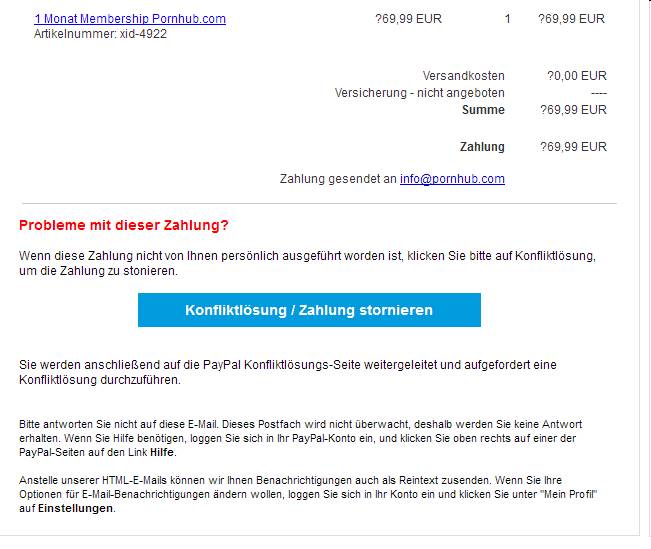
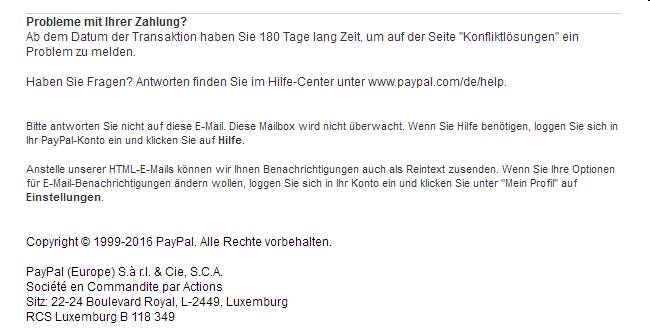
The differences are very subtle: there's a reference number in the top right corner that looks like a link but is not (it is in the legit version). Same with the item description. In the mail I received, there was also a question mark in front of every number.

The scam is also missing the imprint data that PP includes at the end of the mails. The biggest (and most important) difference, however, is the inclusion of a nice, big, friendly button to cancel the payment.

Here's how the lower part of a legit payment confirmation looks:

[caption id="attachment_2244" align="alignnone" width="650"]This is only the bottom part of a legit payment confirmation, received just this morning (I had to buy postage). There's an invoice number just above the light grey line on the top of the picture, which I'm not showing due to privacy reasons. This is only the bottom part of a legit payment confirmation, received just this morning (I had to buy postage). There's an invoice number just above the light grey line on the top of the picture, which I'm not showing due to privacy reasons.


In comparison, this is how the scam/phishing email looks:

[caption id="attachment_2243" align="alignnone" width="651"]paypal_scam You can see that the invoice number is missing. The "problems?" thing is in red, to make sure you see it... and then that nice, friendly, ohsohelpful button (which, you guessed it, will not lead to Paypal proper, but somewhere else).


In case you get something like that, from Paypal or from any other banking/finances site (I received one about a credit card a while ago, if I remember correctly), take a deep breath, open your browser and go directly to Paypal or to your bank. Log in and check - you will find that nothing has actually happened on your account.

You can then report the scam - there's various ways to report various scams, but it's always a good idea to forward the scammy mail to the actual company that it is spoofing.

These scams have gotten much, much better over the course of the last few months, and they really do look a lot like official stuff. With so much of commerce and invoices going through the 'net these days, I guess that they are a very good strategy to making money by fraud. So please beware, double-check, and be safe. Have a backup or two. Never click links in sketchy emails, open dubious attachments, and don't believe everything a random email tells you.

 
0
FEB
22
0

Honey Knowledge.

About a year ago, I sort of decided that keeping bees would be a nice thing to do, as there are too few bees around hereabouts, and it can never hurt to have some more. Bees are wonderful, astounding and fascinating creatures - they not only produce honey (which I don't eat so much of, but I still like it quite a bit), wax (one of the main reasons why they were cultivated in the Middle Ages - there's much less wax to be harvested from a hive than honey) and propolis (I always have a bottle of propolis dissolved in alcohol in my travelling kit), they are also the reason why we get to eat fruits and vegetables. Many, many edible things would not be there if it weren't for the bees...

However, before taking the lives and well-being of several thousand creatures (like 30-50.000) into my hands, I'd like to have some proper grounding in knowledge and experience. So I spent this Saturday learning about the many things that can befall bees and make them suffer, or even die.

One of the things every beekeeper these days has to cope with, and be on the lookout for, is the varroa mite. That is a parasite originally living off Asian honey bees, but it has spread to almost everywhere worldwide these days. The other bees, though, have never developed coping mechanisms for this parasite - so without treatment, the mites will suck on the bee brood and the adults, shortening their lifespan by about one third. Which means that without treatment, the winter worker bees will not survive until April, and die about at the end of January or in February instead. With a lot of the workers dead, the hive cannot generate enough warmth anymore, and there are not enough bees to get the colony going again in spring - so the whole hive will die off.

Another thing, that I will hopefully never have to see myself when keeping bees, is American Foulbrood. This is a bacterial infection that targets the bee brood, and the younger brood is very vulnerable to the bacteria - as little as a single one is enough to infect a one-day old larva. The honey from a hive with this disease is still safe for human consumption, and in some countries it is acceptable practice to keep the symptoms down with antibiotic treatment. However, this means that the honey you buy might contain spores of the bacterium - completely safe to consume for you, but dangerous to bees. If bees eat that honey, they carry the bacteria back to their hive, and there the nasty little buggers can wreak havoc. A hive that is infested with AFB has to be killed off, and the hive box and equipment has to be either burned to destroy it or disinfected completely. If you have AFB in Germany, you have to inform the authorities, there will be an off-limits area established around the stricken hive, and all hives inside the area will have to be tested for AFB as well. This disease? It's really, really nasty. And it can be spread by honey that is perfectly fine and healthy for humans to eat.

Which means... please don't spill honey outside, or leave honey for insects to find and eat. Make sure any honey containers are rinsed, or closed properly (or both) before tossing them. Your honey spills could kill off a bee hive - or even several.
0
FEB
18
0

Lots of Links.

I have a stack of diverse links for you again - hope you'll enjoy them!

First of all, for those of you who understand German, here's a nice video about archaeological excavations of a Villa Rustica (a Roman villa):


Shit Academics Say has a really interesting article about quitting one's PhD study over at the blog - if you're struggling with your PhD and are not feeling happy with the thought of spending x more months doing this work, I'd definitely recommend it.

Historian Sasha Handley is just starting out with a blog about the history of sleep - go check out the very first post on the blog, if human sleep in Early Modern Age is of interest to you.

On an unrelated note: Edible Spoons! (Looks like the spoon-baking thingummy is just a prototype yet, though, and thus not really available.)

And finally, if you're non-white and an SFF fan, you can request assistance to be able to attend a con via Con or Bust. Including WorldCon 75 - application is possible until February 25. Helsinki! I'll be there too!
0

By accepting you will be accessing a service provided by a third-party external to https://pallia.net/

Contact