

Latest Comments

Guest - Katrin Sprang Discussion
18 September 2026
Hi Rachel, I have looked for more photos of you, but that was not very successful. I found a link on...
Guest - Beatrix Sprang Discussion
15 September 2026
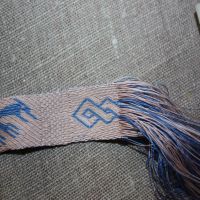
That lozenge pattern element is not a photograph, but a scan. So it should be to scale. But I pinned...
Guest - Katrin Sprang Discussion
15 September 2026
I was not referring to Rachel's reconstruction (is the reconstruction you refer to the one photograp...
Guest - Beatrix Sprang Discussion
14 September 2026
There is something Rachel did not mention. She told me: "Well, I worked with the measurements we too...
Guest - Katrin Sprang Discussion
14 September 2026
Well, this is certainly developing into an interesting discussion. Firstly, going from that lovely l...
OCT
03
0

York Archaeology - Fascicule 17/5 and 17/11

If you're a numbers person (as in somebody who easily remembers numbers, lucky you) and a textile archaeology nerd in addition to that, the two numbers in the blog title might ring a bell for you.

If not, let me bring you up to speed: York Archaeological Trust has been publishing a lot of very nice, very helpful shiny books about various aspects and find groups of all the digs done there - and York has a lot of history, and has had a lot of digs, and consequently there's oodles to research, and to tell. York also boasts a number of textile finds and textile tool finds, which is a delightful thing.

To make all this good stuff even better, they've decided, once they run out of the printed copies of their books, to make them freely available as pdf online. I've posted about this at least once before, but that was a good while ago. Back then, I had downloaded those of interest to me, though the really, really yummy ones - about textile production and textile finds - were still available in print and thus not as pdfs.

Just recently, though, I searched for something else, and the engine threw me a link to one of these two books on the YAT website. Off I went - and to my great delight, both 17/5 Textile, Raw Fibre and Cordage from Coppergate 16-22 and 17/11 Textile Production at 16-22 Coppergate are available now. (Direct links to the pdfs - but do go and visit their page listing the rest of the volumes of Archaeology of York, there's many more.)
0
SEP
20
2

Was it a woman warrior?

You might have read about that Viking warrior found in a grave in Birka, Sweden, who was a woman according to DNA tests. The original article, published in the American Journal of Physical Anthropology, is open-access, so you can go read the real deal for yourself. It's titled "A female Viking warrior confirmed by genomics" - a rather spectacular title.

There are always issues with gender stuff and archaeology. One of them is the fact that yes, for a long time, if someone was buried with a spindle and beads, it was obviously a woman, and if someone had weapons, it was obviously a man. While this is probably the truth in most graves, in some cases, later anthropological study has shown that there is the occasional exception to this archaeologist's "rule", and has led both archaeologists and anthropologists to the firm conviction that it would be a good thing to take in-depth anthropological data for every skeleton found, and if possible, maybe even DNA checks, instead of just assuming things. That's a pipe dream, though, with the scarcity of both funding and personnel in these disciplines, so we'll have to keep on going as best as possible and be delighted about the occasional opportunity to go deeper.

So, what about the Viking warrior woman? I'm not completely convinced that the person buried in this grave was "a powerful military leader". For that, I'd personally expect definite traces of hard military labour, and possibly also evidence for some healed wounds from battle. We may have an unusual woman there, and possibly also one who fought - but it might also be a woman buried with weapons out of some honorary reason. We actually don't know. History on a whole, after all, was not cut-and-dried at all, but just as colourful and as varied and capricious as human beings are.

And as usual when there's an interesting find, there is discussion, by people who offer very interesting thoughts. One of them is Martin Rundkvist who writes in Aardvarcheology. There's also a critical response to the original article written by Judith Jesch, which you can read on her blog.

It remains... interesting.


0
SEP
19
2

Stuff out of the Net.

And here you go again, with an assortment of links in various flavours!

Maybe you have seen the claims that the Voynich manuscript has been deciphered - this has been debunked right away. Bonus article about how it's not been solved.

BBC Travel has a post about the last woman who works with byssus (the silk-like fibre harvested from the mollusc pinna nobilis).

In case you ever wondered where you'd end up if you could tunnel straight through the planet (who hasn't?), here is Antipodes Man and his map to finally solve this for you. (Spoiler alert: Chances are high you'd be swimming. Better pack those swimming clothes, and probably even better: a boat.)

If you're in the UK, UK Handknitting has a workshop list for all kinds of courses and workshops around knitting and crocheting... just in case you are looking for one (or maybe want to offer one).

And that's it for today. I hope you found something of interest!
0
AUG
03
0

Mixed Links.

The online EXARC journal has a short article about bronze spiral decoration in textiles.

Kitty Lux of the Ukulele Orchestra died about two weeks ago, here's her obituary. I'm really sad - and feel very privileged to have seen and heard her live a few times.

The major Roman roads, drawn in a subway map style.
There's a new podcast around: Ask an Archaeologist. (I have not found the time to give it a listen yet, but it's definitely on my list.)

Heritage Daily reports on a Roman bronze figurine that might leave Britain.

Gillian Polack has a post on how to peel oranges... with a fork. Which is intriguing and makes me a little sad that we are currently far from Orange Season here - but it will come, and I will definitely try that.

And that's it for today - I hope there's something of interest for you!
0
JUL
13
0

Those Romans...

Romans are quite fascinating, with their mass-produced goods and their incredible logistical shenanigans like aquaeducts and streets. They are also... weird. In a way, at least - they'd probably consider us modern people at least as weird as we see them, if not more so.

But on to the Roman links showing both their ingenuity and their weirdness: Roman concrete, especially that for under-water use, has long been a thing to wonder about, as it just stays strong and strong, not corroding or decaying in conditions where modern concrete would have long given up. Now, it seems, the question why this is possible has been solved. It actually is corroding - but in a way that makes it stronger. Here's an article from the Guardian giving you details.

In the atlasobscura, you can read about clay instead of concrete. Specially shaped clay - the Romans had pottery jars just for the purpose of fattening dormice, which they would then eat as a delicacy.

Well. Probably not weirder than drinking coffee that has been shat out by civets. Or eating putterfish.
0
JUL
10
1

Birka Literature.

Birka is a rather well-known find place for quite a few textiles, including tablet-woven bands, and a frequently cited resource. The publications are not the newest, and in this case, it's in our favour - they are old enough to be offered as pdf files, for free, on the site of Historiska.se, the Swedish history museum.

You can find the Birka publications here, and if you have a bit of time, also check out their English homepage - which even features a test where you can find out which character from the Norse mythology you might be. (It tells me I'm Skadi... and something about me not minding deadlines, because I'm already done when they approach. Ah, if only.)
0
MAR
07
0

All kinds of interesting things!

Time for a post about interesting things, some of which you can participate in!

If you are in the Southampton area, there's a project about dexterity in flintknapping:With motion capture. How cool is that!

If you're more on the other side of the globe, there's the meeting of the Society for the History of Technology October 26-29, where there's a session about textiles and early industrialisation in planning. You can read more about the Society and their conference here.

There's also a conference about "Embellished Fabrics: Conserving Surface Manipulation & Decoration." It is the 11th North American Textile Conservation Conference, taking place in Mexico City, Mexico, November 6-11, 2017. The website is www.natcconference.com, and it will provide more information in case you're interested.

And another conference, this time in Poland, in June: Dynamics and Organisation of Textile Production in past societies in Europe and the Mediterranean. International Conference, Łódź, 21-22 June, 2017. The preliminary programme looks really nice and interesting!

For those of you who understand German (or for the adventurous of you who don't), there's a TV show where one guy participates in a club for one day, looking at the stuff people do in their spare time... and one of the clubs is a Living History group. You can watch the half-hour show here.

Some more interesting things - Jim Hines has done a survey about novelist's incomes. So if you've ever wondered whether writing a novel will make you rich, you might want to read his long, really interesting multi-part blogpost, starting with part 1 right here.

In 2011, a tunic was discovered in a Norwegian Glacier, and it has since been reconstructed. You can read a bit about the reconstruction and watch a video here. (I'm not totally happy with the spinning part of the video, as you might guess when watching it...)

And that's it for today. Hope you find something you enjoy among these!
0

By accepting you will be accessing a service provided by a third-party external to https://pallia.net/

Contact