Latest Comments

Guest - Katrin Sprang Discussion
18 September 2026
Hi Rachel, I have looked for more photos of you, but that was not very successful. I found a link on...
Guest - Beatrix Sprang Discussion
15 September 2026
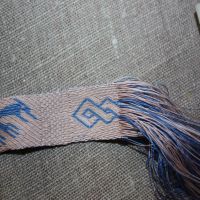
That lozenge pattern element is not a photograph, but a scan. So it should be to scale. But I pinned...
Guest - Katrin Sprang Discussion
15 September 2026
I was not referring to Rachel's reconstruction (is the reconstruction you refer to the one photograp...
Guest - Beatrix Sprang Discussion
14 September 2026
There is something Rachel did not mention. She told me: "Well, I worked with the measurements we too...
Guest - Katrin Sprang Discussion
14 September 2026
Well, this is certainly developing into an interesting discussion. Firstly, going from that lovely l...
MAR
11
0

17th Century Braids.

Just in case you totally need to look at a 17th century manuscript today, which has examples for braids and instructions on how to make them, here you go:

V&A Unknown Manuscript with nine pages, vellum, c 1625-1650.
Ah, they look pretty. Preeeeetty.
0
MAR
05
0

Braiding Fun.

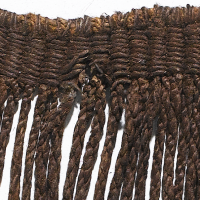
I've been doing a bit of evening playing around research stuff recently - a colleague has sent me some images from braided bands attached to relic purses, and we're trying to figure out how these were done.

Loop-braiding remains absolutely and utterly fascinating for me. The ease with which it is possible to do complex braids, with different patterns; the mindboggling efficiency of this technique, compared to braiding with single ends; the possibility to have several braiders work together on one piece, making it wider and more complex - it's just wonderful.

I have also, in the tests and trials for these technique reconstructions, found out again that sometimes the simple approach is the one most likely to be the right one. There was a good amount of pottering around with just five loops for the first puzzle, moving them from one finger to another, until I finally realised that it was just a very simple braid which I have done gazillions of times before... that was a nice d'oh moment. I was smarter for the next one, though!

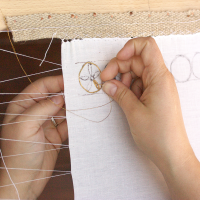
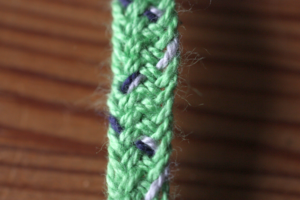
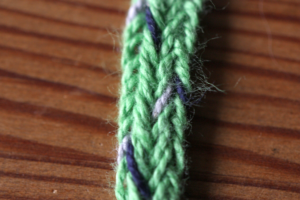
So here's two pictures of the current puzzle in progress, braided with seven loops:

They show front and back of the band; one of the loops is a bicolour one (grey and dark blue) to make things more clear for me when testing the effect of twisting the loop vs. taking it straight. It also shows how one single loop/element travels through the whole braid.

Can you tell I'm having fun with this?
0
FEB
08
0

Braiding, Hair and Other Stuff.

Braiding is a fascinating technique - there's so many different braids that can be made, just by passing strands over each other, and there's a good number of different ways to go at it as well.

That starts from using just your fingers to hold the individual strands, which are fixed at one end, continues with the use of loops held on the fingers or the hands, and ends at the use of more elaborate tools such as braiding stands or braiding tables, weights, and weighted spools for the individual elements. The last is used, among other things, in kumihimo (the Japanese art of braiding), but was also employed in Europe for braiding hair.

In case you're not familiar with that, there was a time in the 19th century when it was totally en vogue to have jewellery or artwork done with human hair, as a keepsake and especially as a remembrance item for deceased loved ones or family members. You can read a bit more about this topic here, and the book referenced whenever hairwork is mentioned, "Self-Instructor in the Art of Hair Work", is freely available on the 'Net, for instance here at archive.org or via googlebooks or Project Gutenberg (if you're not in Germany, that is - Project Gutenberg is blocked off for German IPs, because, ah, stupidity.)

I've thought about trying to do some hair work with my own hair now and then, basically whenever I stumbled across this topic, but I've never actually put together all the necessary things and actually tried it. Maybe some day I will, before my hair gets too short (age is having an effect here - my braid used to be quite a bit longer five or ten years ago!).

Anyway - there is a distinct similarity between this technique used for hair work, with weights attached to the many individual elements and braiding with the help of a stand, and kumihimo. In case you're interested in the latter, the American Kumihimo Society is running a virtual meet-up with several workshops on March 20&21. Registration is possible for both members and non-members; you can learn more about the virtual meet and the workshops here.
0

By accepting you will be accessing a service provided by a third-party external to https://pallia.net/

Contact