Latest Comments

Guest - Katrin Sprang Discussion
18 September 2026
Hi Rachel, I have looked for more photos of you, but that was not very successful. I found a link on...
Guest - Beatrix Sprang Discussion
15 September 2026
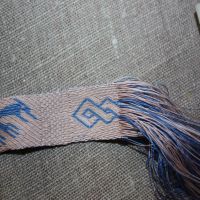
That lozenge pattern element is not a photograph, but a scan. So it should be to scale. But I pinned...
Guest - Katrin Sprang Discussion
15 September 2026
I was not referring to Rachel's reconstruction (is the reconstruction you refer to the one photograp...
Guest - Beatrix Sprang Discussion
14 September 2026
There is something Rachel did not mention. She told me: "Well, I worked with the measurements we too...
Guest - Katrin Sprang Discussion
14 September 2026
Well, this is certainly developing into an interesting discussion. Firstly, going from that lovely l...
MAR
05
2

NESAT!

It's 2020... which means it is three years since the last NESAT conference. Which means that it's time for the next one. I already wrote about trying to get things done early this time around, and testing my demo. The conference is in May, so there's still a good bit of time until things get seriously deadline-y, but nevertheless I'm quite relieved that I have figured it out now.

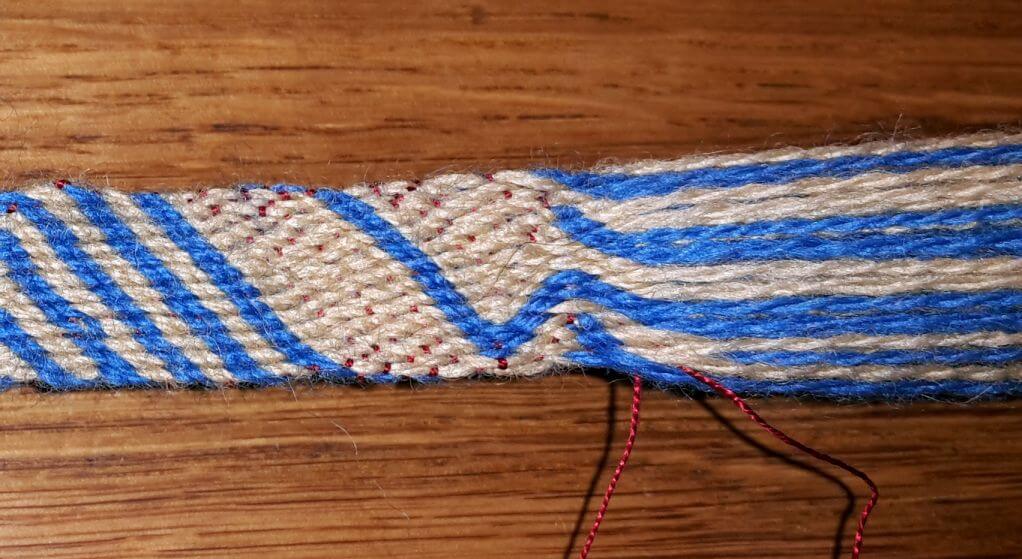
I played around with the demo setup a bit more, cutting the number of tablets down from 12 to ten (which is just, juuuust enough to show the twill pattern rhythm, and the block that forms when a diagonal is cruising its way across the stack of tablets). I've also changed the sequence a bit, including a tiny strip of double face now, then diagonals, then diagonal patterning, and finally a little bit of patterning on 3/1 broken twill (which includes the crux of the thing, the direction change in twill background).

Cutting down to only ten tablets did make a difference. The larger difference was probably made by me abandoning my lovely, trusty weaving knife in favour of just the finger, and not bothering about the fact that my band width is not so even, and the wefts are sloppily tightened.

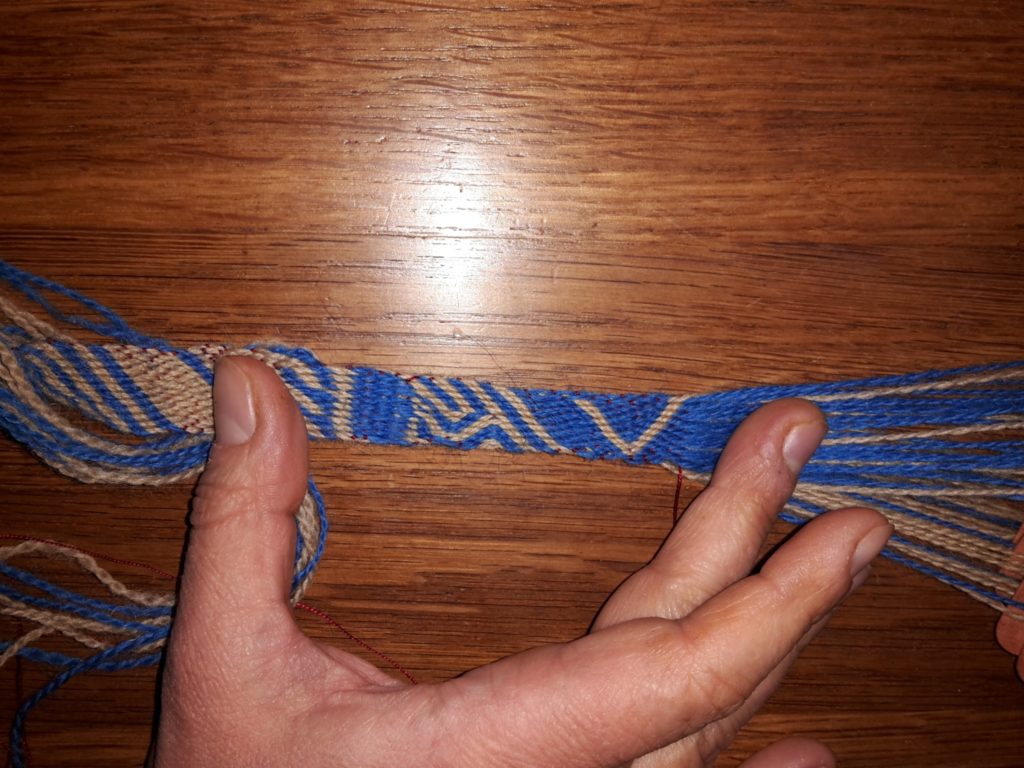
30 minutes is still a very, very short amount of time. It also still results in a very short bit of weaving:


However, the new sequence means I can explain things better as I go along, and that I can, miraculously, squeeze all the important bits into my time slot. Hooray!

Now I only have to make a suitable warp for the conference demo (as I've used up the one on the picture), make sufficient notes of what to do and what to explain at which stage, and then do another practice run or three shortly before the conference.

Which means that I'm now free to work on the other NESAT presentation - also about tablet weaving, but entirely different bands in an entirely different structure. Fun things!

 
0
FEB
20
0

Info Squashing.

NESAT is coming up - well, not utterly urgently and soon yet, but it is looming enough for me to think about it. Especially since I've registered to give an explanatory demo about my method on tablet weaving twill patterns without a pattern draft... and that, in turn, means I will have to aim for an explanation plus demo in about 20-30 minutes. Probably 30 minutes - since my two test runs that I made, quietly mumbling things to myself, took about half an hour.

So here I am, once again with the usual question of "how do I squash as much information as possible into X minutes while still keeping things understandable?" Which is the challenge I'm more or less facing every single time when I give a presentation, or a demo. (Or a workshop. I tend to fill workshops up with lots of info as well.)

For this specific problem, it starts with finding the perfect number of tablets. I have tried things out with a  dozen - which is enough to show the patterns when doing twill background, and how a pattern block moves across the band. For speed purposes, a few less would be even better, so I might cut the number down to ten.

I've also found that the best I can do in the demo is to explain what twill is based on (the diagonals) and show how to do a twill direction reversal. All the rest of how this makes it possible to weave basically anything on the fly will have to be explanatory only - probably with some additional demo bands and printed out pictures. Because this entirely unspectacular looking bit of diagonals and twill weaving, measuring a puny 5 cm, takes me half an hour to weave:

With talking about what I'm doing, and explaining, and showing some things to the empty air. (The cat refused to stand in as audience... she much preferred to nap somewhere else. Ah well.)

So... I'll fine-tune some more, and do it again, and make notes on what to print out in addition, and notes on what I want to say in what sequence. And then, I hope, it will eventually result in a nice little demo that will make my colleagues happy!
0
NOV
25
4

Conferences, Conferences.

There's a number of conferences I've gotten information on, so I will spread the word - here they are:

I will be presenting things at NESAT in Oulu, Finland - and I'm all excited about it! The conference will take place May 17-22. NESAT is only every three years, and it's like some kind of family reunion in a way, as the textile archaeology field is rather small, and after a while, you know most people in it. So I'm already looking forward to meeting friends and colleagues from all over Europe again, and to seeing a bit more of Finland and of Stockholm on the way there and back. I'm also already thinking hard about the best way of doing my tablet weaving demonstration...

Further ahead into the future:

There will be a Nordic Tabletweaving Conference at 11-13 September at Länsmuseet Gävleborg, Gävle, in Sweden. There will be courses held in Nordic languages and in English; you can learn more about the event and find the preliminary sign up here.

The EXAR conference 2020 will take place in the Archäologisches Landesmusuem Brandenburg (Paulikloster) in Brandenburg an der Havel, in Germany. Date for the conference is October 1-4, 2020, the CfP is coming next spring.
0
NOV
19
0

Knitting Symposium Leiden

So, as promised, stories from my past weeks - let's start with the first of my two conferences, the one I only attended (as opposed to organising it).

When I heard about the symposium held by the TRC together with the Knitting History Forum (which you should totally check out, and maybe join, if you are interested in knitting history), to bring the Texel Stocking Project to its culmination and end, I had this inkling that it would be a wonderful conference.

And it was. It was... glorious. Like all the best conferences, it was full of interesting papers looking at the stockings, knitting in general, silk stockings in particular, and Citizen Science. There were things to look at, including (but not limited to) the exhibition about Socks and Stockings at the TRC. We got to meet the TRC collection's curator Lies van de Wege, who came in especially for our group and even let us poke at things in the depot, which was amazing.

There was coffee in abundance (necessary, too, to keep the brain awake), and there were cookies (lovely, buttery, crunchy Dutch cookies), and in coffee breaks and after the conference there was time for socialising (though, of course, there is never enough time to talk to all the people you want to chat with about all the things you could chat about).

Chrystel Brandenburgh did a wonderful job in organising all this, and putting together an amazing programme, which included a look at dyes, at the knitting process, at written data about hand knitters, and at the possibilities and challenges of Citizen Science projects. We were also lucky in that Leiden had a big special market just on the Saturday of the conference, which meant there were even more things to pick from for our lunch, and ample opportunities to sample local delicacies. (The Dutch know how to do delicious food, and delicious cakes.)

I did learn a lot at the conference - amongst the most important bits, for me, was hearing that it had been much easier for most of the knitters to use gummy silk (with the sericin still in it) to knit; after the stocking had been finished, it was then de-gummed and in some cases dyed. There were a lot of interesting conversations with colleagues around that topic, and it made me itchy to find out more about partial de-gumming, and how silk like that might feel, and how easy it would be to work with, and how well it would take dye, and how well that would wear.

Leiden was beautiful, too, and after Friday, even the weather was nice enough to have a little stroll through the city. Saturday evening was spent with a group that had formed after the conference, having dinner together, and I got the opportunity to try on a pair of the stockings (one of the two pairs used for wear-testing). They were amazing. Unfortunately, I was not allowed to take them home, but I am now thinking about making myself some socks from similar silk, and based on the pattern of the original stockings (which, by the way, is available as a Ravelry download, for a little under 9 Euro, and buying it will support the TRC).

So I was going back from the conference having heard a lot, learned so much, with lots of new impressions of all kinds, lots of new connections formed; having drunk entirely too much coffee and having eaten way too much of the local delicacies, and with about a million new questions and a hundred ideas for things that would be good to look at. Or do. (Which includes, by the way, thinking about stocking some gummy silk in the shop, in case someone wants that to knit or weave with.) And with some stroopwafels and chocolate in my pack. Obviously.

To put it shortly: In exactly the state you are in after a perfect conference!
0
OCT
22
0

Knitting Symposium Leiden

To my grand delight, I will be part of the Knitting Symposium taking place in Leiden on November 2 - which includes an adventurous train trip there (with a night train! Yay!). The symposium itself features a number of very interesting topics, including information about current research in knitting history, dye experiments in regard to the silk stockings found in Texel, the experience of wearing such (reconstructed, obviously) stockings, and Citizen Science (which is why I have gotten the opportunity to join in, as I've been involved in Citizen Science before that was a term, it seems).

In case you are in the area, or can get there, and want to join, it looks like there are still tickets available. The Symposium is organised by the Textile Research Centre; you can read more about it (and download the full programme) on their website. You also find instructions for registration there.

 
0
JUL
05
0

Conferences and Book Preorder Stuff.

If you're looking for things to go to, or something to read, here are possibilities:

The EXAR conference, which will take place in Vienna on September 26 to 29, has its programme online. Registration is possible via their website, with a reduced fee if you register before August 15. As there is still space in their poster session, you are also welcome to hand in an abstract for a poster.

There will be a conference "Craftsmen and Metalworking in medieval cities: 35 years later" in Paris on September 12-14. The programme of the symposium is finished, but not available online yet; you can contact the organising committee via their website, though. Registration is open until September 5 or until the limited number of places is taken.

If you are looking for even more conferences, check out the "Conference" section on the RMBLF.be website, where there is a long list of all kinds of them, or the EXARC webpage.

Finally, the book thing - Jane Malcolm-Davies and Ninya Mikhaila are publishing "The Typical Tudor", which will be delivered in May 2020. If you are interested in Tudor-era clothing, this might be an interesting book for you; read more about it on their website (where you can also pre-order).
0
JUN
12
0

Courses and Conferences


Here's some stuff about places you could go at times when there are things that might be vastly interesting:


The CfP of the EXAR conference in Vienna, September 26 to 29 2019, is ending on June 15. You can send your paper proposal via their website.


If you are interested in Tudor clothing, there's a conference with a lot of event stuff around it called "Missing Persons". It will take place in Nottingham on April 3-5, 2020. You can register via the Tudor Tailor site; conference costs are 299 GBP (with an Early Bird registration until June 19 for 275 GBP).


The University of Sheffield will offer Zooarchaeology Short Courses in September 2019: Understanding Zooarchaeology on September 10-12 and Birds in Archaeology on September 13. The courses are directed to students, professionals and enthusiasts, no prior knowledge required, and the courses include hands-on practical activities. For more information, visit the website at the Uni of Sheffield.


The CfP for the European Textile Forum is also open; the Forum will run from November 4-10 in the Laboratory for Experimental Archaeology Lauresham, Lorsch, Germany. Focus topic this year is "Shared Warps, Shared Wefts", but other, non-weaving related papers or presentations are also welcome.


Finally, for those in Germany, I will be offering a two-day tablet weaving workshop on August 31 and September 1, teaching how to do tablet weaving patterns without a written pattern draft. As this is a system and we will start from the very beginning to learn the system, no previous knowledge about tablet weaving is needed. More information and booking possibilities are here via the pallia webshop.

0

By accepting you will be accessing a service provided by a third-party external to https://pallia.net/

Contact