Latest Comments

Guest - Katrin Sprang Discussion
18 September 2026
Hi Rachel, I have looked for more photos of you, but that was not very successful. I found a link on...
Guest - Beatrix Sprang Discussion
15 September 2026
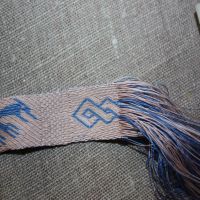
That lozenge pattern element is not a photograph, but a scan. So it should be to scale. But I pinned...
Guest - Katrin Sprang Discussion
15 September 2026
I was not referring to Rachel's reconstruction (is the reconstruction you refer to the one photograp...
Guest - Beatrix Sprang Discussion
14 September 2026
There is something Rachel did not mention. She told me: "Well, I worked with the measurements we too...
Guest - Katrin Sprang Discussion
14 September 2026
Well, this is certainly developing into an interesting discussion. Firstly, going from that lovely l...
JUL
01
0

Viking Bling.

Reconstructions of textile finds are always including a bit of interpretation - the more fragmented the finds, the more interpretation is necessary. That is just normal, but something that is not always mentioned straight out in exhibitions.

So I'm always quite delighted when this is made clear - as is the case in this article about "Fashioning the Viking Age", which shows dress reconstructions based on two spectacular finds. There's also an instagram account with a lot more pretty pictures. Absolutely worth a look!
0
APR
09
0

Exhibition!

I've actually managed not to blog about this yet?

The exhibition about experimental archaeology, for which I've also provided some things, has opened: "Experimental Archaeology" at the MAMUZ at Schloß Asparn/Zaya.

It is, of course, currently closed (hellooo lockdown!) but since it runs until November 2021, there should be time to see the exhibition it if you're planning to do so. I've been at the MAMUZ before, and it is definitely a lovely place to visit!
0
JAN
28
2

The Dye Experiment Card.

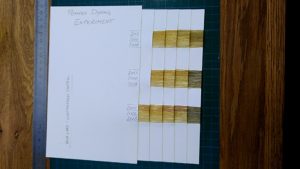
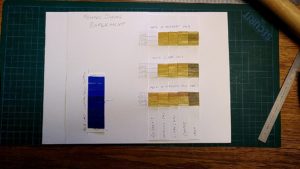
Here are a few more pics from the making of the dyeing experiment card...

It took me a while of thinking on how to best present the results. I wanted them to be comparable across both the different metals and the different runs of the experiment. Because of the lack of a reference in the add-on 2013, there were exactly three different samples for each data point, which made things nicely line up in the end.


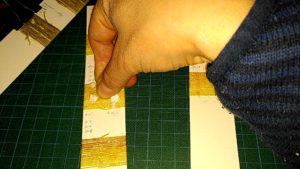
The cardboard strips were labelled on the back, I wound the threads on and fixed them temporarily with sticky tape, then glued them into place with PVA wood glue. I tried to line them up as perfectly as possible, and in the end, there were only very slight variations from the perfect line.


Another thing I pondered for a while: whether I would write the info necessary by hand, or  print it on. I decided, in the end, to do it by hand - there were bits that I would need to do by hand anyways, as I had not printed the metal name on the strips before winding the threads on, and now it was too late. Because I thought it would be weirder to mix than to do it all by hand... well, there you go.

I chose pencil for the writing - because that is very lightfast, and I didn't have a pen that I was sure would be appropriately lightfast. (Yes, I could have used iron gall ink - in theory, but I am not practised at handlettering with that, and, well... perfectionism, anyone?).


As the final thing, I added a blue card - because I could. Because the exhibition and the light exposure of the samples might just as well serve as a fade test; for that, the strips with yarn are layered so they are half exposed and half protected. The blue card is also half exposed and half protected.

I already did a lightfastness test with samples from the last experiment run, in that case fabric samples, but there was none yet with the yarns from that or the previous runs. This will be remedied now! It is, obviously, not a really perfect and proper test as the yarns have seen a few hours (unknown amounts...) of indoor light before in their existence, but it's better than not doing the test at all, or than not adding the bluecard for the reference... so. There you go.

The whole assembly was then glued to another carrier layer of cardboard, and then everything went into a parcel and on its merry way to the exhibition. I hope it will be interesting for the visitors!
0
JAN
22
0

Experimental Archaeology Exhibition...

The MAMUZ, the museum in Asparn/Zaya in Austria, is preparing an exhibition about experimental archaeology (more about it here, in German). The exhibition will then move on as a wandering exhibition, showing objects from archaeological experiments and explaining the objects, and the experiments, in video clips.

So I've been busy doing video stuff, including the cutting and editing, and doing all the other bits and things necessary to prepare. What ate a lot of time - much more than I had expected - was making a colour sample card as the object to go in there to represent the Pompeii Dyeing Experiment.  This started in 2012 with a first run, and there was an add-on made in 2013, followed by two more runs of the experiment in 2016 and 2018. The aim was to find out how a metal kettle would influence the results of the dyeing process, both due to the presence of metal in the mordanting bath, in the dyeing bath, and in both.
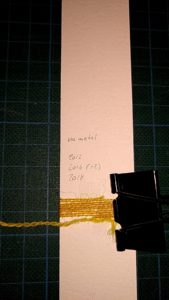


For the exhibition, I wound the samples onto strips of cardboard, grouped by kind (mordant, dye, both) and by metal. Nine turns of the thinner wool, used in 12/13 and 2018, and six turns of the thicker wool used in 2016. All neatly in the same position on each strip...
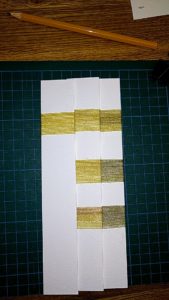


...and it's amazing how much of brain such a simple task can eat.

My personal main takeaway from this experiment, by the way, is the importance of repetition - plus a much higher appreciation of just how much variation natural materials can introduce, and how much of a role sheer luck plays in even the best controlled experiment.

In the 2012 run, we ended up with a reddish colour on the yarn dyed in the copper and the clean lead kettle - which made a kettle made from lead with an oxide layer on the surface the neutral kettle, very close to the actual control dyed in a glass jar with no metal plate added at all. In the following runs, we were never able to reproduce that reddish colour - apart from the iron, our samples all turned out pretty yellow, and much the same across all kettles. If not for that chance aberration in the first run, we would have thought that there is no real difference between the kettle materials, at least not when using madder or birch leaf as a dye.

I'm actually tempted to run the experiment again next time that the Forum will happen (2021, I'm looking at your autumn with a critical eye!), with weld as a dyestuff instead of birch leaf, and see if results are giving us a clear difference there.

Anyway - the card has been finished, which involved lots of glueing, and the use of some of my bookbinding equipment, and now it will go on its way to Asparn!

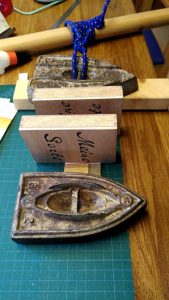
[caption id="attachment_5775" align="alignnone" width="169"] Pressing with weights until the glue has set...
0
OCT
12
0

Exhibitions, Virtual and Real.

I found out on the weekend, by happy chance, that there's a special exhibition running in Bamberg:
Die Bamberger Kaisergewänder unter der Lupe. Methoden und Ergebnisse der aktuellen Forschungen. The exhibition started on September 25 and will run until January 10, 2021. It is presenting the results of the research done on the imperial garments that are conserved in Bamberg in the last five years. These are splendid pieces, and I will definitely go there to look at them - it's almost on my doorstep, after all!

There's also two virtual exhibitions that might be interesting: One about the cultural history of distancing (and social distancing), and one showing some works of Albrecht Dürer. Both are in German (and they were a bit awkward to look at in my browser).
0
SEP
16
0

Purple and Blue - Colouring of Textiles Exhibition

More catching up: There's a recently started exhibition at the Haus der Seidenkultur Krefeld, titled "Purpurschnecke und Färberwaid". It is about the development of textile dyeing and colourings, and it will remain open until 28.02.2021.

You can read more about the exhibition in German here, and English information is available here. And if you want, you can even watch the video recording of the (mostly digital) opening!
0
DEC
03
0

Japanese Weaving Exhibition in London.

If you're in London, or going there in the next two months, you might want to visit the Japanese Embassy building to have a look at their exhibition Hakata Ori: Weaving Through to the Present.

Hakata Ori is regarded as one of most well-known examples of woven textiles in Japan. Weaving in Hakata (now known as Fukuoka City) is said to date back to 1241 and this year is an auspicious one for local weavers as they celebrate 777 years since the beginnings of Hakata Ori.

Traditional Hakata obi (belts) became highly regarded for their strength and durability, enjoying popularity amongst samurai for the ability to hold their swords in place and also the patronage of the shōgun for many centuries.

This exhibition retraces the history of weaving from this area of Kyushu at the same time as putting the spotlight on its modern weaves. Protecting the heritage and customs of the past whilst preparing for the future is essential for any traditional craft to prosper in modern times. Today, Hakata Ori craftsmen create a broad array of items for display as well as for everyday use.

The exhibition runs until January 31, 2019; the embassy (101-104 Piccadilly, London W1J 7JT) is open on weekdays 9:30 to 17:30, closed on weekends, 25-26 December and 31 December – 3 January inclusive. Admission is free, but photo ID is necessary to gain entry to the Embassy.
0

By accepting you will be accessing a service provided by a third-party external to https://pallia.net/

Contact